What are the most valuable AI governance startups?
Everything we know about the AI governance market, in one place. Get our report whether you build or invest.
Summary
Braintrust and Arize AI are the most valuable AI governance startups in our ranking today, at $800 million and roughly $700 million to $800 million respectively, with Protect AI next at $635 million. No pure-play AI governance company has a confirmed valuation above $1 billion yet.
The market is already splitting into two very different businesses. Evaluation, observability and AI security sit near the top of the ranking, while pure compliance and policy-management vendors are generally much smaller.
The strongest hard valuation benchmarks come from cybersecurity acquisitions. Palo Alto Networks paid $635 million for Protect AI, Check Point paid about $201.8 million for Lakera, and F5 paid $145.2 million for CalypsoAI. Acquisition prices like these are among the market signals we follow every quarter in our AI governance market report.
Braintrust's $800 million valuation therefore stands out. It is above every disclosed acquisition value in the ranking and more than five times its earlier roughly $150 million financing mark.
Roughly 18 companies can plausibly be placed at or above $100 million, but only three have sufficiently strong evidence to sit clearly above $500 million: Braintrust, Arize AI and Protect AI. The upper end is still very thin.
The market is also highly concentrated. Using midpoint valuations, the top ten account for roughly three-quarters of the combined value of the top twenty, while companies around position 30 are already mostly in the $40 million to $60 million range.
AI agents are making governance more operational. Testing permissions, tool calls, prompt injection, data leakage and runtime behavior pushes governance into the same budget territory as security and observability rather than leaving it as an annual compliance task.
That helps explain the acquisition pattern. Palo Alto Networks, Check Point, Cisco, F5, SentinelOne and Fortinet have all bought AI-security companies, giving the market a very obvious consolidation route into larger cybersecurity platforms.
Pure governance vendors still have a real regulatory tailwind, especially as the EU AI Act rolls out, but they face a bundling problem. Inventories, policy controls, risk classification and documentation can increasingly be packaged inside security, cloud, data and observability products.
Funding totals do not map neatly to valuation. HiddenLayer has raised more capital than Braintrust, while Patronus AI has raised only about $70 million and still sits around the mid-$400 million range in our dataset.
The first AI governance unicorn is therefore more likely to emerge from a product used continuously in production than from a narrow compliance dashboard. Evaluation, agent testing and runtime security currently have the clearest path because they are tied directly to how enterprises build and run AI every day.

Written by the New Market Pitch teamWe track new markets so founders and investors can move faster. About us

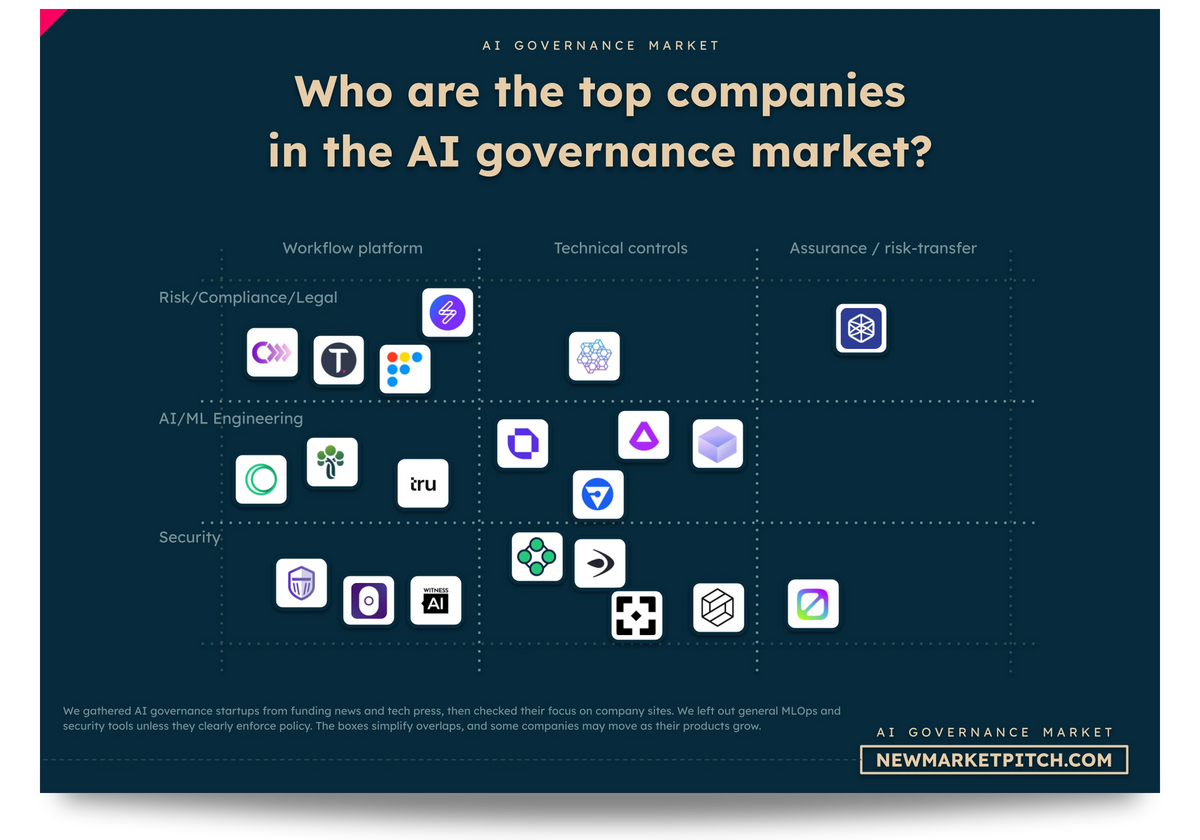
In our report covering the AI governance market, we turn what is vague and complex into simple, useful visuals. Market maps like this one show you at a glance where every startup stands.
Top startups in the AI governance market ranked by valuation
Here is an updated table that ranks the top startups in the AI governance market based on their latest reported or estimated valuations.
If you need to dig deeper and get more detailed data, please check our report covering the AI governance market.
| # | Startup Name | What They Do | Current Valuation ($) | Valuation Confidence Level | Valuation Type | Evidence Status | Total Funding ($) | Funding Confidence Level |
|---|---|---|---|---|---|---|---|---|
| 1 | Braintrust | AI evaluation and observability platform | $800M | Full Confidence | Announced Private Round Valuation | Observed | $121M | Full Confidence |
| 2 | Arize AI | AI observability and evaluation | $700M–$800M | Strong Confidence | Announced Private Round Valuation | Observed | $230M | Full Confidence |
| 3 | Protect AI | Secures AI models and applications | $635M | Full Confidence | Acquisition Value | Observed | $109M | Full Confidence |
| 4 | Patronus AI | Tests reliability of AI agents | $430M–$460M | Strong Confidence | Announced Private Round Valuation | Observed | $70M | Full Confidence |
| 5 | Galileo | GenAI evaluation and observability | $300M–$500M | Partial Confidence | Implied Valuation from Raise | Implied | $68M | Full Confidence |
| 6 | HiddenLayer | Protects enterprise AI infrastructure | $370M–$400M | Strong Confidence | Announced Private Round Valuation | Observed | $156M | Full Confidence |
| 7 | Fiddler | AI observability, governance and security | $200M–$375M | Partial Confidence | Implied Valuation from Raise | Implied | $100M | Full Confidence |
| 8 | Lakera | Protects LLM applications from attacks | $202M | Full Confidence | Acquisition Value | Observed | $30M | Full Confidence |
| 9 | Mindgard | Offensive security testing for AI | $150M–$250M | Strong Confidence | Implied Valuation from Raise | Implied | $41.8M | Full Confidence |
| 10 | Lasso Security | Enterprise AI security and guardrails | $150M–$250M | Strong Confidence | Implied Valuation from Raise | Implied | $44.5M | Full Confidence |
| 11 | JetStream Security | Enterprise AI governance and security | $140M–$230M | Strong Confidence | Implied Valuation from Raise | Implied | $34M | Full Confidence |
| 12 | Cranium | Enterprise AI security and governance | $140M–$220M | Strong Confidence | Implied Valuation from Raise | Implied | $71.6M | Full Confidence |
| 13 | Prompt Security | Secures enterprise generative AI usage | $160M | Full Confidence | Acquisition Value | Observed | ~$23M | Strong Confidence |
| 14 | Arthur | AI monitoring, evaluation and governance | $120M–$180M | Partial Confidence | Comparables-Based Estimate | Estimated | $62.9M | Full Confidence |
| 15 | CalypsoAI | AI inference security and red-teaming | $145M | Full Confidence | Acquisition Value | Observed | $43.2M | Full Confidence |
| 16 | Robust Intelligence | Tests and secures AI systems | $100M–$170M | Low Confidence | Acquisition Value | Estimated | $44M | Full Confidence |
| 17 | Virtue AI | Secures and validates AI systems | $100M–$150M | Partial Confidence | Acquisition Value | Estimated | $30M | Full Confidence |
| 18 | Distributional | Continuous testing for AI systems | $90M–$140M | Partial Confidence | Implied Valuation from Raise | Implied | $30M | Full Confidence |
| 19 | Credo AI | Enterprise AI governance and compliance | $100M–$125M | Strong Confidence | Comparables-Based Estimate | Estimated | $41.3M | Full Confidence |
| 20 | Vijil | Secures and evaluates AI agents | $85M–$140M | Strong Confidence | Implied Valuation from Raise | Implied | $23M | Full Confidence |
| 21 | Kolena | AI model testing platform | $70M–$120M | Partial Confidence | Implied Valuation from Raise | Estimated | $21M | Full Confidence |
| 22 | Harmonic Security | Controls enterprise generative AI use | $70M–$110M | Partial Confidence | Comparables-Based Estimate | Estimated | $26M | Full Confidence |
| 23 | Dynamo AI | AI compliance and security controls | $65M–$105M | Partial Confidence | Comparables-Based Estimate | Estimated | $23.9M | Full Confidence |
| 24 | Holistic AI | Enterprise AI governance lifecycle platform | $60M–$100M | Partial Confidence | Revenue or ARR Multiple Estimate | Estimated | Undisclosed | Low Confidence |
| 25 | LatticeFlow AI | AI safety and compliance | $60M–$90M | Partial Confidence | Implied Valuation from Raise | Implied | $26M | Full Confidence |
| 26 | Openlayer | AI testing, monitoring and governance | $50M–$75M | Partial Confidence | Comparables-Based Estimate | Estimated | $19.3M | Full Confidence |
| 27 | Portal26 | Governs enterprise generative AI adoption | $50M–$65M | Strong Confidence | Implied Valuation from Raise | Implied | $15M | Full Confidence |
| 28 | Aporia | AI observability and runtime guardrails | $45M–$55M | Strong Confidence | Acquisition Value | Estimated | ≈$30M | Strong Confidence |
| 29 | Singulr AI | Enterprise AI governance control plane | $40M–$60M | Partial Confidence | Implied Valuation from Raise | Implied | $10M | Full Confidence |
| 30 | Modulos | AI governance and compliance automation | $40M–$55M | Strong Confidence | Implied Valuation from Raise | Implied | $17.2M | Full Confidence |
| 31 | ValidMind | AI model risk management platform | $35M–$60M | Partial Confidence | Implied Valuation from Raise | Implied | $8.1M | Full Confidence |
| 32 | ModelOp | Enterprise AI lifecycle governance software | $40M–$50M | Strong Confidence | Comparables-Based Estimate | Estimated | $16.7M | Full Confidence |
| 33 | Mind Foundry | Responsible enterprise AI solutions | $35M–$55M | Partial Confidence | Revenue or ARR Multiple Estimate | Estimated | $18.8M | Full Confidence |
| 34 | WhyLabs | AI observability and data monitoring | $30M–$60M | Low Confidence | Acquisition Value | Estimated | $14M | Full Confidence |
| 35 | Guardrails AI | Guardrails and agent risk controls | $35M–$55M | Partial Confidence | Acquisition Value | Estimated | $7.5M | Full Confidence |
| 36 | 2021.AI | Enterprise AI governance platform | $30M–$50M | Low Confidence | Comparables-Based Estimate | Estimated | $12.6M | Full Confidence |
| 37 | TrojAI | AI red-teaming and runtime security | $40M | Full Confidence | Acquisition Value | Observed | $12.1M | Full Confidence |
| 38 | DeepKeep | AI-native model security platform | $32M–$42M | Partial Confidence | Comparables-Based Estimate | Estimated | ~$17M | Strong Confidence |
| 39 | HoneyHive | AI agent evals and observability | $28M–$40M | Partial Confidence | Implied Valuation from Raise | Implied | $7.4M | Full Confidence |
| 40 | Monitaur | Model governance for regulated industries | $24M–$36M | Partial Confidence | Comparables-Based Estimate | Estimated | $13.4M | Full Confidence |
| 41 | AIShield | Secures AI models and applications | $20M–$40M | Low Confidence | Proxy-Based Estimate | Estimated | Undisclosed | Low Confidence |
| 42 | Mona | Production AI monitoring platform | $20M–$35M | Low Confidence | Comparables-Based Estimate | Estimated | $9M | Strong Confidence |
| 43 | Advai | Independent AI assurance testing | $18M–$35M | Low Confidence | Comparables-Based Estimate | Estimated | Bootstrapped / undisclosed | Low Confidence |
| 44 | Trustible | AI governance and compliance platform | $22M–$30M | Strong Confidence | Implied Valuation from Raise | Implied | $6.35M | Full Confidence |
| 45 | Invariant Labs | Secures autonomous AI agents | $15M–$35M | Low Confidence | Acquisition Value | Estimated | No disclosed funding | Low Confidence |
| 46 | Hamming | Tests and monitors voice agents | $18M–$30M | Partial Confidence | Implied Valuation from Raise | Implied | $4.3M | Full Confidence |
| 47 | Enzai | Enterprise AI governance and enablement | $18M–$28M | Partial Confidence | Comparables-Based Estimate | Estimated | $4.0M | Full Confidence |
| 48 | CitrusX | AI validation, explainability and governance | $18M–$27M | Partial Confidence | Comparables-Based Estimate | Estimated | $4.5M | Full Confidence |
| 49 | Enkrypt AI | AI security, compliance and guardrails | $15M–$30M | Low Confidence | Acquisition Value | Estimated | $2.35M | Full Confidence |
| 50 | Giskard | AI testing and red teaming | $15M–$30M | Partial Confidence | Comparables-Based Estimate | Estimated | ~$5M incl. grants | Partial Confidence |
| 51 | BreezeML | Machine-learning deployment and governance | $18M–$24M | Strong Confidence | Comparables-Based Estimate | Estimated | $4.1M | Full Confidence |
| 52 | Calvin Risk | Quantitative AI risk management platform | $16M–$24M | Partial Confidence | Comparables-Based Estimate | Estimated | $5.5M | Full Confidence |
| 53 | Athina AI | AI evaluation development platform | $15M–$25M | Partial Confidence | Implied Valuation from Raise | Implied | $4.1M | Full Confidence |
| 54 | Scorecard | Continuous evaluation for AI agents | $15M–$23M | Strong Confidence | Implied Valuation from Raise | Implied | $3.8M | Full Confidence |
| 55 | FairNow | AI governance and compliance automation | $15M–$22M | Partial Confidence | Acquisition Value | Estimated | $4.15M | Full Confidence |
| 56 | Censius | Production AI observability platform | $12M–$25M | Low Confidence | Comparables-Based Estimate | Estimated | Undisclosed | Low Confidence |
| 57 | QuantPi | AI risk management platform | $12M–$25M | Low Confidence | Comparables-Based Estimate | Estimated | ~$5.2M | Strong Confidence |
| 58 | Preamble | AI security and guardrails | $12M–$25M | Low Confidence | Revenue or ARR Multiple Estimate | Estimated | $4M | Full Confidence |
| 59 | Atla AI | Detects failures in AI agents | $12M–$22M | Low Confidence | Comparables-Based Estimate | Estimated | $5.0M | Full Confidence |
| 60 | Prodago | Data and AI governance orchestration | $12M–$20M | Low Confidence | Proxy-Based Estimate | Estimated | Undisclosed; ≥$0.3M public support | Low Confidence |
| 61 | Deepchecks | Testing and monitoring AI systems | $10M–$20M | Strong Confidence | Acquisition Value | Estimated | $14M | Full Confidence |
| 62 | Deeploy | Explainable responsible AI oversight platform | $12M–$18M | Partial Confidence | Comparables-Based Estimate | Estimated | ≈$5.4M | Strong Confidence |
| 63 | Themis AI | AI uncertainty and risk tooling | $10M–$20M | Low Confidence | Comparables-Based Estimate | Estimated | $2.8M | Full Confidence |
| 64 | Guardrail Technologies | AI security and behavioral governance | $10M–$18M | Partial Confidence | Implied Valuation from Raise | Implied | ~$2.0M | Partial Confidence |
| 65 | Vera | Enforces generative AI usage policies | $10M–$18M | Low Confidence | Comparables-Based Estimate | Estimated | $3.3M | Full Confidence |
| 66 | Armilla AI | AI assessment and warranties | $10M–$18M | Partial Confidence | Implied Valuation from Raise | Implied | $6.8M | Full Confidence |
| 67 | Confident AI | Open-source LLM evaluation tooling | $10M–$18M | Partial Confidence | Implied Valuation from Raise | Implied | $2.2M | Full Confidence |
| 68 | Leap Labs | AI interpretability for scientific discovery | $10M–$18M | Low Confidence | Proxy-Based Estimate | Estimated | $3.0M | Strong Confidence |
| 69 | Seldon | Deploying and governing production AI | $10M–$16M | Strong Confidence | Acquisition Value | Estimated | $33.0M | Full Confidence |
| 70 | Validaitor | AI governance and compliance testing | $8M–$18M | Low Confidence | Implied Valuation from Raise | Estimated | Undisclosed | Low Confidence |
| 71 | Konfer | AI agent governance and assurance | $8M–$16M | Low Confidence | Proxy-Based Estimate | Estimated | ~$3.2M | Partial Confidence |
| 72 | Lumenova AI | AI risk and governance platform | $8M–$15M | Low Confidence | Proxy-Based Estimate | Estimated | Undisclosed | Low Confidence |
| 73 | Fairly AI / Asenion | AI governance testing and assurance | $8M–$14M | Partial Confidence | Comparables-Based Estimate | Estimated | ~$3.4M disclosed | Partial Confidence |
| 74 | SuperAlign | Enterprise AI security infrastructure | $6M–$15M | Low Confidence | Proxy-Based Estimate | Estimated | Undisclosed | Low Confidence |
| 75 | CertifAI | Independent AI testing certification | $5M–$15M | Low Confidence | Proxy-Based Estimate | Estimated | Undisclosed | Low Confidence |
| 76 | trail | Automates enterprise AI governance | $7M–$12M | Partial Confidence | Comparables-Based Estimate | Estimated | $1.7M | Strong Confidence |
| 77 | Adversa AI | Tests AI for security vulnerabilities | $6M–$12M | Low Confidence | Proxy-Based Estimate | Estimated | Undisclosed | Low Confidence |
| 78 | AutoAlign | AI safeguards for industrial operations | $6M–$12M | Low Confidence | Proxy-Based Estimate | Estimated | $0.6M | Strong Confidence |
| 79 | Saidot | AI governance and safety platform | $7M–$10M | Partial Confidence | Comparables-Based Estimate | Estimated | ~$1.9M | Strong Confidence |
| 80 | Numalis | Industrial AI validation and governance | $6M–$10M | Partial Confidence | Comparables-Based Estimate | Estimated | $6.5M | Full Confidence |
| 81 | KomplyAI | End-to-end AI governance platform | $5M–$10M | Low Confidence | Proxy-Based Estimate | Estimated | Undisclosed | Low Confidence |
| 82 | Mithril Security | Privacy infrastructure for AI models | $5M–$10M | Low Confidence | Acquisition Value | Estimated | $1.7M | Full Confidence |
| 83 | Halluminate | Sandboxes for training AI agents | $5M–$10M | Low Confidence | Proxy-Based Estimate | Estimated | $0.2M | Partial Confidence |
| 84 | Datatron | Enterprise MLOps and model governance | $6M–$8M | Partial Confidence | Comparables-Based Estimate | Estimated | $12.1M | Full Confidence |
| 85 | Zetane | AI model deployment and validation | $5M–$9M | Partial Confidence | Implied Valuation from Raise | Implied | $2.18M | Full Confidence |
| 86 | Asher Informatics | Healthcare AI governance platform | $4M–$10M | Low Confidence | Implied Valuation from Raise | Estimated | Undisclosed | Low Confidence |
| 87 | Fairo | AI governance, risk and compliance | $4M–$8M | Low Confidence | Proxy-Based Estimate | Estimated | Undisclosed | Low Confidence |
| 88 | NannyML | Post-deployment machine-learning monitoring | $4M–$8M | Low Confidence | Acquisition Value | Estimated | $2.06M | Full Confidence |
| 89 | Etiq AI | AI testing, fairness and robustness | $4M–$7M | Partial Confidence | Implied Valuation from Raise | Implied | $3.2M | Strong Confidence |
| 90 | Zupervise | AI risk transparency and observability | $3M–$7M | Low Confidence | Proxy-Based Estimate | Estimated | Undisclosed | Low Confidence |
| 91 | Tibo | Prevents sensitive data leakage to AI | $3M–$6M | Low Confidence | Proxy-Based Estimate | Estimated | Undisclosed | Low Confidence |
| 92 | CertKOR AI | AI trust and compliance monitoring | $2M–$6M | Low Confidence | Proxy-Based Estimate | Estimated | No disclosed funding | Low Confidence |
| 93 | Seclea | Responsible AI governance platform | $2M–$6M | Low Confidence | Proxy-Based Estimate | Estimated | No known external funding | Low Confidence |
| 94 | Code4Thought | AI assurance and governance advisory | $2M–$5M | Low Confidence | Proxy-Based Estimate | Estimated | $0 announced | Strong Confidence |
| 95 | SigmaRed | Compliance-focused AI governance platforms | $2M–$5M | Low Confidence | Proxy-Based Estimate | Estimated | Undisclosed | Low Confidence |
| 96 | Aligned AI | Builds AI alignment systems | $2M–$5M | Low Confidence | Revenue or ARR Multiple Estimate | Estimated | $1.1M | Strong Confidence |
| 97 | Daios | Deterministic AI execution governance | $1M–$5M | Low Confidence | Proxy-Based Estimate | Estimated | Undisclosed | Low Confidence |
| 98 | Trubrics | Analytics for AI applications | $2M–$4M | Partial Confidence | Implied Valuation from Raise | Implied | ~$0.5M | Partial Confidence |
| 99 | Trst.ai | AI governance and assurance | $0M–$2M | Low Confidence | Proxy-Based Estimate | Estimated | Undisclosed | Low Confidence |
| 100 | equalityAI | Healthcare responsible AI management | $0M–$1M | Strong Confidence | Proxy-Based Estimate | Estimated | $1.25M | Full Confidence |

Our research about AI governance tools gets updated several times a month, so you always get the latest view of where things stand.
Which AI governance startups are worth the most today?
Braintrust and Arize AI currently sit at the top of the AI governance startup market, with Braintrust at $800 million and Arize AI estimated at roughly $700 million to $800 million.
Braintrust’s number is particularly solid. Its latest $80 million Series B was completed at an $800 million post-money valuation. Arize AI’s valuation is less directly observable, but its $70 million Series C, more than $130 million of reported funding by that point, large enterprise customer base and widely used Phoenix open-source platform support its position in roughly the same valuation tier.
Protect AI comes next at $635 million, a price we can observe directly because Palo Alto Networks completed the acquisition. Patronus AI follows at roughly $430 million to $460 million after its latest $50 million Series B. Galileo and HiddenLayer sit around the $300 million to $500 million range.
The ranking drops quickly after that. Only a small group reaches several hundred million dollars, and the market has yet to produce a clearly established $1 billion pure-play AI governance startup.
| Startup | Current valuation | Main focus | Total funding |
|---|---|---|---|
| Braintrust | $800M | AI evaluation and observability | $121M |
| Arize AI | $700M–$800M | AI evaluation and observability | $230M* |
| Protect AI | $635M | AI security | $109M |
| Patronus AI | $430M–$460M | AI and agent evaluation | $70M |
| Galileo | $300M–$500M | GenAI evaluation | $68M |
| HiddenLayer | $370M–$400M | AI security | $156M |
| Fiddler | $200M–$375M | Observability and governance | $100M |
| Lakera | $202M | LLM and agent security | $30M |
| Mindgard | $150M–$250M | Offensive AI security | $41.8M |
| Lasso Security | $150M–$250M | AI security and guardrails | $44.5M |
| JetStream Security | $140M–$230M | AI governance and security | $34M |
| Cranium | $140M–$220M | AI governance and security | $71.6M |
*Our funding dataset includes capital beyond the more than $130 million publicly reported after Arize AI's Series C.
Is there an AI governance unicorn yet?
No pure-play AI governance company in our ranking has a confirmed valuation above $1 billion today.
Braintrust is the closest with a directly observed $800 million valuation. Arize AI could be in roughly the same range, although its current figure has to be estimated rather than read from a disclosed financing valuation.
That is surprisingly modest when we compare AI governance with neighboring AI markets. Foundation-model companies, AI coding startups, data infrastructure companies and AI cloud providers have already produced valuations in the billions or tens of billions. How big AI governance really is, next to its neighbors, is something we estimate ourselves in our report on AI governance.
AI governance has attracted real money, but investors have been more selective. Braintrust is a good example. Its valuation moved from roughly $150 million around its Series A to $800 million at the latest Series B, a jump of more than five times, yet even that exceptional trajectory leaves the company below $1 billion.
The unicorn line could be crossed fairly soon. Braintrust would need another 25% increase from its latest financing valuation. What we do not have yet is evidence of several independent governance companies comfortably holding multi-billion-dollar values.

In our market report about AI governance tools, we look at what the winners do differently, so you can learn from the best instead of guessing.
Why is Braintrust worth $800 million?
Braintrust reached an $800 million valuation because AI evaluation is becoming part of the everyday infrastructure used to build and run AI applications.
The company raised $80 million in its latest Series B, led by ICONIQ, at an $800 million post-money valuation. Its previous financing had put the business around $150 million, so the valuation increased by more than five times in roughly a year and a half.
The attraction is easier to understand once we look at the workflow Braintrust sits inside. AI teams use evaluation tools to compare models, inspect traces, test prompts, build datasets and check whether a new version of an application performs better than the old one.
Those jobs keep recurring. A team does not evaluate an AI application once and walk away. New models arrive, prompts change, agents gain tools, customer behavior changes and production failures create new tests.
Braintrust also works across model providers. An enterprise can use OpenAI, Anthropic, Google models and open-source models without replacing the evaluation layer each time.
That gives Braintrust a decent shot at becoming infrastructure rather than a one-purpose compliance product. Its latest financing suggests investors are already pricing it that way.
Is Arize AI worth almost as much as Braintrust?
Yes, Arize AI currently belongs in roughly the same valuation tier as Braintrust, although the evidence behind Arize's number is less precise.
Arize raised a $70 million Series C in 2025. The company said the round was the largest investment in AI observability at the time, and TechCrunch reported that it brought total funding above $130 million.
More importantly, Arize had already built a large distribution channel before the recent agent boom. Its open-source Phoenix product had passed two million monthly downloads, while customers included companies such as Uber, Klaviyo and Tripadvisor.
Arize also has a broader history than many newer evaluation startups. It began with machine-learning observability before moving deeper into generative AI, LLM evaluation and agent monitoring. More recently, it has continued pushing agent evaluation through enterprise partnerships and product development.
Braintrust has the cleaner valuation benchmark because we know the exact $800 million price of its latest round. Arize's $700 million to $800 million range requires more inference.
Still, the bigger point is clear: two evaluation and observability companies now occupy the top of this market, rather than two traditional regulatory-compliance vendors.
Why are AI evaluation startups worth more than pure AI compliance startups?
AI evaluation startups are currently worth much more because companies need to test AI continuously, while many compliance tasks happen less frequently and affect a narrower group of buyers.
The difference is visible all through the ranking.
Braintrust is worth $800 million. Arize AI is around $700 million to $800 million. Patronus AI is around $430 million to $460 million. Galileo sits around $300 million to $500 million. Fiddler falls between roughly $200 million and $375 million. Where evaluation and observability end and governance begins is a line we draw in our report covering the AI governance market.
Now compare those figures with companies closer to traditional AI governance. Credo AI is around $100 million to $125 million in our estimates. Holistic AI sits around $60 million to $100 million. Modulos is around $40 million to $55 million. ModelOp is approximately $40 million to $50 million. Monitaur is around $24 million to $36 million.
The categories overlap, so there is no perfect dividing line. Fiddler, for example, covers observability, protection and governance. Holistic AI itself now offers discovery, testing and enforcement rather than limiting the product to compliance paperwork.
But the valuation gap is still too large to ignore.
Evaluation tools can sit inside every development cycle. Every new model, prompt, agent or application version can create another test. Regulatory governance tends to become more important when an enterprise reaches a specific risk threshold, enters a regulated industry or needs to document compliance.
For now, investors are paying considerably more for software that helps teams determine whether AI actually works.

In our document detailing everything you need to know about AI governance, you will always find fresh funding data, taken straight from our own verified funding database.
Is AI security becoming the most valuable part of AI governance?
AI security has become one of the strongest parts of the AI governance market, especially when we look at what large cybersecurity companies are willing to buy.
Protect AI is the clearest example. Palo Alto Networks completed the acquisition for $635 million. Check Point paid approximately $201.8 million for Lakera. F5 paid $145.2 million for CalypsoAI.
Other large cybersecurity companies have been buying in the same direction. SentinelOne acquired Prompt Security. Cisco acquired Robust Intelligence. Fortinet recently bought Virtue AI. The disclosed prices are not available for every transaction, but the buyer pattern is unusually consistent.
There is a practical reason for this.
An enterprise using AI now has to think about prompt injection, sensitive-data leakage, malicious model components, agent permissions, unsafe tool calls, model manipulation and runtime behavior. These problems look much closer to cybersecurity than to an annual compliance exercise.
The acquisition market gives AI security another advantage. Security giants already have enterprise customers, large sales teams and existing budgets into which AI protection can fit. A standalone governance company often has to create a new software category in the customer's budget.
That helps explain why several of the strongest hard valuation benchmarks in our dataset come from security acquisitions.
Why are Palo Alto Networks, Check Point and other security giants buying AI startups?
Large cybersecurity companies are buying AI startups because AI applications and autonomous agents are creating a new security layer that their existing platforms need to cover.
Palo Alto Networks provides the clearest example. It bought Protect AI for $635 million and has kept expanding around AI security. The company's filings describe Protect AI as a cybersecurity business focused directly on securing AI.
Check Point followed the same logic with Lakera. Its regulatory filings put the completed transaction at about $201.8 million and describe Lakera's focus on protecting generative AI applications, chatbots, autonomous agents and multimodal systems from threats such as prompt injection, data leakage and model manipulation.
F5 bought CalypsoAI for $145.2 million and is integrating its red teaming, data-security and inference-protection capabilities into F5's broader application-delivery and security platform.
Cisco folded Robust Intelligence into AI Defense. SentinelOne added Prompt Security to protect enterprise GenAI usage and agents. Fortinet's latest acquisition of Virtue AI adds automated validation and runtime protection for autonomous AI systems.
This is no longer one opportunistic deal. At least half a dozen large cybersecurity vendors have independently decided that AI protection belongs inside their core platforms.
That makes security one of the clearest consolidation paths in the broader AI governance market.

Learning from others' mistakes is the cheapest lesson there is. In our report covering the AI governance market, we look at what broke startups before you, so you don't repeat it.
Do recent acquisitions support today's AI governance startup valuations?
Yes, recent acquisition prices support nine-figure AI governance and AI security valuations, but they also show how unusual an $800 million private valuation still is.
Protect AI gives us the strongest benchmark. Palo Alto Networks' latest annual filing confirms $635 million of total purchase consideration, including $608 million in cash and $27 million in replacement awards.
Check Point's filing puts Lakera at approximately $201.8 million. F5's financial statements put CalypsoAI at $145.2 million.
Those are useful hard prices because they represent completed transactions rather than estimates built from funding rounds.
A startup valued around $150 million to $250 million therefore does not look particularly aggressive if it has strong enterprise adoption and strategic AI-security technology. Buyers have repeatedly paid inside that range.
Braintrust's $800 million valuation is more demanding. It already sits above every disclosed acquisition value in this ranking. Braintrust therefore needs to keep developing into a large independent software business rather than merely becoming an attractive technology acquisition.
| Company | Buyer | Disclosed or estimated value | Main focus |
|---|---|---|---|
| Protect AI | Palo Alto Networks | $635M | AI lifecycle security |
| Lakera | Check Point | $201.8M | LLM and agent security |
| Prompt Security | SentinelOne | ~$160M estimated | GenAI runtime security |
| CalypsoAI | F5 | $145.2M | AI inference security |
| Robust Intelligence | Cisco | $100M–$170M estimated | AI testing and security |
| Virtue AI | Fortinet | $100M–$150M estimated | AI validation and runtime security |
| Aporia | Coralogix | $45M–$55M estimated | Observability and guardrails |
| TrojAI | Acquired | ~$40M | AI red teaming |
Which AI governance startups have raised the most money?
Arize AI, HiddenLayer and Braintrust sit among the most heavily financed companies in our ranking, but funding totals do not neatly predict valuation.
Our dataset puts Arize at roughly $230 million of total capital when all identified financing is included. HiddenLayer has now reached approximately $156 million after its new $100 million Series B. Braintrust stands around $121 million, Protect AI around $109 million and Fiddler exactly $100 million following its latest Series C. Who keeps funding evaluation and model-security startups, and what investors now avoid, is traced in our AI governance market report.
The next group includes Cranium at $71.6 million, Patronus AI around $70 million and Galileo at roughly $68 million.
HiddenLayer is an interesting case because its new round is one of the freshest signals in the market. The company raised $100 million to expand AI security and agentic runtime protection as enterprises deploy more autonomous coding and AI systems.
Yet raising more money clearly does not guarantee a higher valuation. Braintrust has raised less capital than HiddenLayer but carries roughly twice the valuation. Patronus has raised about $70 million and is already valued around $430 million to $460 million.
Funding tells us how much capital a company has attracted. The market is still making a separate judgment about what that company is worth.

In our research about AI governance tools, we always try to gather several sources and make estimates that make sense, so you can work with solid numbers.
Which AI governance startups have grown their valuations fastest?
Braintrust and Patronus AI stand out among the clearest recent valuation jumps in AI governance.
Braintrust moved from roughly $150 million around its earlier financing to $800 million in its latest Series B. That is an increase of more than 430%.
Patronus has followed a similar path. Earlier financing data put the company around the sub-$100 million level, while its latest $50 million Series B supports a valuation in roughly the $430 million to $460 million range in our dataset.
The company's operating story also changed quickly. Patronus has moved deeper into testing AI agents and announced its latest financing around a platform built to simulate environments in which agents can be tested before deployment.
Galileo offers another useful comparison. Its 2024 Series B was only $45 million, but the company said revenue had grown 834% from the start of that year while its enterprise customer count had quadrupled. That growth supports the much higher current valuation range we use today, although Galileo has not publicly confirmed an exact valuation.
HiddenLayer's latest $100 million Series B adds a different type of evidence. We do not have a disclosed valuation from that round, but investors were still willing to commit nine figures to an AI-security company after the first GenAI funding rush had cooled.
The fastest valuation growth is clustering around evaluation, agent testing and runtime security rather than spreading evenly across every governance startup.
How many AI governance startups are worth more than $100 million?
Roughly 18 AI governance startups in our dataset can reasonably be placed at or above the $100 million level today.
Braintrust, Arize AI and Protect AI form the clearest top group. Patronus, Galileo and HiddenLayer occupy the next tier, mostly around $350 million to $500 million.
Below them, Fiddler, Lakera, Mindgard, Lasso Security, JetStream Security, Cranium, Prompt Security, Arthur, CalypsoAI, Robust Intelligence, Virtue AI and Credo AI either have valuations above $100 million or ranges that reach comfortably beyond that threshold.
Distributional and Vijil sit near the boundary, depending on where their final private-market values fall within our ranges.
The more revealing figure is what happens above $500 million. Only three companies have sufficiently strong evidence to place them clearly in that range: Braintrust, Arize AI and Protect AI.
So AI governance already has a meaningful group of nine-figure startups, but its upper tier is still very small.
How top-heavy is the AI governance startup market?
The AI governance market is very top-heavy: the ten highest-ranked companies account for roughly three-quarters of the combined midpoint valuation of the top twenty.
Using the midpoint of each range, the first ten companies add up to about $4.3 billion. The first twenty reach approximately $5.7 billion.
Braintrust and Arize AI alone contribute around $1.55 billion. Once Protect AI and Patronus are added, the first four account for roughly $2.6 billion.
Then the curve falls quickly.
Around position 30, companies are generally worth only $40 million to $60 million. By position 50, the ranking is largely below $30 million. Near the bottom, we are dealing with single-digit-million-dollar estimates.
That distribution tells us more than simply counting 100 startups. This remains a market with a small number of companies that have reached real financial scale and a very long tail of early-stage vendors.

If you build or invest in the AI governance market, you need to know which business models pay off now and which ones are fading. That's why our report covering it has a whole section on it.
Are pure AI governance startups getting left behind?
Pure AI governance startups are growing, but their valuations currently trail companies selling evaluation, observability or security by a wide margin.
Credo AI is worth roughly $100 million to $125 million in our estimate. Holistic AI sits around $60 million to $100 million. ModelOp is approximately $40 million to $50 million, Modulos around $40 million to $55 million, Monitaur around $24 million to $36 million and Trustible roughly $22 million to $30 million.
Braintrust sits at $800 million. Arize is around $700 million to $800 million. Protect AI sold for $635 million. Patronus is around $445 million.
The gap does not mean governance software has no future. Enterprises increasingly need AI inventories, risk classification, approval workflows, documentation, regulatory mapping and audit trails.
The difficulty is that these features are spreading into broader products. Holistic AI itself now covers discovery, testing, risk management and policy enforcement. Fiddler combines observability with protection and governance. Cybersecurity companies are adding AI controls, while cloud and data platforms are building governance features of their own.
That puts pressure on vendors whose main product is simply a compliance dashboard. The more valuable companies are increasingly solving several connected problems at once. Compliance dashboards face pressure from broader platforms, so we compare which AI governance business models keep their margins in our report on AI governance.
Is the EU AI Act actually creating business for AI governance startups now?
Yes, the EU AI Act is creating real demand for AI governance software today, although the biggest high-risk-system compliance deadlines are still ahead.
Parts of the regulation are already enforceable. The European Commission says enforcement powers now apply to areas including prohibited practices, transparency requirements and general-purpose AI rules.
The larger enterprise implementation wave will stretch further out. Under the current timetable, rules covering many high-risk systems listed in Annex III apply from December 2027, while high-risk systems embedded in regulated products move to August 2028.
That timetable helps explain why the regulatory opportunity looks larger than the valuations of pure compliance startups today.
Companies already need to inventory AI systems, classify risk, document models, build oversight procedures and understand which rules apply to them. But many enterprises do not yet face the full compliance burden that will arrive around high-risk systems.
Regulation therefore gives governance vendors a real market without guaranteeing that every company needs a large standalone platform immediately.
The more attractive products may be the ones that combine regulatory work with things companies need anyway: testing, monitoring, security and runtime controls.

In our document detailing everything you need to know about AI governance, we don't want to repeat what boring consulting reports say. Instead, we show you the real and latest market signals that matter.
Are AI agents making AI governance more valuable?
Yes, AI agents are pushing AI governance into real-time operations because companies now need to control what AI systems can actually do, not simply document how they were built.
An ordinary AI chatbot generates an answer. An agent can call an API, read a database, write code, send an email, operate software or trigger another agent. Every additional permission creates another thing that can fail, leak information or behave differently from what the company expected. Every extra permission an agent holds adds a risk, and we rate such risks by likelihood in our report on AI governance.
Patronus is moving directly into this problem. Its latest $50 million Series B supports work on simulated environments where agents can be tested before they interact with real systems.
HiddenLayer's new $100 million financing also focuses heavily on agentic runtime protection, including security for autonomous coding agents.
Fortinet gave us an even fresher piece of evidence when it acquired Virtue AI. The company explicitly described the expanding AI attack surface as including prompts, models, agents, MCP tools, API calls and AI infrastructure.
Security vendors were already buying AI-protection startups. Agents make that trend easier to understand because governance increasingly has to happen while the system is running.
Is AI governance basically becoming cybersecurity?
A large part of technical AI governance is moving into cybersecurity, while regulatory governance remains a separate problem that security tools cannot fully replace.
The acquisition record is already pretty clear. Palo Alto Networks bought Protect AI. Check Point bought Lakera. Cisco bought Robust Intelligence. F5 bought CalypsoAI. SentinelOne bought Prompt Security. Fortinet bought Virtue AI.
All six buyers are major cybersecurity companies.
Those deals concentrate on runtime threats, prompt injection, model attacks, sensitive-data leakage, red teaming, autonomous-agent behavior and application security.
Other governance jobs sit elsewhere. Fairness testing, regulatory classification, model documentation, accountability processes, audit evidence and board-level AI oversight are broader organizational problems.
So the market is splitting into two increasingly distinct layers.
Technical governance is being pulled toward security, observability and AI infrastructure. Regulatory and organizational governance remains a specialist category, although even those vendors are adding more technical controls.
The valuation ranking reflects that split very clearly: technical platforms currently dominate the top.
Is the AI governance startup market too crowded?
Yes, AI governance is already too crowded for all of today's vendors to remain large independent companies.
The ranking contains 100 businesses, but the valuation curve becomes tiny surprisingly quickly.
By around position 40, most companies are worth only about $25 million to $40 million. Around position 60, values generally fall into the $10 million to $20 million range. The final twenty companies are mostly below $10 million.
Enterprises are unlikely to maintain separate tools for AI inventory, model evaluation, agent testing, red teaming, runtime security, policy enforcement, explainability, compliance documentation and monitoring forever.
Some consolidation has already happened. Protect AI joined Palo Alto Networks. Lakera joined Check Point. Robust Intelligence joined Cisco. CalypsoAI joined F5. Aporia joined Coralogix. Prompt Security joined SentinelOne.
Small vendors will not all disappear. Some can own valuable niches, while others can become attractive acquisition targets.
But the current list of 100 startups probably contains far more companies than the number of independent platforms enterprises will eventually buy at scale.

In our report covering the AI governance market, we like to show you the big picture. We know your time is precious, so we make every page quick to read and packed with as much learning as possible per minute.
What could make an AI governance startup worth more than $1 billion?
An AI governance startup can realistically break $1 billion if it becomes infrastructure that companies use continuously as they build and run AI.
Braintrust is already only 25% below that threshold based on its latest $800 million financing. Arize AI could be similarly close depending on where its actual current private valuation sits.
Evaluation is currently the clearest route because every additional AI application creates more things to test, trace and monitor. What has to happen for evaluation to carry a startup past $1 billion is covered under growth drivers in our market report about AI governance.
Agent security could become another. Enterprises may eventually operate huge numbers of autonomous actions across coding, support, finance, internal operations and customer workflows. Controlling those actions could create a large recurring software market.
A pure compliance company has a harder path. Regulatory demand can become substantial, but governance features can also be bundled into cybersecurity, cloud, observability, data and consulting platforms.
The strongest candidates therefore have a reason to be used every day, rather than mainly when a company prepares for an audit.
So how big is the AI governance startup market really?
AI governance is now a serious enterprise software market, but today's valuations are still much smaller than the hype around AI regulation and AI safety might suggest.
The largest company in our ranking is worth $800 million. Arize AI sits in roughly the same neighborhood, and the strongest completed acquisition is Protect AI at $635 million.
Around 18 companies can plausibly claim nine-figure valuations. Most of the 100-company ranking remains below $100 million, while a large majority sits below $50 million.
The category is also becoming broader. Evaluation, observability, AI security, agent control, model risk and regulatory compliance increasingly overlap, which makes the phrase “AI governance market” useful but imperfect.
The most valuable part of that market currently sits close to the technical execution of AI. Braintrust and Arize evaluate it. Protect AI and HiddenLayer secure it. Patronus tests it. Fiddler monitors and governs it.
Pure compliance vendors remain much smaller.
Our clearest conclusion today is that AI governance has moved beyond the experimental stage, but the market has not yet produced the large group of billion-dollar independent companies that would signal a mature standalone software category. The next step will depend heavily on whether evaluation, security and agent governance can keep growing as independent platforms rather than being absorbed into larger cybersecurity and infrastructure products.
Our methodology
This analysis estimates the most defensible current valuation for companies in the AI governance market based on the evidence available today. We focus on startups whose businesses are genuinely centered on AI governance, evaluation, AI assurance, observability, model risk or closely related AI-security controls, rather than larger companies where these activities are only a side business.
We give the most weight to recent completed financing rounds with disclosed valuations, regulatory filings, completed acquisition prices and official company announcements. A recent hard transaction is a much stronger anchor than an old private-market mark, a funding total or a valuation inferred from market chatter.
When a company has no directly disclosed current valuation, we use a range rather than a false-precision point estimate. We can draw on financing size, stage-appropriate dilution, revenue or ARR where available, customer adoption, product usage, operating momentum and comparable software or acquisition benchmarks, but we do not mechanically average those inputs.
Older valuations are treated mainly as historical anchors unless newer evidence supports them. Where a company has raised capital without disclosing a valuation, we can infer a plausible range, but we keep that estimate conceptually separate from a directly observed financing or acquisition value.
For acquired companies that no longer have a meaningful standalone market valuation, we use disclosed purchase consideration where available. That is why Protect AI, Lakera and CalypsoAI provide especially useful benchmarks: their values come from completed transactions rather than an estimated private-company mark.
Funding totals are tracked separately from valuation. They help describe how much capital a company has attracted, but they are not used as a shortcut for company value. The same approach applies to operating signals such as downloads, customer counts, partnerships and growth rates: they can strengthen or weaken an estimate, but they do not override a more direct financial benchmark.
Key sources used for this analysis include Axios on Braintrust's $800 million valuation, Braintrust's Series B announcement, Arize AI's Series C announcement, TechCrunch on Arize AI, Palo Alto Networks' filing on Protect AI, Check Point's filing on Lakera, F5's filing on CalypsoAI, Patronus AI's Series B announcement, HiddenLayer's $100 million Series B announcement, Galileo's Series B announcement, Fiddler's Series C announcement, SentinelOne on Prompt Security, Cisco on Robust Intelligence, Fortinet on Virtue AI, the European Commission's AI Act enforcement timeline, and Holistic AI's current platform description.

When you build or invest in the AI governance market, you need clarity, not confusion. In our research about AI governance tools, we always try to put numbers on and quantify whatever is usually vague and confusing.
Written by the New Market Pitch teamWe track new markets so founders and investors can move faster. About us