LAST UPDATED: November 14, 2026

Make smarter decisions on the nuclear fusion market

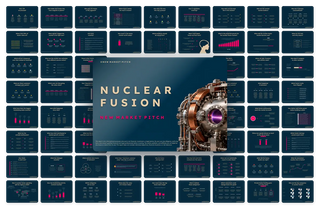
Fusion is always 30 years away, investors aren't waiting. Fusion now has billion-dollar rounds, signed power buyers, and even a stock on Nasdaq. What it still doesn't have is a machine that makes net electricity. This report shows you the whole market as it stands today.

  • 194+ pages
  • 12 sections
  • verified data only
Make smarter decisions on the nuclear fusion market market report cover

What’s inside the report?

12 sections to help founders and investors understand the nuclear fusion market with clarity

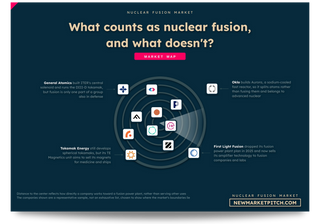
Radar map of the nuclear fusion market showing which companies count as part of it, which sit on its edge and which stay outside: What counts as nuclear fusion, and what only looks like it? (Nuclear Fusion Market, NewMarketPitch)
Market Definition

Where does this market start and stop?

Before we talk numbers, we set the market's limits: what counts as fusion, what doesn't, and what sits right next to it.

Fusion is often mixed up with fission and small modular reactors, but they are different businesses. Fission plants already sell power. No fusion plant does yet. That's why we count the spending to build fusion machines, not electricity sales.

It makes the rest of the report much easier to read.

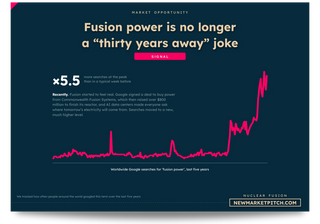
Google Trends curve of worldwide searches over five years for the nuclear fusion market: More and more people ask if fusion power is real, now Google signed a deal (Nuclear Fusion Market, NewMarketPitch)
Market Opportunity

Why is everyone looking at this market now?

In 2026, nuclear fusion is hot, even though no plant sells a single kilowatt yet.

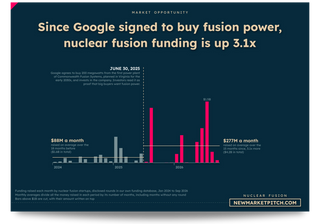
We've found a lot of interesting signals. For example, TAE Technologies agreed to merge with Trump Media in an all-stock deal valued at more than $6B. And General Fusion started trading on Nasdaq, the first company focused only on fusion power to go public. Fusion is moving from private labs to the stock market.

Here, we'll look at where the money is coming from, who is signing up to buy fusion power, and why governments now treat fusion as a race.

Donut chart splitting the nuclear fusion market size between its main categories, with leading companies: Which nuclear fusion category takes the biggest share? (Nuclear Fusion Market, NewMarketPitch)
Market Size

How big could this market get?

Fusion market size estimates online range from a few hundred million dollars to several hundred billion. That's not a small gap.

We took a first-principles approach and added up what is really spent each year: public budgets, ITER, private rounds, and suppliers. We checked the result against other sources and show our assumptions, so you can follow the math.

Since no plant sells power yet, this is the most honest way to size fusion today.

Matrix of the problems nuclear fusion customers still face, rated for each type of buyer: Which fusion problems are still unsolved? (Nuclear Fusion Market, NewMarketPitch)
Pain Points

What are the pain points, and for whom?

Fusion is hard, and the pain goes well beyond the plasma.

We compare tokamak, stellarator and laser fusion teams, plus key suppliers. Each faces different problems, from scarce tritium and magnets to reactor parts that wear out. We rank what matters most to them and their customers.

This helps you see which bottlenecks someone would pay to solve, long before the first plant runs.

Comparison table of the tech offered by leading nuclear fusion companies: Which nuclear fusion firm has the most complete tech today? (Nuclear Fusion Market, NewMarketPitch)
Tech & Infra

What is the latest tech and infrastructure?

Fusion won't advance through one design alone. Stronger magnets, stellarators and powerful lasers are opening different paths to making it work.

We keep this section updated with what's running, what's being assembled, and what's still on paper. We also show which bottlenecks look solvable, like tape supply or wall materials, and roughly when.

A clear snapshot of how close each path really is.

Map of nuclear fusion business models with company logos: How do fusion companies actually make money? (Nuclear Fusion Market, NewMarketPitch)
Value Creation

How is value created and monetized exactly?

No fusion company sells electricity yet. But money already flows: power contracts signed years ahead, magnets and parts sold to other developers, public milestone payments, and neutrons used to make medical isotopes.

We compare these models and explain who pays, when, and for what. A first plant can cost billions before it earns anything, while a supplier can sell parts to every developer, whatever design wins.

You'll see who can make money before fusion produces net energy, and where you'd only be paying for a long wait.

Table of the events that could slow the nuclear fusion market, with their odds and impact: What are the biggest threats to fusion? (Nuclear Fusion Market, NewMarketPitch)
Market Challenges

What could slow this market down?

The big brakes on fusion are no secret: no machine has made net electricity, plants cost billions, and plant dates keep slipping.

Other risks are quieter. The world has only about 25 kg of civil tritium. Few factories make HTS tape. Licensing rules are still being written. And cheap solar and batteries keep raising the bar that fusion must clear.

In this section, we map the main risks and estimate how likely each one is, so you can plan around them before you invest or build.

Timeline of the events that pushed the nuclear fusion market forward, with their impact: What pushed nuclear fusion forward, year after year? (Nuclear Fusion Market, NewMarketPitch)
Growth Drivers

What are the growth drivers in this market?

A growth rate only helps if you know what's behind it. So beyond our estimate for fusion, we explain what keeps pushing spending up.

Some drivers are clear: AI data centers that need firm clean power, record private rounds, and national plans in the US, the UK, Germany, Japan, and China. Others compound over time. Each large tape order lowers magnet costs. Each signed power deal makes the next round easier to raise.

Before building or investing, you should know what has to go right for fusion to move from test machines to plants that sell power.

Bar chart of where investors put their money in nuclear fusion, by category: Where did fusion investors put their money this past year? (Nuclear Fusion Market, NewMarketPitch)
Investor Bets

What are investors backing right now?

Fusion money no longer comes only from a few US names and patient billionaires. Tech giants, utilities, and state funds now join the rounds, and China adds new startups every quarter.

We'll compare funding for tokamaks, stellarators, pulsed machines and lasers. We'll also look at what investors want to see first: signed power customers, an approved site or a supplier that can earn revenue early. And we'll cover newer approaches gaining ground.

You'll see what the latest rounds say about which fusion companies investors trust to build real machines, and how much of the money still goes to a few leaders.

Market grid of the top nuclear fusion startups and companies by segment: Who are the top players in nuclear fusion today? (Nuclear Fusion Market, NewMarketPitch)
Top Players

Who are the top startups and companies?

CFS and Helion have raised the most money and signed the first big power buyers, but they are far from alone in the race.

Some of the most useful companies will never build a power plant. They make HTS tape, gyrotrons, lasers, or tritium systems, and sell them to everyone. Others test new designs in Europe, Japan, and China. They deserve your attention too.

Fusion is not one bet but many. A tokamak, a stellarator, a laser plant, and a magnet supplier have different timelines, costs, and risks. That makes the companies hard to compare, and easy to misjudge.

Below, you'll find the market grids and ecosystem maps we built to show who's doing what and where the market is heading.

Comparison of what nuclear fusion survivors do and which companies missed it: What separates fusion survivors from failures? (Nuclear Fusion Market, NewMarketPitch)
Startup Killers

What could kill a startup in this market?

Fusion punishes impatience. Every machine is the first of its kind, and a two-year delay can use up a startup's cash.

So we studied why fusion startups fail or stumble. Some see their magnets or machines arrive years late. Others find that parts wear out too fast, that lasers can't fire often enough, or that orders stay too small to fund a factory.

If you're building, you'll see why late hardware and worn-out parts can sink a fusion company before the physics does. If you're investing, you'll know what to check about schedules, cash, and real test results.

Scorecard showing what sets the leading nuclear fusion company apart: Why is CFS winning the fusion power race? (Nuclear Fusion Market, NewMarketPitch)
Startup Strategies

How do you win in this market?

Kyoto Fusioneering, Tokamak Energy, Proxima… a few fusion companies are making real progress, even though none sells power yet.

Their paths differ. Kyoto Fusioneering sells components to fusion developers. Tokamak Energy built a separate business around magnets. Proxima signed partners to host its reactor. None has fully proven its model, but each is building a business before commercial fusion arrives.

We'll look at how fusion teams earn trust, revenue, or partners long before their first plant runs.

Questions?

Who is this market report actually for?+

It's for founders, investors, energy companies, suppliers, and strategic teams who want a clear view of the nuclear fusion market.

It's useful if you're comparing fusion designs, weighing a supplier or developer bet, negotiating a power deal, or trying to understand funding, competition, regulation, and risks across the whole market.

How many pages are in the report?+

It has 194+ pages. It is designed to be comprehensive enough to support serious market evaluation, while still being fast to read and easy to use.

We prioritize signal, structure, and visual clarity over unnecessary length.

What do you include in the nuclear fusion market?+

We define the nuclear fusion market as technologies that combine light atomic nuclei to produce usable energy.

We include fusion reactor developers and dedicated systems for plasma control, magnets, fuel handling and energy extraction.

We exclude nuclear fission, conventional power generation and research equipment without a fusion-energy application.

Do you list your sources clearly?+

Yes. All key data points and assumptions are explained and sourced in the document.

All sources are tier-1: company filings, funding databases, public datasets, expert interviews, industry reports, etc.

Is the data up to date?+

Yes. The report was last updated on November 14, 2026 with the latest market signals.

Is this a one-time payment?+

Yes. This is a one-time purchase. There is no subscription required to access the document.

I want to buy several market reports, can I get a discount code?+

Yes. You can use NEWMARKET for 20% off when purchasing two reports, or NEWMARKETMAX for 30% off when purchasing five or more.

I’m interested in a market but I can’t find it here+

If a market you care about is not currently on the list, email us at team@newmarketpitch.com and we may be able to cover it.

I have more questions for you+

No problem. You can reach out directly and we respond within 24 hours.

LAST UPDATED: November 14, 2026

Everyone talks about fusion, few really understand it

Fusion can raise a billion dollars in one round and still be years away from its first watt of power. This report covers the whole market, from technology and suppliers to market size, buyers, business models, funding, competitors, and the risks that could delay the first plants.

PRO
$49
One-time payment
  • ✓ Market Definition
  • ✓ Market Opportunity
  • ✓ Market Size
  • ✓ Pain Points
  • ✓ Tech & Infra
  • ✓ Value Creation
  • ✓ Market Challenges
  • ✓ Growth Drivers
  • ✓ Investor Bets
  • ✓ Top Players
  • ✓ Startup Killers
  • ✓ Startup Strategies
PRO+
$79
One-time payment
  • ✓ Market Definition
  • ✓ Market Opportunity
  • ✓ Market Size
  • ✓ Pain Points
  • ✓ Tech & Infra
  • ✓ Value Creation
  • ✓ Market Challenges
  • ✓ Growth Drivers
  • ✓ Investor Bets
  • ✓ Top Players
  • ✓ Startup Killers
  • ✓ Startup Strategies
PRO++
$99
One-time payment
  • ✓ Market Definition
  • ✓ Market Opportunity
  • ✓ Market Size
  • ✓ Pain Points
  • ✓ Tech & Infra
  • ✓ Value Creation
  • ✓ Market Challenges
  • ✓ Growth Drivers
  • ✓ Investor Bets
  • ✓ Top Players
  • ✓ Startup Killers
  • ✓ Startup Strategies
Use code MARKETPITCH for 10% off your order