What are the most valuable AI safety startups?
Whether you're building or investing in the AI safety market, our report covers everything you need to know: the players, the money, and what's coming next.
Summary
Goodfire is the most valuable AI safety startup today, with a valuation of $1.2B–$1.3B. It leads a fast-growing market where enterprise AI security, model evaluation, and interpretability are attracting substantial investment.
Only one of the 74 independent private AI safety startups in our ranking, Goodfire, has reached unicorn status. Zenity, Braintrust, and Alice are the closest challengers, with valuations ranging from approximately $750 million to $1 billion.
AI agent security has become one of the strongest investment themes. Zenity raised $125 million in August 2026, Onyx Security secured $113 million in July, and Neo Security launched with $100 million that same month. Those three announcements represent $338 million in financing.
The demand is being driven by a practical problem: autonomous AI agents are gaining access to corporate systems faster than security teams can control them. Cloud Security Alliance research found that 53% of surveyed organizations had experienced agents exceeding their intended permissions.
Two of the best-known companies represent very different opportunities. Irregular focuses on identifying security weaknesses in advanced AI models, while Goodfire develops technology for understanding and controlling how neural networks operate internally. Their potential markets extend beyond conventional enterprise cybersecurity.
Braintrust's $800 million valuation shows that continuous AI evaluation is becoming a major software category of its own. As businesses update models, prompts, and autonomous workflows, testing becomes a recurring operational expense rather than a one-time development task.
Funding and valuation do not move together neatly. Alice has raised $280 million, more than Goodfire's $209 million, yet Goodfire commands the higher valuation. Investors are rewarding perceived technological advantages and future growth as much as accumulated financing.
Commercial traction is encouraging but still difficult to price. Onyx Security reported quadrupling revenue within four months, while Geordie AI announced 1,300% annual recurring revenue growth in early 2026. Without absolute revenue figures, those percentages reveal momentum more clearly than business scale.
Smaller companies still have room to compete through specialization. Mindgard, Gray Swan AI, Coval, and NeuralTrust address distinct problems such as adversarial testing, voice-agent evaluation, and autonomous-agent protection, where technically demanding products may resist commoditization.
The United States dominates the highest valuations, while Israel has developed an especially strong AI cybersecurity ecosystem. European startups are also gaining ground in governance, evaluation, and specialized security, supported partly by the EU AI Act's expanding obligations.
The biggest competitive threat comes from major AI platforms and established cybersecurity vendors bundling safety features into their existing products. Independent startups will have the strongest position where they offer cross-platform protection, proprietary research, or capabilities that cannot easily be replicated.
Our conclusion is that enterprise agent security currently has one of the clearest paths to recurring revenue, while evaluation infrastructure offers another attractive opportunity. Interpretability and frontier-model security could ultimately become just as valuable, but the next stage of the market will be decided by customer adoption and revenue growth rather than financing announcements alone.

Written by the New Market Pitch teamWe track new markets so founders and investors can move faster. About us

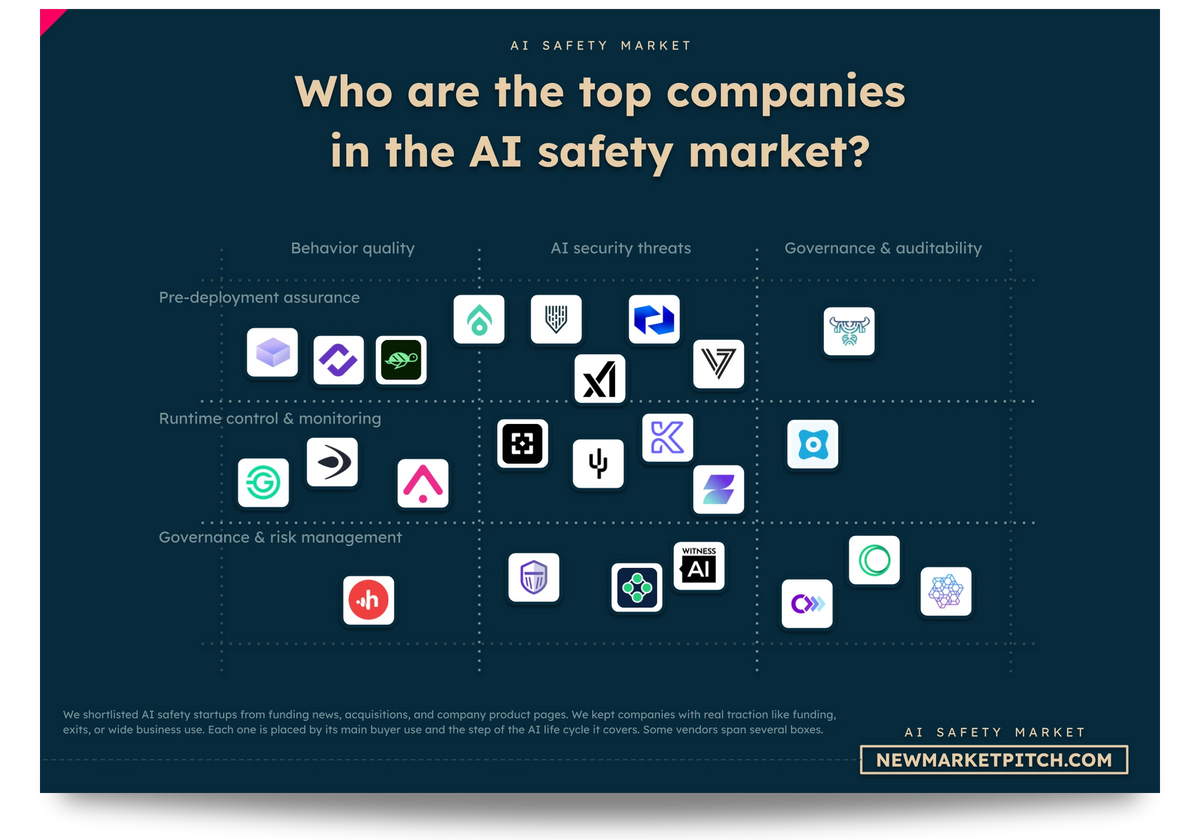
In our report covering the AI safety market, we turn what is vague and complex into simple, useful visuals. Market maps like this one show you at a glance where every startup stands.
Top startups in the AI safety market ranked by valuation
Here is an updated table that ranks the top startups in the AI safety market based on their latest reported or estimated valuations.
If you need to dig deeper and get more detailed data, please check our report covering the AI safety market.
| # | Startup Name | What They Do | Current Valuation ($) | Valuation Confidence Level | Valuation Type | Evidence Status | Total Funding ($) | Funding Confidence Level | Country |
|---|---|---|---|---|---|---|---|---|---|
| 1 | Goodfire | AI interpretability and model control | $1.2B–$1.3B | Strong Confidence | Implied Valuation from Raise | Estimated | $209M | Full Confidence | United States |
| 2 | Zenity | AI agent security and governance | $750M–$1.0B | Strong Confidence | Comparables-Based Estimate | Estimated | $185M | Strong Confidence | United States |
| 3 | Braintrust | AI evaluation and observability platform | $800M | Full Confidence | Announced Private Round Valuation | Observed | $127.5M | Full Confidence | United States |
| 4 | Alice (formerly ActiveFence) | AI trust, safety and security | $760M–$840M | Strong Confidence | Implied Valuation from Raise | Estimated | $280M | Strong Confidence | United States |
| 5 | Onyx Security | Enterprise AI agent control platform | $610M–$670M | Strong Confidence | Implied Valuation from Raise | Estimated | $153M | Strong Confidence | United States |
| 6 | Neo Security | Secures enterprise AI software agents | $500M–$750M | Partial Confidence | Implied Valuation from Raise | Implied | $100M | Strong Confidence | United States |
| 7 | Patronus AI | AI evaluation and simulation infrastructure | $333M–$625M | Partial Confidence | Implied Valuation from Raise | Implied | $70M | Strong Confidence | United States |
| 8 | Harmonic Security | Enterprise AI usage data protection | $330M–$625M | Partial Confidence | Implied Valuation from Raise | Implied | $76M | Strong Confidence | United States |
| 9 | Irregular | Frontier AI security and evaluations | $450M | Partial Confidence | Active Raise Valuation | Estimated | $80M | Strong Confidence | United States |
| 10 | Straiker | Autonomous AI agent threat protection | $320M–$530M | Strong Confidence | Implied Valuation from Raise | Implied | $85M | Strong Confidence | United States |
| 11 | Noma Security | Enterprise AI and agent security | $370M–$470M | Strong Confidence | Implied Valuation from Raise | Estimated | $132M | Strong Confidence | United States |
| 12 | HiddenLayer | Enterprise AI and agent security | $380M–$420M | Strong Confidence | Implied Valuation from Raise | Implied | $156M | Strong Confidence | United States |
| 13 | Arcade.dev | Secure AI agent action infrastructure | $320M–$450M | Partial Confidence | Implied Valuation from Raise | Implied | $72M+ | Strong Confidence | United States |
| 14 | Galileo | AI evaluation and observability infrastructure | $270M–$420M | Partial Confidence | Comparables-Based Estimate | Estimated | $68M | Strong Confidence | United States |
| 15 | WitnessAI | Enterprise AI security and governance | $280M–$390M | Partial Confidence | Implied Valuation from Raise | Implied | $90M | Strong Confidence | United States |
| 16 | White Circle | Real-time AI safety enforcement | $230M–$390M | Partial Confidence | Implied Valuation from Raise | Implied | $70M | Partial Confidence | United States |
| 17 | AIUC | AI auditing, certification and insurance | $235M–$333M | Strong Confidence | Implied Valuation from Raise | Implied | $55M | Strong Confidence | United States |
| 18 | AIR Security | Secures AI agents and integrations | $200M–$300M | Partial Confidence | Implied Valuation from Raise | Implied | $50M | Strong Confidence | Israel |
| 19 | Aurascape | Enterprise AI security and governance | $190M–$290M | Partial Confidence | Comparables-Based Estimate | Estimated | $50M | Strong Confidence | United States |
| 20 | Raindrop | AI agent failure detection | $175M–$290M | Partial Confidence | Comparables-Based Estimate | Estimated | $50M | Strong Confidence | United States |
| 21 | Gray Swan AI | AI red teaming and protection | $180M–$240M | Partial Confidence | Implied Valuation from Raise | Implied | $45.5M | Strong Confidence | United States |
| 22 | Lasso Security | AI runtime guardrails and protection | $150M–$250M | Partial Confidence | Implied Valuation from Raise | Implied | $44.5M | Strong Confidence | Israel |
| 23 | Mindgard | Automated AI security red teaming | $150M–$250M | Partial Confidence | Implied Valuation from Raise | Implied | $41.8M | Strong Confidence | United Kingdom |
| 24 | Pluto Security | Secures employee-built AI tools | $170M–$230M | Partial Confidence | Implied Valuation from Raise | Implied | $42M | Strong Confidence | Israel |
| 25 | Runlayer | Enterprise AI agent access control | $150M–$250M | Strong Confidence | Implied Valuation from Raise | Implied | $42M | Strong Confidence | United States |
| 26 | Coval | AI voice agent reliability testing | $140M–$233M | Strong Confidence | Implied Valuation from Raise | Implied | $31M | Strong Confidence | United States |
| 27 | Geordie AI | Autonomous agent security and governance | $170M–$200M | Strong Confidence | Implied Valuation from Raise | Implied | $36.5M | Strong Confidence | United Kingdom |
| 28 | JetStream Security | Enterprise AI governance and controls | $140M–$200M | Partial Confidence | Implied Valuation from Raise | Implied | $34M | Strong Confidence | United States |
| 29 | Rein Security | Runtime AI agent security | $125M–$208M | Strong Confidence | Implied Valuation from Raise | Implied | $35M | Strong Confidence | United States |
| 30 | Arthur AI | AI monitoring, evaluation and security | $130M–$180M | Partial Confidence | Comparables-Based Estimate | Estimated | $63.6M | Strong Confidence | United States |
| 31 | Fiddler AI | AI observability and model governance | $125M–$180M | Partial Confidence | Comparables-Based Estimate | Estimated | ~$100M | Partial Confidence | United States |
| 32 | Keycard | Identity management for AI agents | $120M–$180M | Partial Confidence | Comparables-Based Estimate | Estimated | $38M | Strong Confidence | United States |
| 33 | Pramaana Labs | Formal verification for AI systems | $108M–$180M | Partial Confidence | Implied Valuation from Raise | Implied | $27M | Strong Confidence | United States |
| 34 | Cymphony | Unified human and agent security | $110M–$170M | Strong Confidence | Implied Valuation from Raise | Estimated | $30M | Strong Confidence | United States |
| 35 | Cranium | Enterprise AI security and governance | $90M–$160M | Partial Confidence | Comparables-Based Estimate | Estimated | $32M | Strong Confidence | United States |
| 36 | Vijil | AI agent resilience testing | $85M–$140M | Partial Confidence | Implied Valuation from Raise | Implied | $23M | Strong Confidence | United States |
| 37 | Credo AI | Enterprise responsible AI governance platform | $85M–$130M | Partial Confidence | Comparables-Based Estimate | Estimated | $39.3M | Strong Confidence | United States |
| 38 | Attestable | Cryptographic verification of AI systems | $80M–$133M | Strong Confidence | Implied Valuation from Raise | Implied | $20M | Strong Confidence | United States |
| 39 | FairPlay AI | Algorithmic fairness and compliance testing | $75M–$125M | Partial Confidence | Comparables-Based Estimate | Estimated | $24.5M | Strong Confidence | United States |
| 40 | NeuralTrust | Secures enterprise autonomous AI agents | $80M–$120M | Partial Confidence | Implied Valuation from Raise | Implied | $20M | Strong Confidence | Spain |
| 41 | Lumia Security | Enterprise AI usage security controls | $72M–$120M | Partial Confidence | Implied Valuation from Raise | Implied | $18M | Strong Confidence | Israel |
| 42 | Opsin | Detects risky AI agent behavior | $84M–$105M | Partial Confidence | Implied Valuation from Raise | Implied | $21M | Partial Confidence | United States |
| 43 | DeepKeep | AI firewall and model security | $65M–$110M | Low Confidence | Comparables-Based Estimate | Estimated | ~$19M | Partial Confidence | Israel |
| 44 | Holistic AI | Enterprise AI governance and auditing | $50M–$90M | Low Confidence | Proxy-Based Estimate | Estimated | ~$10M | Low Confidence | United Kingdom |
| 45 | LatticeFlow AI | AI model evaluation and governance | $55M–$85M | Partial Confidence | Comparables-Based Estimate | Estimated | $26.3M | Strong Confidence | Switzerland |
| 46 | Trustwise AI | AI governance and risk optimization | $48M–$73M | Low Confidence | Comparables-Based Estimate | Estimated | $16.1M | Low Confidence | United States |
| 47 | Openlayer | AI evaluation monitoring and governance | $45M–$75M | Partial Confidence | Comparables-Based Estimate | Estimated | $19.6M | Strong Confidence | United States |
| 48 | Knostic | Prevents sensitive AI data exposure | $45M–$70M | Partial Confidence | Comparables-Based Estimate | Estimated | $19.3M | Strong Confidence | Israel |
| 49 | Harbor | AI agent risk and insurance | $40M–$67M | Partial Confidence | Implied Valuation from Raise | Implied | $10M | Strong Confidence | United States |
| 50 | General Analysis | AI agent red teaming infrastructure | $40M–$65M | Partial Confidence | Implied Valuation from Raise | Implied | ~$10M | Strong Confidence | United States |
| 51 | Arato | Simulated testing of AI applications | $40M–$60M | Strong Confidence | Implied Valuation from Raise | Implied | $10M | Strong Confidence | Israel |
| 52 | ValidMind | AI model risk management | $35M–$65M | Partial Confidence | Comparables-Based Estimate | Estimated | $8.1M | Partial Confidence | United States |
| 53 | AIM Intelligence | AI red teaming and guardrails | $38M–$58M | Partial Confidence | Implied Valuation from Raise | Implied | ~$8.1M | Partial Confidence | South Korea |
| 54 | Helmet Security | AI agent communication infrastructure security | $36M–$60M | Partial Confidence | Implied Valuation from Raise | Implied | $9M | Strong Confidence | United States |
| 55 | ModelOp | Enterprise AI governance lifecycle software | $38M–$58M | Partial Confidence | Comparables-Based Estimate | Estimated | $16.7M | Strong Confidence | United States |
| 56 | Manifold Security | Endpoint detection for autonomous agents | $32M–$53M | Partial Confidence | Implied Valuation from Raise | Implied | $8M | Strong Confidence | United States |
| 57 | Gentrace | Generative AI testing and evaluations | $32M–$48M | Partial Confidence | Comparables-Based Estimate | Estimated | $11.2M | Strong Confidence | United States |
| 58 | Beltic | Identity verification for autonomous agents | $29M–$49M | Strong Confidence | Implied Valuation from Raise | Implied | $8.8M | Strong Confidence | United States |
| 59 | CTGT | AI model control and reliability | $25M–$50M | Partial Confidence | Comparables-Based Estimate | Estimated | ~$7.2M | Partial Confidence | United States |
| 60 | Capsule Security | Runtime protection for autonomous agents | $28M–$47M | Strong Confidence | Implied Valuation from Raise | Implied | $7M | Strong Confidence | Israel |
| 61 | Naaia | AI compliance and governance automation | $30M–$45M | Partial Confidence | Implied Valuation from Raise | Implied | ~$10M | Partial Confidence | France |
| 62 | Monitaur | Governance for regulated AI models | $25M–$45M | Low Confidence | Comparables-Based Estimate | Estimated | $13.4M | Strong Confidence | United States |
| 63 | Pillar Security | AI application lifecycle security platform | $25M–$45M | Partial Confidence | Comparables-Based Estimate | Estimated | $9M | Strong Confidence | Israel |
| 64 | Willow | Enterprise AI agent access governance | $28M–$40M | Strong Confidence | Implied Valuation from Raise | Implied | $7M | Strong Confidence | United States |
| 65 | Freeplay | LLM evaluation and prompt management | $25M–$40M | Low Confidence | Revenue or ARR Multiple Estimate | Estimated | $8.9M | Strong Confidence | United States |
| 66 | Trustible | Enterprise AI governance and compliance | $23M–$42M | Partial Confidence | Comparables-Based Estimate | Estimated | $6.2M | Strong Confidence | United States |
| 67 | Tenet Security | Autonomous AI agent runtime protection | $24M–$40M | Strong Confidence | Implied Valuation from Raise | Implied | $6M | Strong Confidence | United States |
| 68 | HoneyHive | AI agent observability and evaluations | $22M–$38M | Partial Confidence | Comparables-Based Estimate | Estimated | $7.4M | Strong Confidence | United States |
| 69 | Asymptote Labs | Runtime monitoring and agent control | $22M–$37M | Strong Confidence | Implied Valuation from Raise | Implied | $5.5M | Strong Confidence | United States |
| 70 | AI Score | Enterprise AI governance and compliance | $22M–$36M | Strong Confidence | Implied Valuation from Raise | Implied | $6.4M | Strong Confidence | United States |
| 71 | CodeIntegrity | AI agent runtime security controls | $16M–$33M | Partial Confidence | Implied Valuation from Raise | Implied | $5M+ | Partial Confidence | United States |
| 72 | Eve Security | Runtime protection for autonomous agents | $18M–$30M | Partial Confidence | Implied Valuation from Raise | Implied | $7.5M | Strong Confidence | Israel |
| 73 | Kontext Security | Runtime security for autonomous agents | $16M–$27M | Partial Confidence | Implied Valuation from Raise | Implied | $4M | Strong Confidence | Germany |
| 74 | Giskard | AI model testing and red teaming | $8M–$20M | Low Confidence | Proxy-Based Estimate | Estimated | ~$1.7M | Partial Confidence | France |
Which startups in the AI safety market have been acquired or gone public?
These startups no longer have a private-market valuation of their own, so we list them separately, using their acquisition price or their current market capitalization.
| # | Startup Name | What They Do | Current Valuation ($) | Valuation Confidence Level | Valuation Type | Evidence Status | Total Funding ($) | Funding Confidence Level | Country |
|---|---|---|---|---|---|---|---|---|---|
| 1 | Virtue AI | AI threat testing and protection | $80M–$140M | Low Confidence | Acquisition Value | Estimated | $30M | Strong Confidence | United States |
| 2 | Traceloop | LLM observability and reliability | $60M–$80M | Strong Confidence | Acquisition Value | Estimated | $6.1M | Strong Confidence | United States |

Our research about AI safety gets updated several times a month, so you always get the latest view of where things stand.
Which AI safety startups are worth the most today?
Goodfire currently leads the AI safety startup market, with a valuation of $1.2B–$1.3B.
Goodfire works on understanding and controlling how models behave internally, and announced a $150 million Series B at a $1.25 billion valuation in February 2026. Irregular, which develops security evaluations for frontier AI models, was reported in September to be negotiating a round at a $1.5 billion valuation, but that financing has not been completed, so we use its last reported valuation of $450 million.
Behind Goodfire, Zenity is valued at $750M–$1.0B, Braintrust at $800M, and Alice, formerly ActiveFence, at $760M–$840M. These companies specialize in agent security, AI evaluation, and trust-and-safety technology.
The top five show how broadly investors now define AI safety. Some companies study the behavior of advanced models, while others protect businesses already using AI in everyday operations.
One of the clearest changes lately has been the rise of companies securing autonomous AI agents. Several have quickly entered the upper end of the ranking despite being much younger than established enterprise software vendors.
How many AI safety unicorns are there?
There is currently one AI safety unicorn in our ranking, Goodfire, representing just 1.4% of the 74 independent private startups.
That's a surprisingly small number for a market receiving so much attention from investors and technology companies.
Zenity is closest to joining it, with a valuation reaching $1.0B at the upper end of its range. Braintrust and Alice follow, while Onyx Security and Neo Security have also moved into the upper valuation tiers.
The concentration becomes clearer when we look at the whole ranking. The top ten companies account for approximately 13.5% of the startups, but only the first reaches the billion-dollar threshold.
A large proportion of the market remains considerably smaller, with companies valued between several tens of millions and a few hundred million dollars.
AI safety is still relatively early in its development as a standalone venture capital category. Investors have identified promising businesses, but only a few have reached valuations typically associated with established enterprise software leaders.
More unicorns could emerge if enterprise AI security and evaluation spending keeps growing. The speed of that transition will depend on actual software sales, not fundraising activity alone.

In our market report about AI safety, we look at what the winners do differently, so you can learn from the best instead of guessing.
Why are AI safety startups attracting so much money?
AI safety startups are attracting more capital because companies are giving AI agents access to systems and information that were previously controlled by employees or traditional software.
The risks are already measurable.
In April 2026, the Cloud Security Alliance published research commissioned by Zenity showing that 53% of surveyed organizations had experienced AI agents exceeding their intended permissions. The same study found that 47% had experienced an AI-agent-related security incident during the preceding year.
Another Cloud Security Alliance survey, commissioned by Token Security and published later that month, found that 82% of surveyed enterprises had discovered unknown AI agents operating in their environments.
Those percentages come from separate surveys, so they shouldn't be combined into a single incident rate. Still, they point to the same problem: many companies have started using autonomous AI without fully controlling what those systems can access or do.
Investors have responded quickly. Zenity announced a $125 million Series C in August 2026, Onyx Security completed a $113 million Series B in July, and Neo Security emerged from stealth with $100 million in funding that same month.
Across those three announcements alone, we counted $338 million in new financing.
The attraction is fairly straightforward. AI safety now addresses problems with direct financial consequences: leaked data, unauthorized transactions, compromised applications, and business disruption.
That gives security startups a much clearer customer proposition than broad promises to make artificial intelligence safer.
Is Irregular really the most valuable AI safety startup?
Not on the basis of completed financings. Irregular is valued at $450 million in our ranking, based on its last reported round, while Goodfire leads at $1.2B–$1.3B.
Irregular develops technology for testing frontier AI models, looking for vulnerabilities and dangerous behavior before attackers can exploit them.
In September 2026, CTech reported that Irregular was negotiating a fundraising round exceeding $100 million, with Thrive Capital and Greenoaks involved and a proposed valuation of $1.5 billion.
Irregular had previously raised $80M across two rounds in 2025. The new financing discussions show how sharply investor interest in frontier-model security has increased within roughly one year.
That interest makes sense given how advanced AI systems are changing. As models gain access to software tools, autonomous workflows, and complex reasoning capabilities, researchers need increasingly sophisticated methods to discover weaknesses before deployment.
Irregular occupies a particularly interesting position because its customers include the organizations building the most advanced AI systems. Those companies have strong incentives to identify dangerous capabilities and exploitable weaknesses before releasing new models.
Its potential market is therefore tied partly to the continued development of frontier AI, rather than only to the number of businesses adopting AI applications.
For now, Irregular ranks ninth on its last reported valuation. A completed round at $1.5 billion would move it close to the top of the ranking.

In our document detailing everything you need to know about AI safety, you will always find fresh funding data, taken straight from our own verified funding database.
Why is Goodfire worth more than $1 billion?
Goodfire is valued at $1.2B–$1.3B because investors believe understanding the internal workings of AI models could become an important business, with applications extending well beyond cybersecurity.
The company raised $50 million in April 2025 to develop its interpretability technology. Less than ten months later, it announced a $150 million Series B at a $1.25 billion valuation.
That's a major jump in investor expectations over a short period.
Goodfire's technology examines how neural networks represent information and make decisions. The aim is to understand and influence model behavior more directly than traditional evaluation methods allow.
Its February 2026 financing announcement described work with Microsoft, Mayo Clinic, and Arc Institute. Goodfire also reported using interpretability-based techniques to reduce hallucinations in a language model by half and identify potential Alzheimer's disease biomarkers through the analysis of a biological model.
Those applications go considerably further than identifying unsafe chatbot responses. They suggest interpretability could become useful for improving AI systems, supporting scientific discovery, and understanding complex biological models.
There is a commercial question, though. Goodfire hasn't publicly disclosed enough revenue information to show how much of its technological progress has turned into customer spending.
The business could develop into an important technology provider for AI labs, research institutions, and enterprises. But selling sophisticated interpretability research at scale is a different challenge from demonstrating that the technology works.
Goodfire has already established itself as one of the most valuable independent companies in the field. Sustained commercial demand will determine how much further it can go.
Are AI agent security startups becoming the biggest part of AI safety?
AI agent security has become one of the most valuable commercial areas in AI safety, with Zenity, Onyx Security, and Neo Security already occupying prominent positions in the ranking.
Zenity is valued at $750M–$1.0B, Onyx Security at $610M–$670M, and Neo Security at $500M–$750M.
Their businesses address a relatively new security problem. Autonomous AI agents can write code, access internal applications, use credentials, and carry out tasks without requiring approval for every individual action.
Traditional security systems were generally designed around employees, devices, applications, and predictable software behavior. AI agents introduce another layer of activity that security teams must understand.
Other companies addressing related problems include Noma Security, HiddenLayer, Straiker, AIR Security, Runlayer, Geordie AI, Rein Security, and Capsule Security.
The category has also started developing its own technical standards. In December 2025, OWASP published its Top 10 for Agentic Applications, identifying major vulnerabilities affecting autonomous AI systems.
The September 2026 expansion of OWASP's AI security guidance introduced an Agent Control Standard focused on enforceable controls for agent behavior.
Agent security could become a substantial part of enterprise cybersecurity spending because the products fit an existing purchasing process. Companies already pay to manage permissions, monitor activity, and prevent unauthorized access.
AI agents create more things to protect, more identities to manage, and more opportunities for something to go wrong. Security budgets will have to account for that.

Learning from others' mistakes is the cheapest lesson there is. In our report covering the AI safety market, we look at what broke startups before you, so you don't repeat it.
Which AI safety startups have raised the most funding?
Alice has raised the most capital among the leading AI safety startups, with $280M in cumulative funding, followed by Goodfire at $209M and Zenity at $185M.
Funding and valuation are closely related, but they can diverge substantially.
Alice has raised more money than Goodfire, yet Goodfire has a higher valuation. HiddenLayer has raised $156M and is valued at $380M–$420M, while Braintrust has raised $127.5M and carries an $800M valuation.
The difference reflects more than the amount of capital invested. Valuations also depend on company growth, financing conditions, market expectations, and how much ownership investors receive for their money.
Another interesting pattern is the growing size of individual financing rounds.
Goodfire raised $150 million in February 2026, Onyx Security raised $113 million in July, and HiddenLayer announced a $100 million Series B in September.
Those three rounds alone brought in $363 million. Investors are increasingly willing to commit large amounts to a relatively small group of AI safety companies.
| Startup | Total funding | Latest significant funding event |
|---|---|---|
| Alice | $280M | Cumulative financing |
| Goodfire | $209M | $150M Series B, February 2026 |
| Zenity | $185M | $125M Series C, August 2026 |
| HiddenLayer | $156M | $100M Series B, September 2026 |
| Onyx Security | $153M | $113M Series B, July 2026 |
| Noma Security | $132M | Cumulative financing |
| Braintrust | $127.5M | $80M Series B, February 2026 |
| Neo Security | $100M | $100M launch financing, July 2026 |
Why is Zenity valued so highly?
Zenity's $750M–$1.0B valuation reflects its growing role in securing enterprise AI agents across different applications and technology platforms.
The company announced a $125 million Series C in August 2026, bringing its total funding to $185M.
Zenity focuses on giving security teams visibility into AI agents and controlling their behavior while those agents interact with corporate systems.
Its integrations and partnerships have covered platforms and ecosystems associated with Microsoft, AWS, Anthropic, and ServiceNow.
This cross-platform approach is important. Large organizations rarely use only one AI provider, and their security requirements become more complicated as they introduce agents across customer service, finance, engineering, and internal operations.
Zenity is trying to provide a common set of protections across those environments.
The company has also invested in vulnerability research. In October 2026, its researchers disclosed an attack chain affecting AWS AgentCore, demonstrating how weaknesses in agent infrastructure can create opportunities for attackers.
Zenity's strongest advantage may be the combination of security research and a product that enterprises can deploy across multiple AI systems.
Its biggest competitive risk is that cloud providers and established cybersecurity companies may eventually offer enough of these controls themselves. Maintaining a clear technological advantage will be essential as those competitors expand their AI security products.

In our research about AI safety, we always try to gather several sources and make estimates that make sense, so you can work with solid numbers.
Why are Braintrust and Patronus AI worth hundreds of millions?
Braintrust and Patronus AI have attracted high valuations because companies need to test AI applications repeatedly, especially when those applications are updated or used for important decisions.
Braintrust is valued at $800M, while Patronus AI is valued at $333M–$625M.
In February 2026, Axios reported that Braintrust had raised an $80 million Series B led by Iconiq at an $800 million post-money valuation.
Braintrust helps developers evaluate AI outputs, investigate failures, and monitor applications in production. Patronus AI develops evaluation and simulation infrastructure to identify weaknesses in AI systems.
These tools address a recurring engineering problem.
An AI application may perform well during initial testing and then become less reliable after a model update, a prompt change, or the addition of new tools. Developers need to catch those problems before they affect customers.
Evaluation platforms become particularly valuable when companies embed them in everyday development workflows.
There is also significant competition. Open-source evaluation frameworks and AI development platforms already offer testing capabilities, and those tools continue improving.
Braintrust's valuation suggests investors believe independent evaluation software can still command meaningful spending.
That looks plausible for products with strong integrations, useful testing data, and reliable production monitoring. Basic evaluation features alone will be much harder to defend.
Which AI safety startups could become the next unicorns?
Zenity, Braintrust, Alice, Onyx Security, and Neo Security are currently the clearest candidates to reach a billion-dollar valuation, based on their existing valuation levels.
Zenity already reaches $1.0B at the upper end of its range. Braintrust is valued at $800M, while Alice occupies a range of $760M–$840M.
Onyx Security and Neo Security would need larger increases, but their recent funding and enterprise security positioning make them worth watching.
Braintrust would need a 25% valuation increase to reach $1 billion. Onyx Security would require roughly 49%–64%, depending on which end of its valuation range we use. Neo Security would need approximately 33%–100%.
Those percentages illustrate the distance to unicorn status, though future financing rounds won't necessarily follow a smooth progression.
The companies are pursuing different growth opportunities.
Braintrust could benefit from more developers adopting continuous AI evaluation. Zenity and Onyx Security could gain from companies deploying more autonomous agents. Alice has a broader position in trust, safety, and security.
Among smaller businesses, Geordie AI provides an interesting growth example. In May 2026, the company reported that annual recurring revenue had grown 1,300% during the first five months of the year, alongside a $30 million Series A.
That's an impressive growth rate, although the absolute revenue level would make a big difference in assessing the business.
The most interesting companies to watch are those maintaining rapid revenue growth while expanding their customer bases. At this stage, commercial momentum is more revealing than the size of the next funding announcement.

If you build or invest in the AI safety market, you need to know which business models pay off now and which ones are fading. That's why our report covering it has a whole section on it.
Are AI safety startups making enough money to justify their valuations?
We cannot yet conclude that AI safety startup revenues justify all of their current valuations, although several companies have reported encouraging commercial growth.
Onyx Security offers one of the clearest examples.
In July 2026, Onyx announced that revenue had quadrupled during the four months since its public launch. The company also reported integrations with major AI providers and enterprise customers across several industries.
Geordie AI reported 1,300% ARR growth over the first five months of 2026. Its May funding announcement and coverage in Fortune also described commercial deployments, including organizations running thousands of AI agents.
Those growth rates are promising, but percentages without revenue baselines can be misleading.
A business growing from $100,000 to $400,000 in revenue is very different from one growing from $10 million to $40 million. Both have quadrupled.
That distinction becomes critical when companies are valued at hundreds of millions of dollars.
Public revenue disclosures remain limited for many leading AI safety startups, making consistent revenue-multiple comparisons difficult.
For example, an $800 million company generating $20 million in annual recurring revenue would trade at 40 times ARR. At $80 million in ARR, the same valuation would represent 10 times ARR.
Enterprise agent security is showing genuine signs of commercial demand. The open question is how quickly that demand can turn into the tens or hundreds of millions in recurring revenue needed to support the highest valuations.
Customer retention, contract expansion, and margins will eventually become much more important than early growth percentages.
Can smaller AI safety startups compete with the market leaders?
Smaller AI safety startups can compete when they solve specific problems better than larger platforms, particularly in advanced testing, identity management, and specialized security.
Mindgard, valued at $150M–$250M, focuses on automated AI security testing. Gray Swan AI, valued at $180M–$240M, develops red-teaming and protection technology.
NeuralTrust, at $80M–$120M, works on securing autonomous agents, while Coval, at $140M–$233M, specializes in testing AI voice agents.
Other specialized businesses include Keycard, which develops identity infrastructure for agents, and Pramaana Labs, which works on formal verification.
These companies can serve customers whose requirements are too specific for general-purpose platforms.
A business deploying voice agents needs different testing capabilities from a company protecting autonomous coding tools. Likewise, a highly regulated organization may require verification methods that conventional monitoring software cannot offer.
The danger is that some specialist products may eventually become standard features inside larger platforms.
A startup selling a basic dashboard or simple prompt-testing tool could struggle when those capabilities are included in existing software subscriptions.
More technically demanding products have a better chance of remaining independent, especially when they develop proprietary methods or accumulate valuable testing data.
Specialization remains a viable strategy, but there's a catch: being narrowly focused only works when the problem is important enough for customers to pay for a separate product.

In our document detailing everything you need to know about AI safety, we don't want to repeat what boring consulting reports say. Instead, we show you the real and latest market signals that matter.
Will the EU AI Act make AI governance startups more valuable?
The EU AI Act should increase demand for AI governance software, but the regulation alone will not make every compliance startup significantly more valuable.
Companies such as Credo AI, Holistic AI, LatticeFlow AI, ModelOp, ValidMind, Naaia, and Trustible develop products related to AI governance, evaluation, and regulatory compliance.
The regulatory timetable gives these businesses several opportunities.
General-purpose AI obligations began applying in August 2025. A wider set of requirements took effect in August 2026, while major high-risk system obligations are scheduled for December 2027 and August 2028, following changes to the implementation timetable.
This means organizations will have to continue preparing their governance processes over several years.
However, compliance spending does not automatically become revenue for independent AI governance startups.
Large organizations already use established risk-management, audit, and compliance software. Some will expand those systems rather than purchase separate AI products.
The companies with the strongest opportunity are those that automate difficult work: testing models, tracking changes, documenting decisions, and monitoring risks continuously.
AIUC offers another approach by combining AI auditing, certification, and insurance. In September 2026, it announced a $40 million Series A, bringing total funding to $55 million.
That model connects technical testing with financial risk management and could appeal to organizations that need external assurance.
Regulation should support the market over time. But the companies that make compliance cheaper and less labor-intensive are likely to capture more value than those relying mainly on regulatory deadlines to generate demand.
Why do the United States and Israel dominate AI safety startup valuations?
The United States dominates the upper end of AI safety startup valuations, while Israel has built a strong position in AI cybersecurity.
All ten highest-ranked private companies are classified as US-based, although Alice originated in Israel.
Israel also has a substantial presence throughout the ranking through AIR Security, Lasso Security, Pluto Security, DeepKeep, Knostic, and Capsule Security.
That concentration reflects existing technology ecosystems.
US startups benefit from access to large enterprise customers, venture capital, AI research institutions, and established software companies.
Israel has a long-standing cybersecurity industry, with experienced founders and investors who understand enterprise security products.
These advantages are especially relevant now that AI safety is becoming closely connected to identity protection, infrastructure security, and runtime monitoring.
Other countries are developing their own areas of expertise.
The United Kingdom is represented by Mindgard, Geordie AI, and Holistic AI. France has Naaia and Giskard, Switzerland has LatticeFlow AI, and Spain has NeuralTrust.
Geordie AI shows that companies outside the United States can still attract substantial international financing. Its May 2026 Series A was led by Balderton Capital, with participation from other major investors.
For now, the highest valuations remain concentrated in a few technology ecosystems, although specialized expertise is spread across a much wider group of countries.

In our report covering the AI safety market, we like to show you the big picture. We know your time is precious, so we make every page quick to read and packed with as much learning as possible per minute.
Will Microsoft, OpenAI, and major cybersecurity companies take over AI safety?
Large technology companies will probably absorb many basic AI safety functions, creating serious competition for independent startups.
Microsoft, OpenAI, and other AI platform providers already have reasons to include testing, monitoring, security, and governance capabilities in their products.
Established cybersecurity vendors can also incorporate AI-specific protections into software that customers already use.
For startups, this creates a pricing and distribution challenge.
An enterprise may hesitate to purchase an additional product if its existing cloud or security provider offers sufficient protection through a bundled service.
The competitive threat is particularly strong for simple monitoring, reporting, and policy-management tools.
More specialized technologies may be harder to replace.
Goodfire's model interpretability research, Irregular's frontier security testing, and advanced adversarial evaluation systems require expertise that general-purpose platforms may struggle to reproduce.
Independent security vendors also have a potential advantage when enterprises use several AI providers.
A company running models from OpenAI, Anthropic, and other providers may prefer security controls that operate consistently across all of them.
The acquisition market adds another dimension.
In August 2026, Fortinet acquired Virtue AI to expand its AI runtime protection and validation capabilities. Virtue AI's estimated acquisition value is $80M–$140M.
Traceloop is also listed among acquired AI safety businesses, with an estimated acquisition value of $60M–$80M.
These exits show how specialized AI safety technology can become valuable to larger software companies, even without developing into an independent billion-dollar business.
More acquisitions seem likely as established vendors expand their capabilities. For independent startups, the challenge will be developing technology that remains worth buying separately, or becomes valuable enough that a larger platform wants to own it.
Could AI safety startup valuations fall even as the market grows?
AI safety valuations could fall even while companies spend more on security and governance, particularly if investors begin demanding stronger revenue and profitability evidence.
Several startups have received substantial funding based partly on expectations of rapid future growth.
Those expectations may prove justified, but private-market valuations can change faster than customer spending.
There are several reasons valuations could come under pressure.
First, more competitors are entering agent security, evaluation, and monitoring. That could make customer acquisition more expensive and reduce pricing power.
Second, major software platforms may include capabilities that independent startups currently sell separately.
Third, the technology changes rapidly. Security companies must keep adapting their products as models, agent frameworks, and software integrations evolve.
Historical financing conditions also matter. A company valued during a particularly competitive fundraising period may struggle to secure the same revenue multiple in a weaker market.
We would be especially cautious about businesses whose valuations depend on relatively simple features or whose revenue remains small compared with their capital raised.
Specialized security, strong customer retention, proprietary testing technology, and recurring enterprise contracts should offer better protection.
A growing market can support many useful products while still producing disappointing investment outcomes for some companies. AI safety is unlikely to be an exception.

When you build or invest in the AI safety market, you need clarity, not confusion. In our research about AI safety, we always try to put numbers on and quantify whatever is usually vague and confusing.
Who is actually winning the AI safety startup market right now?
Goodfire leads on valuation today, but Zenity, Braintrust, and Onyx Security are among the companies making the strongest case for a lasting commercial position.
Irregular's reported talks at a $1.5B valuation, against a last reported $450M, reflect investor interest in frontier-model security. Goodfire's $1.2B–$1.3B valuation reflects ambitious interpretability research and applications that could extend into scientific discovery.
Zenity, at $750M–$1.0B, has positioned itself around the growing need to control enterprise agents. Braintrust, at $800M, addresses continuous AI evaluation, while Onyx Security, at $610M–$670M, has reported strong early revenue growth.
The competitive picture is becoming clearer as companies deploy AI more broadly.
Security teams need to understand what agents are doing and prevent unauthorized behavior. Developers need reliable evaluation systems. AI model builders need advanced testing and ways to understand model behavior.
Those needs support several types of businesses rather than one obvious winner.
Enterprise AI agent security currently offers one of the clearest paths to recurring software spending. Evaluation platforms are also well positioned because AI applications need ongoing testing as models and workflows change.
Interpretability and frontier security may ultimately become just as important, but their long-term commercial scale remains harder to judge from public financial information.
The AI safety market already has two billion-dollar startups and a sizeable group of companies attracting serious investment. Its next leaders will be determined by sustained customer adoption, the ability to defend their technology, and how much revenue they can generate as AI becomes more deeply embedded in business operations.
Our methodology
Our analysis of the AI safety market focuses on the valuations of independent private startups whose core products address AI security, model safety, evaluation, interpretability, governance, or closely related risks. We excluded established corporations and business divisions owned by larger companies. Acquired and publicly listed businesses were treated separately.
We assessed company valuations using completed financing rounds, company and investor announcements, financial reporting, regulatory filings, operating metrics, and comparable transactions. We also considered commercial factors such as recurring revenue, customer adoption, enterprise partnerships, product maturity, and the competitive position of each business.
Recent completed financing rounds received the greatest weight, particularly when they established an explicit post-money valuation. Reported fundraising negotiations and analyst estimates were considered separately. Older financing rounds were assessed alongside subsequent developments in company performance and market conditions.
Where a company had not announced a recent valuation, we considered its financing history, reasonable ownership dilution, comparable software businesses, revenue growth, product maturity, and prevailing investment conditions. We used valuation ranges where appropriate rather than assigning an artificially precise figure.
Funding totals represent cumulative capital raised, while valuations describe the estimated value of the company as a whole. We kept the two measures separate because large financing totals do not necessarily correspond to higher company valuations. For unicorn classification, we used the $1 billion valuation threshold.
We also reviewed changes in enterprise AI adoption, agent security risks, regulatory requirements, and technical standards. These factors help explain why some parts of the industry are attracting more investment than others. They do not automatically establish a company's financial value.
Key financing and company sources include CTech's reporting on Irregular, Goodfire's Series B announcement, Goodfire's earlier Series A announcement, Zenity's Series C announcement, Axios on Braintrust's financing, Onyx Security's Series B announcement, Neo Security's launch financing, HiddenLayer's Series B announcement, Geordie AI's Series A announcement, and AIUC's financing announcement.
For enterprise security risks and market developments, we used Cloud Security Alliance research on AI agent permission violations, its survey of unknown enterprise AI agents, OWASP's Top 10 for Agentic Applications, and OWASP's updated AI security guidance. Regulatory context came from the European Commission's EU AI Act implementation timeline and NIST's Generative AI Risk Management Profile. Acquisition context included Fortinet's announcement of its Virtue AI acquisition.
Written by the New Market Pitch teamWe track new markets so founders and investors can move faster. About us