
What are the most valuable generative AI startups?
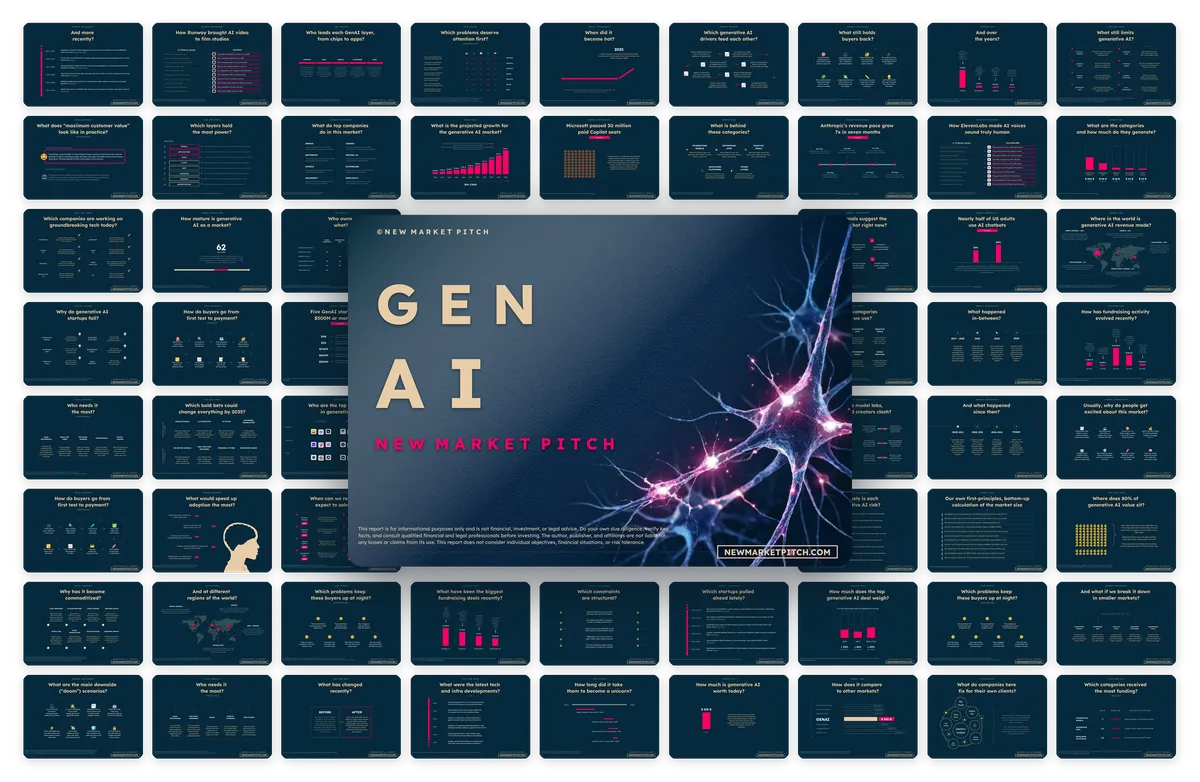
Building a startup or looking for your next investment in generative AI? Our report gives you the full picture.
Summary
OpenAI and Anthropic are the most valuable Generative AI startups today by a huge margin, with current valuation references approaching or exceeding $1 trillion, while xAI sits a distant third at $250 billion.
The headline numbers need one important distinction. Anthropic's $965 billion valuation comes from a completed financing, while OpenAI's $1.2 trillion-plus figure reflects current fundraising discussions; OpenAI's strongest completed transaction anchor remains $852 billion.
The market is extremely concentrated. OpenAI, Anthropic and xAI together represent roughly $2.4 trillion to $2.75 trillion of value in our dataset, versus only around $205 billion to $254 billion for companies ranked fourth through tenth.
What has changed most is the application layer. Cursor at $60 billion and Cognition at $48 billion show that an AI company no longer needs to train a frontier model to reach a valuation normally associated with major public software businesses. Reaching this scale without training a frontier model is the kind of choice we study when asking what leaders do differently in our report on generative AI.
AI coding is currently the standout application category. It combines expensive labor, fully digital workflows and output that can often be tested automatically, giving vendors a much clearer economic case than generic writing or image-generation tools.
The same pattern appears in legal AI, customer-service agents and voice. Harvey, Sierra and ElevenLabs have all reached double-digit-billion valuations by attaching AI to work where the customer can directly compare software spending with professional or labor costs.
Infrastructure is another major winner. Fireworks AI and Together AI are worth billions even as models become cheaper because lower inference prices are encouraging far more AI usage, customization and model switching rather than eliminating the need for infrastructure.
Some of the first stars of the Generative AI boom have moved the other way. Jasper, Stability AI and Character.AI now sit far below newer companies built around coding, agents, professional workflows and infrastructure.
Europe has produced several substantial Generative AI businesses, including Mistral AI, ElevenLabs, Legora and Synthesia. The real gap with the United States is concentrated at the frontier-model level, where no European company is remotely close to OpenAI or Anthropic in financial scale.
The quality of valuation evidence varies sharply across the ranking. Recent financings and acquisitions give companies such as Anthropic, Cognition, Harvey, Fireworks AI and ElevenLabs relatively firm anchors, while some other values depend on active fundraising, revenue multiples or broader market estimates.
The broader shift is pretty clear: investors are putting the highest application valuations on companies that automate expensive work or become infrastructure for other AI businesses. Basic generation on its own is no longer enough to command the biggest premiums.

Written by the New Market Pitch teamWe track new markets so founders and investors can move faster. About us

In our report covering the generative AI market, we turn what is vague and complex into simple, useful visuals. Market maps like this one show you at a glance where every startup stands.
Top startups in the Generative AI market ranked by valuation
Here is an updated table that ranks the top startups in the Generative AI market based on their latest reported or estimated valuations.
If you need to dig deeper and get more detailed data, please check our report covering the Generative AI market.
| # | Startup Name | What They Do | Current Valuation ($) | Valuation Confidence Level | Valuation Type | Evidence Status | Total Funding ($) | Funding Confidence Level |
|---|---|---|---|---|---|---|---|---|
| 1 | OpenAI | Frontier AI models and applications | $1.2T–$1.3T | Partial Confidence | Active Raise Valuation | Estimated | $197.4B | Full Confidence |
| 2 | Anthropic | Enterprise and consumer frontier AI | $965.0B–$1.2T | Strong Confidence | Announced Private Round Valuation | Estimated | $161.5B | Full Confidence |
| 3 | xAI | Grok models and AI infrastructure | $250.0B | Full Confidence | Acquisition Value | Observed | $49.9B | Full Confidence |
| 4 | Anysphere | AI coding editor and agents | $60.0B | Full Confidence | Acquisition Value | Observed | $3.4B | Full Confidence |
| 5 | Cognition | Autonomous AI software engineering agents | $48.0B | Full Confidence | Announced Private Round Valuation | Observed | $3.9B–$4.7B | Partial Confidence |
| 6 | Reflection AI | Open frontier intelligence models | $27.5B–$45.0B | Partial Confidence | Announced Private Round Valuation | Estimated | $4.6B | Full Confidence |
| 7 | Perplexity | AI search and research engine | $30.0B–$35.0B | Partial Confidence | Active Raise Valuation | Estimated | ~$2.3B | Strong Confidence |
| 8 | Mistral AI | Open-weight enterprise foundation models | $24.0B | Full Confidence | Announced Private Round Valuation | Implied | $7.5B | Full Confidence |
| 9 | Cohere | Secure enterprise and sovereign AI | $18.0B–$20.0B | Partial Confidence | Active Raise Valuation | Estimated | $1.5B | Full Confidence |
| 10 | Fireworks AI | AI inference and model infrastructure | $17.5B | Full Confidence | Announced Private Round Valuation | Observed | $1.8B | Full Confidence |
| 11 | Sierra | Enterprise customer-service AI agents | $15.8B | Full Confidence | Announced Private Round Valuation | Observed | ~$1.6B | Strong Confidence |
| 12 | Harvey | AI platform for legal work | $15.5B | Full Confidence | Announced Private Round Valuation | Observed | >$1.6B | Partial Confidence |
| 13 | Hugging Face | Open-source AI model platform | $12.9B | Full Confidence | Acquisition Value | Observed | $399M | Full Confidence |
| 14 | Poolside | Foundation models for software engineering | $12.5B–$13.0B | Strong Confidence | Announced Private Round Valuation | Estimated | $1.6B | Full Confidence |
| 15 | ElevenLabs | Generative voice and audio AI | $11.0B | Full Confidence | Announced Private Round Valuation | Observed | ≈$843M | Strong Confidence |
| 16 | Glean | Enterprise search and AI agents | $8.0B–$11.0B | Strong Confidence | Revenue or ARR Multiple Estimate | Estimated | ~$765M | Strong Confidence |
| 17 | Together AI | AI cloud and model inference | $8.3B | Full Confidence | Announced Private Round Valuation | Observed | $1.3B | Full Confidence |
| 18 | Abridge | AI clinical documentation platform | $6.2B–$7.2B | Strong Confidence | Revenue or ARR Multiple Estimate | Estimated | ~$758M | Strong Confidence |
| 19 | Legora | Collaborative AI platform for lawyers | $5.6B | Full Confidence | Announced Private Round Valuation | Observed | ~$866M | Strong Confidence |
| 20 | Suno | Text-to-music generation platform | $5.4B | Full Confidence | Announced Private Round Valuation | Observed | ≈$775M | Strong Confidence |
| 21 | Runway | Generative video and world models | $5.3B | Full Confidence | Announced Private Round Valuation | Observed | $860M | Full Confidence |
| 22 | Decagon | AI agents for customer support | $4.5B | Full Confidence | Announced Private Round Valuation | Observed | ~$481M | Strong Confidence |
| 23 | Grammarly | AI writing and productivity platform | $3.0B–$5.0B | Partial Confidence | Revenue or ARR Multiple Estimate | Estimated | ~$1.4B | Strong Confidence |
| 24 | Synthesia | Enterprise AI avatar video platform | $4.0B | Full Confidence | Announced Private Round Valuation | Observed | $537M | Full Confidence |
| 25 | Luma AI | Generative video and world models | $3.5B–$4.5B | Strong Confidence | Announced Private Round Valuation | Estimated | ≈$1.1B | Strong Confidence |
| 26 | HeyGen | AI avatar video generation | $3.0B–$4.5B | Partial Confidence | Revenue or ARR Multiple Estimate | Estimated | ≈$75M | Strong Confidence |
| 27 | Hippocratic AI | Safety-focused healthcare AI agents | $3.5B | Full Confidence | Announced Private Round Valuation | Observed | ~$404M | Strong Confidence |
| 28 | Magic | Long-context AI coding models | $2.9B–$3.8B | Partial Confidence | Comparables-Based Estimate | Estimated | $1.0B | Full Confidence |
| 29 | Parloa | AI agents for customer service | $3.0B | Full Confidence | Announced Private Round Valuation | Observed | $562M | Full Confidence |
| 30 | Moveworks | Enterprise AI employee support | $2.9B | Full Confidence | Acquisition Value | Observed | ~$315M | Strong Confidence |
| 31 | Sakana AI | Japan-focused nature-inspired AI models | $2.7B–$3.0B | Strong Confidence | Announced Private Round Valuation | Estimated | $412M | Full Confidence |
| 32 | Genspark | Agentic AI workplace platform | $2.6B | Full Confidence | Announced Private Round Valuation | Observed | >$645M | Partial Confidence |
| 33 | DeepL | AI translation and language tools | $2.0B–$3.0B | Partial Confidence | Comparables-Based Estimate | Estimated | ~$401M | Strong Confidence |
| 34 | Uniphore | Enterprise AI and agent platform | $2.5B | Full Confidence | Announced Private Round Valuation | Observed | $869M | Full Confidence |
| 35 | Aleph Alpha | Sovereign enterprise foundation models | $1.5B–$3.0B | Low Confidence | Proxy-Based Estimate | Estimated | $637M | Full Confidence |
| 36 | EvenUp | AI software for personal-injury law | $2.0B–$2.5B | Strong Confidence | Comparables-Based Estimate | Estimated | ~$385M | Strong Confidence |
| 37 | Gamma | AI presentations and visual content | $2.1B | Full Confidence | Announced Private Round Valuation | Observed | ~$90M | Strong Confidence |
| 38 | Writer | Enterprise generative AI platform | $1.7B–$2.2B | Partial Confidence | Comparables-Based Estimate | Estimated | $326M | Full Confidence |
| 39 | You.com | Search infrastructure for AI agents | $1.5B–$1.8B | Strong Confidence | Comparables-Based Estimate | Estimated | ~$195M | Strong Confidence |
| 40 | Reka AI | Efficient multimodal foundation models | $1.2B–$1.4B | Strong Confidence | Announced Private Round Valuation | Estimated | $170M | Full Confidence |
| 41 | Ambience Healthcare | AI clinical documentation automation | $1.2B–$1.4B | Strong Confidence | Announced Private Round Valuation | Estimated | ~$319M | Strong Confidence |
| 42 | LangChain | Framework for building AI applications | $1.3B | Full Confidence | Announced Private Round Valuation | Observed | ~$160M | Strong Confidence |
| 43 | AI21 Labs | Enterprise language models and agents | $0.9B–$1.4B | Partial Confidence | Proxy-Based Estimate | Estimated | $336M | Full Confidence |
| 44 | Sana | AI workplace knowledge and learning | $1.1B | Full Confidence | Acquisition Value | Observed | $138M | Full Confidence |
| 45 | Character.AI | Consumer AI character chatbots | $0.9B–$1.1B | Strong Confidence | Revenue or ARR Multiple Estimate | Estimated | $190M | Full Confidence |
| 46 | Cognigy | Enterprise conversational AI agents | $955M | Full Confidence | Acquisition Value | Observed | $175M | Full Confidence |
| 47 | Hebbia | AI document analysis for finance | $800M–$1.1B | Partial Confidence | Revenue or ARR Multiple Estimate | Estimated | ~$161M | Strong Confidence |
| 48 | Cresta | AI platform for contact centers | $850M–$1.0B | Partial Confidence | Comparables-Based Estimate | Estimated | >$270M | Partial Confidence |
| 49 | Arize AI | AI model observability platform | $900M–$930M | Strong Confidence | Acquisition Value | Observed | ~$131M | Strong Confidence |
| 50 | Inflection AI | Enterprise conversational AI systems | $600M–$1.2B | Low Confidence | Proxy-Based Estimate | Estimated | $1.5B | Full Confidence |
| 51 | Ada | Automated AI customer support agents | $800M–$1.0B | Partial Confidence | Proxy-Based Estimate | Estimated | ~$200M | Strong Confidence |
| 52 | Jasper | AI content marketing platform | $700M–$1.1B | Low Confidence | Comparables-Based Estimate | Estimated | $125M | Full Confidence |
| 53 | Heidi Health | AI care partner for clinicians | $900M | Full Confidence | Announced Private Round Valuation | Observed | ~$437M | Strong Confidence |
| 54 | Luminance | AI contract and legal automation | $700M–$1.0B | Partial Confidence | Revenue or ARR Multiple Estimate | Estimated | ~$165M | Strong Confidence |
| 55 | PolyAI | Enterprise conversational voice AI agents | $750M–$850M | Strong Confidence | Announced Private Round Valuation | Implied | ~$204M | Strong Confidence |
| 56 | Eudia | AI platform for corporate legal teams | $600M–$900M | Partial Confidence | Implied Valuation from Raise | Implied | Up to $105M | Partial Confidence |
| 57 | Kore.ai | Enterprise conversational AI platform | $650M–$850M | Partial Confidence | Comparables-Based Estimate | Estimated | ~$248M | Strong Confidence |
| 58 | Captions (Mirage) | AI video creation and editing | $600M–$900M | Partial Confidence | Comparables-Based Estimate | Estimated | ≈$175M | Strong Confidence |
| 59 | Photoroom | AI product-image creation tools | $550M–$800M | Partial Confidence | Comparables-Based Estimate | Estimated | ≈$64M | Strong Confidence |
| 60 | Nabla | Ambient AI clinical assistant | $550M–$800M | Partial Confidence | Implied Valuation from Raise | Implied | $120M | Full Confidence |
| 61 | Spellbook | AI contract drafting and review | $500M–$700M | Partial Confidence | Revenue or ARR Multiple Estimate | Estimated | ~$122M | Strong Confidence |
| 62 | Typeface | Enterprise generative content platform | $500M–$650M | Partial Confidence | Proxy-Based Estimate | Estimated | ~$205M | Strong Confidence |
| 63 | Corti | AI assistant for healthcare workflows | $450M–$700M | Partial Confidence | Comparables-Based Estimate | Estimated | ~$89M | Strong Confidence |
| 64 | Yellow.ai | Enterprise customer-service AI agents | $500M–$600M | Strong Confidence | IPO or Listing Range Valuation | Implied | ~$103M | Strong Confidence |
| 65 | Krea | Multimodal AI creative workspace | $450M–$650M | Partial Confidence | Announced Private Round Valuation | Estimated | $83M | Full Confidence |
| 66 | Ideogram | AI image and text generation | $450M–$650M | Low Confidence | Implied Valuation from Raise | Implied | $97M | Full Confidence |
| 67 | Stability AI | Generative image, audio and video | $450M–$550M | Strong Confidence | Implied Valuation from Raise | Implied | $307M | Full Confidence |
| 68 | Maven AGI | Enterprise customer-service AI agents | $400M–$600M | Partial Confidence | Implied Valuation from Raise | Implied | $78M | Full Confidence |
| 69 | Pika | AI video generation and editing | $400M–$550M | Partial Confidence | Comparables-Based Estimate | Estimated | $135M | Full Confidence |
| 70 | Regard | AI clinical insights platform | $400M–$550M | Partial Confidence | Comparables-Based Estimate | Estimated | $81.9M | Full Confidence |
| 71 | Adept AI | AI agents for software workflows | $300M–$600M | Low Confidence | Proxy-Based Estimate | Estimated | $415M | Full Confidence |
| 72 | Observe.AI | AI contact-center intelligence platform | $400M–$500M | Partial Confidence | Proxy-Based Estimate | Estimated | $214M | Full Confidence |
| 73 | Aisera | Enterprise service-management AI agents | $350M–$550M | Low Confidence | Acquisition Value | Estimated | $150M | Full Confidence |
| 74 | Inworld AI | Generative AI for interactive characters | $350M–$550M | Partial Confidence | Comparables-Based Estimate | Estimated | ≈$153M | Strong Confidence |
| 75 | Descript | AI audio and video editor | $350M–$550M | Partial Confidence | Comparables-Based Estimate | Estimated | ≈$100M | Strong Confidence |
| 76 | Suki | AI voice assistant for clinicians | $430M–$460M | Strong Confidence | Announced Private Round Valuation | Estimated | ~$220M | Strong Confidence |
| 77 | Udio | AI music generation platform | $300M–$500M | Low Confidence | Comparables-Based Estimate | Estimated | $10M | Full Confidence |
| 78 | Galileo | Generative AI observability platform | $300M–$500M | Low Confidence | Acquisition Value | Estimated | $68.1M | Full Confidence |
| 79 | Dust | Enterprise collaborative AI agents | $330M–$450M | Strong Confidence | Implied Valuation from Raise | Implied | ~$62M | Strong Confidence |
| 80 | Bria | Licensed enterprise visual generative AI | $300M–$450M | Partial Confidence | Implied Valuation from Raise | Implied | ≈$68M | Strong Confidence |
| 81 | CodaMetrix | Autonomous medical coding software | $250M–$350M | Partial Confidence | Comparables-Based Estimate | Estimated | $110.7M | Full Confidence |
| 82 | Codeium / Windsurf | AI coding editor and agents | $250M–$300M | Low Confidence | Acquisition Value | Estimated | ~$243M | Strong Confidence |
| 83 | Tavus | Conversational AI video humans | $250M–$300M | Strong Confidence | Announced Private Round Valuation | Estimated | ≈$64M | Strong Confidence |
| 84 | ASAPP | AI automation for contact centers | $230M–$300M | Partial Confidence | Proxy-Based Estimate | Estimated | $399M | Full Confidence |
| 85 | Hume AI | Emotionally intelligent voice AI | $150M–$300M | Low Confidence | Proxy-Based Estimate | Estimated | ≈$74M | Strong Confidence |
| 86 | Hedra | AI character video generation | $180M–$240M | Partial Confidence | Announced Private Round Valuation | Estimated | ≈$44M | Strong Confidence |
| 87 | Lakera | AI security and guardrails | $202M | Full Confidence | Acquisition Value | Observed | ~$30M | Strong Confidence |
| 88 | Robin AI | AI contract and legal assistant | $150M–$250M | Low Confidence | Revenue or ARR Multiple Estimate | Estimated | ~$94M | Strong Confidence |
| 89 | DeepScribe | AI medical documentation assistant | $140M–$190M | Partial Confidence | Comparables-Based Estimate | Estimated | $59.2M | Full Confidence |
| 90 | Speechify | AI text-to-speech and voice tools | $120M–$180M | Partial Confidence | Revenue or ARR Multiple Estimate | Estimated | ≈$10M | Strong Confidence |
| 91 | LlamaIndex | Data framework for LLM apps | $110M–$160M | Partial Confidence | Comparables-Based Estimate | Estimated | $27.5M | Full Confidence |
| 92 | Forethought | AI customer-support automation | $110M–$160M | Low Confidence | Proxy-Based Estimate | Estimated | ~$115M | Strong Confidence |
| 93 | Colossyan | AI training video creation | $90M–$150M | Low Confidence | Comparables-Based Estimate | Estimated | ≈$28M | Strong Confidence |
| 94 | Haptik | Enterprise conversational AI platform | $90M–$120M | Low Confidence | Acquisition Value | Estimated | ~$12.2M | Strong Confidence |
| 95 | Anyword | AI marketing copy optimization | $70M–$120M | Low Confidence | Comparables-Based Estimate | Estimated | $30M | Full Confidence |
| 96 | Copy.ai | AI sales and marketing workflows | $50M–$90M | Low Confidence | Acquisition Value | Estimated | ~$20M | Strong Confidence |
| 97 | Tabnine | Enterprise AI coding assistant | $30M–$70M | Low Confidence | Acquisition Value | Estimated | ~$63M | Strong Confidence |
| 98 | Playground AI | Consumer AI image creation | $30M–$60M | Low Confidence | Proxy-Based Estimate | Estimated | Undisclosed | Low Confidence |
| 99 | Scenario | AI assets for creative teams | $20M–$40M | Low Confidence | Proxy-Based Estimate | Estimated | $6M | Full Confidence |
| 100 | Tome | AI presentation creation software | $0M–$10M | Low Confidence | Proxy-Based Estimate | Estimated | $108M | Full Confidence |
OpenAI and Anthropic are by far the most valuable Generative AI startups today, followed at a huge distance by xAI.
Our dataset puts OpenAI at $1.2T–$1.3T based on its current fundraising discussions, Anthropic at $965B–$1.2T and xAI at $250B. After those three, the ranking drops abruptly to Anysphere, the company behind Cursor, at $60B and Cognition at $48B.
That gap is large enough to split Generative AI into several valuation tiers. OpenAI and Anthropic are approaching the scale of the world's largest public technology companies. xAI sits in its own middle tier. Then come AI coding companies, frontier-model challengers such as Mistral and Reflection AI, and fast-growing application or infrastructure businesses such as Fireworks AI, Sierra, Harvey and ElevenLabs.
The lower half of the top 20 is already highly diverse. It contains AI search, inference infrastructure, legal software, voice AI, enterprise search, clinical documentation and music generation. Generative AI has produced valuable companies across a lot of markets, even though most of the industry's value is still concentrated at the very top.
| Rank | Startup | Current valuation | Main business |
|---|---|---|---|
| 1 | OpenAI | $1.2T–$1.3T | Frontier models and AI products |
| 2 | Anthropic | $965B–$1.2T | Frontier models and enterprise AI |
| 3 | xAI | $250B | Models and AI infrastructure |
| 4 | Anysphere / Cursor | $60B | AI coding |
| 5 | Cognition | $48B | AI software-engineering agents |
| 6 | Reflection AI | $27.5B–$45B | Frontier AI models |
| 7 | Perplexity | $30B–$35B | AI search and agents |
| 8 | Mistral AI | $24B | Foundation models |
| 9 | Cohere | $18B–$20B | Enterprise foundation models |
| 10 | Fireworks AI | $17.5B | AI inference infrastructure |

Our research about generative AI gets updated several times a month, so you always get the latest view of where things stand.
Is OpenAI really worth more than $1 trillion now?
OpenAI can currently be described as a trillion-dollar Generative AI company only if we use the valuation being discussed for its next financing rather than its last completed round.
Bloomberg reported that OpenAI completed a $122B financing at an $852B valuation earlier this year. More recently, the company entered early discussions around another financing at more than $1.2T. That prospective figure is the best indication of where investors may price OpenAI now, but the transaction has not closed.
The difference is substantial. Moving from $852B to $1.2T would add roughly $348B of value, or about 41%, in less than a year.
OpenAI also has enough revenue scale to make the conversation less absurd than the headline initially sounds. The Financial Times recently reported that OpenAI's annualized revenue had moved above $40B. At $1.2T, that would still imply a valuation of roughly 30 times annualized revenue, an extremely rich multiple for a company with enormous infrastructure spending.
The financial risk is just as unusual as the growth. OpenAI's expansion requires huge commitments to chips, data centers and model development. Investors are betting that revenue can keep growing fast enough for today's massive compute bill to become much smaller relative to the future business.
So $1.2T is best treated as OpenAI's current fundraising value, while $852B remains the strongest completed transaction anchor.
Is Anthropic actually catching OpenAI?
Anthropic has caught OpenAI in private-market valuation much faster than most people expected.
Anthropic's latest completed financing is unusually easy to verify for a private AI company: it announced a $65B Series H at a $965B post-money valuation. Anthropic also said its run-rate revenue had crossed $47B.
That puts Anthropic above OpenAI's last completed $852B valuation, although OpenAI's newer fundraising discussions point to a value above $1.2T. Depending on which OpenAI reference we use, Anthropic is either slightly ahead or roughly 20% behind.
The commercial gap has narrowed too. Claude has become deeply embedded in professional workflows, and Claude Code has helped Anthropic capture unusually valuable software-development usage. Enterprise customers also appear to account for a much larger part of Anthropic's business than they did during the early ChatGPT-versus-Claude period.
OpenAI still has broader consumer distribution through ChatGPT and operates across consumer subscriptions, enterprise products, APIs and coding tools. Anthropic's position is more concentrated around professional and enterprise use.
Still, a $965B completed valuation makes Anthropic far more than a distant challenger. In valuation terms, Generative AI currently has two companies operating near the trillion-dollar line.

In our market report about generative AI, we look at what the winners do differently, so you can learn from the best instead of guessing.
How big is the gap between OpenAI, Anthropic and every other Generative AI startup?
The Generative AI valuation gap is enormous: OpenAI, Anthropic and xAI together are worth roughly ten times the next seven companies combined.
Using the lower end of our valuation ranges, OpenAI, Anthropic and xAI together represent about $2.4T. Using the upper end, they approach $2.75T.
Companies ranked fourth through tenth add up to roughly $205B–$254B. Even that group includes Cursor at $60B, Cognition at $48B, Perplexity at more than $30B, Mistral at $24B and Fireworks at $17.5B. Where the next tier of generative AI companies sits relative to the giants is shown on the market grids in our generative AI market report.
Another way to see the gap is to compare entire application markets with one frontier lab. Harvey and Legora together are worth around $21B in legal AI. Runway, Synthesia and Luma AI together are worth roughly $13B–$14B in generative video. Sierra, Decagon and Parloa total about $23B across customer-service AI.
Each of those clusters represents only a small fraction of Anthropic's $965B valuation.
Investors are placing a much larger financial value on companies that could own a general-purpose intelligence platform than on companies dominating one specific workflow.
How many Generative AI unicorns are there?
Our dataset contains roughly 45 Generative AI companies that clearly exceed $1B or have a credible current valuation range extending above $1B.
The exact number changes depending on how strictly we apply the unicorn definition. Character.AI sits around $900M–$1.1B, AI21 Labs around $900M–$1.4B and Hebbia around $800M–$1.1B. Counting every company whose range crosses $1B produces a higher total than requiring the whole range to remain above it.
The more useful finding is how crowded the higher levels have become. Around 15 companies in our ranking are worth roughly $10B or more. Five reach at least $48B. Those valuation levels used to be extraordinary outcomes for mature private technology companies.
A $1B valuation therefore tells us much less about market leadership in Generative AI today. The companies really separating from the field are increasingly those breaking through $5B, $10B and, in a handful of cases, $50B.
Are foundation-model startups still worth more than Generative AI applications?
Foundation-model startups still dominate Generative AI valuations overall, but the strongest AI applications have now become tens-of-billions-of-dollars companies.
OpenAI, Anthropic, xAI, Mistral, Reflection AI and Cohere collectively represent an enormous share of the value in our ranking. Their advantage comes from selling intelligence across many different applications instead of depending on one workflow.
Application companies are getting much larger, though. Cursor reached a $60B acquisition value. Cognition is worth $48B. Harvey reached $15.5B in legal AI, Sierra $15.8B in customer-service agents and ElevenLabs $11B in voice AI.
Those companies also weaken the old idea that application startups are inevitably thin wrappers around somebody else's model. The leaders increasingly own workflow, customer relationships, distribution, proprietary context or specialized technology around the underlying model.
Gamma provides a smaller but useful example. The presentation and content platform announced that it had crossed $100M in ARR while remaining profitable, then raised at a $2.1B valuation. That's a fairly conventional software business with AI built deeply into the product rather than a company trying to finance frontier-model research.
Frontier models still capture the biggest valuations, but applications have clearly shown that they can create durable multi-billion-dollar companies.

In our document detailing everything you need to know about generative AI, you will always find fresh funding data, taken straight from our own verified funding database.
Has AI coding become the most valuable Generative AI application?
AI coding is currently the most valuable pure application category in Generative AI.
Cursor's $60B acquisition value and Cognition's $48B valuation put both companies ahead of every other application-focused startup in our dataset. Coding is one of the problems buyers pay to solve, and we map which others they pay for in our market report about generative AI.
Cognition's recent numbers help explain the enthusiasm. The company said annualized run-rate revenue grew from $492M to nearly $900M in about four months. Its valuation moved from $26B to $48B over roughly the same period. Revenue rose around 83%, while valuation increased about 85%.
Cursor provides even stronger external validation because its $60B value came through a completed acquisition rather than another venture financing. Bloomberg reported that SpaceX completed the deal after an earlier agreement giving it the right to acquire the company.
Coding is unusually well suited to AI. Software engineers are expensive, almost all of their work is already digital, generated code can often be tested automatically, and even modest productivity improvements can justify expensive subscriptions.
Legal AI and customer-service agents are producing large companies too, but neither category has yet created two businesses approaching $50B.
| Generative AI application | Leading company | Current valuation |
|---|---|---|
| AI coding | Cursor / Anysphere | $60B |
| Software-engineering agents | Cognition | $48B |
| Customer-service agents | Sierra | $15.8B |
| Legal AI | Harvey | $15.5B |
| Voice AI | ElevenLabs | $11B |
| Enterprise search | Glean | $8B–$11B |
| Legal AI | Legora | $5.6B |
| AI music | Suno | $5.4B |
| Generative video | Runway | $5.3B |
| AI avatar video | Synthesia | $4B |
Are AI agents becoming more valuable than basic Generative AI tools?
AI agents are attracting much higher valuations than many of the writing, image and chatbot startups that dominated the first Generative AI boom.
Cognition is worth $48B, Sierra $15.8B, Harvey $15.5B, Decagon $4.5B and Parloa $3B. These companies sell systems that complete parts of a workflow rather than stopping after generating text.
The contrast with several early Generative AI names is sharp. Jasper is estimated around $700M–$1.1B. Stability AI sits around $450M–$550M. Character.AI is around $900M–$1.1B. Those companies were once some of the most visible names in the sector.
The economics explain a lot of the change. A writing tool has to justify a software subscription. An AI customer-service agent can be compared with the cost of thousands of human support interactions. Coding agents compete with expensive engineering labor. Legal AI can save hours billed at hundreds of dollars each.
Investors are now paying the largest application valuations for AI tied directly to expensive work.

Learning from others' mistakes is the cheapest lesson there is. In our report covering the generative AI market, we look at what broke startups before you, so you don't repeat it.
Why is legal AI suddenly worth so much?
Legal AI has become one of the richest Generative AI verticals because law firms are paying for products that save expensive professional time.
Harvey recently raised $550M at a $15.5B valuation, only months after reaching $11B and less than a year after being valued around $8B. The company says 80% of the Am Law 100 now uses Harvey.
Legora has followed a similar path at smaller scale. Its latest financing valued the company at $5.6B after it crossed $100M in ARR. That valuation is more than three times the roughly $1.8B figure attached to its previous major round.
The customer economics are unusually attractive for AI. Large law firms bill substantial amounts for research, drafting, document review, due diligence and other text-heavy work. If software removes even a few hours from a matter, a high annual subscription can be easy to justify.
Legal work also gives specialist platforms room to differentiate. Firms need document permissions, matter-specific context, auditability, integrations and tools designed around legal workflows. A generic chatbot can perform some legal tasks, but deploying AI across an entire firm requires much more than a good answer in a chat window.
Harvey and Legora now have more than $20B of combined value. Legal AI has turned into one of the clearest examples of a vertical market producing genuinely large Generative AI companies.
How big has healthcare AI become?
Healthcare AI has already produced several billion-dollar startups, although its leaders are still much smaller than the biggest legal or coding companies.
Abridge sits around $6.2B–$7.2B in our dataset. Hippocratic AI has a confirmed $3.5B valuation after raising $126M in its latest round. Ambience Healthcare is estimated around $1.2B–$1.4B.
There is also a substantial group below $1B: Heidi Health around $900M, Nabla at roughly $550M–$800M, Corti around $450M–$700M, Regard around $400M–$550M and Suki around $430M–$460M.
The largest cluster is developing around clinical documentation and workflow automation. Abridge, Ambience, Nabla and Heidi all reduce the time clinicians spend writing notes or interacting with health-record systems. Hippocratic AI has taken a different route with patient-facing healthcare agents and said it was working with more than 50 large health systems, payers and pharmaceutical companies around the time of its $3.5B financing.
Healthcare has plenty of economic value to capture, but deployments are harder than in ordinary software. Hospitals deal with sensitive data, complex integrations, procurement processes and high consequences when systems fail.
That friction helps explain why healthcare has created many valuable AI companies without yet producing a $10B-plus application leader.

In our research about generative AI, we always try to gather several sources and make estimates that make sense, so you can work with solid numbers.
Which creative AI startups are worth the most now?
ElevenLabs, Suno and Runway currently lead the creative Generative AI market, while video has produced the deepest group of multi-billion-dollar companies.
ElevenLabs is worth $11B. The company closed the previous year with more than $330M in ARR and has expanded from synthetic voice into enterprise conversational agents.
Suno raised more than $400M at a $5.4B post-money valuation. Fortune later reported that the music-generation company had reached roughly 2 million paying subscribers and $300M in ARR.
Runway reached $5.3B after raising $315M. Synthesia is at $4B after a $200M Series E, and Luma AI sits around $3.5B–$4.5B in our dataset. HeyGen occupies a similar $3B–$4.5B range.
Image generation looks less valuable today. Stability AI is around $450M–$550M, while Krea and Ideogram are each roughly in the $450M–$650M zone.
The creative market has moved well beyond basic image generation. Voice, music and especially video are supporting much larger businesses, partly because they can be sold into professional workflows as well as consumer creation. Selling into professional workflows, not only to consumers, is the kind of growth driver we weigh in our generative AI market report.
Why is ElevenLabs worth $11 billion?
ElevenLabs reached an $11B valuation because it has turned voice generation into a large enterprise business rather than relying mainly on novelty text-to-speech usage.
The company raised $500M at $11B after finishing the previous year with more than $330M in ARR. Its valuation had more than tripled in one year.
ElevenLabs has also widened the product considerably. Its ElevenAgents platform lets companies deploy voice and chat agents for customer service, sales and internal workflows. Deutsche Telekom, Square and Revolut were among the enterprise customers the company highlighted around the financing.
That expands the addressable market quite a bit. A voice-generation tool competes for media and creator spending. A voice agent can compete with part of a call center, sales operation or customer-service budget.
PolyAI, valued around $750M–$850M, provides another indication that businesses are willing to fund voice-agent specialists. Hume AI and Speechify sit lower, at approximately $150M–$300M and $120M–$180M respectively.
ElevenLabs has separated from that group because its revenue scale is already much larger and its product now spans both generative audio and conversational automation.
Why are AI infrastructure startups worth billions if AI models keep getting cheaper?
AI infrastructure startups are worth billions because cheaper models are driving much more AI usage, and somebody still has to run, customize and serve those models efficiently.
Fireworks AI is the clearest example. The company raised $1.505B at a $17.5B valuation after surpassing $1B in annualized revenue run rate. It also said its infrastructure was processing more than 40 trillion tokens per day.
Together AI reached $8.3B after raising $800M. Reuters reported that its annual bookings had crossed $1.15B, with customers including Cursor, Cognition and Decagon. Inference infrastructure is a layer where we separate what already works at scale from what is still being tested in our generative AI market report.
Those numbers show how rapidly the open-model infrastructure market has grown. Companies increasingly use several models, customize them on proprietary data and move workloads depending on price or performance. Specialized infrastructure providers make that easier.
Falling inference prices can actually help these businesses when lower costs trigger much more usage. Cloud computing followed a similar pattern: cheaper compute increased the number of workloads companies were willing to run.
The long-term risk is strong competition from hyperscalers. AWS, Microsoft and Google can bundle compute, models and enterprise relationships. Fireworks and Together AI still have to prove that specialization is worth paying for.
For now, annualized revenue or bookings above $1B make both companies much more substantial than infrastructure startups built only around investor expectations.

If you build or invest in the generative AI market, you need to know which business models pay off now and which ones are fading. That's why our report covering it has a whole section on it.
Is Europe actually producing big Generative AI startups?
Europe is producing several major Generative AI companies, although it still has nothing close to OpenAI or Anthropic in valuation.
Mistral AI is the obvious leader. The French company recently raised €3B at a valuation of roughly €21B, or about $24B. Reuters reported that Mistral's annual recurring revenue was around $1B.
ElevenLabs follows at $11B. Legora is worth $5.6B, Synthesia $4B and DeepL around $2B–$3B in our dataset. Photoroom, Nabla and Dust add another group of European companies worth hundreds of millions of dollars.
Europe is also producing leaders in several different parts of the stack. Mistral competes in foundation models, ElevenLabs in voice, Legora in legal AI, Synthesia in enterprise video and DeepL in language tools.
The remaining gap is concentrated at the very top. Mistral's $24B valuation is only about 2.5% of Anthropic's $965B completed valuation.
Europe has proved that it can build global Generative AI companies. It has not yet produced a frontier lab with anything close to the financial scale of the two American leaders.
Which Generative AI startups have increased their valuations the fastest?
Cognition, Fireworks AI, ElevenLabs, Sierra, Legora and Decagon are among the clearest examples of Generative AI startups whose valuations have jumped several times over in a short period.
Cognition moved from $10B in an earlier financing to $26B and then $48B. More importantly, its revenue moved quickly at the same time: annualized run-rate revenue climbed from $492M to nearly $900M between its two latest rounds.
Fireworks AI went from roughly $4B to $17.5B as annualized revenue passed $1B. ElevenLabs more than tripled its valuation to $11B. Decagon said its $4.5B financing tripled its valuation in less than six months.
Sierra reached $15.8B after a $950M financing, around 60% above its previous $10B valuation. Harvey went from roughly $8B to $11B and then $15.5B in less than a year.
Legora has moved even faster from a smaller base. Its valuation rose from about $1.8B to $5.6B while ARR crossed $100M.
The common thread is unusually fast commercial growth in categories where customers can connect AI spending directly to labor or infrastructure costs.
| Startup | Earlier valuation | Current valuation | Approximate change |
|---|---|---|---|
| Cognition | $10B | $48B | 4.8× |
| Fireworks AI | ~$4B | $17.5B | ~4.4× |
| Sierra | $4.5B | $15.8B | ~3.5× |
| ElevenLabs | ~$3.3B | $11B | ~3.3× |
| Legora | ~$1.8B | $5.6B | ~3.1× |
| Decagon | $1.5B | $4.5B | 3.0× |
| Harvey | ~$8B | $15.5B | ~1.9× |
| Synthesia | $2.1B | $4B | ~1.9× |
Are Generative AI valuations rising faster than the actual businesses?
Some Generative AI valuations are extremely aggressive, but several of the biggest recent increases have come with revenue growth that is just as unusual.
Cognition is the cleanest example. Its annualized run-rate revenue increased from $492M to nearly $900M while its valuation rose from $26B to $48B. Both figures increased by roughly 80%.
Fireworks announced more than $1B in annualized revenue at the time of its $17.5B financing. That puts its valuation at roughly 17.5 times run-rate revenue. A multiple like this reads differently next to the market's size, which we estimate ourselves from the ground up in our report covering the generative AI market.
Mistral's latest $24B valuation came alongside annual recurring revenue of roughly $1B, giving a multiple in the mid-20s. Gamma looks somewhat less expensive by comparison: $2.1B against more than $100M in ARR, or about 21 times revenue, with the additional distinction that Gamma said it was already profitable.
The biggest multiples still require aggressive assumptions about future growth. Cognition at $48B against nearly $900M of run-rate revenue is worth more than 50 times that figure. Some agent startups with lower disclosed revenue appear richer still.
Those multiples would look extreme for mature public software businesses. Investors are accepting them because the fastest AI companies are adding revenue at rates mature software companies rarely achieve.
The real test over the next few years is whether those growth rates remain extraordinary after the easiest early adopters have already bought the products.

In our document detailing everything you need to know about generative AI, we don't want to repeat what boring consulting reports say. Instead, we show you the real and latest market signals that matter.
Do Generative AI acquisitions prove these startup valuations are real?
Completed acquisitions give us some of the strongest valuation evidence in Generative AI because a buyer actually agreed to pay the stated price.
Cursor is the biggest example in our dataset. Bloomberg reported that SpaceX completed its $60B acquisition of the AI coding company after an earlier agreement between the two businesses.
Several other companies in the ranking are also anchored to acquisition values rather than theoretical private-market estimates. Moveworks appears at roughly $2.9B, Sana at $1.1B and Lakera at $202M.
Acquisition prices still need interpretation. A strategic buyer can justify paying more than ordinary financial investors if the target brings scarce talent, technology, customers or products that fit a larger platform.
Cursor is especially useful because its transaction came after AI coding had already produced strong revenue growth across several companies. Cognition's $48B financing gives us a separate market reference in the same category.
A completed sale gives more confidence than a rumor or comparables-based estimate, although it does not mean every similar startup could command the same multiple.
Does raising more money mean a Generative AI startup is worth more?
Generative AI funding and valuation are closely linked among frontier-model labs, but the relationship becomes much weaker among application startups.
OpenAI has raised an extraordinary amount of capital because training models and securing compute requires huge upfront spending. Anthropic's latest round alone was $65B. xAI has followed the same capital-intensive pattern.
Applications can reach large valuations with much smaller amounts of funding. Gamma announced a $2.1B valuation after raising $68M in its Series B and roughly $90M overall. HeyGen is estimated at $3B–$4.5B after raising about $75M. Photoroom sits around $550M–$800M with roughly $64M raised.
The reverse happens too. Inflection AI raised around $1.5B historically but is now estimated at only $600M–$1.2B following major changes to the company. Adept raised more than $400M but sits around $300M–$600M in our dataset.
Funding tells us a lot about how capital-intensive the company's strategy has been, but much less about how valuable the remaining business is today.
For application startups, revenue and customer adoption usually tell us more than cumulative funding alone.
Are early Generative AI stars like Jasper and Stability AI being left behind?
Several of the companies that defined the first Generative AI boom are now worth far less than newer coding, agent and vertical-AI startups.
Jasper is currently estimated around $700M–$1.1B. Stability AI sits around $450M–$550M. Character.AI is around $900M–$1.1B.
Compare those figures with Cognition at $48B, Sierra at $15.8B, Harvey at $15.5B, ElevenLabs at $11B and Decagon at $4.5B. Early leaders that were later overtaken invite the question of what stalled startups had in common, which we study in our market report about generative AI.
The change reflects how quickly basic generation features became available everywhere. Writing assistance is now embedded in ChatGPT, Claude, Gemini, Microsoft products and countless SaaS applications. Image generation has followed a similar path as high-quality models became easier to access.
The companies climbing fastest today are generally attached to a more expensive workflow or a harder technical layer. Coding, legal work, customer support and inference infrastructure all give vendors a clearer path to capturing large budgets.
Early visibility helped create the first generation of AI unicorns. These days, investors appear much more interested in who controls valuable work after the novelty of generation wears off.

In our report covering the generative AI market, we like to show you the big picture. We know your time is precious, so we make every page quick to read and packed with as much learning as possible per minute.
What does the Generative AI valuation ranking tell us about where the market is going?
The Generative AI ranking increasingly points toward three groups: trillion-dollar frontier labs, a small group of $10B–$60B infrastructure and application leaders, and a much wider market of specialized companies below them.
The second group is the biggest change. Cursor at $60B, Cognition at $48B, Fireworks at $17.5B, Sierra at $15.8B, Harvey at $15.5B and ElevenLabs at $11B show that enormous value can now be created without building the most powerful general-purpose model.
Those companies tend to control something concrete. Cursor and Cognition sit inside software development. Harvey owns legal workflows. Sierra automates customer interactions. ElevenLabs has become a major voice platform. Fireworks operates the infrastructure that other AI companies use to run models.
Creative AI has also produced real scale, but its valuations remain lower. Suno, Runway, Synthesia and Luma AI are worth billions rather than tens of billions.
The ranking suggests that the market is becoming less impressed by generation for its own sake. The biggest application valuations now tend to follow products that automate costly work or become infrastructure for other AI businesses.
What is the final verdict on the most valuable Generative AI startups?
Generative AI has already created an extraordinary amount of private-company value, but the market is much more concentrated than a list of 100 startups initially suggests.
OpenAI and Anthropic now occupy a near-trillion-dollar tier, depending on whether we use completed financings or current fundraising discussions. xAI is a distant third at $250B. The rest of the market begins another large step lower, with Cursor at $60B and Cognition at $48B.
The biggest surprise is how quickly the application layer has matured. AI coding has produced two companies around $50B or more. Legal AI has produced Harvey at $15.5B and Legora at $5.6B. Voice AI has ElevenLabs at $11B. Customer-service agents have Sierra at $15.8B and Decagon at $4.5B. AI infrastructure has Fireworks at $17.5B and Together AI at $8.3B.
There is also a clear split between the first Generative AI wave and the current one. Earlier stars built around writing, image generation or consumer chat are generally much lower in the ranking. The companies gaining value fastest now are tied to software engineering, professional work, enterprise automation and infrastructure.
Some valuations remain much firmer than others. Anthropic's $965B, Harvey's $15.5B, Cognition's $48B, Fireworks' $17.5B and ElevenLabs' $11B all come from recent completed financings. OpenAI's $1.2T-plus figure is still an active fundraising discussion. Other companies farther down the ranking depend on revenue multiples, comparable transactions or broader operating evidence.
Even after allowing for that uncertainty, the picture is clear. Frontier-model labs still capture the overwhelming share of Generative AI value, while the best applications have moved well beyond the old "AI wrapper" stage and become major software companies in their own right.
Our methodology
This analysis estimates the most defensible current valuations across the generative AI market using the evidence available today. We focus on companies whose businesses are genuinely centered on Generative AI and exclude broader companies where Generative AI is only a secondary activity.
We reviewed completed funding rounds, company announcements, acquisition announcements, public-market values where relevant, regulatory and corporate filings, investor materials, reported revenue and ARR, operating metrics, comparable transactions and reporting from established financial publications. A recent completed financing normally provides the strongest private-market valuation anchor.
We separate observed, implied and estimated valuations. An observed valuation comes directly from a completed financing, acquisition, public-market value or similarly strong transaction evidence. An implied valuation can be derived when financing information is available but not every transaction term is disclosed. Estimated valuations rely more heavily on revenue multiples, comparable companies and operating evidence.
Recency matters. A valuation disclosed within roughly the previous twelve months can often remain a strong anchor when the company has not changed dramatically. Figures around twelve to twenty-four months old receive more scrutiny, while substantially older valuations are mainly useful as historical references unless newer evidence still supports them.
When updating an older valuation, we look at both the company's own development and changes in valuation conditions among comparable businesses. We do not apply automatic percentage increases or decreases. Where reliable revenue or ARR is available, we can use relevant company or transaction multiples while adjusting for growth, business model, maturity, geography and market conditions.
Where a financing amount is known but the valuation is undisclosed, stage-appropriate dilution can help establish a plausible range, but we treat that result as inferred rather than confirmed. When financial information is scarce, customer growth, users, hiring, commercial partnerships and transaction activity can support an estimate, although those indicators receive less weight than direct financial evidence.
We do not mechanically average different valuation methods. The strongest, newest and most direct evidence receives the most weight. For acquired companies that no longer have a meaningful standalone private valuation, the disclosed acquisition value can provide the relevant reference.
A precise point estimate is appropriate when recent transaction evidence is strong. When valuation depends more heavily on inference, we prefer a range. Wider ranges indicate greater uncertainty rather than an attempt to manufacture precision from incomplete information.
Key sources used for this analysis include Bloomberg on OpenAI's completed $122B financing at an $852B valuation, Bloomberg on OpenAI's fundraising discussions above $1.2T, the Financial Times on OpenAI's revenue and financing context, Anthropic's Series H announcement, Bloomberg on Cognition's $48B valuation, and Bloomberg on the reported $60B Cursor acquisition.
Other important sources include Reuters reporting on Mistral AI's roughly $24B valuation, Fireworks AI's Series D announcement, Reuters reporting on Together AI's $8.3B financing, Harvey's $15.5B financing announcement, TechCrunch on Legora's $5.6B valuation, ElevenLabs' Series D announcement, Suno's Series D announcement, Bloomberg on Runway's $5.3B valuation, Synthesia's Series E announcement, Decagon's Series D announcement, Hippocratic AI's Series C announcement, and Gamma's account of crossing $100M in ARR and raising at a $2.1B valuation.

When you build or invest in the generative AI market, you need clarity, not confusion. In our research about generative AI, we always try to put numbers on and quantify whatever is usually vague and confusing.
Written by the New Market Pitch teamWe track new markets so founders and investors can move faster. About us