Who are the top investors in creator economy?
Building a startup or looking for your next investment in creator economy? Our report gives you the full picture.
Summary
Andreessen Horowitz is the most active creator economy investor, joining 9 equity rounds in our research. NVIDIA follows with 6, and Khosla Ventures comes next. The familiar VC names still lead the overall list, but NVIDIA is getting harder to ignore.
The difference between joining and leading a deal is important here. Andreessen Horowitz was named lead in 8 of its 9 rounds, the exception being ElevenLabs' $500M Series D, which Sequoia Capital led. NVIDIA appeared as a participant rather than the named lead in the rounds where that role was disclosed.
Look at who is writing deals this year, though, and the order changes. NVIDIA and Khosla Ventures are tied for the busiest investor, while Andreessen Horowitz has kept last year's pace of 2 rounds.
Much of the competition centers on creative AI. Andreessen Horowitz backs tools for voice, images and production workflows; NVIDIA appears in companies working on AI music and video; Khosla Ventures also backs storytelling and creator businesses beyond model development.
That doesn't mean every creator company needs a huge AI model. ShopMy and Levanta help brands turn creator recommendations into sales, while Substack and Whop help independent businesses charge their audiences.
Smaller founders face a different investor market. Among rounds with named investors, Seed accounted for 93 of the 194 with a known stage, and a16z speedrun was the busiest seed backer. The firms that turn up for large later-stage rounds are often different.
At Series D and later, NVIDIA, Sequoia Capital and General Atlantic are tied with 2 rounds each. BOND and Flexpoint Ford also show up in larger creator businesses, though they have different reasons for backing music, publishing or video technology.
Some of the repeat partnerships are quite specific. General Atlantic and NVIDIA returned to Runway together, while Iberis Capital and Indico Capital Partners backed Primetag together more than once.
The contrast between Runway and Primetag is useful. One needs expensive AI research and computing power; the other sells tools that help brands measure creator campaigns. Investors can understand both without treating them as the same business.
For now, Andreessen Horowitz leads by total rounds joined, NVIDIA and Khosla Ventures set the pace this year, and a16z speedrun leads at seed. A founder should pay as much attention to who leads, and at what stage, as to the biggest name on the announcement.

Written by the New Market Pitch teamWe track new markets so founders and investors can move faster. About us

In our report covering the creator economy market, you will always find fresh funding data, taken straight from our own verified funding database.
Which VCs invest the most in creator economy right now?
Andreessen Horowitz leads creator economy investing with 9 rounds joined, and was named lead in 8 of them.
NVIDIA follows alone with 6 rounds, and Khosla Ventures is next with 5. Those are counts of company financings each investor joined, rather than the dollars each firm committed. The difference is especially important when an investor joins a large round without leading it.
The portfolios show why these names keep coming up. Andreessen Horowitz backed ElevenLabs, Luma AI, Krea AI and Ideogram. NVIDIA appears alongside ElevenLabs, Suno, Higgsfield, Runway and Luma AI. Khosla Ventures has backed Moonvalley and Inkitt, among other creator businesses. A founder building creative AI will find familiar investors across these companies, but a founder selling music rights or creator marketing software may find a better match elsewhere.
The table below ranks the 20 most active creator economy investors by the number of equity rounds they joined, with the rounds they led, their main stages, the startups they backed and the biggest round they joined.
If you want to go more into detail and get more data to understand what investors are betting on now, please check our creator economy report.
| # | Investor | Rounds | Led | Main stages | Creator economy startups backed | Biggest round joined | Latest round |
|---|---|---|---|---|---|---|---|
| 1 | Andreessen Horowitz ▲ | 9 | 8Usually leads (89% of its rounds) |
Series A 3Seed 2 | ElevenLabs, Luma AI, Krea AI, Ideogram, Mirelo AI + 2 more | $500MElevenLabs · 2026 | Apr 2026 |
| 2 | NVIDIA ▲ | 6 | 0Never led (lead known for 4 of 6 rounds) |
Series B 2Series D+ 2 | ElevenLabs, Suno, Higgsfield, Runway, Luma AI | $315MRunway · 2026 | Oct 2026 |
| 3 | Khosla Ventures ▲ | 5 | 5Named as lead in every round found | Series A 3Seed 1 | Inkitt, Moonvalley, Sekai, Nas.io, Hook | $70MMoonvalley · 2024 | Jun 2026 |
| 4 | a16z speedrun | 4 | 3Usually leads (75% of its rounds) |
Seed 4 | Hedra, Sekai, Clouted, Oasiz | $10MHedra · 2024 | Oct 2025 |
| 5 | Volition Capital | 3 | 3Named as lead in every round found | Series A 2Series B 1 | Levanta, Statusphere | $22MLevanta · 2026 | Aug 2026 |
| 6 | Bain Capital Ventures ▼ | 3 | 3Named as lead in every round found | Series B 2Seed 1 | ShopMy, Krea AI, Osmo Studio | $78MShopMy · 2025 | Aug 2026 |
| 7 | BOND | 3 | 3Named as lead in every round found | Series A 1Series C 1 | Suno, Substack, Passes | $400MSuno · 2026 | Jun 2026 |
| 8 | Lightspeed Venture Partners | 3 | 3Named as lead in every round found | Seed 1Series B 1 | Suno, Pocket FM, MITO AI | $125MSuno · 2024 | Jan 2026 |
| 9 | Index Ventures | 3 | 3Named as lead in every round found | Seed 2Series C 1 | Mirage, Hedra, Mirelo AI | $60MMirage · 2024 | Dec 2025 |
| 10 | NFX | 3 | 3Named as lead in every round found | Seed 3 | DRiP, Palo, Agentic Marketing Technologies | $8MDRiP · 2024 | Nov 2025 |
| 11 | Flexpoint Ford | 3 | 2Named as lead in every round found (lead known for 2 of 3 rounds) |
Growth 2Series B 1 | Create Music Group, Duetti | $165MCreate Music Group · 2024 | Mar 2026 |
| 12 | Iberis Capital | 3 | 2Named as lead in every round found (lead known for 2 of 3 rounds) |
Series A 2Series B 1 | FRVR, Primetag | $13MFRVR · 2024 | Jun 2025 |
| 13 | AMD Ventures | 3 | 0Never led (lead known for 1 of 3 rounds) |
Series C 1 | Luma AI, Video Rebirth | $900MLuma AI · 2025 | Mar 2026 |
| 14 | Zeev Ventures | 2 | 2Named as lead in every round found | Series A 1Series C 1 | Spines, Riverside | $30MRiverside · 2024 | Nov 2026 |
| 15 | Sequoia Capital | 2 | 2Named as lead in every round found | Series D+ 2 | ElevenLabs, Whop | $500MElevenLabs · 2026 | Oct 2026 |
| 16 | DGE3 Investment | 2 | 2Named as lead in every round found | Seed 2 | FOTOhub | $5.1MFOTOhub · 2026 | Jun 2026 |
| 17 | Connect Ventures | 2 | 2Named as lead in every round found | Series A 2 | Music AI, Sekai | $40MMusic AI · 2025 | Jun 2026 |
| 18 | Slow Ventures | 2 | 2Named as lead in every round found | Seed 1 | Clouted, Steven.com | $7MClouted · 2026 | May 2026 |
| 19 | General Atlantic | 2 | 2Named as lead in every round found | Series D+ 2 | Runway | $315MRunway · 2026 | Feb 2026 |
| 20 | Peak XV Partners | 2 | 2Named as lead in every round found | Seed 1Series A 1 | Dashverse, Palo | $13MDashverse · 2025 | Nov 2025 |
No investors match this search.
Data from January 2024 through 19 November 2026, which is enough to show who is active today and who has been for years. Rounds: equity rounds in which the investor is named. Led: rounds it led or co-led. ▲ more rounds in 2026 so far than its 2025 pace, ▼ fewer.

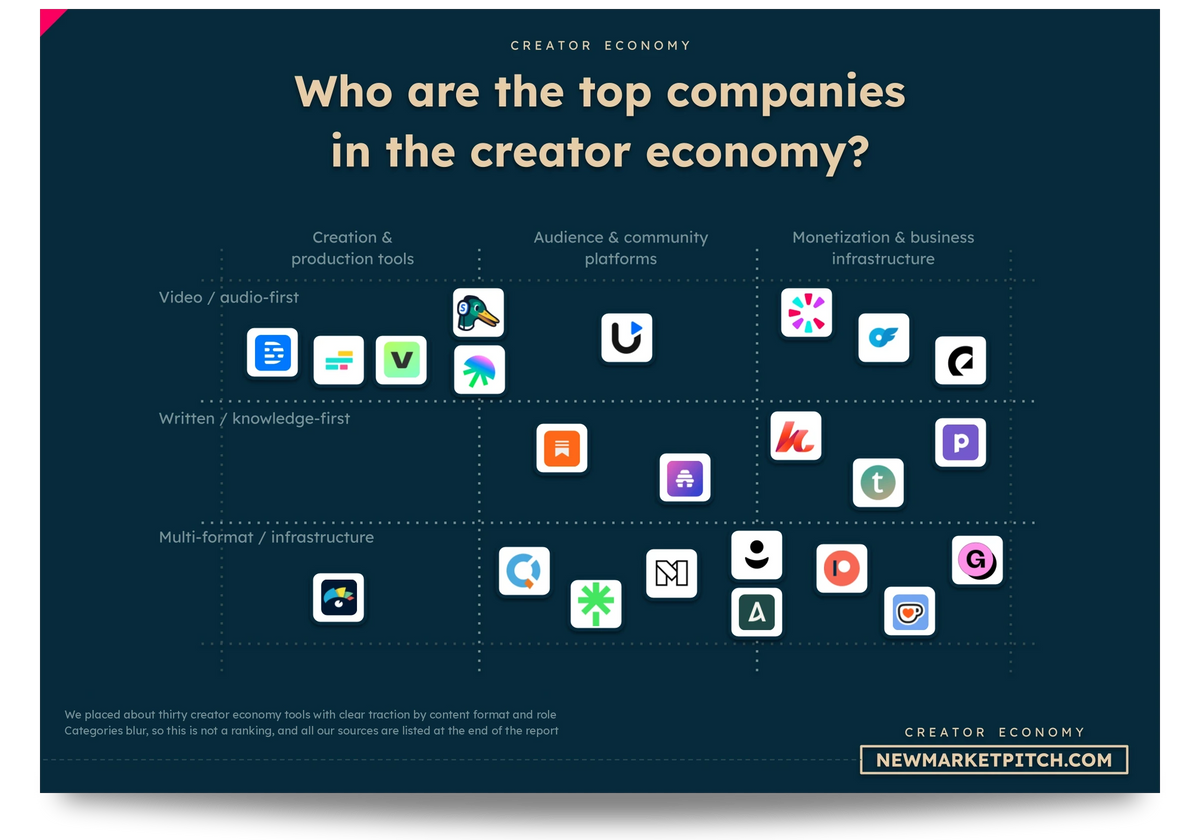
In our research about the creator economy, we turn what is vague and complex into simple, useful visuals. Market maps like this one show you at a glance where every startup stands.
Are big VCs crowding out specialist creator economy investors?
Large VCs lead creator economy activity overall, but smaller and more focused investors are still backing very different kinds of creator businesses.
Andreessen Horowitz, NVIDIA and Khosla Ventures appear most often across the equity rounds we counted. Their investments cover AI voice, music, images and video, where the same technology can sell to creators, brands and enterprises. That gives broad technology investors more opportunities to appear in this market than a firm focused only on creators' direct earnings.
Volition Capital shows another path through Levanta and Statusphere, which help brands work with creators and track sales. Bain Capital Ventures backed ShopMy, a platform that turns creator recommendations into measurable purchases. Flexpoint Ford backed Create Music Group, which handles distribution, rights and services for independent musicians. Those companies have customers and costs that look little like an AI model developer's.
So specialists haven't been pushed aside. The activity leader is simply the investor that joined the most eligible rounds. For a creator commerce company, experience with retail partnerships may count more than a famous name on an AI video deal.
Do Andreessen Horowitz and a16z speedrun back the same kinds of startups?
Andreessen Horowitz and a16z speedrun belong to the same firm, but their creator investments target different moments in a startup's life.
The main Andreessen Horowitz program has backed ElevenLabs, Luma AI, Krea AI, Ideogram and Glif. In April 2026, a16z explained why it led Glif's seed financing: creators were juggling separate models for voice, images and video, and Glif was building a way to control them through one creative agent. That is a product bet informed by how people actually make content.
The speedrun program backs founders much earlier. Its creator investments include Hedra, Sekai, Clouted and Oasiz, and the activity we counted sits at seed stage. a16z describes speedrun as an accelerator with founder support, access to specialists and early customer connections, alongside investment capital.
The two programs make different kinds of decisions. A founder looking for an accelerator should ask about speedrun; a company already building a specialized AI platform may be talking to another a16z team. The shared name doesn't make the investment process identical.

In our market report about the creator economy, we always try to gather several sources and make estimates that make sense, so you can work with solid numbers.
Is NVIDIA actually leading creator AI investments now?
NVIDIA is highly active in creator economy AI, but it joins rounds rather than leading them: it has never been the named lead where that role was disclosed.
Its investments include ElevenLabs, Suno, Higgsfield, Runway and Luma AI. Most sell products that need advanced AI computing, giving NVIDIA an interest in how these companies build and run their models. Its NVentures program openly links investing with longer-term work across the AI ecosystem.
Runway makes that relationship tangible. General Atlantic led its 2025 Series D and its February 2026 Series E, with NVIDIA participating. Since that 2025 Series D, Runway has also demonstrated its video models on NVIDIA's Rubin platform and joined an open world-model collaboration with NVIDIA. That makes the corporate relationship useful well beyond a funding announcement.
ElevenLabs offers a second example: in May 2026, it announced a strategic investment from NVIDIA, separate from its Series D, while expanding both creative audio and enterprise voice products. But NVIDIA's technical importance should not be confused with deciding the terms of a financing. General Atlantic led Runway's rounds, and Sequoia Capital led ElevenLabs' Series D. Those are different jobs.
Does Khosla Ventures invest in creators beyond AI video?
Khosla Ventures backs creator tools and audience businesses beyond generative video, even though video is a major part of its recent activity.
We counted 5 creator economy rounds joined by Khosla Ventures, with the firm named as lead in each one we found. Moonvalley is the obvious AI video example. Inkitt, Sekai, Nas.io and Hook show a wider interest in stories, communities and ways for creators to reach audiences.
Moonvalley's investors have emphasized licensed training material and tools that let professional users control the result. That is a different pitch from making impressive short clips. Inkitt's business begins with reading and storytelling, while Nas.io helps people run audience-based communities and sell to members. Both live closer to the relationship between creators and their customers.
This breadth is why Khosla Ventures belongs in the creator economy discussion rather than only in a generative AI roundup. Its recent activity puts it level with NVIDIA this year, but the companies it picks span different ways of making and selling content.
Which creator economy investors are still investing this year?
NVIDIA and Khosla Ventures are tied as the busiest creator economy investors this year, each joining 3 rounds.
Andreessen Horowitz joined 2 rounds this year, the same as last year, and remains the overall leader. Among the 20 ranked investors, 15 have joined a round this year and 5 have not. The current-year race therefore looks different from the full activity ranking.
NVIDIA has appeared in financings for creative AI businesses including ElevenLabs and Higgsfield. Khosla Ventures has backed companies including Sekai. Andreessen Horowitz joined ElevenLabs' Series D this year, and its most recent recorded deal is Glif, whose creative agent brings image, video, audio and other tools into a single workflow. The firm is still investing in this market; it simply isn't matching the pace set by the current-year leaders.
The table below shows, year by year, how many rounds 12 of the most active creator economy investors joined, so it is easy to see who is still investing and who has slowed down.
If you want to go more into detail and see which investors are still writing checks and which have slowed down, please check our creator economy report.
| Investor | 2024 | 2025 | 2026* | Total |
|---|---|---|---|---|
| NVIDIA | 1 | 2 | 3 | 6 |
| Khosla Ventures | 2 | 3 | 5 | |
| Andreessen Horowitz | 5 | 2 | 2 | 9 |
| Volition Capital | 1 | 2 | 3 | |
| Sequoia Capital | 2 | 2 | ||
| DGE3 Investment | 2 | 2 | ||
| Bain Capital Ventures | 2 | 1 | 3 | |
| BOND | 1 | 1 | 1 | 3 |
| Lightspeed Venture Partners | 2 | 1 | 3 | |
| Flexpoint Ford | 2 | 1 | 3 | |
| AMD Ventures | 1 | 1 | 1 | 3 |
| Zeev Ventures | 1 | 1 | 2 |
* 2026: January to 19 November. Darker cells mean more rounds that year. Data from January 2024 through 19 November 2026.
Is Sequoia Capital seriously getting into creator economy startups?
Sequoia Capital is making big, selective creator economy bets, especially where a creator product can become a much broader business.
Sequoia Capital joined 2 creator economy rounds, both this year, involving ElevenLabs and Whop. Sequoia led ElevenLabs' Series D as the voice company expanded into enterprise agents while keeping a creative audio product. It also led Whop's October 2026 financing with Shopify Ventures, backing a platform that helps people sell online products and services.
Whop's announcement gave a telling detail: the company was pitching itself to internet business operators, not just social-media influencers. It highlighted payments, business-launch tools and software that helps people run what they sell. ElevenLabs is making a similar move beyond creators into customer support, sales and business communication. Both firms still serve the creator economy, but their ambitions reach further.
That explains Sequoia's interest more convincingly than its name alone. The investor appears in some prominent financings, yet its participation count remains below the market's most frequent backers. It is an important player in a few large companies, rather than the firm turning up in the greatest number of creator deals.

Our document detailing everything you need to know about creator economy gets updated several times a month, so you always get the latest view of where things stand.
Why is BOND backing both Substack and Suno?
BOND is backing different ways for people to build a business around content, from paid writing on Substack to AI-generated music on Suno.
BOND joined 3 creator economy rounds, across Suno, Substack and Passes. Substack and Passes give writers or other creators ways to charge fans directly. Suno starts with creation itself, letting people make songs using AI. The products differ, but in each case a creator needs people to keep coming back.
Substack's founders said their 2025 fundraise would support independent publishing and reader relationships. BOND and The Chernin Group led it. In June 2026, BOND led Suno's Series D, while Suno told users it was working with the music industry on models for artists and fans. By September, Suno had introduced v6, built with music-industry partners including Warner Music Group, BMG and Believe.
That progression matters for BOND's music bet: Suno now has to build useful creative tools while making agreements with the people who own recordings and compositions. Substack's challenge is different, involving paid readership and communities. The common thread is getting people to pay for creative work repeatedly, rather than collecting views once.
Are AI music startups attracting investors despite copyright fights?
AI music startups still attract major creator economy investors, but music rights are now part of the product discussion, not an issue that can be put off.
BOND and Lightspeed Venture Partners have backed Suno, while music investors also appear around businesses such as Create Music Group and Duetti. Suno's own June 2026 announcement described a new music model being built with industry partners. Its September v6 launch named Warner Music Group, BMG and Believe among those partners. Investors can now judge the company on commercial agreements as well as model quality.
That is a real change from the early excitement about text-to-song demos. Professional musicians need editing control, predictable rights and some idea of how their work is used. Suno has been making those promises more concrete through its model releases and partnerships. Whether those agreements settle every legal dispute is another matter, and a funding round does not settle it either.
The wider music market gives investors alternatives. Flexpoint Ford has backed music distribution and rights businesses through Create Music Group and Duetti. One group of investors is funding new ways to produce music; another is financing the catalogs and services that help musicians earn from it. Both can succeed, though the risks they face have little in common.
Why are a16z, NVIDIA and General Atlantic backing AI video?
Major investors are backing creator AI video because it can serve filmmakers today and power much broader software tomorrow.
Andreessen Horowitz has backed Luma AI, NVIDIA appears in Luma AI and Runway, and General Atlantic led Runway's major financings. Khosla Ventures backed Moonvalley, while AMD Ventures joined Luma AI's financing. The companies compete for attention from creators, yet their ambitions range from editing workflows to models that simulate scenes and movement.
Runway's February 2026 announcement said it would use new funding to train world models, while its subsequent work with NVIDIA covered simulation research as well as video generation. Luma AI likewise described a move toward multimodal models for creative work and other applications. Moonvalley has stressed controllable output and licensed content, needs that matter particularly to professional studios.
Those differences help explain the investor mix. A production tool can sell better editing and predictable output to businesses making videos. A world-model developer may spend heavily on research before selling into other fields. We should be careful about calling them identical creator startups just because all make AI video. The investor's role and the product's real customers tell us much more.
Which creator economy investors back seed rounds, and which back growth rounds?
Seed is the busiest stage in creator economy financing: among rounds with named investors, 93 of the 194 with a known stage were seed deals.
a16z speedrun leads seed activity with 4 rounds. Later in the company's life, the names change: HubSpot Ventures leads at Series C with 2 rounds, NVIDIA, Sequoia Capital and General Atlantic are tied at Series D and later with 2 rounds each, and we counted 32 rounds at Series C or later. These stage differences are especially useful for a founder choosing whom to approach.
At Series A, Andreessen Horowitz and Khosla Ventures are tied at 3 rounds each. Andreessen Horowitz, NVIDIA and Bain Capital Ventures are tied at Series B with 2 apiece. Flexpoint Ford leads the separate growth-equity category with 2 rounds, including investments linked to established music and artist-service companies. The busiest early backer isn't automatically the investor that will join the next large financing.
The table below shows, for 12 of the most active creator economy investors, how many rounds they joined at each stage, from seed to growth.
If you want to go more into detail and see where each investor places its bets, from seed to growth, please check our creator economy report.
| Investor | Seed | Series A | Series B | Series C | Series D+ | Growth |
|---|---|---|---|---|---|---|
| Andreessen Horowitz | 2 | 3 | 2 | 1 | 1 | · |
| NVIDIA | · | · | 2 | 1 | 2 | · |
| Khosla Ventures | 1 | 3 | · | 1 | · | · |
| a16z speedrun | 4 | · | · | · | · | · |
| Volition Capital | · | 2 | 1 | · | · | · |
| Bain Capital Ventures | 1 | · | 2 | · | · | · |
| BOND | · | 1 | · | 1 | 1 | · |
| Lightspeed Venture Partners | 1 | · | 1 | · | 1 | · |
| Index Ventures | 2 | · | · | 1 | · | · |
| NFX | 3 | · | · | · | · | · |
| Flexpoint Ford | · | · | 1 | · | · | 2 |
| Iberis Capital | · | 2 | 1 | · | · | · |
Most active at each stage, among all creator economy investors: Seed, a16z speedrun · Series A, Andreessen Horowitz and Khosla Ventures · Series B, Andreessen Horowitz, NVIDIA and Bain Capital Ventures · Series C, HubSpot Ventures · Series D+, NVIDIA, Sequoia Capital and General Atlantic · Growth, Flexpoint Ford. Bigger dots mean more rounds. Data from January 2024 through 19 November 2026.

In our report covering the creator economy market, we look at what the winners do differently, so you can learn from the best instead of guessing.
Can creator startups raise seed funding without a famous VC?
Creator startups do have seed investors beyond the biggest venture brands, including funds that concentrate on smaller communities and new ways to publish.
NFX joined 3 creator economy seed rounds, with bets including DRiP, Palo and Agentic Marketing Technologies. Slow Ventures backed Clouted. Peak XV Partners backed Dashverse and Palo in early-stage financings. Founders aren't restricted to a16z speedrun just because it appears most often at seed.
These investors bring different assumptions to a pitch. A company built around creator referrals or digital communities may appeal to NFX's long-standing interest in products whose value grows as people connect. A small content tool could be more suited to an accelerator, which helps a founder test a product and find first customers. Neither pitch resembles the budget required to build and train a frontier video model.
We should also be precise about what these completed deals prove. They show that several investor types have funded young creator companies. They don't reveal how many applications were rejected or how much money remains available. For a founder, the useful question is which investor has already backed a business with similar customers and a similar first product.
Do giant creator funding rounds tell us who invests the most?
A huge creator economy round can make an investor famous without making it the most active backer.
Andreessen Horowitz joined ElevenLabs' $500M Series D, while NVIDIA's largest round was Runway's $315M Series E. Khosla Ventures' largest was Moonvalley's $70M seed. Those amounts describe the total company financings; none tells us what an individual backer paid.
The contrast runs through other parts of the market. BOND joined Suno's $400M+ Series D. Bain Capital Ventures joined ShopMy's $78M Series B, while Volition Capital backed Levanta's $22M Series B. The size of a music-model round says little about the amount needed to build a platform for creator affiliate sales.
A named lead is a clearer clue about who organized a deal. Even then, announcements rarely disclose the investors' exact checks. For anyone comparing backers, round frequency, stage and named leadership are more useful than treating the biggest disclosed financing as proof that a particular firm spent the most.
The table below shows the largest round joined by selected active creator economy investors.
| Investor | Startup | Round size | Stage |
|---|---|---|---|
| Andreessen Horowitz | ElevenLabs | $500M | Series D+ |
| BOND | Suno | $400M | Series D+ |
| NVIDIA | Runway | $315M | Series D+ |
| Bain Capital Ventures | ShopMy | $78M | Series B |
| Khosla Ventures | Moonvalley | $70M | Seed |
| Volition Capital | Levanta | $22M | Series B |
| a16z speedrun | Hedra | $10M | Seed |
Round sizes are whole-company financing amounts, not individual investors' checks.
Do Andreessen Horowitz and Khosla Ventures usually lead creator deals?
Andreessen Horowitz and Khosla Ventures are regularly named lead investors in creator economy financings, unlike NVIDIA, which usually joins alongside a lead.
Andreessen Horowitz was named lead in 8 of its 9 rounds, or 89%, and Khosla Ventures in all 5 of its rounds. a16z speedrun led 3 of its 4 rounds, or 75%. NVIDIA, by contrast, was not named lead in any recorded round for which we could establish that role. The difference is easy to see in company announcements.
Sequoia Capital led ElevenLabs' Series D. General Atlantic led Runway's recent financing, and BOND led Suno's Series D. Those announcements identify the firms that took the lead role, even when several other well-known investors also joined. A participant can still bring technical help, customers and valuable contacts, as NVIDIA has done with Runway.
Still, we wouldn't equate lead status with a bigger personal check or stronger belief. Company announcements are much better at naming leads than every smaller investor. We use lead roles to identify responsibility for a funding round, while treating the resulting lead rates as an upper bound.

In our research about the creator economy, we don't want to repeat what boring consulting reports say. Instead, we show you the real and latest market signals that matter.
Are investors still backing creator commerce instead of only AI?
Creator commerce still draws venture capital because brands want to know whether creator recommendations actually sell products.
Volition Capital has backed Levanta and Statusphere. Levanta helps brands manage creator affiliate programs and connect referrals with purchases. Statusphere works on creator campaigns and content for brands. Both businesses need advertisers to keep spending after the initial campaign, which is a more concrete test than simply generating more content.
ShopMy operates in the same broad market but serves a network of brands and tastemakers, with shopping activity tied to the people recommending products. Bessemer Venture Partners and Bain Capital Ventures led its Series B. Agentio has also attracted investors including Benchmark and Forerunner for its creator advertising software.
The case for investing is straightforward: brands already spend money to find customers, and these platforms promise to show which creators actually help. They face hard questions about measurement, platform policies and repeat purchases, but those are familiar commercial problems. AI video firms face different costs and competition. Both fit the creator economy, and investors are clearly backing both.
Will VCs still fund paid newsletters and creator memberships?
Paid newsletters and fan memberships still have serious venture backers, even as AI content tools grab more headlines.
Substack's founders announced a financing led by BOND and The Chernin Group to expand independent publishing. BOND has also backed Passes, which connects creators with paying fans. Sequoia Capital's investment in Whop reaches a nearby market: digital products, online businesses and memberships sold directly to customers.
These aren't identical products. A newsletter asks readers to keep paying for writing. A fan platform needs creators to maintain relationships with subscribers. Whop gives people ways to sell digital products or services and manage the resulting business. Whop's October 2026 announcement emphasized business creation, payments and tools for operators, showing how far some creator platforms are moving beyond the traditional influencer model.
Each business still has to make the same basic promise: customers must get enough value to pay again. A large follower count doesn't guarantee that. But the continued financing of Substack, Passes and Whop makes it hard to argue that investors have abandoned direct creator payments.
Why does private equity invest in creator music businesses?
Growth Equity can back creator music businesses because music rights, royalties and artist services have value beyond the next app launch.
Flexpoint Ford joined 3 creator economy rounds involving Create Music Group and Duetti. Create Music Group provides distribution, publishing, marketing and other services to independent artists. Duetti finances musicians and works with rights and catalogs. Both depend on the continuing value of music and the companies that help artists earn from it.
Create Music Group's June 2024 announcement described a $165M investment led by Flexpoint Ford. In March 2026, the company completed a $450M financing that mixed new equity, share sales and debt without publishing the split. We count it as an equity round of undisclosed size, and Flexpoint Ford remains a minority investor.
BOND and Lightspeed Venture Partners have backed Suno, whose AI music product faces different questions: model performance, licensing and whether users will keep creating music with it. A royalty catalog and a new music-generation platform both sit inside the creator economy. Investors choose between them based on the work the business actually does.
Which creator economy investors most often invest together?
General Atlantic and NVIDIA are tied with Iberis Capital and Indico Capital Partners as the creator economy investor pairs that appear together most often.
Each pair joined 2 rounds together. General Atlantic and NVIDIA both appeared in Runway financings, while Iberis Capital and Indico Capital Partners both backed Primetag. These are repeat investments in individual startups, rather than a pattern of the same funds joining many unrelated creator companies.
Runway's announcements named General Atlantic as lead and NVIDIA as a participant. Their connection now extends into work on video generation and world models. Primetag, by contrast, helps brands measure influencer marketing, a business with other technology and other customers. The repetition tells us these firms returned to companies they already knew; it doesn't prove a wider alliance between them.
The table below lists the pairs of creator economy investors named together in at least two equity rounds, with the startups they backed together.
If you want to go more into detail and see which investor networks back the same startups, please check our creator economy report.
| Investor pair | Rounds together | Startups backed together |
|---|---|---|
| General Atlantic + NVIDIARunway | 2 | Runway |
| Iberis Capital + Indico Capital PartnersPrimetag | 2 | Primetag |
Pairs of investors named in the same equity round. Data from January 2024 through 19 November 2026.

Learning from others' mistakes is the cheapest lesson there is. In our market report about the creator economy, we look at what broke startups before you, so you don't repeat it.
Can European funds compete for creator economy deals?
European investors are backing creator economy startups, but the most frequent names in this market are still mostly American firms.
Index Ventures joined 3 creator economy rounds, including Mirage, Hedra and Mirelo AI. Iberis Capital also joined 3, including activity involving FRVR and Primetag. The list reaches outside Europe and the United States too: India's Peak XV Partners has backed Dashverse and Palo.
Index's investment in Mirelo AI shows what a European fund can offer. The startup's Berlin team combines music and AI research to make sound that matches video. In its December 2025 investment announcement, Index highlighted the founders' music backgrounds and their approach to rights-cleared audio. Primetag takes another route, selling influencer measurement tools to businesses rather than creative models.
These are credible examples of non-US funds finding creator businesses worth backing. They don't establish that European investors are catching up by deal count, because a fund's home country isn't the same as the location of the company it backs. For a founder, the more useful point is that investment choices extend beyond Silicon Valley and beyond generative video.
So, who are the biggest investors in creator economy startups today?
Andreessen Horowitz is the most active creator economy investor today, with 9 equity rounds joined.
NVIDIA ranks next by overall participation, and Khosla Ventures is another frequent backer. Yet the current-year leaders are NVIDIA and Khosla Ventures, rather than Andreessen Horowitz. The right answer changes again for a startup seeking its first seed check or a large later-stage investment.
For creative AI, Andreessen Horowitz, Khosla Ventures and NVIDIA are obvious names to study, though they don't all lead deals. For a company selling through creators, Volition Capital and Bain Capital Ventures have relevant experience. Music founders should also look at BOND and Flexpoint Ford, whose investments cover separate sides of the industry.
We'd start with what the company sells and the round it wants to raise. That produces a more useful shortlist than a big-name ranking alone. And none of these round counts tells us which firm wrote the largest personal check.
The table below shows what we found.
| Question | Answer |
|---|---|
| Can a chipmaker really challenge the top VCs? | NVIDIA is now a leading creator economy backer. It joined 6 recorded equity rounds in this market. Yet its role was participation, not named leadership. |
| Have recent deals changed who's investing most? | NVIDIA and Khosla Ventures are tied for this year's lead. Both joined 3 creator economy rounds so far. Andreessen Horowitz still leads over the longer research period. |
| Is the earliest creator funding dominated by generalists? | a16z speedrun is the busiest creator economy seed investor. The accelerator joined 4 rounds at that early funding stage. Its program helps new founders develop products before their businesses mature. |
| Does backing AI video mean backing only creators? | Runway and Luma AI now pursue broader model businesses. Their products reach beyond conventional video editing and creation. That wider ambition helps explain interest from NVIDIA. |
| Has Sequoia become the busiest creator economy VC? | Sequoia Capital is active but isn't the overall leader. We counted 2 creator equity rounds involving the firm. ElevenLabs and Whop show its preference for large platforms. |
| Are creators still getting funded outside generative AI? | Volition Capital backs creator commerce companies such as Levanta. Its recorded activity includes 3 creator economy rounds. These businesses help brands connect creators with sales. |
| Does music attract investors beyond software venture funds? | Flexpoint Ford backs music rights and distribution businesses. The private equity firm joined 3 creator economy rounds. Catalogs and royalties create a different investment case. |
| Are investor partnerships spread across many startups? | General Atlantic and NVIDIA repeatedly backed Runway together. The two firms appeared together in 2 creator economy rounds. Their repeated investment activity centers on just one company. |
| Are European investors missing from creator startup funding? | Index Ventures is active in creator economy financing. It joined 3 rounds involving creative technology companies. Mirelo AI shows why sound tools attract attention. |
| Can one giant round prove who invested most? | Andreessen Horowitz joined an ElevenLabs round totaling $500M. That figure describes the entire company financing, not its check. Round size alone cannot rank investors by money committed. |

If you build or invest in the creator economy market, you need to know which business models pay off now and which ones are fading. That's why our report covering it has a whole section on it.
Our methodology
Our data runs through November 19, 2026. We then reviewed this article and updated its answers on November 24, 2026, the date shown under the title. We have tracked creator economy equity rounds systematically, deal by deal, since January 2024, a window long enough to show which investors return repeatedly. The market covers independent, audience-first digital creators and the platforms, creative tools, payments, financing and services that help them publish or earn from original work and fan relationships. We include creator storefronts, memberships, publishing and music services, creator-focused AI products and brand-to-creator platforms, including companies on the category's borders. Every company counted meets our startup definition: independent, growth-oriented, founded in 2007 or later, and either unlisted or listed within the past 5 years; companies acquired within the past 3 years remain eligible.
We count the equity rounds each named investor joined and those it led, not the money that investor put into a deal. IPOs and offerings after a listing are excluded because they are not private startup financings. We combine reports of the same round, standardize investor names from company announcements and reliable press coverage, and exclude vague labels such as "existing investors" or "angel investors." A round counts for each named investor who joined it, so investor appearances do not equal the number of distinct startup rounds. A round with no named backer remains in the funding tracker but not the investor tables. The current-year column begins in March, once three months of data are available.
Announcements name lead investors more reliably than smaller participants, so rounds that an investor joined without leading are undercounted and lead rates are an upper bound.
Rounds confirmed by a company announcement, a press article or a regulatory filing are counted in full. Where no article exists, a round is counted only when at least two recognised databases agree on its date (within one month) and amount (within 5%), and it is marked as low confidence; a round found in a single database stays in the company's history but is left out of totals. For companies that have raised more than $100M, every round counted is backed by an article.
We do not build investor histories from Crunchbase, PitchBook or similar databases alone, because they can misattribute backers or mix equity with grants and debt. We found named investors in 204 of 238 rounds, or 86%. The remaining rounds belong in the market's history, but cannot raise a particular investor's activity count. Every investor's count is therefore a floor, and our investor rankings will not exactly match the distinct deal totals in the funding tracker.
A famous generalist can outrank a creator specialist by appearing in more completed, attributable equity deals. That says nothing about which firm has the largest fund, writes the biggest private check or earns the best returns. We also keep a16z speedrun separate from the main Andreessen Horowitz program because founders encounter different investment teams and stages. These choices make the counts useful for deciding whom to approach, without turning a participation ranking into a claim about who spent the most.
Key sources include Andreessen Horowitz on its Glif investment and creative workflow thesis, Andreessen Horowitz explains the speedrun accelerator, NVIDIA describes NVentures and its investment approach, ElevenLabs identifies Sequoia Capital as its Series D lead, ElevenLabs announces new backers including NVIDIA, Runway names General Atlantic and NVIDIA in its Series E, Runway names investors in its earlier Series D, Runway describes its work on NVIDIA's Rubin platform, Runway details its world-model collaboration with NVIDIA, Bessemer explains Moonvalley's licensed video approach, Suno names BOND and discusses its music model plans, Suno identifies its music-industry partners for v6, Substack's founders name their funding leads, Whop describes its Sequoia-led financing and business tools, ShopMy names its Series B leads and explains creator commerce, Create Music Group announces Flexpoint Ford's investment, Create Music Group explains its later mixed equity and debt financing, Duetti describes its music financing and rights services, Index Ventures describes Mirelo AI and its founders, Agentio's creator advertising product and backers, Primetag's adviser identifies Iberis Capital and Indico Capital Partners, and Luma AI explains its multimodal strategy and investors.
Written by the New Market Pitch teamWe track new markets so founders and investors can move faster. About us