What’s funding like in the defense AI market right now?
Building a startup or looking for your next investment in defense AI? Our report gives you the full picture.
Summary
Defense AI funding is much stronger right now, but the boom is heavily concentrated in scale-up rounds: more companies and investors are active, while capital below $50 million is actually slightly lower than it was a year ago.
We counted 60 financings across 53 companies in the latest 12 months, up from 50 deals across 42 companies previously. The median round more than doubled from $12.85 million to $29 million, so the expansion is real even beyond the headline funding total.
The $14.55 billion of current funding is still a misleading number on its own. Almost 96% came from rounds above $50 million, and removing sub-$50 million deals leaves slightly less capital than in the previous period.
The concentration pattern has changed rather than disappeared. The largest deal now represents 34.4% of capital instead of 59.7%, but defense AI has developed a much wider group of companies capable of raising $100 million, $500 million or several billion dollars.
Startup formation remains alive. First financings increased from 17 to 19 and the median company receiving its first financing is still only about one year old, but almost all of the incremental capital went to companies that had already raised before.
The market has moved materially later-stage. Early-stage rounds fell from 80% to 68.3% of transactions, while later-stage share reached 26.7% and Series D+ rounds alone supplied roughly 80% of current capital.
Autonomy remains the center of gravity. Autonomous Systems Software accounted for 46.7% of deals but 88.8% of capital, while its median financing tripled to $45.5 million. Counter-drone and fire-control technology is the other category where both breadth and round size clearly improved.
Europe has become financially important without overtaking North America in startup breadth. European companies represented 35% of deals but 20.3% of capital, up from only 4.6% previously, with Helsing showing that European defense AI companies can now raise at true mega-round scale.
Strategic capital is also becoming harder to ignore. Strategic investors participated in 20% of current financings versus 8% previously, consistent with a market where manufacturing, integration, procurement access and deployment infrastructure increasingly matter alongside the software itself.
Companies are not simply raising more often. In the observable follow-on sample, the median time between rounds lengthened from 7.8 to 10.5 months, while the median round-to-round step-up increased to 4.08x. The pattern is closer to longer proof periods followed by much larger checks.
The clearest way to read the market is that defense AI has become broader as an ecosystem and dramatically deeper for proven winners. It is increasingly an industrial technology market, with a healthy startup funnel underneath a funding system that now puts extraordinary amounts of capital behind companies ready for deployment, production and procurement-scale growth.

Written by the New Market Pitch teamWe track new markets so founders and investors can move faster. About us

In our report covering the defense AI market, you will always find fresh funding data, taken straight from our own verified funding database.
All funding deals in the defense AI market over the last 24 months
Below is the table listing all the deals. You can find our methodology at the end of this page.
If you want a deeper understanding of the market and its current dynamics, get our report covering the defense AI market.
| Company | Category | Date | Stage | Deal size | What they do | Region | Lead investors | Country | Rank |
|---|---|---|---|---|---|---|---|---|---|
| Occam Industries | Autonomous Systems Software | September 2026 | Seed | ≈$4.3M | Develops hardware-agnostic tactical autonomy and machine-vision software for military drones in contested environments. | Europe | North Ventures | United Kingdom | |
| Bulwark Dynamics | Logistics & Maintenance AI | September 2026 | Seed | $6.8M | Builds AI-powered autonomous landing craft for GPS-denied contested military resupply and beach logistics. | North America | Not disclosed | United States | |
| AITAN | Autonomous Systems Software | September 2026 | Series A | $41M | Builds edge-AI robotic weapon systems, autonomy kits and vendor-agnostic command-and-control software for allied militaries. | Middle East | Deep33; Dell Technologies Capital | Israel | |
| Mara | Targeting & Fire-Control AI | August 2026 | Seed | $7M | Builds an AI-enabled counter-UAS platform combining multisensor targeting with autonomous kinetic interceptor drones. | North America | Khosla Ventures | United States | |
| Smack Technologies | Command & Decision Systems | August 2026 | Series B | $61M | Builds domain-specific military AI decision platforms for command-level planning and tactical-edge intelligent autonomy. | North America | Costanoa Ventures; First In | United States | |
| Aurelius Systems | Targeting & Fire-Control AI | August 2026 | Series A | $40M | Develops AI-autonomous directed-energy counter-drone systems that detect, track and neutralize aerial threats. | North America | Draper Associates; KAS Venture Partners | United States | |
| Monava AB | ISR & Intelligence AI | August 2026 | Seed | $523K | Builds passive acoustic sensors using AI to detect, track and classify drones in battlefield environments. | Europe | Gungnir Capital | Sweden | |
| Agon | Autonomous Systems Software | July 2026 | Seed | $7M | Builds synthetic battlefields for designing, training, testing and hardening AI-enabled autonomous weapon and defense systems. | Europe | Lakestar | United Kingdom | |
| Agon | Autonomous Systems Software | July 2026 | Seed | $23M | Builds synthetic battlefields for designing, training, testing and hardening AI-enabled autonomous weapon and defense systems. | Europe | Unknown | United Kingdom | |
| Cathedral | Cyber Defense AI | July 2026 | Unknown | $160M | Develops AI infrastructure and software for offensive and defensive U.S. military cyber operations. | North America | Andreessen Horowitz; Sequoia Capital | United States | |
| Twenty | Cyber Defense AI | July 2026 | Series B | $30M | Builds AI-enabled offensive cyber-warfare systems for U.S. and allied military and intelligence operations. | North America | Khosla Ventures | United States | |
| Helsing | Autonomous Systems Software | July 2026 | Series D+ | $1.8B | Develops AI-defined autonomous military platforms and battlefield software across air, land, sea and electronic-warfare missions. | Europe | Dragoneer Investment Group; Lightspeed Venture Partners | Germany | |
| Surtr Defense Systems | Command & Decision Systems | July 2026 | Seed | $4.8M | Builds AI-enabled command-and-control software that fuses counter-UAS sensors, command tools and effectors into one operator interface. | North America | Allegis Capital; Eniac Ventures; Gaingels; Robinhood Ventures; Streamlined Ventures | United States | |
| Dominion Dynamics | Command & Decision Systems | June 2026 | Series A | $100M | Builds an AI-native military command network and autonomous aircraft systems for Arctic and allied defense operations. | North America | Georgian | Canada | |
| Six Robotics AS | Autonomous Systems Software | June 2026 | Seed | ≈$13.8M | Develops collaborative autonomy software enabling teams of unmanned military systems to operate in contested environments. | Europe | DTCP | Norway | |
| Askari Defense | Targeting & Fire-Control AI | June 2026 | Seed | $9M | Develops autonomous computer-vision-guided hit-to-kill interceptors for counter-UAS missions. | North America | Builders VC | United States | |
| STARK Defence | Autonomous Systems Software | June 2026 | Series C | ≈$570M | Builds software-defined autonomous military systems and AI-enabled command software coordinating unmanned systems across multiple domains. | Europe | Sequoia Capital; Founders Fund | Germany | |
| Dream | Cyber Defense AI | June 2026 | Series C | $260M | Develops sovereign AI-powered cyber-defense systems for governments and critical national infrastructure. | Middle East | Bicycle Capital; Group 11 | Israel | |
| Comand AI | Command & Decision Systems | June 2026 | Series A | ≈$37M | Builds an AI-native military command-and-control platform for mission planning, battlefield understanding and decision support. | Europe | Blossom Capital | France | |
| PDKINEMATICS | Targeting & Fire-Control AI | June 2026 | Seed | $2.3M | Develops autonomous precision-guidance technology for military drones and munitions operating in GPS-denied environments. | Europe | Coinvest Capital; Iron Wolf Capital | Lithuania | |
| Twenty | Cyber Defense AI | June 2026 | Series B | $100M | Develops AI-enabled offensive cyber-warfare capabilities for U.S. military and intelligence missions. | North America | Accel | United States | |
| Valkyr Defense Systems AB | Targeting & Fire-Control AI | June 2026 | Seed | ≈$420K | Develops autonomous close-range counter-UAS systems using AI target detection, sensor fusion and automated engagement. | Europe | Not disclosed | Sweden | |
| Traysar Industries | Autonomous Systems Software | June 2026 | Seed | $25M | Develops autonomous self-guided underground military systems for mapping, penetrating and securing subterranean environments. | North America | Silent Ventures | United States | |
| Alta Ares | Targeting & Fire-Control AI | June 2026 | Series A | ≈$57.6M | Builds AI-enabled counter-UAS and air-defense systems combining sensor fusion, edge AI and autonomous guidance. | Europe | Air Street Capital | France | |
| Allen Control Systems | Targeting & Fire-Control AI | June 2026 | Series B | $200M | Builds AI-powered autonomous weapon stations that detect, track and physically defeat hostile drones. | North America | Smash Capital | United States | |
| Orion Edge Group | Electronic Warfare AI | May 2026 | Seed | $3M | Develops tactical electronic-warfare systems using autonomous electronic attack and intelligent RF automation for military operations. | North America | Backswing Ventures | United States | |
| Arkeus | ISR & Intelligence AI | May 2026 | Series A | ≈$18M | Builds AI-powered optical and hyperspectral sensing systems that provide autonomous military platforms with detection and targeting intelligence. | Asia-Pacific | QIC Ventures | Australia | |
| Twin Prime | ISR & Intelligence AI | May 2026 | Seed | $10M | Develops multimodal AI models that interpret physical-world sensor data for real-time defense and security decisions. | North America | Expeditions | United States | |
| Anduril | Autonomous Systems Software | May 2026 | Series D+ | $5B | Builds AI-enabled military autonomy software and autonomous air, land, sea and counter-UAS systems around its Lattice platform. | North America | Thrive Capital; Andreessen Horowitz | United States | |
| Heaviside Industries, Inc. | Targeting & Fire-Control AI | May 2026 | Series A | $28M | Develops autonomous precision munitions and embedded mission-autonomy systems for U.S. and allied forces. | North America | Interlagos | United States | |
| Scout AI | Autonomous Systems Software | April 2026 | Series A | $100M | Develops foundation-model-based autonomy software for unmanned military systems and coordinated robotic warfare. | North America | Align Ventures; Draper Associates | United States | |
| True Anomaly, Inc. | Autonomous Systems Software | April 2026 | Series D+ | $600M | Builds autonomous orbital vehicles and mission-autonomy software for military space operations and space superiority. | North America | Eclipse; Riot Ventures | United States | |
| Stendr AS | ISR & Intelligence AI | April 2026 | Seed | $5.4M | Builds an AI-native multi-sensor platform for passive detection, tracking and classification of hostile drones. | Europe | Rainfall; ACME; Skyfall | Norway | |
| Saronic | Autonomous Systems Software | March 2026 | Series D+ | $1.8B | Develops autonomous surface vessels and associated autonomy software for U.S. and allied maritime defense missions. | North America | Kleiner Perkins | United States | |
| Shield AI | Autonomous Systems Software | March 2026 | Series D+ | $2B | Develops Hivemind AI pilot and autonomy software for military aircraft and other autonomous systems operating in contested environments. | North America | Advent International; Strategic Investment Group of JPMorganChase's Security and Resiliency Initiative | United States | |
| EGIDE | Targeting & Fire-Control AI | March 2026 | Seed | ≈$9.3M | Develops AI-enabled software and low-cost autonomous interceptor systems for detecting, tracking and defeating hostile drones and loitering munitions. | Europe | Expeditions; Eurazeo; Heartcore Capital | France | |
| Swarm Aero | Autonomous Systems Software | March 2026 | Series A | $35M | Develops military UAV swarms plus AI-enabled command, control and autonomy software allowing operators to coordinate large numbers of unmanned systems. | North America | Two Sigma Ventures; Silent Ventures | United States | |
| UFORCE | Autonomous Systems Software | March 2026 | Seed | $50M | Builds combat-proven autonomous military systems linked by AI-assisted command-and-control and autonomy software across air, land and sea. | Europe | Shield Capital; Lakestar | United Kingdom | |
| Mutable Tactics | Autonomous Systems Software | March 2026 | Seed | $2.1M | Builds an AI decision layer that converts commanders' intent into coordinated actions for teams of military drones in contested environments. | Europe | Seraphim Space | United Kingdom | |
| NODA AI | Command & Decision Systems | February 2026 | Series A | $25M | Develops an AI-native military orchestration platform for coordinating tactics, mission objectives and heterogeneous manned and unmanned systems. | North America | Bessemer Venture Partners | United States | |
| TYTAN Technologies | Targeting & Fire-Control AI | February 2026 | Series A | ≈$35.3M | Develops AI-powered autonomous interceptor systems for counter-UAS and layered military air defense. | Europe | Armira; NATO Innovation Fund | Germany | |
| Breaker | Autonomous Systems Software | February 2026 | Seed | $6M | Builds AI-agent software that lets military operators orchestrate teams of autonomous air, land and maritime systems using high-level commands. | North America | Bessemer Venture Partners | United States | |
| Terra Industries | Autonomous Systems Software | February 2026 | Seed | $22M | Builds autonomous defense and security systems combining AI software with aerial, ground and fixed platforms for threat detection and response. | Africa | Lux Capital | Nigeria | |
| Farsight Vision | ISR & Intelligence AI | February 2026 | Seed | ≈$8.6M | Provides AI-driven battlefield geospatial intelligence and continuously updated 3D situational awareness for military planning and unmanned systems. | Europe | Axon Enterprise; SmartCap Defence Fund | Ukraine | |
| Occam Industries | Autonomous Systems Software | February 2026 | Seed | ≈$3.6M | Develops retrofit computer-vision autonomy software enabling military FPV drones to navigate and track targets with reduced dependence on GPS, communications or manual control. | Europe | Presto Tech Horizons | United Kingdom | |
| Tenna Systems | Electronic Warfare AI | February 2026 | Seed | $13.5M | Uses AI and distributed RF data to detect, classify and geolocate jamming, spoofing and other electromagnetic threats for military operations. | North America | Costanoa | United States | |
| Overland AI | Autonomous Systems Software | February 2026 | Series B | $80M | Develops autonomous ground-vehicle software and command systems for off-road military operations in GPS- and communications-denied environments. | North America | 8VC | United States | |
| Shield Space | Autonomous Systems Software | January 2026 | Seed | $2.7M | Develops autonomous AI-guided space-control and counterspace systems for NATO and allied defense missions. | Europe | Mercia Ventures; Twin Path Ventures | United Kingdom | |
| Dominion Dynamics | Command & Decision Systems | January 2026 | Seed | $15.2M | Builds an AI-native Arctic autonomy and command layer fusing military sensors, autonomous assets and operators into a unified operating picture. | North America | Georgian | Canada | |
| Onebrief | Mission Planning Software | January 2026 | Series D+ | $200M | Provides an AI-enabled military command operating system spanning planning, wargaming, simulation and live operational decision support. | North America | Battery Ventures; Sapphire Ventures | United States | |
| Harmattan AI | Autonomous Systems Software | January 2026 | Series B | $200M | Develops AI mission systems, controlled autonomy and autonomous defense platforms for military ISR, interception and electronic-warfare missions. | Europe | Dassault Aviation | France | |
| Terra Industries | Autonomous Systems Software | January 2026 | Seed | $11.8M | Builds autonomous defense and security systems combining AI software with aerial, ground and fixed platforms for threat detection and response. | Africa | 8VC | Nigeria | |
| Shield AI | Autonomous Systems Software | December 2025 | Series D+ | $300M | Builds Hivemind AI pilot and autonomy software and autonomous military aircraft for GPS- and communications-denied operations. | North America | Not disclosed | United States | |
| Vatn Systems | Autonomous Systems Software | December 2025 | Series A | $60M | Builds autonomous UUVs plus proprietary mission-planning, navigation, sensor-fusion and collaborative-autonomy software for naval operations. | North America | BVVC | United States | |
| Sky Spy Inc. | ISR & Intelligence AI | December 2025 | Seed | $1.6M | Develops compact AI-driven SIGINT systems that autonomously detect, classify and geolocate hostile emitters in contested spectrum. | North America | Expeditions Fund; Superangel | United States | |
| NestAI | Autonomous Systems Software | November 2025 | Unknown | ≈$115M | Develops physical-AI software for defense unmanned vehicles, autonomous operations and AI-enabled command-and-control platforms. | Europe | Tesi; Nokia | Finland | |
| Twenty | Cyber Defense AI | November 2025 | Series A | $38M | Builds agentic systems that automate the offensive cyber-operations lifecycle for U.S. and allied military and intelligence missions. | North America | Caffeinated Capital | United States | |
| Vermeer | Autonomous Systems Software | October 2025 | Series A | $10M | Provides vision-based GPS-independent navigation and autonomy software for military drones operating in electronic-warfare environments. | North America | Draper Associates | United States | |
| Govini | Logistics & Maintenance AI | October 2025 | Growth Equity | $150M | Provides AI-enabled defense-acquisition software for supply-chain, production, sustainment, logistics and modernization decisions. | North America | Bain Capital | United States | |
| HavocAI | Autonomous Systems Software | October 2025 | Unknown | $85M | Develops software-first collaborative autonomy that lets operators command large fleets of unmanned military systems. | North America | Not disclosed | United States | |
| Tycho.AI | Autonomous Systems Software | October 2025 | Series A | $10M | Develops resilient navigation and autonomous-intelligence software for unmanned systems operating in GPS-denied contested environments. | North America | FirstMark | United States | |
| Aventra Defense Systems | Targeting & Fire-Control AI | October 2025 | Seed | $3M | Develops AI-powered modular guidance kits that turn unguided munitions into long-range GPS-independent precision weapons. | North America | Lavrock Ventures | United States | |
| Orbotix | Autonomous Systems Software | October 2025 | Seed | ≈$7.6M | Develops AI-powered autonomous drone and swarm systems for battlefield targeting, strike and contested-environment missions. | Europe | BVVC Fund | Poland | |
| Unmannd | Autonomous Systems Software | September 2025 | Seed | $2M | Builds autonomous military drones using AI-driven navigation, swarm networking and contested-environment autonomy for logistics and counter-UAS missions. | Asia-Pacific | Speciale Invest; Accel | India | |
| Auterion | Autonomous Systems Software | September 2025 | Series B | $105M | Provides AI-enabled operating-system, autonomy and swarming software for military drones and other unmanned combat platforms. | North America | Bessemer Venture Partners | United States | |
| NORDA Dynamics | Autonomous Systems Software | September 2025 | Seed | $1M | Develops AI-powered UAV autonomy and terminal-guidance software designed to operate without GPS or communications under electronic warfare. | Europe | Varangians | Ukraine | |
| C2GRID OÜ | ISR & Intelligence AI | September 2025 | Seed | ≈$354K | Converts battlefield UAV and video feeds into near-real-time 3D geospatial intelligence with AI-based threat detection. | Europe | Sunfish Partners | Estonia | |
| Swarmer | Autonomous Systems Software | September 2025 | Series A | $15M | Develops hardware-agnostic AI software enabling military unmanned systems to execute missions autonomously and operate as coordinated swarms. | North America | Broadband Capital Investments | United States | |
| Indrajaal | Command & Decision Systems | September 2025 | Seed | ≈$5.5M | Builds an AI-orchestrated wide-area counter-UAS system that fuses sensors and coordinates electronic and kinetic responses to drone threats. | Asia-Pacific | India Accelerator; Finvolve | India | |
| Offset Labs | ISR & Intelligence AI | September 2025 | Seed | ≈$700K | Develops specialized AI models for signal, voice and operational-data intelligence for NATO-aligned defense and national-security users. | Europe | Archangel | United Kingdom | |
| Aurelius Systems | Targeting & Fire-Control AI | September 2025 | Seed | $10M | Builds autonomous laser counter-UAS systems using AI-guided detection and tracking to engage hostile drones. | North America | General Catalyst; Draper Associates | United States | |
| Blue Water Autonomy | Autonomous Systems Software | August 2025 | Series A | $50M | Designs fully autonomous long-range unmanned ships integrating AI and autonomy for U.S. Navy and allied naval missions. | North America | GV | United States | |
| STARK Defence | Autonomous Systems Software | August 2025 | Unknown | $62M | Builds AI-enabled autonomous loitering munitions and associated mission-control software for military strike operations. | Europe | Sequoia Capital | Germany | |
| ARX Robotics | Autonomous Systems Software | July 2025 | Series A | ≈$12.7M | Develops AI-powered software and autonomous unmanned ground systems for military mobility, reconnaissance and vehicle modernization. | Europe | Speedinvest | Germany | |
| Delian Alliance Industries | Autonomous Systems Software | July 2025 | Series A | $14M | Develops AI-powered autonomous sensing, navigation, surveillance and strike systems specifically for defense missions. | Europe | Air Street Capital; Marathon Venture Capital | Greece | |
| Project Q GmbH | Command & Decision Systems | July 2025 | Seed | ≈$8.7M | Builds an AI-enabled defense integration platform connecting battlefield sensors, unmanned systems and operational data for command decisions. | Europe | Project A | Germany | |
| Rune Technologies | Logistics & Maintenance AI | July 2025 | Series A | $24M | Builds AI-enabled military logistics software for planning, forecasting and executing sustainment in contested environments. | North America | Human Capital | United States | |
| Armory | Electronic Warfare AI | June 2025 | Seed | ≈$1.5M | Develops AI-driven counter-UAS systems combining RF threat detection, electronic countermeasures and an in-house defense operating system. | Asia-Pacific | GrowX Ventures | India | |
| Helsing | Command & Decision Systems | June 2025 | Series D+ | ≈$694M | AI-based defence software and uncrewed systems for European militaries | Europe | Prima Materia (Daniel Ek) | Germany | |
| Onebrief | Mission Planning Software | June 2025 | Series C | $20M | Provides AI-enhanced operational-planning and staff-collaboration software built specifically for military headquarters. | North America | Battery Ventures | United States | |
| Anduril | Autonomous Systems Software | June 2025 | Series D+ | $2.5B | Builds AI-powered autonomous defense systems and Lattice software for operating and coordinating military sensors and unmanned platforms. | North America | Founders Fund | United States | |
| LINE5 Defense Ltd. | Autonomous Systems Software | May 2025 | Seed | $20M | Develops AI-driven autonomous battlefield systems intended to carry out military missions with reduced direct soldier exposure. | Middle East | NFX Capital | Israel | |
| CX2 | Electronic Warfare AI | May 2025 | Series A | $31M | Develops machine-learning-powered electronic-warfare systems that autonomously detect, classify, target and respond to RF threats. | North America | Point72 Ventures | United States | |
| TurbineOne | ISR & Intelligence AI | May 2025 | Series B | $36M | Provides edge AI software that lets deployed military sensors detect, identify and support action against battlefield threats without cloud connectivity. | North America | The General Partnership | United States | |
| Kela Technologies | Command & Decision Systems | May 2025 | Series B | $60M | Develops an AI-enabled battlefield operating system integrating sensors, autonomous assets, edge systems and military technologies. | Middle East | Not disclosed | Israel | |
| Arondite | Command & Decision Systems | May 2025 | Seed | $2.3M | Builds AI-enabled command software that connects and orchestrates heterogeneous autonomous defense systems, sensors and crewed assets. | Europe | Creator Fund; Concept Ventures | United Kingdom | |
| Arondite | Command & Decision Systems | May 2025 | Seed | $10M | Builds AI-enabled command software that connects and orchestrates heterogeneous autonomous defense systems, sensors and crewed assets. | Europe | Index Ventures | United Kingdom | |
| ARX Robotics | Autonomous Systems Software | April 2025 | Series A | ≈$35.2M | Builds autonomous military ground vehicles and an AI-driven operating system for autonomizing military vehicle fleets. | Europe | HV Capital | Germany | |
| Theseus | Autonomous Systems Software | April 2025 | Seed | $4.3M | Develops vision-based autonomous navigation software allowing military unmanned systems to operate without GPS. | North America | First Round Capital | United States | |
| Scout AI | Autonomous Systems Software | April 2025 | Seed | $15M | Develops hardware-agnostic AI foundation models that provide autonomous capabilities to defense robotic systems. | North America | Align Ventures; Booz Allen Ventures | United States | |
| Blue Water Autonomy | Autonomous Systems Software | April 2025 | Seed | $14M | Develops full-stack autonomous ship technology for unmanned U.S. Navy missions. | North America | Not disclosed | United States | |
| Gallatin AI | Logistics & Maintenance AI | April 2025 | Seed | $15M | Builds an AI-native platform for predicting, planning and executing military logistics in contested environments. | North America | 8VC | United States | |
| Allen Control Systems | Targeting & Fire-Control AI | March 2025 | Series A | $30M | Develops AI and computer-vision fire-control robotics that autonomously detect, track and engage aerial threats. | North America | Craft Ventures | United States | |
| Arkeus | ISR & Intelligence AI | March 2025 | Unknown | ≈$3.2M | Develops AI-enabled hyperspectral sensing and optical-radar systems for wide-area military ISR. | Asia-Pacific | Not disclosed | Australia | |
| Distributed Spectrum | Electronic Warfare AI | March 2025 | Series A | $25M | Builds edge-AI radio-signal sensors and software that detect, classify and map electromagnetic threats for military electronic-warfare missions. | North America | Conviction; Shield Capital; Nat Friedman | United States | |
| Quantum Aero Co., Ltd. | Autonomous Systems Software | March 2025 | Seed | ≈$2.6M | Integrates and supplies AI-enabled autonomous military-aircraft and defense solutions in South Korea, including Shield AI's V-BAT and Hivemind technology. | Asia-Pacific | Not disclosed | South Korea | |
| Kela Technologies | Command & Decision Systems | March 2025 | Seed | $10M | Provides an AI-enabled open defense platform integrating commercial and military sensors and systems into a common command interface. | Middle East | Sequoia Capital | Israel | |
| Kela Technologies | Command & Decision Systems | March 2025 | Series A | $28M | Provides an AI-enabled open defense platform integrating commercial and military sensors and systems into a common command interface. | Middle East | Lux Capital | Israel | |
| Alpine Eagle | Targeting & Fire-Control AI | March 2025 | Seed | ≈$11M | Develops AI-enabled counter-UAS systems that detect, track and support engagement of hostile drones. | Europe | IQ Capital | Germany | |
| Shield AI | Autonomous Systems Software | March 2025 | Series D+ | $240M | Builds AI autonomy software enabling military aircraft and other platforms to operate autonomously in contested environments. | North America | Not disclosed | United States | |
| Deepnight | ISR & Intelligence AI | February 2025 | Seed | $5.5M | Develops AI-based computational imaging software for military night-vision and low-light sensing. | North America | Initialized Capital | United States | |
| Rune Technologies | Logistics & Maintenance AI | February 2025 | Seed | $6.2M | Builds AI-enabled predictive logistics software for military operations in contested environments. | North America | Andreessen Horowitz | United States | |
| Saronic | Autonomous Systems Software | February 2025 | Series C | $600M | Develops autonomous surface vessels and autonomy software for U.S. and allied maritime-defense missions. | North America | Elad Gil | United States | |
| Onebrief | Mission Planning Software | January 2025 | Series C | $50M | Provides AI-enabled operational-planning software for military staffs to develop, coordinate and execute plans. | North America | General Catalyst; Insight Partners | United States | |
| Overland AI | Autonomous Systems Software | January 2025 | Series A | $32M | Builds autonomy and command software for uncrewed ground vehicles used in U.S. and allied defense missions. | North America | 8VC | United States | |
| Comand AI | Command & Decision Systems | December 2024 | Seed | $8.9M | Builds AI-native military command-and-control software for operational planning, decision support and after-action learning. | Europe | Eurazeo | France | |
| Reveal Technology | ISR & Intelligence AI | December 2024 | Series A | $11.2M | Builds offline tactical AI that converts sensor and identity data into geospatial and biometric intelligence for military operators. | North America | Next Frontier Capital | United States | |
| Vatn Systems | Autonomous Systems Software | November 2024 | Seed | $13M | Builds autonomous underwater vehicles with onboard navigation and multi-vehicle autonomy for U.S. and allied military missions. | North America | DYNE Ventures | United States | |
| Origin Robotics | Targeting & Fire-Control AI | October 2024 | Seed | ≈$2.6M | Develops AI- and computer-vision-guided autonomous weapon systems for military ISR and precision strike missions. | Europe | Change Ventures | Latvia | |
| Vidar Systems | ISR & Intelligence AI | October 2024 | Seed | $450K | Builds AI-powered acoustic weapon-locating systems that detect and geolocate artillery and mortar fire for battlefield intelligence. | Europe | Not disclosed | Ukraine | |
| STARK Defence | Autonomous Systems Software | October 2024 | Series A | $15M | Builds AI-enabled, software-defined autonomous strike and unmanned systems for military operations. | Europe | Sequoia Capital | Germany |
Current L12M: October 8, 2025–October 7, 2026
Previous 12M: October 8, 2024–October 7, 2025

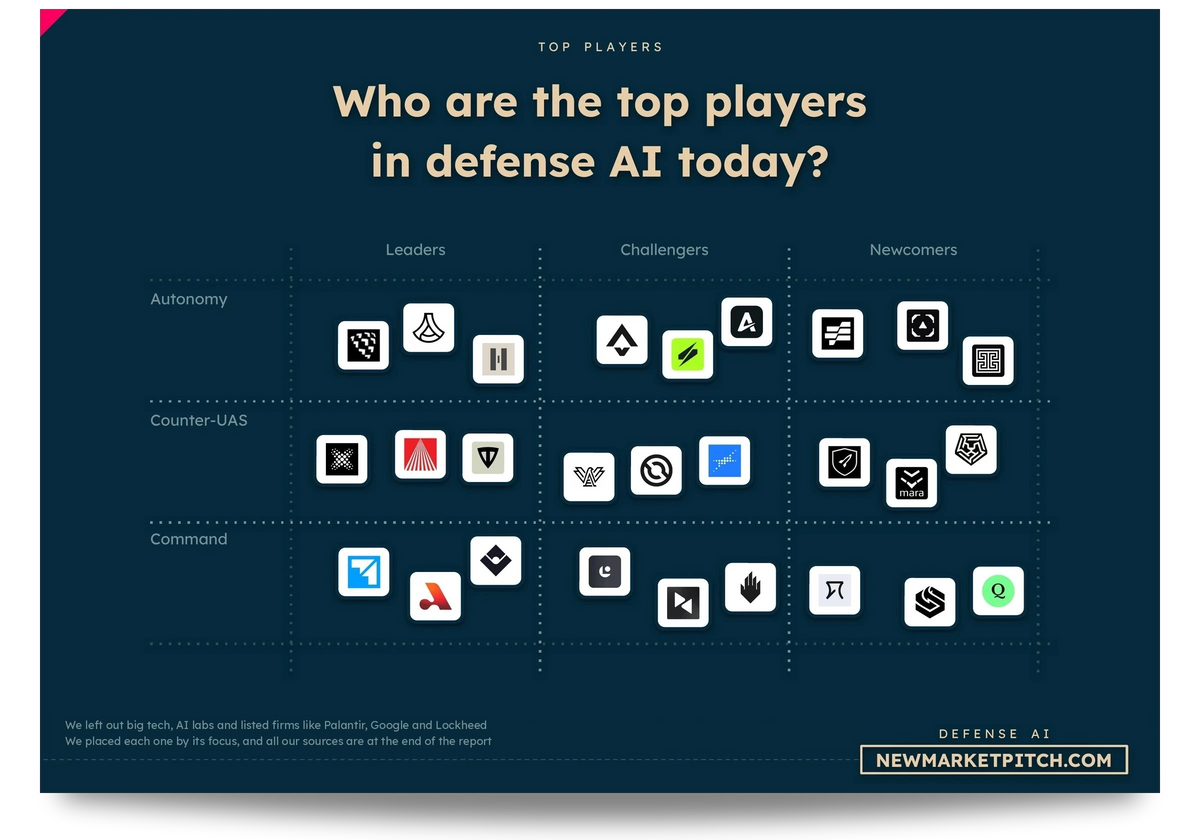
In our research about AI for defense, we turn what is vague and complex into simple, useful visuals. Market maps like this one show you at a glance where every startup stands.
Is the defense AI funding market actually healthier than it was a year ago?
Yes, the defense AI funding market is healthier today in several important ways, but it is also much more mature and much more dependent on large scale-up rounds than it was one year ago.
We found 60 financings across 53 companies in the current 12 months, up from 50 deals across 42 companies previously. Median round size more than doubled from $12.85 million to $29 million, the pool of disclosed lead investors expanded from 49 to 72, and strategic participation rose from 8% to 20%. That is hard to square with a market being propped up by one isolated transaction.
At the same time, the improvement is highly uneven. Total capital surged from $4.19 billion to $14.55 billion, yet funding below $50 million actually slipped from $623.4 million to $605.9 million. Early-stage deals lost 11.7 percentage points of share, first-financing share edged down, and more than 95% of current capital came from rounds above $50 million.
So we would not call this a broad-based funding boom. Defense AI has become broader in companies and investors, but the money itself has moved decisively toward companies that can absorb very large checks.
| Market-health signal | Current L12M | Previous 12M | What changed |
|---|---|---|---|
| Deals | 60 | 50 | +20.0% |
| Unique companies | 53 | 42 | +26.2% |
| Total capital | $14.55B | $4.19B | +247.3% |
| Median round | $29.0M | $12.85M | +125.7% |
| First-financing share | 31.7% | 34.0% | -2.3 pp |
| Later-stage deal share | 26.7% | 16.0% | +10.7 pp |
| Disclosed lead investors | 72 | 49 | +46.9% |
| Strategic participation | 20.0% | 8.0% | +12.0 pp |
Is the 247% defense AI funding increase real without the megadeals?
Only partly. Defense AI funding is genuinely stronger now, but the headline 247% increase is overwhelmingly a large-round phenomenon.
The contrast is unusually stark. Total funding increased from $4.19 billion to $14.55 billion. Remove rounds above $100 million and current-period capital is still ahead, at $1.25 billion versus $745.4 million, a 67.6% increase. So the improvement does extend below the very largest transactions.
But cut the threshold to $50 million and the conclusion reverses. Funding falls to $605.9 million in the current period from $623.4 million previously. Below $50 million, investors deployed slightly less capital despite funding more companies overall.
The largest individual financing also became less dominant. It accounted for 34.4% of current capital compared with 59.7% previously. Concentration did not disappear, though. Instead of one enormous deal carrying the market, we now have a much larger group of enormous deals.
The current market is not dependent on a single winner. It is increasingly dependent on the class of companies capable of raising $50 million, $100 million or several billion dollars.
| Outlier test | Current L12M | Previous L12M | Change |
|---|---|---|---|
| Headline capital | $14.55B | $4.19B | +247.3% |
| Capital excluding >$50M | $605.9M | $623.4M | -2.8% |
| Capital excluding >$100M | $1.25B | $745.4M | +67.6% |
| Largest deal share | 34.4% | 59.7% | -25.3 pp |
| Top 3 share | 60.5% | 79.7% | -19.2 pp |
| Top 5 share | 76.6% | 83.7% | -7.1 pp |
| Top 10 share | 87.1% | 89.2% | -2.1 pp |
| Capital from >$50M rounds | 95.8% | 85.1% | +10.7 pp |

Your time is limited. In our market report about AI for defense, we put numbers on each part of the market, so you can see where it makes sense to focus.
Are more defense AI companies actually getting funded now?
Yes. Defense AI funding reached materially more companies over the last 12 months, so the expansion cannot be dismissed as the same handful of startups repeatedly raising money.
We counted 53 unique funded companies compared with 42 in the previous period, a 26% increase. That is actually faster than the 20% growth in deal count. If repeat fundraising alone were driving the market, we would expect transactions to grow faster than the number of companies. We see the opposite.
The repeat-fundraising-company rate also fell from 16.7% to 11.3%. Six companies had multiple financings in the current window compared with seven previously, even though the market itself became larger.
This is probably the cleanest positive health indicator in the dataset. Defense AI is adding funded companies rather than merely inflating the financing frequency of the existing cohort.
The catch is that broader company participation did not translate into broader capital distribution. The additional companies joined a market where the overwhelming majority of dollars were flowing into much larger scale financings.
Are investors still backing new defense AI startups, or mostly doubling down on existing winners?
Investors are still creating new funded defense AI startups, but existing winners captured almost all of the incremental money.
First financings increased from 17 to 19. Their median also edged up from $6.2 million to $7 million, and aggregate first-financing capital rose sharply to $449.2 million from $128 million. So there is no evidence that the startup funnel has closed.
Yet first financings represented only 31.7% of deals, slightly below 34% previously. Follow-ons reached 41 financings and absorbed $14.11 billion of the $14.55 billion invested during the current period.
The difference in check size is more revealing than the deal counts. Median follow-on financing doubled from $20 million to $41 million, while the median first financing rose by only $800,000.
In practice, that leaves two defense AI markets operating at once: an active formation layer where very young companies can still secure seed capital, and a scale-up layer where companies with prior institutional validation are attracting dramatically larger amounts.
Has the funding bar moved higher for defense AI startups?
Yes. The defense AI funding bar has clearly moved upward, particularly once companies progress beyond their first institutional financing.
The strongest evidence is in the round-size distribution. Deals below $20 million fell from 64% of all transactions to 41.7%. At the other end, $100 million-or-more rounds jumped from 8% to 28.3% of financings. There were 17 rounds at or above $100 million in the current period compared with only four previously.
The shift appears before conventional late stage. Series A median size climbed from $24.5 million to $37.5 million, while the Series B median increased from $60 million to $90 million. This is not simply a handful of billion-dollar Series D and E financings stretching the average.
The evidence does not tell us that every startup must prove more before raising, because structured milestone data are absent. But companies successfully raising institutional follow-ons are clearly being financed at a much higher level than they were a year earlier.
Defense AI now looks less like an experimental venture niche and more like a sector where investors expect successful companies to move quickly into capital-intensive deployment, integration and production.

In our document detailing everything you need to know about defense AI, we always try to gather several sources and make estimates that make sense, so you can work with solid numbers.
Is defense AI becoming a later-stage market?
Yes. Defense AI has moved materially later-stage over the last 12 months, even though seed deals still form the largest single stage by transaction count.
Early-stage financings fell from 80% to 68.3% of deals, while later-stage rounds increased from 16% to 26.7%. Series D+ transactions represented only 11.7% of current deals but supplied roughly 80% of all capital.
The change is visible lower down the stage ladder too. Series B median financing reached $90 million. Series C had only two current-period observations, but their $415 million median shows how quickly financing requirements can escalate once a company crosses into scaled deployment.
Seed remains important: 27 current deals were classified as Seed. Defense AI has not abandoned early-stage investing. What changed is the amount of economic weight sitting above that startup funnel.
| Stage | Current deal share | Current median | Previous deal share | Previous median |
|---|---|---|---|---|
| Seed | 45.0% | $7.0M | 52.0% | $5.85M |
| Series A | 23.3% | $37.5M | 28.0% | $24.5M |
| Series B | 10.0% | $90M | 6.0% | $60M |
| Series C | 3.3% | $415M | 6.0% | $50M |
| Series D+ | 11.7% | $1.75B | 4.0% | $1.37B |
| Growth Equity | 1.7% | $150M | 0% | - |
| Unknown | 5.0% | $115M | 4.0% | $32.6M |
Is autonomous defense software still carrying the defense AI market?
Yes. Autonomous Systems Software is not merely the largest defense AI category today; it is where the sector’s scale-up economics are most visible.
Autonomy represented 46.7% of current deals, only modestly above 44% previously. If we looked only at transaction count, that would suggest continuity rather than a dramatic shift.
Capital tells a very different story. Autonomous Systems Software absorbed 88.8% of current-period funding, while its median round tripled from $15 million to $45.5 million.
Companies such as Shield AI, Saronic, Helsing and True Anomaly illustrate why. These are no longer small experimental software financings. The sector increasingly includes large autonomous aircraft, maritime, space and multi-domain systems whose software is inseparable from deployment, integration and physical production.
Autonomy's dominance looks structural rather than statistical. It gained capital intensity without needing a dramatic increase in deal share.
Is counter-drone defense AI becoming a real funding category?
Yes. Targeting and Fire-Control AI is one of the clearest examples of genuine category momentum because both the number of deals and the typical financing size increased.
Its share of defense AI transactions rose from 10% to 16.7%, while median round size increased from $10 million to $18.65 million. That is more convincing than a category whose capital share jumps because of one exceptional transaction.
We see the pattern across different parts of the counter-UAS stack. Allen Control Systems raised $30 million in March 2025 and later-stage systems such as Aurelius, TYTAN and newer interceptor platforms continued attracting capital. The common thread is not simply drone manufacturing; it is automated detection, tracking, fire control and interception.
The demand backdrop has also become unusually concrete. At NATO's July 2026 Ankara Summit, Allies announced more than $40 billion of counter-drone investment over five years and a NATO counter-drone marketplace designed to shorten the path from testing to procurement.
That does not prove the NATO announcement caused individual venture rounds. It does show that private investors are funding a capability area where the customer side is now signalling procurement at tens-of-billions-of-dollars scale.

Our report covering the defense AI market gets updated several times a month, so you always get the latest view of where things stand.
Which defense AI categories actually gained momentum?
Autonomy and Targeting and Fire-Control show the most convincing structural momentum today because they gained either large-scale capital intensity, breadth, or both.
Cyber Defense AI also appeared quickly with five current-period financings and a $100 million median, but that category is still too young in this dataset to treat its current financing profile as a stable equilibrium. A few large transactions can materially change the picture.
Command and Decision Systems moved in the opposite direction on breadth but not on financing quality. Deal share fell from 16% to 10%, yet its median increased from $9.45 million to $31 million. That looks more like concentration into fewer, larger platforms than retreat.
ISR and Intelligence AI similarly lost deal share, from 14% to 10%, while median financing improved from $3.15 million to roughly $7 million. Electronic Warfare AI was the clearest weak spot, although its tiny sample makes strong conclusions difficult.
| Category | Current deal share | Current median | Structural read |
|---|---|---|---|
| Autonomous Systems Software | 46.7% | $45.5M | Dominant and scaling |
| Targeting & Fire-Control AI | 16.7% | $18.65M | Gaining breadth and size |
| ISR & Intelligence AI | 10.0% | $6.98M | Less breadth, larger rounds |
| Command & Decision Systems | 10.0% | $31.0M | Fewer but larger platforms |
| Cyber Defense AI | 8.3% | $100M | Emerging at high intensity |
| Electronic Warfare AI | 3.3% | $8.25M | Softer, small sample |
| Logistics & Maintenance AI | 3.3% | $78.4M | Narrow but capital-intensive |
| Mission Planning Software | 1.7% | $200M | Very concentrated |
Has Europe finally become a major defense AI funding center?
Yes. Europe is financially consequential in defense AI today, although the change is much stronger in capital than in the number of funded companies.
European companies represented 35% of current deals compared with 32% previously, a modest three-point increase. Their share of capital, however, jumped from 4.6% to 20.3%.
That is the real change. Europe did not suddenly produce four times as many funded defense AI startups. It began producing and financing companies capable of absorbing much larger rounds.
Helsing is the clearest example. Its July 2026 $1.8 billion Series E valued the company at $18 billion, and the company said investor demand significantly exceeded the allocation. STARK adds another scale-up example from Germany.
This is happening against a materially stronger procurement backdrop. NATO's July 2026 investment update said European Allies and Canada increased core defense expenditure by nearly 20% in 2025. The relevant point for venture investors is not simply higher military budgets; it is the movement toward procurement, production and technology adoption.
North America, meanwhile, increased its share of deals from 50% to 56.7%. Europe gained financial weight without displacing North America as the main source of funded companies.

In our research about AI for defense, we look at what the winners do differently, so you can learn from the best instead of guessing.
Are strategic investors becoming more important in defense AI?
Yes. Strategic capital is becoming a much more visible part of defense AI financing as companies move closer to procurement, manufacturing and integration.
Strategic-backed deals increased from four to 12, taking participation from 8% to 20% of all financings. The median strategic-backed round also rose from $37.5 million to $50.5 million.
The names help explain the shift. Current-period financings include participation from Booz Allen Ventures, Dell Technologies Capital, Saab, Deloitte Ventures, THEON International and Onomichi Dockyard. These are not all equivalent investors, but they can offer things a generalist financial investor often cannot: proximity to military customers, systems integration, industrial capacity, distribution or deployment infrastructure.
That becomes more useful as defense AI companies move beyond proving that software works. A counter-drone company may need manufacturing partners. An autonomy provider needs platforms on which its software can operate. A command system needs interoperability and procurement access.
The rising strategic share fits a market moving from venture experimentation toward an industrial ecosystem.
Is defense AI attracting more investors, or are a few funds controlling the market?
More investors are participating. Defense AI became broader at the investor level over the last 12 months rather than concentrating around a smaller venture syndicate.
We identified 72 unique disclosed lead investors in the current period compared with 49 previously, an increase of almost 50%. The number appearing more than once also rose from three to ten.
Recurring names include Bessemer, Draper Associates, 8VC, Georgian, Lakestar, Silent Ventures, Andreessen Horowitz, Sequoia, Khosla and Expeditions. It is a fairly broad mix of established generalist firms, specialist defense investors and investors comfortable with technically or industrially complex businesses.
Capital still remains extremely concentrated at the company level. More investors are trying to access defense AI, while a disproportionate amount of money is still being directed toward a relatively small number of businesses that investors believe can become major platforms.
Investor breadth improved more than capital breadth.
Are defense AI companies raising again faster than before?
No. The observable defense AI companies actually took longer to return for their next financing, even as the subsequent rounds became much larger.
Among follow-ons where the previous round date was available, median time between financings increased from 7.8 months to 10.5 months. Only 61.1% of the current sample returned within 12 months, down from 84.6% previously.
So the funding boom is not simply the result of companies suddenly raising every few months.
The pattern looks closer to longer validation periods followed by larger financing events. Overland AI, Shield AI and other scale-stage companies illustrate a market where the big change is the magnitude of the next check rather than the cadence alone.
We should keep this conclusion directional because previous-round dates are available for only 18 of 41 current follow-ons and 13 of 33 previous follow-ons. Still, nothing in the usable sample points to a generalized acceleration in fundraising frequency.

In our market report about AI for defense, we don't want to repeat what boring consulting reports say. Instead, we show you the real and latest market signals that matter.
Are defense AI follow-on rounds getting much bigger?
Yes. Companies that successfully return to the defense AI funding market are often making unusually large jumps in round size.
The median current-to-previous-round multiple reached 4.08x, up from 3.43x in the preceding period. More than 72% of observable current follow-ons were over twice the size of the preceding known round.
STARK's observed step-up was about 9.2x. Shield AI and Allen Control Systems were both around 6.7x, Dominion Dynamics around 6.6x, and Arkeus around 5.7x.
The >2x share was actually slightly higher in the previous sample, at 76.9%, so large step-ups did not suddenly appear this year. What changed is that the current sample combines a higher median multiple, fewer down-sized rounds and much larger absolute financing amounts.
As seen above, companies are not obviously returning sooner. They are returning with funding needs and investor commitments that are much larger when they do come back.
Are very young defense AI startups still able to raise money?
Yes. Defense AI still funds very young companies, so the move toward scale-up capital has not closed the door on startup formation.
The median company age at first financing was one year in both periods. The overall median funded-company age increased only from one to two years, while the median follow-on company remained about three years old.
A founder can still enter the market and secure institutional capital shortly after company formation. The database includes newly formed businesses such as Shield Space, EGIDE, Stendr and other 2025–2026 entrants securing first financings.
What changed is not the age at which a company can enter. It is the amount of capital available once a company demonstrates that it belongs in the scaling cohort.
The current defense AI market looks mature without looking closed. New companies continue appearing underneath an increasingly powerful group of established winners.
Has defense AI funding become more consistent month to month?
Deal activity has become more consistently active, but defense AI capital still arrives in dramatic bursts.
Both periods recorded at least one financing every month, so the structural change is not the elimination of inactive months. Instead, median monthly deal count increased from three to 4.5 and average monthly deals reached five.
Median monthly capital climbed even faster, from roughly $98 million to $396 million. The improvement is broader than a single annual megadeal.
But the monthly pattern remains volatile. March, May and July 2026 became enormous funding windows, while August and September produced only about $109 million and $52 million respectively. May alone exceeded $5 billion.
The current market has a higher baseline of financing activity underneath extremely episodic capital deployment. Defense AI deals now appear every month; billion-dollar checks are still anything but regular.

Learning from others' mistakes is the cheapest lesson there is. In our document detailing everything you need to know about defense AI, we look at what broke startups before you, so you don't repeat it.
Are defense AI startups raising to build technology, or to scale it?
The largest defense AI financings now look increasingly oriented toward scaling, integration and deployment, although the deals we tracked don't allow a clean quantitative use-of-funds comparison.
Most financing announcements do not say how the money will be split, so we cannot responsibly say that a specific percentage of capital moved from R&D into manufacturing, sales or geographic expansion.
The company-level evidence nevertheless points in a consistent direction at the upper end of the market. Helsing said its July 2026 financing would accelerate the development and integration of new AI platforms into the defense capabilities of a growing number of partner nations. Shield AI's financing sits around a much broader autonomy platform and planned acquisition strategy. Saronic's financing supports a company moving from autonomous-vessel development toward autonomous shipbuilding at scale.
The wider procurement environment is moving in the same direction. NATO's 2026 agenda increasingly uses the language of production, testing, interoperability and procurement rather than simply innovation funding.
We cannot quantify a market-wide use-of-funds transition from this database. But among the companies absorbing the largest rounds, the center of gravity has clearly moved beyond pure product experimentation.
Do defense AI startups need more proof to raise money today?
For the biggest rounds, almost certainly yes; for first financings, the evidence is much less clear.
The first-financing median remains only $7 million and the median company receiving its first financing is still about one year old. Investors continue to fund technical teams before they become mature operating businesses.
The later-stage market looks very different. Follow-on median size doubled to $41 million, later-stage share increased by more than ten percentage points, and companies such as Helsing, Shield AI, Saronic and True Anomaly are raising amounts that imply a different underwriting question: whether the company can deploy, integrate, manufacture or win at institutional scale.
We do not have a structured milestone field, so we cannot prove that revenue, contracts or production milestones became explicit prerequisites across the whole dataset.
Still, the financing pattern suggests a bifurcated bar. Investors remain willing to fund promising new entrants early, but enormous checks are increasingly reserved for companies with enough evidence to support a credible scale-up story.
Is defense AI becoming an industrial market rather than just a software market?
Yes. Defense AI is increasingly behaving like an industrial technology market in which software, hardware, manufacturing and procurement are difficult to separate.
The category label can obscure this. Autonomous Systems Software dominates the database, but the companies receiving the largest checks are often tied to aircraft, ships, drones, satellites, sensors or other physical defense systems.
Strategic participation rose to 20%. Later-stage financing expanded. Autonomy absorbed almost 89% of capital. Counter-drone systems gained both deal share and round size. European funding accelerated while NATO members shifted more resources toward procurement and production.
The value is no longer just in producing an AI model or autonomy layer. The financially important businesses increasingly need to put those systems into fieldable products, integrate them with military infrastructure and support deployment at scale.
That helps explain why funding requirements are rising so quickly. Scaling defense software embedded in physical systems can require far more capital than scaling conventional SaaS.

If you build or invest in the defense AI market, you need to know which business models pay off now and which ones are fading. That's why our report covering it has a whole section on it.
What is the biggest mistake people could make when looking at defense AI funding today?
The biggest mistake would be to look at the jump from $4.19 billion to $14.55 billion and conclude that defense AI funding became roughly three-and-a-half times easier to access.
It did not.
The market became easier to access in one sense: 53 companies raised capital rather than 42, 19 first financings occurred rather than 17, and considerably more investors participated.
But capital below $50 million fell slightly. Sub-$20 million deals dropped from 64% of transactions to 41.7%. Almost 96% of current funding came from rounds above $50 million.
So the $14.55 billion headline describes the amount of money investors were prepared to place into defense AI, not the breadth of that money across every type of startup.
The better interpretation is that defense AI became a deeper market for winners. There are more funded companies at the bottom, but the extraordinary capital growth sits overwhelmingly at the top.
What really changed over the last 12 months?
First, defense AI became fundamentally healthier in participation, but not uniformly healthier in access to capital. We found more deals, more funded companies, more disclosed lead investors and more strategic participation. Those are real improvements. Yet funding below $50 million declined slightly, making the expansion much stronger for scale-stage companies than for the wider market.
Second, the sector moved decisively from startup formation toward scale-up financing. First financings remain alive and their count increased, but follow-ons absorbed $14.11 billion of the $14.55 billion invested. Later-stage share rose 10.7 percentage points and Series D+ alone supplied roughly 80% of current capital.
Third, capital became less dependent on one exceptional company but more dependent on very large rounds as a class. The largest deal's share fell from 59.7% to 34.4%, yet 95.8% of all current capital came from rounds above $50 million. The market now has a wider bench of very large winners rather than one dominant megadeal.
Fourth, autonomy and counter-drone technology show the clearest genuine category momentum. Autonomous Systems Software combines overwhelming capital share with a tripling of its median round, while Targeting and Fire-Control AI gained both transaction share and median financing size. Those patterns are more persuasive than capital spikes driven by one isolated round.
Fifth, Europe became a serious scale-up market. Its deal share increased only modestly, but its capital share jumped from 4.6% to 20.3%, with companies such as Helsing and STARK demonstrating that very large defense AI financings are no longer an overwhelmingly North American phenomenon.
Sixth, investors appear willing to wait longer and then fund larger transitions. Observable fundraising intervals lengthened rather than compressed, while median step-ups increased and follow-on median financing doubled. The current market rewards companies that return with a credible case for deployment, integration, production or procurement-scale expansion.
The misleading headline would therefore be: “defense AI funding increased 247%.” The more useful conclusion is that defense AI has become broader as an ecosystem, more industrial in character and dramatically deeper for proven winners, while the smaller-round funding environment has barely improved at all.
Our methodology
This analysis compares defense AI funding across two consecutive, non-overlapping 12-month periods: October 8, 2025–October 7, 2026 and October 8, 2024–October 7, 2025. The quantitative analysis is based on the verified defense AI deals in our funding data.
We use the database to compare deal count, unique funded companies, disclosed capital, median round size, first financings and follow-ons, funding stage, category, geography, disclosed lead investors, strategic participation, monthly activity and capital concentration. Tests excluding rounds above $50 million and $100 million are used to separate broad funding conditions from the effect of large scale-up transactions.
Round-to-round timing and financing-step-up calculations use only companies where a usable previous financing date or previous round amount was available. For fundraising intervals, that means 18 of 41 current follow-ons and 13 of 33 previous follow-ons, so those results are treated as directional rather than as complete market measurements.
The database does not contain a structured use-of-funds or milestone field. We therefore do not assign percentages of capital to R&D, manufacturing, deployment or expansion. Company announcements and NATO material are used only to interpret the broader shift toward deployment, integration, production and procurement.
For the 2026 market context, we checked NATO's July 2026 announcements from the Ankara Summit. NATO reported that European Allies and Canada increased core defense expenditure by nearly 20% in 2025 and separately announced more than $40 billion of counter-drone investment over five years, alongside a NATO counter-drone marketplace intended to support faster procurement.
We also checked Helsing's July 13, 2026 financing announcement. Helsing confirmed a $1.8 billion Series E at an $18 billion valuation, said investor demand significantly exceeded the available allocation, and said the financing would support the development and integration of new AI platforms into the defense capabilities of a growing number of partner nations.
Key sources used for the contextual checks include: NATO's 2026 defense investment update, NATO's announcement on more than $40 billion of counter-drone investment, and Helsing's announcement of its $1.8 billion Series E.

In our research about AI for defense, we like to show you the big picture. We know your time is precious, so we make every page quick to read and packed with as much learning as possible per minute.
Written by the New Market Pitch teamWe track new markets so founders and investors can move faster. About us