What are the top digital twin startups by total funding raised?
Whether you're building or investing in the digital twin market, our report covers everything you need to know: the players, the money, and what's coming next.
Summary
Matterport leads our Digital Twin funding ranking at about $409 million, followed by Twin Health at roughly $350 million-plus, COSMOPlat at $318 million and Buildots at about $297 million.
The category is already much bigger than the classic factory-twin idea. Healthcare, construction, robotics, spatial mapping, infrastructure and engineering now sit beside industrial software in the most heavily funded group.
Funding is highly concentrated. The 77 companies in our dataset have raised roughly $4.3 billion of identifiable equity funding, but the top 10 account for close to 60% and the top 20 for around 85%. With the top 10 holding close to 60% of the money, who leads and who trails is mapped in the market grids of our digital twin market report.
The market is also getting more expensive to compete in. Buildots raised $130 million, Mujin added $134 million of equity, and RobCo and Neural Concept each closed $100 million rounds.
Physical AI is becoming one of the strongest funding narratives underneath the category. NavVis, Mujin, RobCo and PassiveLogic are increasingly selling the idea that digital representations are useful because machines can act on them, not just because people can visualize them.
Construction and infrastructure have become unusually deep pools of capital. Buildots, NavVis, BuildingMinds, Exodigo, Neara and PassiveLogic all show that investors are willing to fund software tied directly to expensive physical assets and project delays.
Healthcare is now large enough to stand on its own inside the ranking. Twin Health has raised roughly $350 million-plus, while Unlearn, Q Bio, Quibim and smaller virtual-patient companies push the Digital Twin idea into clinical care, trials and medical simulation.
Matterport's lead needs context. Its $409 million total includes a $295 million PIPE attached to its SPAC transaction, so it is not directly comparable with a private startup that accumulated the same amount through conventional venture rounds.
The $100 million threshold now marks a real upper tier. Around 15 companies in the dataset have crossed it, and several did so with one unusually large financing rather than a long sequence of smaller rounds.
Large corporate and strategic investors matter more here than in many software markets. NTT, Intel Capital, Schindler, Johnson Controls, Prologis Ventures and National Grid Partners can bring customers, deployment environments and industrial access as well as capital.
The direction of travel is clear: the biggest checks are increasingly going to companies that use Digital Twins to make a decision, prediction or physical action. The label may fade from the marketing, but the underlying technology is moving deeper into construction intelligence, robotics, grid analysis, engineering AI and healthcare.

Written by the New Market Pitch teamWe track new markets so founders and investors can move faster. About us

In our report covering the digital twin market, you will always find fresh funding data, taken straight from our own verified funding database.
Top startups in the Digital Twin market ranked by total funding raised
Here is an updated table that ranks the top startups in the Digital Twin market based on the total amount of funding they have raised to date.
The table also includes the total number of funding rounds, the date and size of the latest round, the financing type (e.g. Series A, equity financing), key investors, the startup’s current status (active, IPO, acquired, or shut down), and a confidence score based on the data collected (we excluded startups with very low data confidence, to make sure everything is reliable).
If you need to dig deeper and get more detailed data, please check our report covering the Digital Twin market.
| # | Startup | What They Do | Total Raised ($) | Total Rounds | Last Round Date | Last Round Amount ($) | Last Round Type | Key Investors | Current Stage | Confidence |
|---|---|---|---|---|---|---|---|---|---|---|
| 1 | Matterport | 3D spatial digital twins | $409M | ~9 | July 2021 | $295M | PIPE / Public Equity | BlackRock, Dragoneer, Lux Capital | Acquired | Partial |
| 2 | Twin Health | Metabolic health digital twins | $348M | 7 | September 2026 | $59M | Series F | Benchmark, Black Capital, Peak XV | Active | Partial |
| 3 | COSMOPlat | Industrial internet and digital twins | $318M | 3 | September 2021 | $155M | Series B | Hongtai Fund, Guosheng Capital, Cowin Capital | Active | Full |
| 4 | Buildots | AI construction progress intelligence | $296M | 7 | September 2026 | $130M | Series E | O.G. Venture Partners, Viola Growth, Intel Capital | Active | Full |
| 5 | Mujin | Intelligent industrial robotics automation platform | $245M | 5 | December 2025 | $134M | Series D | NTT Group, Qatar Investment Authority, Salesforce Ventures | Active | Full |
| 6 | Exodigo | AI-powered underground infrastructure mapping | $242M | 4 | July 2025 | $96M | Series B | Greenfield Partners, Zeev Ventures, 10D | Active | Strong |
| 7 | Cognite | Industrial data and AI platform | $225M | ~3 | May 2021 | $150M | Series B / Growth | TCV | Active | Strong |
| 8 | BuildingMinds | Real-estate portfolio data platform | $170M | 1 | March 2019 | $170M | Corporate Funding | Schindler Group | Active | Partial |
| 9 | NavVis | Enterprise spatial mapping digital twins | $162M+ | ≥6 | August 2026 | $85M | Series D | The Jordan Company, Cipio Partners, Yttrium | Active | Partial |
| 10 | RobCo | Autonomous modular industrial robotics | $160M | 4 | January 2026 | $100M | Series C | Lightspeed Venture Partners, Lingotto Innovation, Sequoia Capital | Active | Full |
| 11 | DroneDeploy | Aerial and ground reality capture | $158M | 8 | September 2025 | $15M | Series E Extension | Emergence Capital, Scale Venture Partners, Bessemer Venture Partners | Acquired | Strong |
| 12 | PassiveLogic | Autonomous building digital twin controls | $154M | 5 | September 2025 | $74M | Series C | noa, Addition, Brookfield | Active | Strong |
| 13 | Neural Concept | AI engineering simulation platform | $138M | 4 | December 2025 | $100M | Series C | Goldman Sachs Alternatives, Forestay Capital, Alven | Active | Full |
| 14 | Unlearn | Clinical-trial patient digital twins | $135M | 7 | February 2024 | $50M | Series C | Altimeter Capital, Radical Ventures, Wittington | Active | Full |
| 15 | Neara | Infrastructure physics digital twins | $124M | 5 | February 2026 | $64M | Series D | TCV, EQT, Partners Group | Active | Strong |
| 16 | Q Bio | Whole-body digital health platform | $85M | ~6 | July 2024 | $27M | Strategic / Later Stage | Khosla Ventures, Andreessen Horowitz, TELUS Global Ventures | Active | Partial |
| 17 | Willow | Smart-building operational digital twins | $84M | 4 | January 2024 | $12M | Series C | Undisclosed investors | Active | Partial |
| 18 | Sight Machine | Industrial AI manufacturing digital twins | $80M+ | ≥10 | September 2025 | Undisclosed | Venture | NVentures | Active | Partial |
| 19 | LocusView | Utility digital construction management | $64M | 1 | April 2021 | $64M | Series A | Israel Growth Partners | Acquired | Full |
| 20 | Istari | Secure collaborative digital engineering twins | $63M | 3 | July 2026 | $23M | Series A Extension | Icon Ventures, Teamworthy Ventures | Active | Strong |
| 21 | Quibim | AI medical imaging digital twins | $60M | 3 | January 2025 | $50M | Series A | Asabys Partners, Buenavista Equity Partners, UI Investissement | Active | Strong |
| 22 | Doxel | AI construction progress tracking | $57M | ~3 | August 2021 | $40M | Series B | Insight Partners, Andreessen Horowitz, Amplo | Active | Strong |
| 23 | Seebo | AI manufacturing process digital twins | $53M | 7 | April 2022 | $7M | Series B / Late VC | Undisclosed | Acquired | Strong |
| 24 | Cintoo | 3D reality data management platform | $50M | 4 | November 2024 | $40M | Series B | Partech, AMAVI Capital, Armilar Venture Partners | Active | Strong |
| 25 | Sensat | Infrastructure digital twin platform | $36M | 4 | May 2026 | $4M | Venture Equity | Mercia Ventures, National Grid Partners | Active | Strong |
| 26 | blackshark.ai | AI planetary-scale 3D mapping | $35M | 2 | November 2023 | $15M | Series A Extension | Point72 Ventures, M12, In-Q-Tel | Active | Full |
| 27 | Reconstruct | Visual construction progress intelligence | $30M+ | ≥6 | May 2025 | Undisclosed | Equity Round | Nemetschek, undisclosed investors | Active | Partial |
| 28 | VEERUM | Industrial asset visual operations | $29M | 4 | March 2025 | $9M | Series B | Veriten, Emerson Ventures, BDC Capital | Active | Strong |
| 29 | Cosmo Tech | Enterprise AI simulation software | $29M+ | ≥4 | December 2024 | Undisclosed | Majority Equity Investment | Insight Partners, Phillip Hazen, Gerry Coulter | Active | Partial |
| 30 | SiteAware | Automated construction verification | $28M+ | ≥6 | August 2025 | $1M | SAFE | Vertex Ventures Israel | Active | Partial |
| 31 | DataMesh | Enterprise XR digital twin platform | $24M | 7+ | June 2024 | Undisclosed | Strategic / Series B Extension | KDDI Open Innovation Fund III, Singtel Innov8 | Active | Partial |
| 32 | SharperShape | Utility digital twins and inspections | $21M+ | 3 | May 2022 | $18M | Series B | Michael Harvey Trust | Active | Partial |
| 33 | Cohesion | Smart building digital twin SaaS | $20M | 2 | November 2021 | $15M | Series A | Morgan Stanley Next Level Fund, Hyde Park Angels, Three Bridges | Active | Strong |
| 34 | Skyral | Strategic modelling and simulation twins | $20M | 1 | June 2025 | $20M | Series A | NOIA Capital, Accrete Capital | Active | Full |
| 35 | OnScale | Cloud engineering simulation digital prototypes | $18M | 3+ | August 2021 | $5M | Venture / Series Unknown | Parkway Venture Capital | Acquired | Partial |
| 36 | Tignis | AI process control digital twins | $16M | 5 | May 2022 | $7M | Series A | DN Capital, Clear Ventures, Paul Maritz | Acquired | Partial |
| 37 | Energy Robotics | Autonomous industrial inspection robot software | $16M | 2 | October 2025 | $14M | Series A | Climate Investment, Blue Bear Capital, BMH | Active | Full |
| 38 | TwinThread | Industrial AI and digital twins | $15M | 3 | March 2022 | $6M | Series A Follow-on | Frazier VC, Next Frontier Capital | Acquired | Strong |
| 39 | Electric Twin | Synthetic audiences predict human behavior | $14M | 2 | February 2026 | $10M | Seed | Atomico, LocalGlobe, Mercuri | Active | Full |
| 40 | Samp | AI industrial-site digital twins | $11M | 2 | September 2024 | $7M | Series A / Strategic | Promus Ventures, Kvanted, HTGF | Active | Full |
| 41 | FTD solutions | Industrial water digital twin software | $10M | 1 | October 2024 | $10M | Series A | Ecolab | Active | Strong |
| 42 | Virtonomy | Virtual patients for device testing | $10M+ | 3 | December 2025 | $6M | Series A | Companisto, Bayern Kapital | Active | Partial |
| 43 | Leucine | Pharma manufacturing compliance software | $8M+ | 4 | October 2023 | $7M | Series A | Ecolab, Axilor Ventures, Techstars | Active | Strong |
| 44 | Slingshot Simulations | Decision intelligence digital twin simulations | $7M | 3 | January 2023 | $4M | Series A | Northern Gritstone, Mercia, Northern Powerhouse Investment Fund | Active | Full |
| 45 | ANNEA | Predictive maintenance for renewable assets | $4M | 2 | December 2023 | $3M | Seed | Voyager Ventures, Faber Ventures, Innoport | Active | Full |
| 46 | MetAI | AI simulation-ready industrial digital twins | $4M | 1 | January 2025 | $4M | Seed | NVIDIA, SparkLabs Taiwan, Addin Ventures | Active | Full |
| 47 | Sympheny | Digital-twin energy planning software | $4M+ | ≥3 | February 2022 | $4M | Corporate Minority / Seed | Industrielle Werke Basel | Active | Partial |
| 48 | ONIQ | AI manufacturing process optimization | $4M+ | 2 | July 2022 | $4M | Seed | TechVision Fonds, coparion | Active | Strong |
| 49 | Sedaro | Cloud simulation and digital twins | $3M+ | ≥4 | March 2026 | Undisclosed | Unattributed Equity | Undisclosed | Active | Partial |
| 50 | Ebenbuild | Patient-specific digital lung simulations | $3M | 1 | March 2022 | $3M | Seed | High-Tech Gründerfonds, Bayern Kapital | Active | Full |
| 51 | SkyReal | Immersive engineering CAD collaboration | $3M | 1 | May 2023 | $3M | Seed / Venture | Sopra Steria Ventures | Active | Full |
| 52 | Geopipe | AI-generated real-world 3D twins | $3M | 2 | September 2021 | $2M | Seed | Village Global, Matrix Partners, Amazon Alexa Fund | Active | Strong |
| 53 | Twinzo | Live 3D industrial digital twins | $3M | 1 | December 2023 | $3M | Seed / Venture | Critical Ventures, Venture to Future Fund, Soulmates Ventures | Active | Full |
| 54 | ELEM Biotech | Virtual humans for biomedical simulation | $2M | 2 | December 2021 | $1M | Seed | Oracle, Capital Cell investors, Namarel Ventures | Active | Strong |
| 55 | Tomorrow Things | Machine connectivity and digital twins | $2M | 1 | March 2024 | $2M | Seed | HTGF, neoteq ventures, Notion Capital | Active | Full |
| 56 | KorrAI | Satellite AI infrastructure risk monitoring | $2M | 1 | 2022 | $2M | Pre-Seed | Y Combinator, ParticleX, Unpopular Ventures | Active | Strong |
| 57 | Twyn | Phygital smart-factory digital twins | $2M+ | 3 | November 2023 | $1M | Pre-Series A | JIIF, ah! Ventures, HEM Angels | Active | Partial |
| 58 | Verto Health | Healthcare data digital twin platform | $2M+ | 2 | October 2023 | Undisclosed | Seed II | MaRS Investment Accelerator Fund | Active | Partial |
| 59 | ExactSpace | Industrial asset AI digital twins | $1M+ | ≥2 | February 2026 | Undisclosed | Strategic / Acquisition-related | Thermax | Acquired | Partial |
| 60 | Indeex | Industrial process digital twin analytics | $1M | 2 | November 2024 | $1M | Seed / Early VC | Uni.Fund, TECS Capital | Active | Strong |
| 61 | EKORE | Building and city digital twins | $1M | 1 | December 2024 | $1M | Seed | SOM, HabiSmart, CDP Venture Capital | Active | Full |
| 62 | gemineers | Manufacturing quality digital twin platform | >$1M | 1 | May 2023 | >$1M | Seed | Undisclosed corporate investor | Active | Partial |
| 63 | SEKAI Digital Twins | Enterprise industrial digital twin platform | $900K | 1 | July 2020 | $900K | Pre-Seed | Undisclosed | Active | Strong |
| 64 | Cloudworx | No-code enterprise digital twin builder | $790K | 4–5 | April 2024 | $600K | Seed | Venture Catalysts, 1Crowd, SucSEED | Active | Partial |
| 65 | ProCheck | Manufacturing IoT operational intelligence | $460K | 2 | February 2020 | $210K | Seed | Undisclosed | Active | Partial |
| 66 | Duality AI | Synthetic simulation for autonomous systems | $120K | 1 | March 2019 | $120K | Seed | AngelPad | Active | Strong |
| 67 | Enreport | AI energy forecasting and optimization | $120K | 1 | April 2023 | $120K | Pre-Seed / Seed | Techstars Paris Accelerator | Active | Full |
| 68 | Blynksolve | Pharma manufacturing digital knowledge twins | $100K | 1 | 2023 | $100K | Pre-Seed | Enterprise Ireland | Active | Partial |
| 69 | Hexwise | Heat-exchanger digital twin optimization | $80K+ | 2 | April 2024 | Undisclosed | Pre-Seed | Rockstart, Oost NL, angel investors | Active | Strong |
| 70 | Andorean | Industrial IoT digital twin platform | $0 | 0 | — | — | — | — | Active | Strong |
| 71 | BaseN | IoT and digital twin platform | $0 | 0 | — | — | — | — | Active | Full |
| 72 | DeepCast | Industrial AI forecasting digital twins | $0 | 0 | — | — | — | — | Active | Full |
| 73 | Geminum | Operational industrial digital twins | $0 | 0 | — | — | — | — | Active | Strong |
| 74 | Novacene | IoT building energy digital twins | $0 | 0 | — | — | — | Active | Partial | |
| 75 | OpenCities | Digital government experience software | $0 | 0 | — | — | — | — | Acquired | Partial |
| 76 | VividGrd | Intelligent digital energy management | $0 | 0 | — | — | — | — | Active | Strong |
| 77 | cmBuilder.io | 4D construction logistics simulation | $0 | 0 | — | — | — | — | Active | Strong |

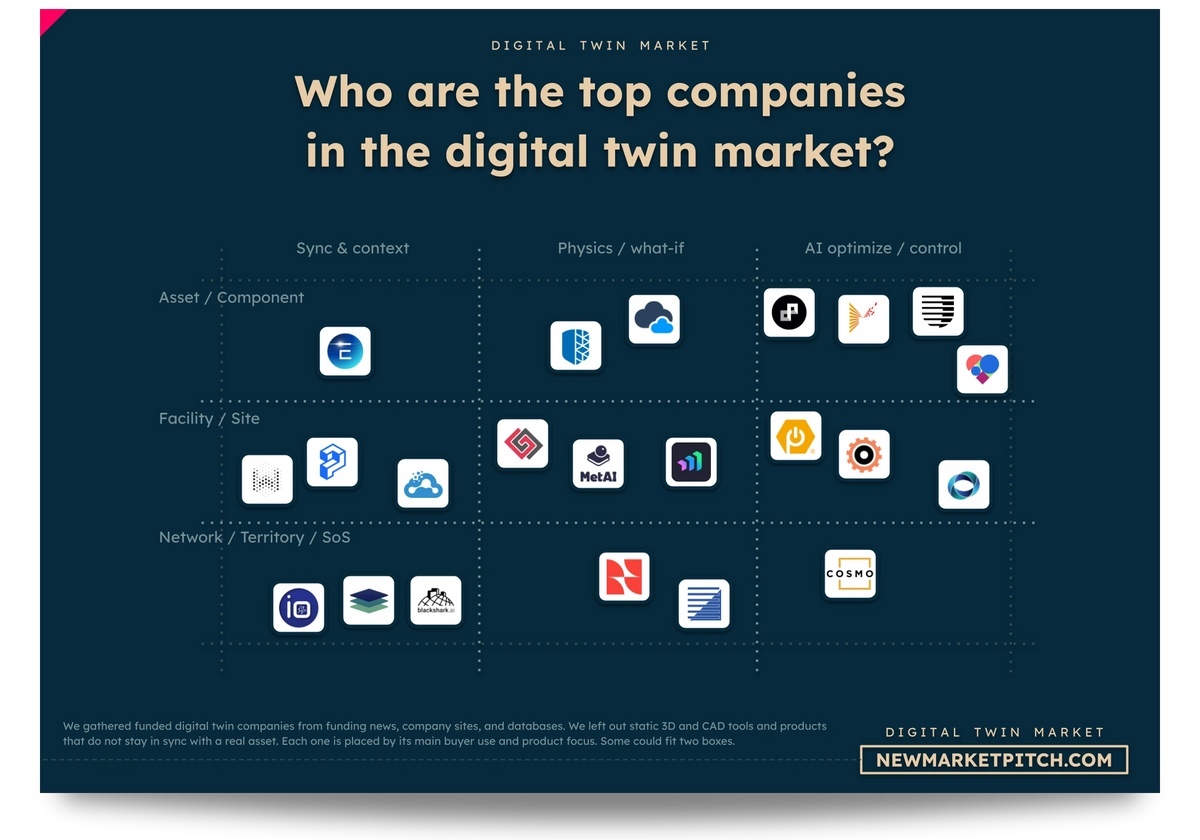
In our research about digital twins, we turn what is vague and complex into simple, useful visuals. Market maps like this one show you at a glance where every startup stands.
Which Digital Twin startups have raised the most money?
Matterport leads our Digital Twin funding ranking at about $409 million, followed by Twin Health at roughly $350 million-plus, COSMOPlat at $318 million and Buildots at about $297 million.
The top of the ranking has changed quite a lot lately. Buildots added $130 million in its latest round, taking its disclosed total to $297 million. Twin Health has continued raising late-stage money. Mujin raised another $134 million of equity as part of a larger financing package, while Exodigo, NavVis, RobCo and Neural Concept have all closed unusually large rounds.
The companies near the top also show how broad the Digital Twin market has become. Matterport digitizes physical spaces. Twin Health models human metabolism. Buildots tracks construction projects. Mujin and RobCo automate factories. Exodigo maps underground infrastructure. Cognite organizes industrial data. Factories, buildings and even metabolism all sit under this label, so we start by defining what counts in our report on digital twins.
There is already enough capital in the category for several very different Digital Twin businesses to reach serious scale.
| Startup | Approx. cumulative equity funding | Main use |
|---|---|---|
| Matterport | $409M | 3D spatial twins |
| Twin Health | ~$350M+ | Metabolic-health twins |
| COSMOPlat | $318M | Industrial internet |
| Buildots | $297M | Construction intelligence |
| Mujin | ~$245M | Industrial robotics |
| Exodigo | $214M+ verified by company; broader records higher | Underground infrastructure |
| Cognite | $225M | Industrial data |
| BuildingMinds | $170M | Real-estate data |
| NavVis | $160M+ | Spatial mapping |
| RobCo | $160M | Industrial robotics |
How much funding have Digital Twin startups raised altogether?
The 77 Digital Twin companies in our dataset have raised roughly $4.3 billion of identifiable equity funding, with most of that money concentrated in a surprisingly small group.
That $4.3 billion should be read as an analytical estimate rather than a perfectly closed accounting figure. Some older rounds remain partially disclosed, databases occasionally classify the same financing differently, and several companies have announced rounds without revealing the amount.
The concentration is much clearer than the exact decimal point. The top five companies account for roughly $1.6 billion. The top 10 represent about $2.6 billion, close to 60% of all funding in the dataset. By the top 20, roughly $3.7 billion has already been accounted for, or around 85% of the total.
So although our ranking contains 77 companies, most of the money sits inside a much smaller group of well-capitalized businesses.
Is Matterport really the best-funded Digital Twin company?
Matterport still ranks first in our Digital Twin funding data, although its $409 million total comes from a financing history that is quite different from a normal private startup.
The biggest reason is its transition to the public market. Matterport’s SPAC transaction included a $295 million PIPE backed by investors including BlackRock, Dragoneer, Fidelity, Tiger Global and Lux Capital. We count that PIPE because it was an equity investment into the company, while the SPAC trust cash itself does not belong in a cumulative startup-equity ranking.
Matterport later became part of CoStar Group. CoStar announced the acquisition at an estimated $1.6 billion enterprise value and completed it in 2025.
That history makes Matterport a useful benchmark for how much equity capital Digital Twin technology has attracted, although investors comparing private startups today will probably care more about companies such as Twin Health, COSMOPlat and Buildots.

In our market report about digital twins, we always try to gather several sources and make estimates that make sense, so you can work with solid numbers.
Which private Digital Twin startups have raised the most funding?
Twin Health, COSMOPlat and Buildots currently make up the clearest top group of independent Digital Twin companies, with each around or above the $300 million mark.
Twin Health’s financing history now stretches into very late-stage venture funding, with current funding databases showing roughly $350 million-plus raised. COSMOPlat stands at approximately $318 million in our reconstructed dataset. Buildots has reached $297 million following its new $130 million financing.
Below them, Mujin has roughly $245 million of identifiable equity funding in our reconstruction, Exodigo has disclosed more than $214 million itself, and Cognite stands around $225 million.
Those numbers change the scale of the market. Raising $100 million in total used to make a Digital Twin startup look unusually well funded. We now count around 15 companies at or above that level.
Which Digital Twin startups have raised the biggest rounds recently?
Buildots, Mujin, RobCo, Neural Concept, Exodigo and NavVis are responsible for some of the biggest recent Digital Twin rounds, and the checks are now reaching $100 million surprisingly often.
Buildots raised $130 million. Mujin raised $134 million of new equity. RobCo closed a $100 million Series C. Neural Concept also raised $100 million. Exodigo secured $96 million, while NavVis raised another $85 million.
PassiveLogic added $74 million, Neara raised AUD 90 million, equivalent to roughly the mid-$60 millions in US dollars around the announcement period, and Twin Health has also continued raising large late-stage rounds. Fresh capital on this scale is one of the market signals we track every quarter in our report covering the digital twin market.
Take ten of the largest recent rounds represented in our research and we get close to $900 million of fresh capital. That is a meaningful amount against a dataset whose entire cumulative funding base is only around $4.3 billion.
| Startup | Recent equity round | Amount |
|---|---|---|
| Mujin | Series D equity component | $134M |
| Buildots | Growth round | $130M |
| RobCo | Series C | $100M |
| Neural Concept | Series C | $100M |
| Exodigo | Series B | $96M |
| NavVis | Series D | $85M |
| PassiveLogic | Series C | $74M |
| Neara | Series D | AUD 90M |
| Twin Health | Late-stage round | ~$59M |
| Quibim | Series A | $50M |
What are the biggest Digital Twin funding rounds ever?
Individual Digital Twin funding rounds have now reached well into nine figures, with several private companies raising $100 million or more at once.
COSMOPlat’s roughly $155 million Series B remains one of the largest straightforward venture rounds in the dataset. Cognite raised $150 million from TCV. Mujin recently added $134 million of equity, Buildots raised $130 million, and both RobCo and Neural Concept closed $100 million rounds.
Exodigo’s $96 million Series B deserves attention because the company reached that scale relatively early. NavVis’ $85 million Series D and PassiveLogic’s $74 million Series C sit just below the $100 million threshold.
Matterport’s $295 million PIPE was much larger, although a PIPE attached to a SPAC transaction belongs to a different financing context from a conventional Series C or Series D.
A $100 million Digital Twin round is now plausible. Five years ago, that size of check was much harder to imagine outside a handful of category leaders.

Our document detailing everything you need to know about digital twin gets updated several times a month, so you always get the latest view of where things stand.
Why did Buildots just raise another $130 million?
Buildots raised $130 million because construction delays have become an expensive AI-infrastructure problem, and its software increasingly sits in the middle of that problem.
The round brings Buildots to $297 million raised. The company says its platform is used by more than 100 major construction firms, contractors and project owners, while its CEO has described several years of roughly tripling annual revenue.
Data centers make the timing especially interesting. Huge amounts of capital are being poured into AI infrastructure, and every delayed facility leaves expensive chips, electricity agreements and customer demand waiting for a building to be finished.
Buildots continuously captures what is happening on a construction site and compares actual progress with the plan. That makes the product increasingly useful for identifying delays early rather than documenting them after they become obvious.
Its $130 million round makes more sense when Buildots is viewed as software controlling expensive construction schedules rather than simply as a Digital Twin visualization company.
Is physical AI taking over the Digital Twin market?
Physical AI is becoming one of the clearest reasons investors are putting larger amounts of money into Digital Twin companies now.
RobCo’s $100 million Series C was explicitly raised to push its physical-AI roadmap and expand deployments of autonomous industrial robots. NavVis described its new $85 million Series D around creating the spatial-data foundation for physical AI. PassiveLogic raised $74 million to bring autonomous control into buildings and infrastructure. Twins that let machines act, not just people look, are a technology we split into working, tested and still on paper in our digital twin report.
Mujin offers another strong example. Its latest Series D included $134 million of equity and $99 million of debt, with NTT and Qatar Investment Authority co-leading the equity side. Mujin describes its technology around intelligent robotics, physical AI and digital-twin automation.
These companies all need software that understands the physical environment before machines can act inside it. Factories need representations of equipment and workflows. Buildings need models of their systems. Robots need geometry, constraints and live context.
Digital Twins are increasingly becoming part of the machinery behind physical AI, which gives investors a much bigger commercial story than visualization alone.
Are construction Digital Twin startups getting the most funding?
Construction and the built environment are currently one of the deepest pools of Digital Twin capital, with several companies already above $100 million raised.
Buildots sits at $297 million. BuildingMinds received roughly $170 million. NavVis has raised well over $150 million. DroneDeploy accumulated roughly $158 million in our dataset before its acquisition. PassiveLogic has also crossed $125 million according to its latest financing announcement.
Further down, Doxel has raised around $57 million, Cintoo roughly $50 million, Sensat approximately $36 million and Reconstruct at least $30 million.
There is also a strong commercial reason for this cluster. Construction involves constant gaps between plans and physical reality. Walls move, schedules slip, installations clash and work gets covered before someone notices a problem.
Reality capture, computer vision and Digital Twin software can now measure those changes much more frequently. Construction is therefore becoming one of the easiest places to connect better digital models with an immediate financial cost.

In our report covering the digital twin market, we look at what the winners do differently, so you can learn from the best instead of guessing.
Are industrial Digital Twin startups still attracting serious money?
Industrial Digital Twin companies remain heavily funded, and the strongest ones are moving deeper into AI, engineering and automation.
COSMOPlat has raised roughly $318 million in our dataset. Mujin has accumulated around $245 million of identifiable equity funding. Cognite sits around $225 million after a $150 million investment from TCV. Neural Concept reached roughly $138 million after raising a $100 million Series C.
Sight Machine has raised more than $80 million, while companies such as VEERUM, Cosmo Tech, DataMesh, TwinThread, Tignis, Samp and Energy Robotics extend the industrial part of the ranking.
The products are becoming more ambitious too. Neural Concept uses physics-aware AI to speed up engineering and simulation. Mujin controls industrial robots. Energy Robotics sends autonomous inspection robots through industrial environments. Samp creates digital representations of industrial sites from existing documentation and field data.
Industrial Digital Twins are increasingly tied to decisions, automation and engineering work rather than sitting separately as another enterprise-software dashboard.
Why are infrastructure Digital Twin startups raising so much money?
Infrastructure Digital Twin startups are attracting big rounds because they help answer questions that can move millions of dollars: where can we build, what is underground, how much load can the grid handle and which asset is likely to fail?
Exodigo raised $96 million in its Series B and said the financing brought total funding since launch to $214 million. The company combines multiple sensing technologies with AI to map underground utilities and other hidden infrastructure.
Neara raised AUD 90 million in its latest Series D. Its software builds physics-based models of electricity infrastructure, allowing utilities to understand capacity, vegetation risk, extreme-weather exposure and potential network upgrades.
Sensat focuses on large infrastructure projects, while SharperShape works around utility inspection and asset intelligence.
Electricity demand from AI data centers, electrification and grid expansion is making accurate infrastructure models more valuable right now. That gives companies such as Neara a much more urgent market than the phrase “Digital Twin software” might suggest. Grid expansion and aging networks are the kind of growth drivers we follow closely in our market report about digital twins.
Is healthcare becoming a real Digital Twin funding market?
Healthcare has quietly become one of the largest Digital Twin funding categories, led by Twin Health and Unlearn.
Twin Health has raised roughly $350 million-plus around its metabolic-health platform. Unlearn has raised more than $130 million and uses patient Digital Twins in clinical trials. Q Bio has raised around $85 million around whole-body health data, while Quibim raised $50 million in a Series A focused on AI medical imaging.
Smaller companies push the concept into other areas. Virtonomy creates virtual patients for medical-device testing. Ebenbuild models individual lungs. ELEM Biotech develops virtual-human simulation technology.
These companies are solving very different problems, so “healthcare Digital Twin” remains a broad label. What investors keep funding is the same underlying idea: a computational model of a patient can help make a real medical decision faster, cheaper or with more information.

In our research about digital twins, we don't want to repeat what boring consulting reports say. Instead, we show you the real and latest market signals that matter.
How much funding has Twin Health actually raised?
Twin Health is now one of the best-funded private Digital Twin companies, with current records putting cumulative funding at roughly $350 million-plus.
Its financing history includes a $140 million Series C in 2021, followed by additional late-stage funding. Twin Health itself announced another $53 million investment in 2025, and current venture databases record a subsequent financing round as well.
That repeated fundraising is more interesting than any single round. Twin Health has managed to keep bringing in large amounts of capital while moving far beyond the usual Series A-to-Series-C path.
The company also shows how far the Digital Twin concept has travelled. One of the largest businesses in our ranking now applies the technology to metabolism rather than a factory, building or machine.
How much funding has NavVis raised?
NavVis has raised well over $150 million and is now firmly inside the upper tier of Digital Twin startups after adding an $85 million Series D.
Its precise cumulative total varies across financing databases because older rounds are classified differently. Our dataset puts NavVis above $160 million, while some broader databases produce a higher figure.
The latest round itself is much clearer. NavVis announced an $85 million investment led by The Jordan Company alongside existing investors including Yttrium, KOZO KEIKAKU ENGINEERING and Cipio Partners.
The scale of the underlying platform is also growing quickly. NavVis says more than one billion square meters were scanned, processed and distributed during 2025 alone.
That helps explain why the company now talks about supplying spatial data for physical AI. A massive, continuously updated map of factories and other built environments becomes increasingly useful when AI systems and robots need to understand those spaces.
Which Digital Twin startups have raised more than $100 million?
Around 15 companies in our dataset have crossed roughly $100 million of cumulative equity funding, creating a clear top tier in the Digital Twin market.
The group spans spatial computing, construction, industrial software, robotics, infrastructure and healthcare. There is no single business model behind the largest funding totals. With no single business model behind the biggest totals, we compare which digital twin models make money and keep their margins in our digital twin market report.
Some companies also crossed $100 million very quickly. Neural Concept added $100 million in one Series C. RobCo did the same. Exodigo’s $96 million Series B pushed its company-confirmed total above $200 million.
The $100 million threshold therefore separates a relatively small group of heavily financed businesses from the much larger early-stage tail underneath them.
| Company | Approx. cumulative equity funding |
|---|---|
| Matterport | $409M |
| Twin Health | ~$350M+ |
| COSMOPlat | $318M |
| Buildots | $297M |
| Mujin | ~$245M |
| Cognite | $225M |
| Exodigo | $214M+ company-confirmed |
| BuildingMinds | $170M |
| NavVis | $160M+ |
| RobCo | $160M |
| DroneDeploy | ~$158M |
| PassiveLogic | $125M+ |
| Neural Concept | ~$138M |
| Unlearn | $130M+ |
| Neara | $120M+ |

Learning from others' mistakes is the cheapest lesson there is. In our market report about digital twins, we look at what broke startups before you, so you don't repeat it.
Who are the biggest investors in Digital Twin startups?
No venture firm controls Digital Twin funding, although TCV, Lightspeed, NVIDIA-linked capital and several large industrial investors keep appearing around major companies.
TCV invested $150 million in Cognite and later led Neara’s Series D. Lightspeed has backed Buildots and RobCo. Goldman Sachs Alternatives led Neural Concept’s $100 million round. NVIDIA’s NVentures has backed companies including PassiveLogic and Sight Machine.
Other well-known investors include Sequoia Capital in RobCo, Intel Capital in Buildots, Brookfield in PassiveLogic, Salesforce Ventures in Mujin and Partech in Cintoo.
The investor base has become much more mainstream as the rounds have grown. What once looked like a specialist industrial-software category now attracts global growth funds, sovereign capital, major corporate investors and large generalist venture firms.
Why are so many big companies investing in Digital Twin startups?
Corporate investors are unusually important in Digital Twin funding because customers, industrial partners and technology providers often overlap.
Schindler provided major backing to BuildingMinds. NTT participated heavily in Mujin’s latest financing. Intel Capital invested in Buildots. Johnson Controls and Prologis Ventures joined PassiveLogic. National Grid Partners backed Sensat. Ecolab invested in FTD Solutions.
These investors can bring more than money. A utility can provide infrastructure knowledge and deployment opportunities. An industrial company can expose a startup to real factories. A building-technology group can help software reach assets that would otherwise take years to access.
That makes corporate capital especially useful in a market where getting software into the physical world is often harder than building the software itself.
Is Digital Twin funding spread across the market or concentrated at the top?
Digital Twin funding is extremely concentrated: roughly 60% of the money in our dataset sits with the top 10 companies, while the top 20 account for around 85%.
This concentration explains why the market can look huge and early-stage at the same time. At one end, Buildots can raise $130 million in a single transaction. RobCo and Neural Concept can each raise $100 million. At the other, dozens of Digital Twin startups have accumulated less than $20 million.
Several companies have disclosed less than $1 million, and others have no verifiable outside funding at all. Those zero figures usually mean that we could not identify a public equity round; they should not be read as proof that a company has never received external capital.
Smaller companies can still compete by focusing on narrow problems. ANNEA works on renewable-energy asset maintenance, Ebenbuild on lung simulation, FTD Solutions on industrial water systems and Hexwise on heat-exchanger optimization. None needs to reproduce the entire platform of a $200 million company to build a useful product.
| Funding group | Approx. share of dataset |
|---|---|
| Top 5 companies | ~37% |
| Top 10 companies | ~60% |
| Top 20 companies | ~85% |
| Companies ranked 21–30 | ~9% |
| Remaining companies | ~6% |

If you build or invest in the digital twin market, you need to know which business models pay off now and which ones are fading. That's why our report covering it has a whole section on it.
Is AI really the reason Digital Twin funding rounds are getting bigger?
AI is clearly helping Digital Twin companies raise larger rounds, especially where it turns a static model into software that can predict or act.
Buildots uses AI to interpret construction progress. Neural Concept applies AI to engineering simulation. Exodigo combines sensing with AI to understand underground infrastructure. RobCo uses physical AI for industrial robots. Neara runs engineering analysis over digital models of electricity networks.
NavVis offers perhaps the clearest change in language: its latest financing was explicitly framed around becoming a data foundation for physical AI.
Investors are paying more attention because these products can increasingly influence what happens next in the physical world. A system can identify a construction delay, propose a design change, detect an infrastructure risk or help a robot adapt to a factory environment.
That additional capability gives Digital Twin companies access to much larger AI and automation budgets. Bigger AI and automation budgets mean new customers, and we profile who they are and what they would pay to solve in our digital twin market report.
Are Digital Twin startups getting acquired instead of going public?
Acquisitions are becoming an important exit route for Digital Twin startups, with Matterport and DroneDeploy providing two major recent examples.
CoStar completed its acquisition of Matterport in 2025 after initially valuing the transaction at roughly $1.6 billion in enterprise value. The strategic logic was straightforward: CoStar wanted Matterport’s 3D spatial technology inside its much larger real-estate data and marketplace business.
DroneDeploy followed a similar path in construction. Procore agreed to acquire the company for approximately $845 million in cash and completed the acquisition recently. DroneDeploy’s aerial imagery, ground capture, robotics and visual intelligence now sit inside a much larger construction software platform.
Our dataset also includes acquired companies such as LocusView, Seebo, OnScale, Tignis and TwinThread.
The pattern makes sense for Digital Twin technology because the model often becomes more valuable once it is connected directly to a larger workflow. Real-estate data, construction management and industrial operations can all absorb Digital Twin capabilities without customers needing a separate standalone category.
Does raising more money mean a Digital Twin startup is actually winning?
A bigger funding total shows investor conviction and access to capital, but it tells us much less about whether a Digital Twin company has built the strongest business.
The capital needs vary dramatically. RobCo and Mujin work with physical robotics. Exodigo deploys complex sensing technology in the field. Twin Health operates inside healthcare. Buildots sells software into large construction programs. Comparing their funding needs directly can therefore be misleading.
The same warning applies to funding efficiency. A company that reaches meaningful revenue with $30 million can create a better outcome than one that requires $200 million to reach the same point.
Funding still tells us something useful. Investors willing to commit $100 million in one round are making a strong bet on market size, technology and growth. What the number cannot tell us on its own is whether that bet will produce attractive economics.
So we use cumulative funding to rank financial backing, not overall company quality.

In our report covering the digital twin market, we like to show you the big picture. We know your time is precious, so we make every page quick to read and packed with as much learning as possible per minute.
Where is Digital Twin startup funding really going now?
Digital Twin funding is increasingly flowing toward AI systems that understand and act on the physical world, with construction, industrial automation, infrastructure, engineering and healthcare taking most of the biggest checks.
The funding distribution makes that direction hard to miss. Our 77-company dataset contains roughly $4.3 billion of identifiable equity funding, yet the top 20 companies hold around 85% of it. Recent rounds include $130 million for Buildots, $134 million of equity for Mujin, $100 million for RobCo, $100 million for Neural Concept, $96 million for Exodigo and $85 million for NavVis.
Those companies solve very concrete problems. Buildots tries to keep expensive construction projects on schedule. Mujin and RobCo automate factory work. Exodigo maps infrastructure hidden underground. Neara models electricity networks. Neural Concept speeds up engineering. Twin Health models individual metabolism.
The Digital Twin label itself may become less visible as these companies grow. Customers increasingly buy construction intelligence, physical AI, autonomous robotics, engineering AI or grid analysis, with Digital Twin technology sitting underneath.
The market is broader than the name suggests. The strongest funding today is going to companies that turn a digital representation of reality into a decision, prediction or physical action.
Our methodology
This analysis ranks companies in the digital twin market by cumulative equity funding raised. The objective is to reconstruct a checkable funding history for each company rather than repeat a headline total from a single database.
We focused on companies whose products are meaningfully centered on Digital Twin technology or closely related digital representations of physical systems, environments or people. Broad technology companies where Digital Twins are only a minor activity were generally left out.
For each company, we reconstructed funding round by round wherever the public record allowed it. We used company and investor announcements, regulatory filings, official press releases, reputable financial and industry reporting, and venture databases to identify round dates, amounts, financing types and major investors.
The ranking includes equity financing. Debt, grants and other non-equity capital were excluded wherever those components could be separated. Mujin’s latest $233 million headline financing, for example, included $134 million in equity and $99 million in debt, so only the equity portion is included in the comparison.
Matterport required separate treatment because its funding history includes a $295 million PIPE attached to its SPAC transaction. We count that PIPE as equity investment into the company, but not the SPAC trust cash itself.
When sources disagreed, we gave more weight to direct company or investor disclosures and authoritative filings. We kept older rounds because this is a cumulative ranking, while recent financing searches were used to catch new rounds and changes in company status.
Approximate figures and lower-bound totals are used where older rounds were disclosed incompletely or classified differently across databases. The roughly $4.3 billion market total should therefore be read as an analytical estimate, while the concentration of funding at the top is much more robust than the exact decimal point.
Key sources include Buildots on its $130 million round and $297 million cumulative funding, Mujin on its $233 million Series D package, RobCo on its $100 million Series C, Neural Concept on its $100 million Series C, Exodigo on its $96 million Series B and $214 million cumulative funding, NavVis on its $85 million Series D, Neara on its AUD 90 million Series D, and PassiveLogic on its $74 million Series C.
Other important references include Cognite on TCV’s $150 million investment, Twin Health on its 2025 $53 million investment, CB Insights on Twin Health’s financing history, DCVC on Unlearn’s $50 million Series C and cumulative funding, Quibim on its $50 million Series A, and Cintoo on its €37 million Series B.
For Matterport and recent exits, we also used Matterport’s SPAC announcement, Matterport’s SEC filing confirming the $295 million PIPE, CoStar’s Matterport acquisition announcement, the Matterport acquisition completion announcement, Procore’s $845 million DroneDeploy acquisition announcement, and Procore’s confirmation that the DroneDeploy acquisition was completed.
The underlying market page is New Market Pitch’s digital twin market page.

When you build or invest in the digital twin market, you need clarity, not confusion. In our research about digital twins, we always try to put numbers on and quantify whatever is usually vague and confusing.
Written by the New Market Pitch teamWe track new markets so founders and investors can move faster. About us