Digital Twin Funding Tracker (102 deals)
Whether you're building or investing in the digital twin market, our report covers everything you need to know: the players, the money, and what's coming next.
Summary
Across 102 tracked deals, digital twin funding remains substantial in 2026, but the market has become noticeably narrower, with fewer companies raising and a larger share of capital flowing to established scale-ups.
From January through August 2026, we tracked 15 financings worth about $309 million, versus 25 deals and roughly $326 million over the same period in 2025. Deal count fell 40% while capital barely moved.
That resilience in dollars is mostly an upper-end story. NavVis, Antioch and Buildots raised $247 million between them in recent financings, enough to make a slower market look much healthier from the headline total alone.
The full market is also quite concentrated. Seven rounds above $50 million account for 40% of quantified capital, while the ten largest recipient companies hold 52.9% of everything we tracked. No single deal explains the market, but a relatively small group does.
For an ordinary startup, the funding benchmark is much lower: the median round is $5 million, 48% of all financings are below $5 million, and roughly three quarters remain below $20 million. The median first external financing is only about $1.57 million.
The market splits sharply by stage. Seed and Series A make up 76.9% of classified financings but receive only 33.5% of classified capital; Series B through Growth account for less than a quarter of deals and take two thirds of the money. Series B is the obvious pinch point, with only eight rounds versus 26 Series A financings.
Capital is also clustering around digital twins that sit close to expensive real-world operations. Asset, process, building and infrastructure platforms dominate funding, while factory-only software and implementation services together account for just five deals and about $17 million.
The biggest checks usually arrive late. Companies raising more than $50 million have a median age of roughly nine years, compared with around three years for companies raising below $5 million. The $70 million to $130 million rounds are mostly paying for businesses that have already spent years proving deployments, integrations and repeatability.
Strategic investors are unusually visible here. They appear in 33 of 102 financings, and those rounds have a median size of about $8.66 million versus $3.68 million when no strategic investor is identified. In a market built around grids, factories, buildings, warehouses and other physical systems, access to customers and operating infrastructure can be almost as useful as the capital.
Europe leads deal formation, North America produces much larger typical rounds, and the lead-investor base remains fragmented. Taken together, the numbers suggest that digital twin technology is spreading across several industries, but fundraising still behaves like a collection of sector-specific markets rather than one mature standalone venture category.

Written by the New Market Pitch teamWe track new markets so founders and investors can move faster. About us

In our report covering the digital twin market, you will always find fresh funding data, taken straight from our own verified funding database.
Our funding tracker covering the digital twin market
Below is the table listing all the deals. You may find our methodology at the end of this page.
And, if you want to gain a deeper understanding of the market and its current dynamics, get our report covering the Digital Twin Market.
| Company | Category | Date | Stage | Deal size | What they do | Region | Lead investors | Country |
|---|---|---|---|---|---|---|---|---|
| Buildots | Building Twin Software | September 2026 | Series D+ | $130M | Uses computer vision, BIM, schedules, and recurring site captures to maintain digital twins of construction projects for progress tracking and delay forecasting. | Middle East | O.G. Venture Partners | Israel |
| Antioch | Asset Twin Platforms | September 2026 | Series A | $32M | Provides a cloud platform that converts real robots and autonomous systems into telemetry-calibrated digital twins for parallel simulation, testing, and validation. | North America | Greylock Partners | United States |
| GridSight | Infrastructure Twin Systems | September 2026 | Series B | $26M | Builds AI-powered electrical digital twins of distribution grids using utility operational data and physics to model capacity and optimize grid connections and operations. | Asia-Pacific | Insight Partners | Australia |
| Bios Life | Process Twin Applications | August 2026 | Seed | $25M | Maintains continuously updated patient digital twins from genomic, clinical, laboratory, and lifestyle data to personalize cancer screening and survivorship surveillance. | North America | Redmile; Vsquared Ventures; Kindred Capital | United States |
| NavVis | Asset Twin Platforms | August 2026 | Series D+ | $85M | Provides survey-grade reality capture and the NavVis IVION platform to maintain always-current spatial twins of factories, plants, buildings, and infrastructure. | Europe | The Jordan Company | Germany |
| Reform Technologies | Process Twin Applications | June 2026 | Seed | ≈$1.1M | Builds digital twins of banks' live AML transaction-monitoring environments so institutions can simulate, validate and optimize control changes before production deployment. | Europe | Not disclosed | Belgium |
| Gigaton | Process Twin Applications | June 2026 | Series A | $26M | Continuously models live industrial-plant processes in digital twins to predict operating behavior, simulate control changes and autonomously optimize production. | Europe | Plural | United Kingdom |
| ConeLabs | Infrastructure Twin Systems | June 2026 | Seed | $1.5M | Creates AI-powered 3D digital twins of bridges, roads and other infrastructure from field imagery for defect detection, change tracking and inspection workflows. | North America | Spatial Capital | Canada |
| Sensat | Infrastructure Twin Systems | May 2026 | Unknown | $4M | Provides geospatial AI software that creates and maintains digital twins of civil infrastructure projects and assets for planning, monitoring and delivery optimization. | Europe | Mercia Ventures | United Kingdom |
| JuliaHub | Asset Twin Platforms | April 2026 | Series B | $65M | Platform (Dyad) that builds physics-based digital twins of engineered systems | North America | Dorilton Capital | United States |
| SPREAD AI (SPREAD GmbH) | Asset Twin Platforms | April 2026 | Series B | $30M | Builds live Product Twins that unify engineering, manufacturing, operations, and service data for complex industrial products. | Europe | OTB Ventures | Germany |
| Antaris, Inc. | Asset Twin Platforms | March 2026 | Series A | $28M | Provides full-mission virtualization software whose TrueTwin environment models satellite systems and mission behavior from design through on-orbit operations. | North America | WestWave Capital | United States |
| ThinkLabs | Infrastructure Twin Systems | March 2026 | Series A | $28M | Provides physics-informed AI digital twins and high-performance simulation for electric-grid planning and operations. | North America | Energy Impact Partners | United States |
| Enline | Infrastructure Twin Systems | March 2026 | Unknown | ≈$2.3M | Provides live, sensorless multi-physics digital twins of power grids for monitoring, forecasting, capacity optimization and operational decision-making. | Europe | Not disclosed | Portugal |
| Prevu3D Inc. | Asset Twin Platforms | March 2026 | Unknown | ≈$3.7M | Provides an as-built digital-twin platform that turns repeat reality-capture data into up-to-date interactive industrial facility models linked to engineering and enterprise systems. | North America | Not disclosed | Canada |
| Neara | Infrastructure Twin Systems | February 2026 | Series D+ | ≈$63M | Builds physics-enabled digital twins of power and critical-infrastructure networks for engineering analysis, scenario simulation, planning, and operations. | Asia-Pacific | TCV | Australia |
| SPACE AIC Co., Ltd. (天空智算互联网科技(上海)有限责任公司) | Infrastructure Twin Systems | February 2026 | Seed | ≈$1.4M | Builds satellite-network digital-twin systems for constellation planning, real-time simulation and prediction, hardware-in-the-loop validation, and intelligent operations. | Asia-Pacific | Fudan Science & Technology Innovation (复旦科创) | China |
| Powerline | Asset Twin Platforms | February 2026 | Seed | $7M | Runs continuously updated AI digital twins of battery projects and portfolios using operational and market data for benchmarking, scenario testing, and optimization. | North America | MaC Venture Capital | United States |
| AVES Reality GmbH | Infrastructure Twin Systems | January 2026 | Seed | ≈$3.2M | Generates georeferenced, simulation-ready digital twins of real environments from satellite and aerial data, with live and periodic data integration for monitoring and what-if simulation. | Europe | Matterwave Ventures | Germany |
| Sim&Cure | Process Twin Applications | November 2025 | Series A | ≈$11.6M | Provides patient-specific digital twins that let clinicians simulate and optimize neurovascular device placement and endovascular treatments before intervention. | Europe | Elaia | France |
| Parallax Worlds | Factory Twin Software | November 2025 | Seed | $4M | Creates high-fidelity digital twins of factories and warehouses so robotics teams can stress-test and optimize robots before physical deployment. | North America | Pear VC | United States |
| Mondra | Process Twin Applications | October 2025 | Series A | $13.3M | Maintains product-level digital twins of food supply chains for live environmental, price and climate-risk tracking and sourcing scenario analysis. | Europe | AlbionVC; Planet A Ventures | United Kingdom |
| etalytics | Process Twin Applications | October 2025 | Series A | $9.3M | Maintains digital twins of industrial energy, HVAC and cooling systems for real-time monitoring, predictive analysis, scenario simulation and autonomous operating optimization. | Europe | M12 | Germany |
| TaDa | Building Twin Software | October 2025 | Seed | $2.3M | Creates continuously updated digital twins of homes and commercial or industrial spaces from smart-meter data to disaggregate loads, detect anomalies and optimize energy consumption. | Europe | Italian Founders Fund (IFF); Nextalia Ventures | Italy |
| Dexory | Process Twin Applications | October 2025 | Series C | $100M | Combines autonomous scanning robots with DexoryView to maintain a live digital twin of warehouse inventory and operations for continuous visibility and optimization. | Europe | Eurazeo | United Kingdom |
| Enurgen | Asset Twin Platforms | October 2025 | Seed | $4.1M | Maintains physics-based digital twins of utility-scale solar plants from design through operations, reconciling field performance with modeled output to detect and optimize losses. | North America | Business Development Bank of Canada (BDC); Brightspark; Diagram | Canada |
| Cyberwave | Asset Twin Platforms | October 2025 | Seed | $8.1M | Maintains synchronized programmable digital twins of robots, sensors and machines for live control, telemetry, simulation and AI-driven physical automation. | Europe | United Ventures | Italy |
| Intangles | Asset Twin Platforms | October 2025 | Series B | $30M | Creates data-driven digital twins of vehicles from live telematics to predict component failures and optimize fleet maintenance and performance. | Asia-Pacific | Avataar Venture Partners | India |
| Metreecs | Process Twin Applications | October 2025 | Seed | $2.7M | Maintains digital twins of retailers' distribution networks to combine inventory and external signals for forecasting, allocation, replenishment and rebalancing decisions. | Europe | Not disclosed | France |
| CYVL | Infrastructure Twin Systems | October 2025 | Series A | $14M | Builds continuously refreshed digital twins of roads, sidewalks and municipal assets from vehicle-mounted LiDAR and imagery for condition monitoring, planning and maintenance optimization. | North America | Sentinel Global | United States |
| Optimuse | Building Twin Software | October 2025 | Seed | $4.7M | Creates building digital twins used for physics-based energy simulation, variant analysis and operational performance optimization using building, consumption and sensor data. | Europe | seed + speed Ventures; Blum Ventures | Austria |
| Cetasol AB | Asset Twin Platforms | September 2025 | Seed | ≈$2.7M | Provides continuously updated vessel and engine digital twins through iHelm for fuel, operational-performance and predictive-maintenance optimization. | Europe | BackingMinds; Shift4Good | Sweden |
| C2GRID | Infrastructure Twin Systems | September 2025 | Seed | ≈$354K | Creates near-real-time 3D digital twins of evolving battlespaces from UAV and video feeds for situational awareness, change detection and mission planning. | Europe | Sunfish Partners | Estonia |
| PassiveLogic | Building Twin Software | September 2025 | Series C | $74M | Provides physics-based real-time digital twins and autonomous-control software for buildings and building systems. | North America | noa | United States |
| Crion Technologies Private Limited | Asset Twin Platforms | September 2025 | Unknown | ≈$398K | Provides the Clonos industrial digital-twin platform for live asset monitoring, simulation, predictive maintenance and remote asset management. | Asia-Pacific | SIG Tattva | India |
| Teton.ai | Process Twin Applications | September 2025 | Series A | $20M | Maintains live digital twins of residents, spaces and care delivery using computer vision to support continuous monitoring and predictive care. | Europe | Plural | Denmark |
| Red Dot Analytics Pte. Ltd. | Infrastructure Twin Systems | August 2025 | Seed | Not Disclosed | Builds AI- and physics-driven data-center digital twins using live infrastructure data for simulation, capacity planning, energy optimization and predictive maintenance. | Asia-Pacific | Granite Asia | Singapore |
| Twin Health | Process Twin Applications | August 2025 | Series D+ | $53M | Creates continuously updated metabolic digital twins from connected-device, laboratory and behavioral data to optimize chronic metabolic care. | North America | Maj Invest | United States |
| Beijing Freedo Technology Co., Ltd. (北京飞渡科技股份有限公司) | Asset Twin Platforms | August 2025 | Unknown | Not Disclosed | Develops a cross-industry digital twin platform combining spatial data, real-time rendering, simulation and AI for cities, buildings, infrastructure and factories. | Asia-Pacific | Not disclosed | China |
| Bisly | Building Twin Software | August 2025 | Series A | ≈$5M | Provides building automation software and controls centered on a real-time digital twin of each building for diagnostics and continuous energy and performance optimization. | Europe | 2C Ventures | Estonia |
| Makersite GmbH | Asset Twin Platforms | July 2025 | Series B | $70.2M | Creates digital twins of manufactured products and supply chains from enterprise product data to optimize cost, sustainability, compliance and sourcing decisions. | Europe | Lightrock; Partech | Germany |
| Dockware, Inc. | Asset Twin Platforms | July 2025 | Seed | $2.5M | Creates real-time digital twins of freight shipments from computer-vision scans to validate identity, dimensions, condition and downstream handling. | North America | Zenda Capital | United States |
| RTDT Laboratories AG | Asset Twin Platforms | July 2025 | Seed | $4M | Creates real-time digital twins of wind turbines using blade-mounted sensors and physics/data-driven analytics to optimize control, design and maintenance. | Europe | Swisscom Ventures | Switzerland |
| Cosma | Twin Implementation Services | June 2025 | Seed | ≈$2.9M | Uses autonomous underwater surveys, photogrammetry and AI to create repeatable digital twins of the seabed for environmental and subsea-infrastructure monitoring. | Europe | Wind; Ternel | France |
| Tibo Energy | Infrastructure Twin Systems | June 2025 | Seed | ≈$7M | Models commercial and industrial energy systems as site-specific digital twins used for scenario simulation and subsequent real-time asset control. | Europe | KOMPAS VC | Netherlands |
| RIIICO | Factory Twin Software | June 2025 | Seed | $5M | Converts LiDAR scans of existing factories into editable, simulation-ready digital twins for factory redesign and reconfiguration. | Europe | Pi Labs | Germany |
| Skyral | Infrastructure Twin Systems | June 2025 | Series A | $20M | Creates strategic digital twins combining human-behaviour models with real-time and projected infrastructure systems for large-scale simulation. | Europe | NOIA Capital | United Kingdom |
| MDsim | Process Twin Applications | June 2025 | Seed | ≈$2.6M | Develops patient-specific biomechanical digital twins of the spine for degeneration prevention and treatment and surgery planning. | Europe | Kadmos Capital | Luxembourg |
| Buildots | Building Twin Software | May 2025 | Series D+ | $45M | Uses recurring 360-degree site captures, BIM and schedules to maintain digital twins of construction projects for progress tracking, forecasting and operational optimization. | Middle East | Qumra Capital | Israel |
| Converge | Process Twin Applications | May 2025 | Series A | $22M | Provides ConcreteDNA, which combines embedded sensors, AI and BIM-linked real-time data to maintain and simulate a digital twin of concrete performance and concreting activity. | Europe | ABN AMRO Sustainable Impact Fund | United Kingdom |
| Rhizome | Infrastructure Twin Systems | May 2025 | Seed | $6.5M | Maintains data-driven representations of utility grids using asset, outage, condition and climate data to simulate infrastructure risks and compare resilience investments. | North America | Base10 Partners | United States |
| VEERUM | Asset Twin Platforms | May 2025 | Series B | $8.7M | Provides an industrial digital-twin and visual-operations platform that unifies reality-capture, engineering and operational data for remote asset monitoring, inspection and decision-making. | North America | Veriten; Emerson Ventures | Canada |
| Gradyent | Infrastructure Twin Systems | April 2025 | Series B | ≈$30.3M | Provides a real-time digital twin platform that synchronizes geographical, weather and sensor data with physics-based and AI models to optimize heating, cooling, steam and CO₂ grids. | Europe | Blue Earth Capital | Netherlands |
| Prorizon Ltd | Process Twin Applications | February 2025 | Seed | $504K | Builds continuously updated individual mind-body digital twins from biopsychosocial data to predict stress, health and performance and recommend interventions. | Europe | GC Angels | United Kingdom |
| ACCURE Battery Intelligence | Asset Twin Platforms | February 2025 | Series B | $16M | Maintains physics- and AI-based digital twins of battery systems from live operational data to monitor safety, predict degradation and optimize performance. | Europe | Incharge Capital Partners | Germany |
| Aetos Imaging, Inc. | Building Twin Software | February 2025 | Series A | $4M | Creates operational 3D digital twins of facilities that connect equipment data, maintenance workflows, training and remote collaboration. | North America | Flyover Capital; Tech Square Ventures | United States |
| Basetwo Artificial Intelligence Inc. | Process Twin Applications | January 2025 | Series A | $11.5M | Provides physics-informed digital twins for pharmaceutical and chemical processes to run virtual experiments and optimize production in real time. | North America | AVP | Canada |
| Aleph Digital Technologies Pte. Ltd. | Process Twin Applications | January 2025 | Seed | $750K | Provides AI-driven process digital twins that simulate and optimize operating parameters in chemical, pharmaceutical and other process plants. | Asia-Pacific | Cocoon Capital | Singapore |
| Scenexus B.V. | Infrastructure Twin Systems | January 2025 | Seed | ≈$1.7M | Provides predictive city and regional digital twins for interactive scenario analysis across mobility, land use, environment and infrastructure planning. | Europe | LUMO Labs | Netherlands |
| MetAI Technology | Factory Twin Software | January 2025 | Seed | $4M | Creates simulation-ready industrial digital twins for semiconductor fabs, warehouses and automation systems, including synthetic data and physical-AI training. | Asia-Pacific | Not disclosed | Taiwan |
| Varadise Limited | Building Twin Software | January 2025 | Series A | $3M | Provides a construction digital-twin platform combining BIM/GIS, IoT and analytics to manage projects, facilities and built assets across their lifecycle. | Asia-Pacific | Betatron Venture Group | Hong Kong |
| EKORE | Building Twin Software | December 2024 | Seed | ≈$1.4M | Provides cloud building digital twins combining BIM, IoT, BMS and energy data for monitoring, predictive maintenance and energy optimization. | Europe | SOM S.p.A.; HabiSmart | Italy |
| Terria | Infrastructure Twin Systems | December 2024 | Seed | ≈$1.9M | Provides a browser-based spatial digital-twin platform integrating live geospatial data to model buildings, cities, regions and infrastructure for planning and what-if analysis. | Asia-Pacific | Main Sequence | Australia |
| Syro | Process Twin Applications | December 2024 | Series A | ≈$7.9M | Provides vessel-specific digital-twin software that continuously updates voyage and vessel-setting recommendations using operational, weather and vessel data. | Europe | alter equity | France |
| etalytics | Process Twin Applications | November 2024 | Series A | ≈$8.4M | Provides real-time asset and process digital twins that combine AI and physical models to predict and autonomously optimize industrial energy systems. | Europe | Alstin Capital; ebm-papst | Germany |
| Indeex | Process Twin Applications | November 2024 | Seed | ≈$1.1M | Connects to industrial production equipment to maintain real-time process twins for monitoring, traceability, fault detection, and operational optimization. | Europe | Uni.Fund | Greece |
| Meissa Inc. | Infrastructure Twin Systems | November 2024 | Series C | >$7.1M | Provides drone- and satellite-fed digital twins of construction sites and infrastructure for mapping, progress tracking, deviation analysis and remote monitoring. | Asia-Pacific | Not disclosed | South Korea |
| METRON | Process Twin Applications | November 2024 | Growth Equity | ≈$13M | Runs real-time digital twins of industrial energy systems to monitor consumption, simulate scenarios, detect performance drift and optimize plant energy use. | Europe | GET Fund | France |
| Nominal Systems (now Zendir) | Asset Twin Platforms | November 2024 | Seed | ≈$2.2M | Provides digital-twin software for spacecraft and satellites spanning mission design, testing, telemetry-linked operations and asset management. | Asia-Pacific | Investible; Beaten Zone Venture Partners | Australia |
| Flyted S.r.l. | Twin Implementation Services | November 2024 | Series A | ≈$1.1M | Creates and maintains 3D digital twins of infrastructure, buildings and construction sites using drones, LiDAR, photogrammetry and its TED monitoring platform. | Europe | Not disclosed | Italy |
| Scalpel AI | Asset Twin Platforms | October 2024 | Series A | $4.8M | Creates and updates digital twins of surgical instruments to track and validate each tool through the healthcare supply chain. | Europe | Mercia Ventures | United Kingdom |
| Neara | Infrastructure Twin Systems | October 2024 | Series C | $31M | Creates physics-enabled digital twins of utility and critical-infrastructure networks for monitoring, scenario simulation, risk analysis, and asset optimization. | Asia-Pacific | EQT | Australia |
| inHEART | Asset Twin Platforms | October 2024 | Series A | ≈$810K | Creates patient-specific AI-driven heart twins from CT/MRI and integrates them into electroanatomic mapping workflows for procedure planning and guidance. | Europe | Not disclosed | France |
| EVO Human Performance | Asset Twin Platforms | October 2024 | Seed | ≈$1.3M | Builds athlete-specific musculoskeletal digital twins from biomechanical and sensor data for continuous load monitoring and performance optimization. | Europe | Not disclosed | Greece |
| FTD Solutions Inc. | Process Twin Applications | October 2024 | Series A | $10M | Maintains live digital twins of industrial water systems using plant data to monitor operations, simulate scenarios, and optimize reliability, cost, and sustainability. | North America | Not disclosed | United States |
| Stream.Security | Infrastructure Twin Systems | October 2024 | Series B | $30M | Maintains a real-time twin of live cloud infrastructure to model exposures, attack paths, breach impact, and security response. | Middle East | U.S. Venture Partners | Israel |
| Multiscale Technologies, Inc. | Process Twin Applications | September 2024 | Unknown | $11.1M | MIND builds and deploys data-driven digital twins of semiconductor manufacturing processes from process, metrology, inspection and simulation data for optimization and predictive decision-making. | North America | Not disclosed | United States |
| Samp | Asset Twin Platforms | September 2024 | Series A | ≈$6.6M | Creates continuously updateable AI-generated digital twins of industrial sites for asset monitoring, inspection, maintenance and modification planning. | Europe | Promus Ventures | France |
| Ainwater | Process Twin Applications | August 2024 | Seed | $537K | Provides a digital twin application for water and wastewater treatment plants that ingests operational data to monitor, predict and optimize plant parameters. | Latin America | Südlich Capital | Chile |
| 51WORLD (Beijing 51WORLD Digital Twin Technology Co., Ltd.) | Asset Twin Platforms | August 2024 | Growth Equity | ≈$28M | Provides cross-industry digital twin platforms that maintain virtual representations of real-world cities, infrastructure and industrial assets for real-time monitoring, simulation and optimization. | Asia-Pacific | Nanning Huanxin Capital | China |
| Optimise-AI | Building Twin Software | July 2024 | Seed | ≈$951K | Uses building digital twins, energy models, BMS data, and AI to simulate and optimize energy use and carbon emissions in non-domestic buildings. | Europe | Development Bank of Wales | United Kingdom |
| nhance.ai | Building Twin Software | July 2024 | Seed | $1.5M | Provides a building digital-twin operating platform connecting building systems and data for performance monitoring and AI-driven optimization. | Asia-Pacific | Not disclosed | India |
| Q Bio | Process Twin Applications | July 2024 | Unknown | $27M | Builds a clinical digital-twin platform around quantitative whole-body scanning to monitor anatomy and physiology longitudinally and model health risks. | North America | Not disclosed | United States |
| Buildots | Building Twin Software | July 2024 | Series D+ | $15M | Maintains computer-vision digital twins of active construction sites from recurring 360° captures to track progress, predict delays, and optimize execution. | Middle East | Intel Capital | Israel |
| Sensorita | Asset Twin Platforms | July 2024 | Seed | $3.3M | Uses connected radar/GPS sensors and AI to maintain digital twins of waste containers for fill, location, collection, and recycling optimization. | Europe | Brick & Mortar Ventures | Norway |
| SIMLAB | Building Twin Software | July 2024 | Series A | ≈$3.4M | Maintains building digital twins combining spatial models and IoT data for construction monitoring, building automation, and lifecycle asset management. | Europe | Carpathian Partners | Poland |
| Kodifly | Infrastructure Twin Systems | July 2024 | Seed | $750K | Creates LiDAR- and video-updated digital twins of transport infrastructure for real-time monitoring, safety analytics, and asset management. | Asia-Pacific | Laidlaw Scholars Ventures | Hong Kong |
| SIMSYSGLOBAL Inc. (심시스글로벌) | Asset Twin Platforms | June 2024 | Series A | ≈$2.2M | Provides AI-enabled digital-twin platforms that synchronize physical spaces and infrastructure with 3D virtual models for monitoring, simulation and optimization. | Asia-Pacific | Not disclosed | South Korea |
| Cupix, Inc. | Building Twin Software | May 2024 | Series C | ≈$19.1M | Creates time-stamped 4D digital twins of construction sites and facilities from 360° capture to track as-built conditions, progress, and design deviations. | Asia-Pacific | Atinum Investment | South Korea |
| ThinkLabs | Infrastructure Twin Systems | May 2024 | Seed | $5M | Builds a physics-informed AI digital twin of the electric grid that continuously models grid conditions for planning and control-room recommendations. | North America | Powerhouse Ventures; Active Impact Investments | United States |
| inHEART | Asset Twin Platforms | May 2024 | Series A | $11M | Builds patient-specific AI-driven digital twins of the heart from CT/MR imaging for cardiac procedure planning and predictive modeling. | Europe | Vesalius Biocapital IV; Elaia Partners | France |
| Cetasol AB | Asset Twin Platforms | April 2024 | Seed | $2.1M | Creates continuously updated vessel digital twins from operational data to optimize fuel use, performance, and energy efficiency. | Europe | Not disclosed | Sweden |
| Emission Twin (The Ontology Way AB) | Process Twin Applications | April 2024 | Unknown | $330K | Builds digital twins of corporate climate and value-chain data so companies can simulate and prioritize emissions-reduction actions. | Europe | Not disclosed | Sweden |
| Cloudworx Technologies Pvt. Ltd. | Asset Twin Platforms | April 2024 | Seed | $600K | Provides a no-code web platform for creating and maintaining live digital twins of industrial assets and facilities linked to operational data. | Asia-Pacific | Venture Catalysts; 1Crowd | India |
| TwinLabs.ai | Asset Twin Platforms | March 2024 | Seed | $500K | Provides a real-time SaaS digital-twin platform that integrates live sensor and business data into virtual representations of venues, events and other physical environments for monitoring and optimization. | Europe | Not disclosed | United Kingdom |
| Tomorrow Things GmbH | Asset Twin Platforms | March 2024 | Seed | ≈$1.6M | Provides an industrial platform that creates connected digital twins of machines and equipment for real-time data collection, monitoring and operational optimization. | Europe | High-Tech Gründerfonds (HTGF); neoteq ventures | Germany |
| Looq AI | Infrastructure Twin Systems | February 2024 | Seed | $2.6M | Creates survey-grade, georeferenced digital twins of critical infrastructure from repeated field capture for engineering, inspection, analysis, and asset intelligence. | North America | BootstrapLabs | United States |
| Threedy GmbH | Asset Twin Platforms | February 2024 | Series A | $10.4M | Provides instant3Dhub, an industrial spatial-computing platform linking live 3D engineering data with source-system, business, and sensor data for asset digital twins. | Europe | LBBW Venture Capital | Germany |
| Myrspoven AB | Building Twin Software | February 2024 | Unknown | $5.8M | Runs continuously updated AI models of individual buildings using BMS and external data to predict and optimize HVAC energy use and indoor climate. | Europe | 4impact capital; Vantaa Energy; AMAVI Capital | Sweden |
| Willow Technology Corporation Ltd. (Willow) | Building Twin Software | January 2024 | Unknown | $12M | Provides operational digital twins of buildings and built assets by combining spatial, asset and live system data for monitoring, analysis and optimization. | Asia-Pacific | Not disclosed | Australia |
| Enline | Infrastructure Twin Systems | January 2024 | Seed | $3.8M | Provides sensorless digital twins of electricity grids and energy assets for real-time monitoring, forecasting, simulation and operational optimization. | Europe | Criteria Venture Tech | Portugal |
| Geminus AI | Process Twin Applications | January 2024 | Series A | $13M | Provides physics-informed digital twins of complex industrial systems using operational data and simulation for real-time prediction, optimization and control. | North America | SLB | United States |
| Tibo Energy | Infrastructure Twin Systems | January 2024 | Seed | $3.3M | Provides software that creates, simulates and controls digital versions of commercial and industrial energy networks using real-time data and forecasts. | Europe | SET Ventures | Netherlands |

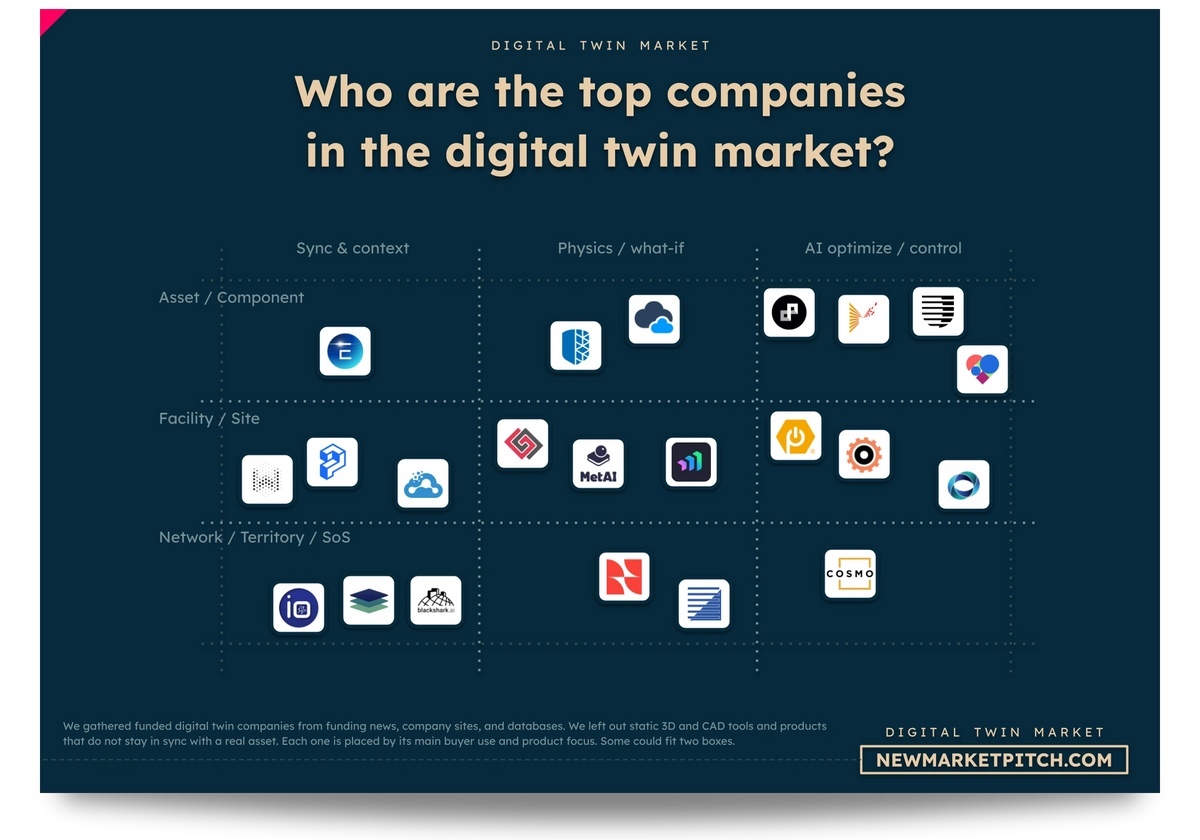
In our research about digital twins, we turn what is vague and complex into simple, useful visuals. Market maps like this one show you at a glance where every startup stands.
Is digital twin funding actually getting stronger right now?
Digital twin funding looks stronger in headline dollars today, but the underlying deal flow has cooled sharply.
From January through August 2026, we tracked 15 financings worth about $309 million. Over the same eight months of 2025, there were 25 deals worth roughly $326 million. Capital held up surprisingly well while the number of companies raising fell 40%.
The latest financings make the market look hotter again. NavVis raised $85 million, followed shortly afterward by Antioch's $32 million Series A and Buildots' $130 million round. Those three deals alone add $247 million.
Follow the dollars alone and digital twin funding currently looks very healthy. The company count is tougher: money is still available, but increasingly for a smaller group of businesses that investors already believe can scale.
How big is the digital twin funding market?
We tracked 102 digital twin financings across 93 companies from the beginning of 2024 through the end of our research window, representing at least $1.438 billion of disclosed equity funding.
That capital figure is deliberately conservative. Two rounds had clearly occurred but were disclosed only as "tens of millions of RMB" and "several million dollars," so we counted the deals without inventing dollar amounts for them.
The typical round is far smaller than the $1.44 billion headline suggests. The median financing is $5 million, compared with an average of $14.38 million. Large rounds pull the market average upward quite aggressively.
There is clearly enough capital here to support serious scale-ups. For most companies, though, digital twin financing still means raising a few million dollars rather than tens of millions.
Is most digital twin funding going to just a few companies?
Digital twin funding is concentrated enough that a small group of companies shapes the market, although several different scale-ups contribute to that concentration.
The seven rounds above $50 million account for 40% of all quantified capital while representing less than 7% of financings. At company level, the ten largest recipients hold 52.9% of the money we tracked.
Buildots is the biggest individual case, with $190 million across three rounds inside the research window. Dexory reaches $100 million, Neara $94 million across two financings and NavVis $85 million.
At the other end, 45 of the 91 companies with quantifiable cumulative funding raised no more than $5 million. Only seven companies crossed $50 million.
Even the latest $130 million Buildots round accounts for roughly 9% of total capital, so one financing cannot explain the whole market. The concentration comes from a relatively small upper tier of companies rather than a single freak deal.
| Company | Financings in the period | Capital raised |
|---|---|---|
| Buildots | 3 | $190M |
| Dexory | 1 | $100M |
| Neara | 2 | $94M |
| NavVis | 1 | $85M |
| PassiveLogic | 1 | $74M |
| Makersite | 1 | $70.2M |
| Twin Health | 1 | $53M |
| ThinkLabs | 2 | $33M |
| Antioch | 1 | $32M |
| Gradyent | 1 | $30.25M |

In our market report about digital twins, we always try to gather several sources and make estimates that make sense, so you can work with solid numbers.
What can a normal digital twin startup actually expect to raise?
A normal digital twin startup is still raising single-digit millions today.
Forty-nine of the 102 financings we tracked came in below $5 million. That is 48% of all deals, yet those rounds contributed less than 8% of total capital.
Another 27 deals landed between $5 million and $20 million. Put those two groups together and roughly three quarters of digital twin financings remained below $20 million.
The starting point is lower again. A first external financing has a median size of about $1.57 million, while the median Seed round is $2.5 million. Series A moves the typical check to roughly $10 million.
A founder reading about Buildots, NavVis or Dexory could easily get the wrong benchmark. Those rounds come after a company has already built meaningful commercial traction. For a younger digital twin business, a financing somewhere between a few million dollars and the low tens of millions is much closer to what we usually see.
Which types of digital twin companies are getting the most money?
Serious digital twin money is flowing into asset, process, building and infrastructure software, while factory-only and implementation businesses remain tiny by comparison.
Asset Twin Platforms lead with about $406 million across 30 deals. Process Twin Applications are close behind at $394 million across 26. Together, those two categories absorb more than half the market's capital.
Building Twin Software stands out for a different reason. Sixteen financings attracted $327 million, giving the category far more capital per deal than its share of transaction activity would normally suggest.
Infrastructure Twin Systems are almost the reverse. We found 25 deals but only about $295 million in capital, partly because 14 of those financings were Seeds.
Factory Twin Software and Twin Implementation Services barely move the overall totals. Together they account for five deals and around $17 million.
| Digital twin category | Deals | Companies | Capital | Median round |
|---|---|---|---|---|
| Asset Twin Platforms | 30 | 29 | $405.6M | $4.8M |
| Process Twin Applications | 26 | 25 | $393.9M | $10.5M |
| Building Twin Software | 16 | 14 | $327.1M | $4.84M |
| Infrastructure Twin Systems | 25 | 21 | $294.5M | $4.5M |
| Factory Twin Software | 3 | 3 | $13.0M | $4.0M |
| Twin Implementation Services | 2 | 2 | $4.0M | $2.0M |
| Whole market | 102 | 93 | $1.438B | $5.0M |
Why can some digital twin companies raise $70M, $100M or even $130M?
The biggest digital twin checks are going to companies that have turned the twin into an operating layer for large, expensive physical systems.
Buildots shows this clearly. Its latest $130 million round followed years of expansion from individual construction projects toward portfolio-wide enterprise deployments. Buildots says more customers are now using the platform across multiple projects, while data centers, industrial facilities and other huge construction programs are putting much more pressure on schedule visibility.
NavVis is solving a different problem at similar scale. The company said it scanned, processed and distributed more than one billion square meters during 2025 before raising $85 million. Its capital is going into the spatial-data infrastructure and AI layer behind factories, buildings and other physical environments.
Dexory raised $100 million of Series C equity inside a broader $165 million financing package after expanding its warehouse intelligence platform across Europe, North America and Asia-Pacific. Its system combines autonomous scanning robots with a continuously updated operational view of warehouses.
PassiveLogic's $74 million Series C pushes digital twins into autonomous building control, while Makersite's €60 million Series B supports a product and supply-chain intelligence platform used by large manufacturers.
Across those companies, investors are paying for deployment depth, proprietary operational data, enterprise integrations and the ability to become embedded in a customer's workflow. These are much more expensive businesses to scale than a standalone visualization tool.

Our document detailing everything you need to know about digital twin gets updated several times a month, so you always get the latest view of where things stand.
How old are digital twin companies before investors write serious checks?
Digital twin companies usually spend years building before they reach serious funding: the median company is five years old when it raises, and companies receiving rounds above $50 million have a median age of roughly nine years.
The smaller financings come much earlier. Companies raising below $5 million have a median age of around three years, which lines up closely with the Seed market.
Age then rises through most of the funding ladder. The typical Series A company is about five years old and Series B reaches 6.5 years. Series C companies have a median age of nine years.
So the giant rounds we see now generally sit on top of years of product development, customer deployments and operating history.
Is digital twin funding mostly early stage?
Digital twin funding is early-stage by deal count and late-stage by dollars.
Among the 91 rounds where we could classify the stage reliably, Seed and Series A account for 76.9% of financings. They receive only 33.5% of classified capital.
The smaller later-stage group absorbs the majority of the money. Series B through Growth represent 23.1% of classified deals and 66.5% of the capital.
Series D+ is particularly striking. Six financings account for $391 million, more than the 44 Seed rounds combined.
The market looks young when we count startups and much more mature when we count dollars. Both views are true at the same time.
| Stage | Deals | Capital | Median round |
|---|---|---|---|
| Seed | 44 | $140.0M | $2.5M |
| Series A | 26 | $316.2M | $10.2M |
| Series B | 8 | $241.1M | $30.0M |
| Series C | 5 | $231.2M | $31.0M |
| Series D+ | 6 | $391.0M | $58.0M |
| Growth Equity | 2 | $41.0M | $20.5M |
| Unknown | 11 | $77.6M | $4.91M |
Where does digital twin funding get really difficult?
Series B is where digital twin funding gets brutally selective: we found 26 Series A rounds and only eight Series B rounds.
The jump in check size helps explain the narrowing. The median Series A is about $10.2 million, while Series B reaches $30 million.
A startup asking for $30 million needs a very different story from one raising $3 million or $10 million. Investors are looking for something they can scale across customers, sites or regions, and the business often needs a stronger sales machine, deeper integrations and evidence that deployments can repeat.
These counts are cross-sectional, so they do not imply that 18 of every 26 Series A companies fail. Some younger companies simply have not had enough time to reach B yet. Still, the drop is hard to ignore when we look at where funding currently thins out.
Are investors funding new digital twin startups or backing companies they already know?
Most digital twin capital today goes to companies that already have venture backing.
We identified 24 first financings, representing 23.5% of all transactions but only about $77 million of capital. The median first check is roughly $1.57 million.
The 77 known follow-on financings account for around $1.34 billion. Their median size is $8.4 million, more than five times the typical first financing.
New companies are clearly still entering the market. The money gets much heavier once a company has already crossed its first financing milestone and comes back with evidence that the product is working.
This also explains how headline funding can stay high during periods when fewer startups are raising. A handful of mature follow-ons can replace a surprisingly large number of Seed rounds in dollar terms.

In our report covering the digital twin market, we look at what the winners do differently, so you can learn from the best instead of guessing.
Do corporate investors really matter in digital twin funding?
Corporate investors matter a lot in digital twin funding, especially when the product touches infrastructure that the corporate already owns, builds or operates.
We found a strategic investor in 33 of 102 financings. Those deals have a median size of about $8.66 million, compared with $3.68 million when no strategic investor is identified.
The current examples are unusually concrete. ThinkLabs' $28 million Series A brought in NVentures, Edison International and existing investor GE Vernova around AI-based electricity-grid simulation. SPREAD AI's $30 million Series B included Salesforce as it expands the connection between engineering product data and downstream enterprise workflows.
RIIICO's factory-twin Seed included Volvo Cars Tech Fund. Tibo Energy brought in Hitachi Ventures and WEPA Ventures for industrial energy management. VEERUM's Series B was backed by Emerson Ventures, whose parent company sells industrial automation technology to the same asset-heavy customers.
The logic is fairly straightforward. A corporate can bring operating data, customer access, engineering expertise, physical assets and credibility with buyers. In digital twins, those things can be just as useful as the check itself.
Which VCs actually keep showing up in digital twin deals?
Almost none: among 83 digital twin deals with a disclosed lead, only Plural and Mercia Ventures lead more than one financing in our research.
Plural appears as lead on two deals worth about $46 million combined. Mercia Ventures leads two worth roughly $8.8 million.
Every other disclosed lead appears once.
That is a striking amount of fragmentation for a market with more than $1 billion of observed capital. We see construction investors, climate funds, generalist VCs, industrial specialists, deep-tech firms, energy investors and corporate venture arms, but very little repetition.
Digital twin funding still behaves more like several overlapping investment themes than a mature venture category with a recognizable group of specialist funds controlling the ladder.
Is Europe actually leading digital twin funding?
Europe is clearly leading digital twin deal formation, while North America is producing much larger typical rounds.
European companies account for 53 of the 102 financings we tracked, or 52% of the market. They raised about $607 million, with a median round of $4 million.
North America generated only 23 financings but reached roughly $376 million, and its median deal is $10 million. A North American round is therefore typically much larger even though the region produces far fewer transactions.
Asia-Pacific contributes 21 deals and about $235 million. The Middle East reaches $220 million from only four rounds, but three of those financings belong to Buildots, so the regional total is extremely concentrated.
The United States is the largest individual country by capital at roughly $347 million, followed by Germany at $239 million, Israel at $220 million, the United Kingdom at $192 million and Australia at $136 million.
| Region | Deals | Capital | Median round |
|---|---|---|---|
| Europe | 53 | $606.6M | $4.0M |
| North America | 23 | $376.1M | $10.0M |
| Asia-Pacific | 21 | $234.8M | $3.0M |
| Middle East | 4 | $220.0M | $37.5M |
| Latin America | 1 | $0.54M | $0.54M |

In our research about digital twins, we don't want to repeat what boring consulting reports say. Instead, we show you the real and latest market signals that matter.
Which parts of the digital twin market are barely getting funded?
Factory-only digital twin software, implementation services and Latin America barely register in the funding market we tracked.
Factory Twin Software has just three financings and $13 million of capital. All three are Seed rounds. Interestingly, each one has a corporate investor, including Volvo Cars Tech Fund in RIIICO, which suggests real industrial interest even though the venture market remains tiny.
Twin Implementation Services is smaller again, with two companies and about $4 million. Service-heavy businesses can struggle to produce the recurring software economics that venture funds usually want, which may partly explain the lack of larger rounds.
Latin America contributes a single qualifying deal. With a sample that small, there is very little we can say about the region beyond the obvious point that it is barely represented in the financings we found.
Growth Equity is also sparse, with only two transactions. Later-stage money exists, but it tends to show up as Series C or D financings for software businesses rather than as a broad pool of traditional growth-equity deals.
Is "digital twin" actually one market?
Digital twin funding currently looks more like a family of adjacent markets sharing the same technical idea than one clean venture category.
Buildots creates continuously updated representations of construction projects. NavVis builds a spatial-data layer for physical environments. Dexory maps live warehouse operations. ThinkLabs simulates electricity grids. Makersite models products and supply chains. Antaris virtualizes satellite missions. Teton.ai builds patient and care-environment representations.
Those companies share a basic architecture: they connect a model to a real system, update it with data and use that model to monitor, simulate, predict or optimize what happens next.
Commercially, though, the similarities quickly fade. They sell to different customers, face different procurement cycles, use different data and require very different levels of hardware, integration and regulatory approval.
That is why the $1.44 billion headline needs context. It describes a real technology pattern across many industries. Investors still appear to underwrite the underlying industries first, construction, energy, manufacturing, logistics, healthcare, space, with "digital twin" sitting across them as a common technology layer.
What should we actually take away from the funding data?
Digital twin funding is a substantial market now, but its strongest current numbers come from a fairly small scale-up layer. Deal flow has slowed while large rounds continue to keep capital totals high.
For most startups, the market is still much smaller than the headlines suggest. Single-digit-million-dollar rounds are common, and the first institutional financing usually sits around the low millions.
The difficult jump comes when a company needs real expansion capital. Series B is the clearest pressure point, with far fewer rounds and a typical check of roughly $30 million.
The companies attracting the biggest money have usually spent years getting embedded into real operations. Construction portfolios, warehouses, factories, grids and large industrial product systems are where we currently see investors writing the heaviest checks.
Corporate investors also have an unusually visible role because access to customers, infrastructure and operating data can materially improve a digital twin business.
The category itself remains messy, and that is useful to remember. Digital twin technology is spreading across several large industries, while the funding market around it is still fragmented by sector, stage and investor type.
Our methodology
This analysis tracks private-company digital twin financings announced from January 1, 2024 through September 21, 2026. The objective is to give a quantitative and realistic picture of fundraising activity in the market, including deal count, disclosed capital, stage, company age, geography, investor participation and the concentration of funding across companies and categories.
We included qualifying equity financings of at least $300,000 where a digital twin product was central to the company or to the financed product line. Debt, grants, loans, public offerings and other clearly non-equity financing were excluded. When a financing package mixed equity with debt or secondary transactions, we counted only the identifiable primary-equity component. Dexory's $165 million package, for example, contributes $100 million to our equity totals because the remaining $65 million was growth debt.
Each financing was treated as a separate deal. Duplicate reports of the same round were consolidated, while extensions, additional closes and tranches were kept separate only when public evidence supported treating them as distinct financings. When a company disclosed only vague wording such as "several million dollars" or "tens of millions of RMB," the deal was counted but no precise dollar amount was invented.
Stages, lead investors, strategic investors, financing history and founding dates were recorded only when they could be supported publicly. We did not infer a stage from check size or assume that a prominent participant had led a financing. Local-currency amounts were converted approximately into US dollars where necessary.
The market definition covers digital twins used across physical assets, industrial processes, buildings, infrastructure and other continuously modeled systems, but the twin architecture had to be central to the relevant product. This deliberately captures companies operating in several underlying industries, which is why category and regional comparisons are treated as descriptive rather than as perfectly uniform markets.
After compiling the financings, we ran a separate quality-control pass to check period boundaries, equity components, minimum deal size, category eligibility, possible missed financings and duplicate reporting. Company and investor disclosures were generally given priority for round size, timing, use of funds and named participants, with reputable financial and industry reporting used to cross-check material facts.
Key sources used to verify major financings and product positioning include Buildots on its $130 million financing, NavVis on its $85 million Series D, Dexory on its $165 million financing package, PassiveLogic on its $74 million Series C, and Makersite on its €60 million Series B.
Additional first-hand sources include ThinkLabs on its $28 million Series A, SPREAD AI on its $30 million Series B, RIIICO on its $5 million Seed, Tibo Energy on its €6 million Seed, VEERUM on its C$12 million Series B, Antaris on its $28 million Series A, and Antioch on its $32 million Series A.
Other company materials used in the research include Teton.ai, Basetwo, ACCURE, Converge, Sensat, Rhizome, and Gradyent.

Learning from others' mistakes is the cheapest lesson there is. In our market report about digital twins, we look at what broke startups before you, so you don't repeat it.
Written by the New Market Pitch teamWe track new markets so founders and investors can move faster. About us