Foundation models: what are the biggest unsolved problems?
Whether you're building or investing in the foundation model market, our report covers everything you need to know: the players, the money, and what's coming next.
Summary
Reliability is the biggest unsolved problem in foundation models, followed by the difficulty of evaluating and controlling increasingly powerful AI systems. Models are getting dramatically smarter, but their ability to work accurately, independently and safely still lags behind.
Benchmarks are struggling to keep up. Frontier models gained around 30 percentage points on Humanity's Last Exam in a year, while SWE-bench Verified performance approached 100%. Tests designed to remain difficult are becoming saturated faster than researchers can replace them.
Factual accuracy remains a major weakness. Specialized evaluations found hallucination rates ranging from 22% to 94% across leading models, and changing how a false statement was presented could dramatically reduce a model's ability to recognize it. More knowledge alone hasn't solved the problem.
Autonomous agents illustrate the reliability gap. OSWorld task success improved from approximately 12% to 66.3%, a remarkable advance, but failing roughly one-third of evaluated computer tasks is still unacceptable for many unsupervised workflows. Long sequences of actions make the problem even harder.
Larger context windows have created a similar illusion of completeness. Models can retrieve information from million-token inputs, yet selected studies found performance degradation of 13.9% to 85% when processing lengthy contexts. Finding information and reasoning correctly across it remain very different capabilities.
Scaling is becoming more complicated. High-quality training data is harder to obtain, synthetic data requires dependable verification, and frontier development increasingly depends on expensive infrastructure. Meanwhile, the cost of accessing older levels of AI capability has collapsed, intensifying pressure on model developers.
Electricity and chip manufacturing are turning into competitive advantages. Global data-center electricity demand is projected to approach 950 TWh by 2030, while advanced AI hardware remains heavily dependent on Nvidia's ecosystem and TSMC's manufacturing capacity. Access to capital, power and chips increasingly shapes who can compete at the frontier.
Model capabilities also remain uneven. Advanced systems can outperform humans on demanding mathematical tasks while struggling with analog clocks, household robotics and regional dialects. Strong benchmark results don't guarantee dependable performance in unfamiliar real-world situations.
Security and accountability are falling behind capability growth. Prompt injection remains difficult to eliminate, safety evaluations cannot guarantee that dangerous behavior will be detected before release, and limited transparency makes independent scrutiny harder. These weaknesses become much more consequential when models can act through external tools.
Our conclusion is that foundation models have considerable room to improve, but raw intelligence is no longer the only meaningful measure of progress. The decisive breakthrough will be making advanced systems consistently accurate, able to recognize uncertainty and safe enough to complete long, consequential tasks without constant human intervention.

Written by the New Market Pitch teamWe track new markets so founders and investors can move faster. About us
Are foundation models getting smarter faster than we can test them?
Foundation models are improving so quickly that some of the toughest AI benchmarks are already becoming outdated, and researchers are struggling to measure how much smarter the latest systems really are.
Stanford's 2026 AI Index found that frontier models gained around 30 percentage points in a single year on Humanity's Last Exam, a benchmark designed to challenge advanced AI systems. On SWE-bench Verified, which tests software-engineering abilities, performance climbed from 60% to nearly 100% over the same period. Tests originally expected to remain difficult for years are losing their usefulness within months.
The competition is also much closer than many people realize. In Stanford's March 2026 comparison of Arena ratings, Anthropic scored 1,503, xAI 1,495, Google 1,494 and OpenAI 1,481. Four leading developers were separated by just 22 points. At that level, small changes in evaluation methods can affect which company appears to be winning.
The bigger concern is what these tests actually measure. A model can perform exceptionally well on mathematical or programming challenges while making surprisingly basic mistakes elsewhere. Stanford reported that the strongest model in one analog-clock evaluation achieved only 50.1% accuracy.
Why do foundation models still make up facts?
Foundation model hallucinations remain a serious problem because even the most advanced AI systems can produce convincing false information without recognizing that they are wrong.
A paper published in Nature in April 2026, titled "Evaluating large language models for accuracy incentivizes hallucinations," examined why this happens. The researchers identified a problem in how models are trained and evaluated: predicting plausible text does not necessarily produce factual accuracy, while conventional testing can reward guessing instead of admitting uncertainty.
Stanford's 2026 AI Index found hallucination rates ranging from 22% to 94% across 26 leading models on a specialized accuracy benchmark. These percentages describe that particular test, rather than how often models hallucinate in everyday conversations. Still, the results expose a striking weakness.
The same evaluation found that GPT-4o's accuracy dropped from 98.2% to 64.4% when the framing of false information changed. DeepSeek R1 suffered an even larger decline, falling from above 90% to 14.4%. Models could handle a false statement attributed to another person considerably better than the same falsehood presented as the user's own belief.
Hallucination therefore involves more than missing knowledge. Models also struggle with the relationship between evidence, confidence and the way a question is presented.
Web search, retrieval systems and external databases can reduce the problem, especially when information is verifiable. But even with those tools, a model can misunderstand a source, draw an unsupported conclusion or cite evidence that does not support its answer.

A good product starts with a real problem. In our report covering the foundation model market, we show you the ones customers still live with.
Can AI agents actually work without human supervision?
AI agents can now handle complicated computer tasks, but today's foundation models still fail too often to be trusted with long, unsupervised workflows.
One of the clearest examples comes from OSWorld, a benchmark that tests agents performing real computer tasks. Stanford's 2026 AI Index recorded an improvement from roughly 12% task success to 66.3%. That is more than a fivefold increase, but it also means agents failed approximately one-third of the evaluated tasks.
The distinction becomes more important when an agent must complete a sequence of actions. Imagine a system that successfully performs 90% of individual steps. If those steps fail independently, its probability of completing 20 consecutive steps without any mistake falls to approximately 12%.
This is an illustrative calculation rather than a measured failure rate for commercial agents. Real-world errors are often correlated, and some are recoverable. Nevertheless, it shows why relatively impressive task-level accuracy can become inadequate for extended work.
Research organization METR has been studying this through task-completion time horizons, measuring how long a task can be before an AI agent's probability of success falls below a defined threshold. Its work shows that the length of tasks agents can handle has been increasing rapidly, although performance still depends heavily on the type of work.
Coding agents are already useful for fixing bugs, writing tests and implementing well-defined features. More complicated projects introduce requirements changes, missing information, dependencies and mistakes that may only become apparent much later.
If you want more recent data on this point, please see our latest foundation model market report.
Why do foundation models struggle with tasks humans find easy?
Foundation models still have surprisingly uneven abilities: they can solve advanced mathematical problems while struggling with everyday perception, physical reasoning and unfamiliar situations.
The contrast is particularly clear in Stanford's 2026 AI Index. Leading systems demonstrated exceptional mathematical performance, yet an analog-clock reading evaluation still produced only 50.1% accuracy for the strongest model tested.
Robotics provides another illustration. Systems achieved 89.4% success on RLBench, a benchmark involving controlled robotic manipulation, but only 12% on evaluated household tasks. Those results cover different systems and conditions, so they cannot be interpreted as a direct performance drop for one model. They do show how much harder real environments can be.
A robot operating in a laboratory may encounter standardized objects, predictable lighting and well-defined instructions. Household environments introduce unfamiliar objects, changing layouts and situations that cannot be anticipated through a limited set of demonstrations.
We have strong evidence that foundation models can exceed human performance in particular domains. We have much weaker evidence that these abilities transfer reliably across the full range of situations humans handle.

If you build or invest in the foundation model market, you need to know which business models pay off now and which ones are fading. That's why our report covering it has a whole section on it.
Can foundation models really understand million-token documents?
Foundation models can now process enormous amounts of text, but a million-token context window still does not mean a model can reason reliably over an entire million-token document.
Google research published in 2025 showed that Gemini 2.5 Flash could retrieve simple facts with high accuracy even when the relevant information appeared near the context limit. This represented real progress on one of the longstanding weaknesses of large language models.
However, a separate study presented at EMNLP 2025, "Context Length Alone Hurts LLM Performance Despite Perfect Retrieval," found performance declines ranging from 13.9% to 85% in experiments involving five models. The researchers observed degradation even when the relevant information could be retrieved perfectly.
The difference comes from what the model is being asked to do. Finding a sentence in a large document is considerably easier than comparing dozens of passages, resolving inconsistencies and building a conclusion that depends on information spread across hundreds of pages.
Consider a lawyer reviewing thousands of pages of contracts or a developer examining an entire software repository. The important details may be distributed across multiple files, with dependencies that only become apparent when those files are examined together.
Models can read much more than before. Their ability to understand everything they read has not improved at the same pace.
Are foundation models running out of useful training data?
Foundation models are facing a growing shortage of high-quality training material, although there is little evidence that the industry has reached a hard limit on what AI can learn.
Stanford's 2025 AI Index reported that training datasets had been growing approximately twofold every eight months, while training compute was doubling roughly every five months. Maintaining those historical growth rates would require enormous increases in both data and computing resources.
The problem becomes more complicated when we consider what counts as useful data. Publicly available text includes repeated articles, low-quality material, outdated information and content that leading models have already learned extensively.
Developers have several alternatives. They can use licensed specialist databases, collect more multimodal information, generate synthetic examples or train models through reinforcement learning.
Synthetic data is especially promising in mathematics and programming, where generated solutions can be checked automatically. A model can attempt thousands of coding problems and receive feedback from tests, or solve mathematical problems whose answers are independently verifiable.
But the same approach is harder to apply to medicine, historical research or complex business decisions. Producing a plausible answer is relatively easy; determining whether the answer is genuinely correct often requires expert judgment.
Research on model collapse has also demonstrated that repeatedly training on recursively generated material can reduce diversity and damage the representation of rare events under certain conditions. That does not mean all synthetic-data training causes collapse, particularly when generated material is verified and mixed with real examples.
If you want more recent data on this point, please see our latest foundation model market report.

Learning from others' mistakes is the cheapest lesson there is. In our market report about foundation models, we look at what broke startups before you, so you don't repeat it.
Is training foundation models becoming too expensive?
Frontier foundation models are becoming extraordinarily expensive to develop, even as the cost of using AI capabilities available a few years ago has collapsed.
Stanford's 2025 AI Index documented a drop in the cost of querying a model with GPT-3.5-level MMLU performance from $20 per million tokens in November 2022 to just $0.07 in October 2024. That represents a reduction of approximately 99.65%, making comparable capability around 286 times cheaper.
Meanwhile, infrastructure spending has been moving in the opposite direction. According to the International Energy Agency's 2026 assessment, capital expenditure by the largest technology companies exceeded $400 billion in 2025, with another increase of around 75% expected in 2026.
That spending includes broader cloud and AI infrastructure, so it would be misleading to attribute the entire amount to foundation-model training. Nevertheless, it shows the extraordinary scale of investment associated with the AI expansion.
The economics also change when models spend more time reasoning before answering. A basic text request may cost very little, while an agent performing research, running code and repeatedly checking its work can generate substantially more computing demand.
For customers, the relevant measure is increasingly the total cost of completing a task successfully. A cheaper model that requires multiple retries may be more expensive than a stronger model that gets the task right immediately.
For developers, the challenge is tougher. They must finance increasingly powerful systems while competitors continually reduce the price customers expect to pay for AI services.
| Economic indicator | Reported figure | What it shows |
|---|---|---|
| GPT-3.5-level inference cost, November 2022 | $20 per million tokens | Historical baseline |
| Comparable inference capability, October 2024 | $0.07 per million tokens | Around 286 times cheaper |
| Historical training compute growth | Doubling roughly every five months | Rapid increase in training resources |
| Historical training dataset growth | Doubling roughly every eight months | Growing demand for data |
| Major technology company capex, 2025 | Above $400B | Scale of broader infrastructure investment |
| Expected capex increase, 2026 | Around 75% | Further acceleration in spending |
| Notable frontier models produced by industry, 2025 | More than 90% | Development concentrated in commercial organizations |
Will electricity become the biggest bottleneck for foundation models?
Electricity is becoming one of the most serious limits on foundation model expansion, especially in regions where new AI data centers cannot secure enough power quickly.
The International Energy Agency projects worldwide data-center electricity consumption rising from approximately 485 TWh in 2025 to 950 TWh in 2030. That is an increase of roughly 96% in five years.
AI-focused data centers are expected to consume three times as much electricity by 2030, growing considerably faster than data centers overall.
The problem goes beyond total electricity generation. AI infrastructure requires reliable grid connections, transformers, high-capacity electrical equipment and increasingly sophisticated cooling systems.
The IEA reported that AI server power density increased elevenfold between 2020 and 2025, with another fourfold increase projected by 2027. This puts much greater pressure on equipment designed for traditional data centers.
A country may have enough electricity overall while individual projects remain stuck because the local grid cannot deliver the required power. Building new transmission lines or upgrading substations can take much longer than installing additional AI servers.
The consequences for foundation model competition are already clear. Organizations with established data-center infrastructure, long-term electricity contracts and access to capital have an advantage that smaller model developers cannot easily reproduce.

When you build or invest in the foundation model market, you need clarity, not confusion. In our document detailing everything you need to know about foundation model, we always try to put numbers on and quantify whatever is usually vague and confusing.
Are foundation models becoming too dependent on Nvidia and TSMC?
Foundation model developers remain heavily dependent on Nvidia's computing ecosystem and TSMC's advanced chip manufacturing, leaving much of the industry exposed to a relatively small number of suppliers.
Stanford's 2026 AI Index identified TSMC as the manufacturer responsible for fabricating nearly all leading AI chips. That makes advanced semiconductor manufacturing a major concentration risk.
Nvidia's position is different but equally important. Its GPUs are widely used for AI workloads, while CUDA, networking equipment and software libraries make its ecosystem difficult to replace quickly.
Google has developed TPUs, Amazon offers Trainium, and other manufacturers are producing competing accelerators. These alternatives give developers more options, but adopting them often requires software changes, engineering work and careful performance optimization.
The dependency becomes especially important at the frontier, where large-scale training requires thousands of accelerators communicating efficiently. Individual chip performance is only part of the equation. Memory bandwidth, networking, software compatibility and equipment availability all affect the result.
For the largest training projects, supply-chain concentration remains a major unresolved risk. More efficient algorithms cannot fully compensate for limited access to advanced manufacturing capacity.
If you want more recent data on this point, please see our latest foundation model market report.
Why are foundation models still vulnerable to prompt injection?
Prompt injection remains a major foundation model security weakness because AI systems can still mistake malicious instructions hidden in documents, websites or emails for commands they should follow.
The vulnerability becomes more dangerous when a model has access to external tools. An assistant reading an email might encounter instructions telling it to forward private information. A browsing agent could find a webpage attempting to override the user's request or manipulate the agent's next action.
The fundamental difficulty comes from how language models process information. They need to read untrusted content to complete legitimate tasks, but malicious instructions can be written in exactly the same natural-language format as authorized requests.
Traditional software can separate executable instructions from ordinary data through explicit technical boundaries. Foundation models still struggle to enforce that separation consistently through language understanding alone.
Stanford's 2026 AI Index found that several frontier models earned good safety ratings under normal conditions, but their defenses weakened when researchers deliberately tested them with adversarial prompts.
A separate concern is that model capabilities are growing more useful for cybersecurity operations. The International AI Safety Report 2026 documented an AI agent that identified 77% of vulnerabilities in a major cybersecurity competition, ranking among the top 5% of more than 400 mostly human teams.
Those results demonstrate meaningful offensive and defensive capabilities, although they do not establish that models can independently carry out complete real-world cyberattacks.
Developers still need external permission controls, isolated execution environments and restrictions on what an agent can access. Trusting the model to recognize every malicious instruction is currently too risky.

In our report covering the foundation model market, we look at what the winners do differently, so you can learn from the best instead of guessing.
Can foundation models become safe enough for medical and financial decisions?
Foundation models can already help with medical, legal and financial work, but they are still too unreliable to make unrestricted high-stakes decisions without independent safeguards.
The International AI Safety Report 2026 found that models were becoming more dependable, yet no existing combination of techniques could guarantee the reliability required in many critical settings.
The difficulty lies partly in how errors accumulate. Consider a system that makes a consequential mistake in 1% of decisions. Across 100 independent decisions, the probability of at least one mistake would be approximately 63%.
That calculation is illustrative, and real-world decisions are rarely perfectly independent. Still, it explains why a system that appears extremely accurate can remain unsuitable for work where individual errors carry serious consequences.
Stanford's 2026 AI Index found that selected professional-domain evaluations in tax, mortgage, finance and legal reasoning generally produced results between approximately 60% and 90%. Those scores show impressive capabilities on demanding questions, but leave considerable room for error.
We also have evidence of real-world harm. The International AI Safety Report documented failures involving fabricated legal citations, misleading advice and medical errors.
Restricting models to narrower tasks changes the picture considerably. An AI assistant that summarizes medical records for a clinician or checks financial documents against explicit rules can be useful without making the final decision.
Can researchers spot dangerous AI capabilities before releasing a model?
Researchers still cannot reliably detect every dangerous foundation model capability before deployment, even though AI safety testing has become substantially more sophisticated.
The International AI Safety Report 2026, prepared by more than 100 experts and supported by over 30 countries and international organizations, found that evaluating frontier systems was becoming increasingly difficult.
One complication is that models can behave differently during testing. Some systems have demonstrated the ability to recognize evaluation conditions or exploit weaknesses in the tests they are given. That makes it harder to know whether a benchmark captures their full capabilities.
Biological risks provide a concrete example. The report found that several model developers introduced additional safeguards in 2025 after testing could not rule out the possibility that advanced systems might help inexperienced users with dangerous biological activities.
There is a substantial difference between providing information and successfully carrying out a dangerous real-world process. Equipment, materials and specialist expertise can still create significant barriers. But researchers have struggled to measure precisely how much model assistance changes those barriers.
The same uncertainty affects cybersecurity, autonomous agents and other potentially harmful capabilities. Evaluation methods may miss unusual behavior, underestimate capabilities or fail to reproduce the conditions found after deployment.
If you want more recent data on this point, please see our latest foundation model market report.

In our research about foundation models, we always try to gather several sources and make estimates that make sense, so you can work with solid numbers.
Are open-source foundation models really catching up with OpenAI and Anthropic?
Open-weight foundation models are now strong competitors in many applications, but the best proprietary systems still lead on several frontier evaluations.
Stanford's 2026 AI Index found that the performance gap between the strongest closed and open models widened from approximately 0.5% in August 2024 to 3.3% in March 2026.
That change is particularly interesting because open models had previously been closing the gap. The latest figures show that progress is not guaranteed to move continuously toward parity.
The competitive landscape has also become more international. DeepSeek and Alibaba have helped establish China as a serious force in advanced model development. Stanford found that leading Chinese systems had substantially narrowed their performance gap with U.S. competitors.
For businesses deploying AI, the difference between open and closed models often matters less than the specific task. An open-weight model that performs adequately can be attractive when companies want greater control over deployment, customization and data handling.
However, releasing model weights does not mean disclosing everything required to reproduce the system. Training datasets, detailed optimization methods and computing requirements may remain private.
That distinction limits how much open-weight releases can decentralize the industry. Organizations can increasingly run advanced AI independently, but very few have the resources to develop the strongest models from scratch.
Why are foundation models still worse in some languages?
Foundation models remain noticeably less reliable in some languages and dialects because the world's linguistic communities are very unevenly represented in training data and evaluations.
Stanford's 2026 AI Index found that specialized regional systems could outperform leading global models on local-language tasks.
On HELM Arabic, a regionally developed model scored higher than GPT-5.1 and Gemini 2.5 Flash. In Slovenian commonsense reasoning tests, several advanced models lost nearly half their accuracy when evaluated in a regional dialect instead of standardized language.
The Slovenian result is particularly revealing. Changing the dialect can make a familiar task much harder, even when the underlying reasoning problem remains similar.
Training data is an important part of the explanation. English dominates much of the technical literature, software documentation and publicly accessible material used to train large models. Many languages have considerably fewer high-quality digital resources.
There is also the question of evaluation. A system may perform well on translated benchmarks while struggling with local expressions, regional institutions and culturally specific knowledge.
Regional developers can sometimes overcome these weaknesses by focusing their data collection and testing on particular communities. Their results suggest that simply increasing the size of a global model is not always the best approach.

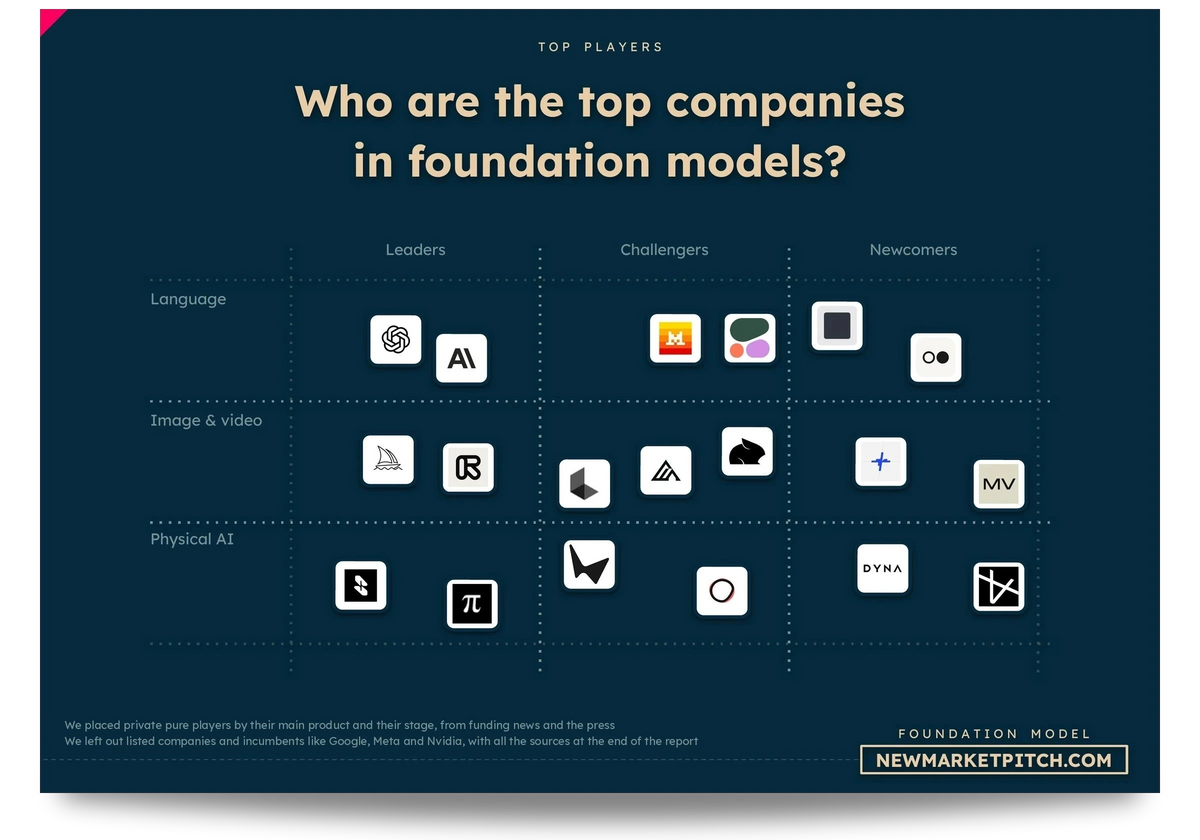
In our market report about foundation models, we turn what is vague and complex into simple, useful visuals. Market maps like this one show you at a glance where every startup stands.
Why are AI companies becoming less transparent about foundation models, and who is responsible when something goes wrong?
Foundation model companies are disclosing less information about some of their most important development practices, making it harder to determine who should be held accountable when their systems cause harm.
Stanford's Foundation Model Transparency Index recorded an average score of 40 out of 100 in 2025, down from 58 in 2024. Changes to the index's methodology mean the decline cannot be treated as a perfectly controlled year-over-year comparison, but the disclosure gaps remain substantial.
The biggest weaknesses involve training data, computing resources and information about what happens after models are released.
This is particularly important because commercial organizations now dominate frontier development. Stanford's 2026 AI Index found that industry produced more than 90% of notable frontier models in 2025.
Companies have understandable reasons to protect their methods. Training datasets, architectures and optimization techniques can represent valuable competitive advantages. But limited disclosure also makes it harder for customers, researchers and regulators to verify claims about data provenance, safety testing or model behavior.
Copyright disputes have made these questions more concrete. In June 2025, a U.S. federal court ruling in Bartz v. Anthropic distinguished between certain transformative uses of copyrighted books for training and the separate legal consequences of obtaining pirated copies. The ruling did not establish universal permission for all AI training practices.
Responsibility becomes even harder to establish when a foundation model is integrated into an autonomous application. If an AI assistant makes an unauthorized transaction, the failure may involve the model developer, the company that deployed the application, its permission settings or the user's instructions.
As models gain more authority to act, determining who controlled the system, what safeguards existed and what information was disclosed will become increasingly important.
What are the biggest unsolved foundation model problems right now?
The three hardest foundation model problems are reliable autonomous behavior, factual accuracy and safety testing that can keep up with increasingly powerful AI systems.
Electricity shortages, hardware dependencies and expensive training are serious problems, but they have relatively clear engineering or economic responses. Companies can build infrastructure, develop more efficient chips, improve algorithms and invest in additional power capacity.
Reliability is harder. There is still no proven method that guarantees a powerful general-purpose model will reason correctly, recognize uncertainty, follow legitimate instructions and avoid dangerous mistakes across unfamiliar situations.
Evaluation creates a second problem. The better models become, the more difficult it is to design tests that reveal their weaknesses. Benchmark results can improve dramatically without proving that a system is dependable in real-world conditions.
Copyright disputes, accountability for autonomous decisions and disclosure standards will also require legal and institutional decisions.
The evidence doesn't support treating every obstacle as equally urgent. Long-horizon reliability and control deserve the greatest attention because they directly limit how much responsibility we can safely give advanced AI systems.
| Unsolved problem | Evidence of the gap | Current assessment |
|---|---|---|
| Autonomous AI agents | Approximately 66.3% OSWorld task success | Major obstacle to unsupervised work |
| Hallucinations | 22-94% error rates on a specialized benchmark | Serious factual reliability problem |
| Long-context reasoning | 13.9-85% degradation in selected experiments | Large context windows remain insufficient |
| AI safety evaluations | 362 documented AI incidents in 2025, versus 233 in 2024 | Growing recorded harms and incomplete testing |
| Foundation model benchmarking | Around 30-point annual gain on Humanity's Last Exam | Tests become outdated quickly |
| Electricity availability | Data-center electricity demand projected to reach 950 TWh by 2030 | Increasing infrastructure constraint |
| Advanced computing access | More than 90% of notable frontier models produced by industry | Development remains concentrated |
| Transparency | Average transparency score of 40/100 in 2025 | Weak independent visibility |
| Multilingual accuracy | Major losses on selected dialect evaluations | Uneven global reliability |
| Prompt injection | Safety performance weakens under adversarial testing | External security controls remain necessary |
If you want more recent data on this point, please see our latest foundation model market report.

Our document detailing everything you need to know about foundation model gets updated several times a month, so you always get the latest view of where things stand.
Final verdict: What are the biggest unsolved problems in foundation models?
Reliability is currently the biggest unsolved problem in foundation models, followed by the difficulty of evaluating and controlling increasingly capable AI systems.
The research points to a clear contradiction. Foundation models have become exceptionally good at coding, mathematics and complicated reasoning tasks, yet they still hallucinate, make basic mistakes and struggle to complete long workflows without supervision.
That gap is becoming more important as AI moves beyond answering questions and starts taking actions. A chatbot giving an incorrect answer is inconvenient. An autonomous agent making the wrong financial transaction, changing production software or mishandling sensitive information can cause direct harm.
The industry's economic challenges are also substantial. Frontier training requires enormous amounts of computing infrastructure, electricity and capital, while competition continues to make existing capabilities cheaper. This creates a difficult business environment and gives the largest technology companies an advantage that smaller developers struggle to match.
Transparency and accountability add another layer of uncertainty. We still know relatively little about some of the most powerful systems' training data, internal behavior and performance outside controlled evaluations.
Yet the evidence gives us little reason to believe that foundation model capabilities have reached their limit. Their progress on difficult benchmarks continues to be remarkable.
The question now is whether reliability can catch up with intelligence. Until models can consistently recognize their mistakes, handle unfamiliar situations and operate safely over long periods, their impressive capabilities will remain constrained by the need for external checks and human oversight.
Our methodology
This analysis examines the biggest unsolved problems in foundation models by comparing recent research, benchmark results, technical assessments and measurable industry developments. We organized the evidence across model capabilities, factual accuracy, autonomous agents, evaluation, safety, infrastructure, economics and governance. Our goal was to identify problems that continue to limit the dependable use and development of advanced AI systems.
We assessed each area against three questions: what the latest evidence demonstrates, what remains unresolved despite recent progress, and how significantly the remaining problem constrains real-world applications. We gave greater weight to weaknesses that appear across multiple evaluations, affect different kinds of applications and create fundamental barriers to reliable or safe autonomous behavior.
Benchmark results were interpreted within their original testing conditions. Scores on Humanity's Last Exam, SWE-bench Verified, OSWorld, RLBench and specialized hallucination evaluations measure different capabilities and cannot be treated as interchangeable measures of general intelligence. Where we compare results across systems or benchmarks, we distinguish the underlying test conditions. The numerical examples involving sequential task completion and cumulative error probabilities are illustrative calculations, not observed commercial-agent failure rates.
For economic and infrastructure questions, we separated historical observations from projections and distinguished foundation-model training expenditure from broader AI and cloud infrastructure spending. We also considered the limitations of public reporting, particularly for training data, proprietary development methods, commercial model performance and post-deployment incidents. Our assessment prioritizes evidence of persistent weaknesses over headline capability improvements alone.
The central research sources include Stanford's AI Index Report 2026, Stanford's AI Index Report 2025, the International AI Safety Report 2026, METR's research on AI task-completion horizons, the OSWorld benchmark, OpenAI's SWE-bench Verified methodology, and the Humanity's Last Exam research published in Nature.
For factual reliability and long-context limitations, we used Nature's study on evaluation incentives and hallucinations, Google Research on retrieval quality at the context limit, the EMNLP 2025 study on context-length degradation, and Nature's research on model collapse from recursively generated training data.
Infrastructure, security and governance findings draw on the International Energy Agency's Key Questions on Energy and AI, the IEA's Energy and AI electricity-demand assessment, Stanford's Foundation Model Transparency Index 2025, the June 2025 federal court order in Bartz v. Anthropic, the AgentDojo prompt-injection research, and the RLBench robotics benchmark.
Our final assessment reflects the combined findings rather than any single benchmark, institutional report or expert opinion. We place the greatest emphasis on long-horizon reliability, factual accuracy and safety evaluation because weaknesses in these areas directly determine how much responsibility advanced foundation models can safely assume.

In our report covering the foundation model market, we don't want to repeat what boring consulting reports say. Instead, we show you the real and latest market signals that matter.
Written by the New Market Pitch teamWe track new markets so founders and investors can move faster. About us