What’s the latest funding news in the healthcare AI agents market? (October 2026)
Whether you're building or investing in the healthcare AI agent market, our report covers everything you need to know: the players, the money, and what's coming next.
Healthcare AI agents are attracting fresh investment as medical practices, hospitals and health plans look for software that can complete work rather than simply generate answers.
As of October 2026, the 12 recent funding announcements covered here represent approximately $316.4 million in reported equity and venture financing, spanning patient access, hospital administration, clinical workflows and care coordination.
The market now includes both specialized agents already handling operational tasks and established clinical AI companies expanding into more autonomous capabilities.
And if you want to better understand this new industry, you can download our pitch covering the healthcare AI agents market.
Insights
- The 12 healthcare AI agent funding announcements total approximately $316.4 million, but capital is concentrated: Suki and Heidi Health alone account for $190 million, or roughly 60% of the disclosed financing.
- Five companies, Confido Health, Vocca, Parakeet Health, InTouchNow and Ferry Health, focus heavily on patient access and communication. They represent 42% of the deals but only about 17% of the capital.
- Healthcare AI agents are increasingly targeting tasks that directly affect revenue or capacity. Appointment recovery, referral processing, insurance verification and staff scheduling offer clearer commercial outcomes than general-purpose healthcare chatbots.
- The financing mix suggests a market at different stages of maturity: six Series A transactions, four seed rounds, one Series C and one Series E. Specialized startups coexist with larger clinical AI platforms.
- Clinical documentation remains an important entry point, but Suki's $90 million financing and Heidi's $100 million equity round show investors supporting a broader move toward supervised clinical actions and connected workflows.
- Hospital automation is emerging as a distinct category. Vitalize targets staffing, Health Force executes back-office processes, and Basalt accelerates post-acute referrals, addressing three operational problems with different buyers and success metrics.
- Eight of the 12 companies are primarily U.S.-focused, while Vocca, Heidi Health, InTouchNow and Health Force demonstrate international demand across European healthcare systems, Australian clinical software and NHS primary care.
- Financing headlines require careful interpretation. Confido announced its extension in October although it had reportedly closed in February, while Heidi's separate $240 million growth facility is not part of its $100 million equity round.
- Most companies have not disclosed valuations, making operational traction especially useful. Practice adoption, completed appointments, reduced referral times and hospital deployments offer more concrete ways to assess healthcare AI agent businesses.

Written by the New Market Pitch teamWe track new markets so founders and investors can move faster. About us

In our report covering the healthcare AI agent market, you will always find fresh funding data, taken straight from our own verified funding database.
Summary table of the latest funding deals in the healthcare AI agents market as of October 2026
We define the healthcare AI agents market as AI systems that carry out multi-step clinical or administrative workflows for healthcare organizations.
We include agents for patient communication, care coordination, documentation and operational tasks with appropriate human oversight.
We exclude standalone prediction models, basic chatbots and healthcare software without autonomous workflow execution.
| Name | When | Amount in $ | Round Type | Category |
|---|---|---|---|---|
| Confido Health | October 14, 2026 | $12.5M | Series A Extension | Healthcare Administration & Patient Access |
| Suki | October 13, 2026 | $90M | Series E | Clinical Documentation & Workflow Agents |
| Readily | October 13, 2026 | $11M | Series A | Healthcare Compliance Automation |
| Vocca | October 6, 2026 | $20M | Series A | Patient Communication & Scheduling |
| Vitalize | October 6, 2026 | $31M | Series A | Hospital Workforce & Capacity Management |
| Parakeet Health | October 1, 2026 | $10M | Series A | Patient Access & Referral Scheduling |
| Basalt Health | September 24, 2026 | $20M | Series A | Post-Acute Admissions & Care Coordination |
| Heidi Health | September 22, 2026 | $100M | Series C | Clinical Documentation & Supervised AI Agents |
| InTouchNow | September 21, 2026 | ~$3.1M | Seed | Primary Care Reception & Voice AI |
| Health Force | September 17, 2026 | ~$4.8M | Seed | Hospital Administration & Insurance Workflows |
| Ferry Health | September 16, 2026 | $9M | Seed | Patient Navigation & Appointment Booking |
| Kairon Health | September 15, 2026 | $5M | Seed | Value-Based Care & Patient Outreach |
All the latest funding deals in the healthcare AI agents market as of October 2026
Confido Health announced a $12.5 million Series A extension in October 2026.
When was it?
Confido Health announced the extension on October 14, 2026, although the financing reportedly closed in February 2026.
Who are they?
Confido Health develops CareOS, an AI platform that handles patient calls, appointment scheduling, insurance verification, billing and other administrative tasks across medical practice systems.
Geographical focus?
Confido Health primarily serves U.S. medical groups, including independent practices and multi-location healthcare organizations across several states.
Why do we include them in the healthcare AI agents market?
Confido's agents execute connected administrative workflows across electronic health records, phone systems and billing software, placing the company in healthcare operations and patient access automation.
What is the company stage?
Confido Health is in its commercial growth stage, with its platform deployed across more than 1,500 sites of care and expanding into larger provider organizations.
How much did they raise?
The $12.5 million extension brought Confido Health's Series A financing to $22.5 million, although the extension was announced after its reported closing date.
What round is it?
The financing was a Series A extension led by Z47, with participation from Justin Saks and existing investors Together Fund and Blume Ventures.
Why did they raise?
Confido Health secured the financing to expand CareOS, support larger medical groups and automate more workflows across disconnected healthcare software systems.
Suki raised $90 million in Series E financing in October 2026.
When was it?
Suki announced its $90 million financing on October 13, 2026.
Who are they?
Suki develops clinical AI software that prepares medical notes, supports order entry, suggests billing codes and helps clinicians complete tasks within healthcare systems.
Geographical focus?
Suki primarily targets U.S. health systems and healthcare technology vendors, with distribution through clinical software partners.
Why do we include them in the healthcare AI agents market?
Suki combines clinical documentation with supervised workflow automation, including order preparation and planned referral and follow-up agents, within the clinical operations category.
What is the company stage?
Suki is an established growth-stage company serving more than 450 healthcare organizations and working with over 30 technology partners.
How much did they raise?
The company secured $90 million to expand its healthcare AI capabilities and commercial operations.
What round is it?
The financing was a Series E involving Healthier Capital, Crosslink Capital, Hercules Capital and existing institutional investors.
Why did they raise?
Suki plans to develop agents for referrals, orders and other clinical workflows while expanding enterprise adoption and integrations with health technology companies.

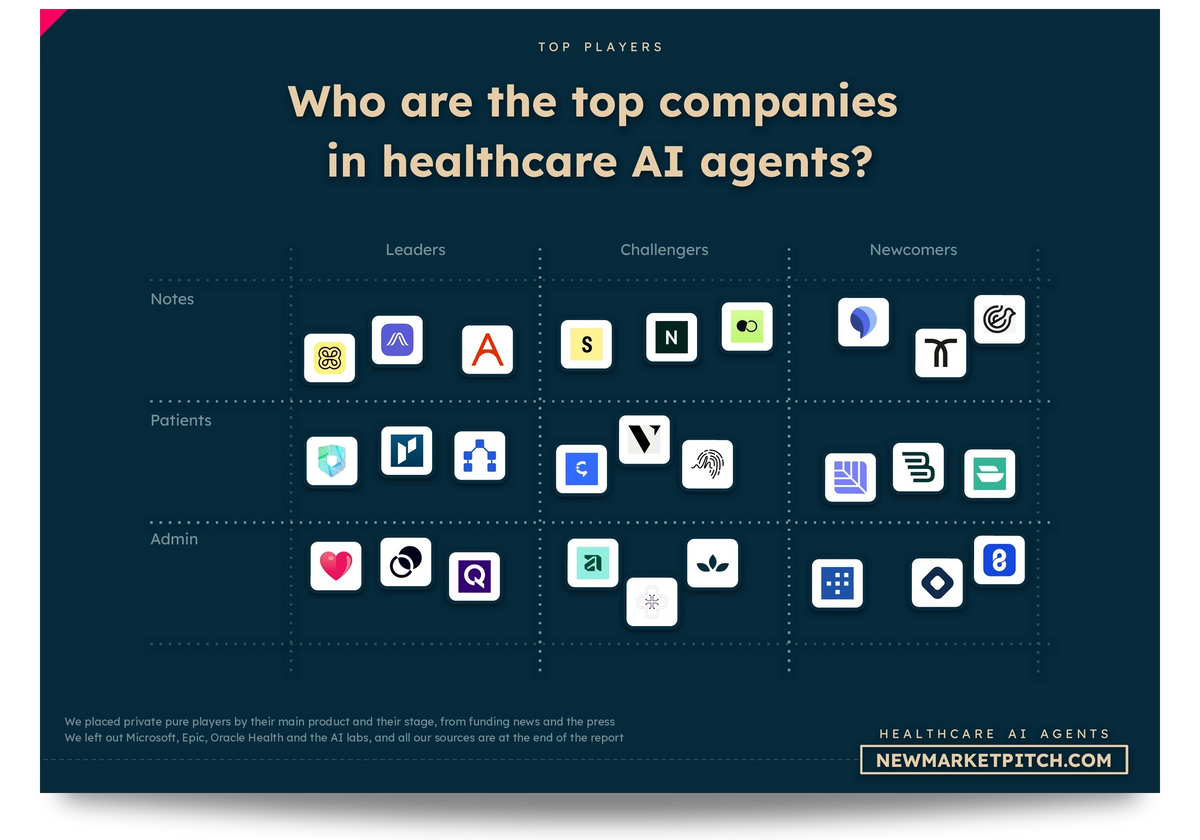
In our research about AI agents in healthcare, we turn what is vague and complex into simple, useful visuals. Market maps like this one show you at a glance where every startup stands.
Readily secured $11 million in Series A funding in October 2026.
When was it?
Readily announced its latest funding on October 13, 2026.
Who are they?
Readily develops AI software that monitors healthcare regulations, identifies affected policies, drafts revisions and gathers supporting evidence for compliance teams.
Geographical focus?
Readily operates in the United States, serving health plans and healthcare organizations managing regulatory obligations across multiple states.
Why do we include them in the healthcare AI agents market?
Readily automates connected compliance processes from regulatory monitoring to policy updates and audit preparation, making it a healthcare administrative workflow agent rather than a simple search tool.
What is the company stage?
Readily is in its early growth stage, with commercial deployments among health plans and healthcare organizations covering millions of insured individuals.
How much did they raise?
Readily raised $11 million to strengthen its compliance platform and support commercial expansion.
What round is it?
The financing was a Series A led by Define Ventures, with participation from Y Combinator and the California Health Care Foundation Innovation Fund.
Why did they raise?
Readily intends to build a broader enterprise oversight platform linking regulatory obligations, assigned actions and evidence of completed compliance work.
Vocca raised $20 million in a Series A round in October 2026.
When was it?
Vocca first announced the financing on October 6, 2026, followed by broader international coverage on October 8.
Who are they?
Vocca develops AI medical receptionists that answer patient calls, book appointments, reschedule visits and manage follow-up communications through existing healthcare software.
Geographical focus?
Vocca operates in Europe and the United States, with teams in Paris and New York and customers across several medical specialties.
Why do we include them in the healthcare AI agents market?
Vocca's voice agents complete appointment scheduling and patient communication tasks without requiring staff to handle every interaction, placing it in patient access automation.
What is the company stage?
Vocca has reached product-market fit and is scaling commercially, supporting approximately 15,000 medical practitioners across more than 1,500 practices.
How much did they raise?
Vocca secured $20 million, bringing its disclosed total funding to approximately $25 million.
What round is it?
The financing was a Series A led by Norrsken VC, with participation from Heal Capital, Speedinvest, Firstminute Capital and angel investors.
Why did they raise?
Vocca plans to deepen specialty-specific scheduling, expand automated patient communication and accelerate commercial growth in the United States and Europe.

Your time is limited. In our market report about AI agents in healthcare, we put numbers on each part of the market, so you can see where it makes sense to focus.
Vitalize raised $31 million in Series A financing in October 2026.
When was it?
Vitalize announced the funding on October 6, 2026.
Who are they?
Vitalize develops an AI operating platform that helps hospitals manage employee scheduling, staffing coordination, workforce allocation and patient capacity.
Geographical focus?
Vitalize focuses on U.S. hospitals and health systems that need to coordinate clinical staffing across departments and facilities.
Why do we include them in the healthcare AI agents market?
Vitalize automates hospital staffing and scheduling workflows using operational data, placing it in the hospital workforce and capacity management category.
What is the company stage?
Vitalize is in its commercial growth stage, with hospital deployments and reported improvements in workforce efficiency and staffing costs.
How much did they raise?
Vitalize raised $31 million to scale its hospital operations platform.
What round is it?
The financing was a Series A led by Oak HC/FT, alongside Norwest, .406 Ventures, Constellation Ventures and other investors.
Why did they raise?
Vitalize plans to expand across more hospitals, automate complex staffing processes and help healthcare operators reduce overtime and dependence on agency labor.
Parakeet Health secured $10 million in Series A funding in October 2026.
When was it?
Parakeet Health announced its financing on October 1, 2026.
Who are they?
Parakeet Health builds AI agents that manage patient calls, appointment bookings, referrals, reminders and follow-up outreach across phone, text, email, fax and web channels.
Geographical focus?
Parakeet Health serves U.S. outpatient medical groups, with particularly strong adoption among dermatology practices and other specialist providers.
Why do we include them in the healthcare AI agents market?
Parakeet Health executes patient communication and scheduling tasks across multiple connected channels, placing it in healthcare patient access and referral automation.
What is the company stage?
Parakeet Health is in a strong early growth phase, supporting more than 2,800 healthcare providers across over 1,100 locations.
How much did they raise?
Parakeet Health raised $10 million, bringing its cumulative disclosed funding to $13 million.
What round is it?
The financing was a Series A led by Canvas Ventures, with Blank Space Ventures, StoryHouse Ventures and HMC INQ participating.
Why did they raise?
Parakeet Health intends to enter more medical specialties, expand its communication capabilities and help practices convert missed calls and referrals into scheduled appointments.

In our document detailing everything you need to know about healthcare AI agent, we always try to gather several sources and make estimates that make sense, so you can work with solid numbers.
Basalt Health announced a $20 million Series A in September 2026.
When was it?
Basalt Health announced its funding on September 24, 2026, following an initial report on September 23.
Who are they?
Basalt Health develops AI software that reviews hospital referrals, evaluates post-acute admission criteria and helps care facilities process patient placements.
Geographical focus?
Basalt Health operates in the United States, serving hospitals, rehabilitation providers and post-acute care networks.
Why do we include them in the healthcare AI agents market?
Basalt automates referral intake and admission preparation across healthcare systems, placing it in post-acute care coordination while leaving final admission decisions to clinicians.
What is the company stage?
Basalt Health is in commercial growth, with deployments involving Lifepoint Health and expansion plans covering ScionHealth hospitals.
How much did they raise?
Basalt Health raised $20 million, bringing cumulative disclosed financing to approximately $24.5 million.
What round is it?
The financing was a Series A led by NEA, with participation from Frist Cressey Ventures and 25m Health.
Why did they raise?
Basalt plans to expand automated referral processing, accelerate hospital discharge coordination and develop additional workflows involving payers and post-acute facilities.
Heidi Health secured $100 million in Series C equity financing in September 2026.
When was it?
Heidi Health's financing was reported on September 22, 2026.
Who are they?
Heidi Health develops clinical AI software that turns consultations into medical notes, referral documents and other records while expanding toward supervised clinical workflow assistance.
Geographical focus?
Heidi Health is based in Australia and serves healthcare professionals internationally, with significant activity across North America, Europe and Asia-Pacific.
Why do we include them in the healthcare AI agents market?
Heidi Health is expanding its clinical documentation platform toward supervised workflow execution, making it an emerging healthcare agent provider, although some advanced capabilities remain under development.
What is the company stage?
Heidi Health is an advanced growth-stage company, with its clinical assistant supporting approximately 2.8 million patient visits weekly.
How much did they raise?
Heidi Health secured $100 million in equity alongside a separate $240 million nondilutive growth financing arrangement, creating a $340 million headline financing package.
What round is it?
The equity financing was a Series C led by Blackbird, while the separate growth facility came from General Catalyst's Customer Value Fund.
Why did they raise?
Heidi Health plans to expand globally, improve clinical integrations and build more capable supervised AI agents that help clinicians complete administrative and care-related tasks.

Our report covering the healthcare AI agent market gets updated several times a month, so you always get the latest view of where things stand.
InTouchNow raised approximately $3.1 million in seed financing in September 2026.
When was it?
InTouchNow announced the £2.3 million investment on September 21, 2026.
Who are they?
InTouchNow develops AI voice receptionists for general practitioner practices, answering incoming calls, supporting appointment requests and collecting routine patient information.
Geographical focus?
InTouchNow focuses on the United Kingdom, particularly NHS general practices that need to manage large volumes of patient telephone calls.
Why do we include them in the healthcare AI agents market?
InTouchNow automates primary care reception workflows and routes complex requests to human staff, placing it in healthcare voice agents and patient communication.
What is the company stage?
InTouchNow is in early commercial expansion, building on its healthcare call-center experience and serving more than 150 GP practices.
How much did they raise?
InTouchNow secured £2.3 million, equivalent to approximately $3.1 million at the time of the announcement.
What round is it?
The financing was a seed round led by Ada Ventures, with participation from Exceptional Ventures and Kadmos Capital.
Why did they raise?
InTouchNow plans to improve voice recognition, add multilingual capabilities, deepen patient record integrations and expand adoption across NHS primary care.
Health Force raised approximately $4.8 million in seed funding in September 2026.
When was it?
Health Force announced its €4.2 million financing on September 17, 2026.
Who are they?
Health Force develops AI agents that work inside hospital software to perform insurance checks, claims processing, regulatory reporting and other administrative tasks.
Geographical focus?
Health Force focuses on European healthcare organizations, with operations associated with Spain, Austria and Italy and an emphasis on hospital deployments.
Why do we include them in the healthcare AI agents market?
Health Force builds agents that carry out multi-step hospital administrative workflows in existing systems, making it a direct match for hospital back-office automation.
What is the company stage?
Health Force is a seed-stage company with active commercial hospital deployments and reported automation covering more than 200,000 patient cases annually.
How much did they raise?
Health Force raised €4.2 million, or approximately $4.8 million to $4.9 million, depending on the exchange rate used.
What round is it?
The financing was a seed round led by LUMO Labs, with participation from Step Venture, Next Tier Ventures, Target Global and Calm/Storm Ventures.
Why did they raise?
Health Force plans to expand its agent catalog, automate additional hospital workflows and deploy its software across more European healthcare systems.

In our research about AI agents in healthcare, we look at what the winners do differently, so you can learn from the best instead of guessing.
Ferry Health secured $9 million in seed financing in September 2026.
When was it?
Ferry Health announced its financing and public launch on September 16, 2026.
Who are they?
Ferry Health develops an AI healthcare assistant that identifies suitable in-network providers, contacts medical offices, checks appointment availability and books visits for patients.
Geographical focus?
Ferry Health operates across the United States, with access through healthcare partners covering patients in all 50 states.
Why do we include them in the healthcare AI agents market?
Ferry's agents perform the practical steps required to arrange medical care, from contacting provider offices to confirming appointments, placing the company in patient navigation automation.
What is the company stage?
Ferry Health is in early commercial growth following its public launch, with more than one million patients able to access the service through partner organizations.
How much did they raise?
Ferry Health secured $9 million to expand its AI-powered healthcare navigation platform.
What round is it?
The financing was a seed round backed by Andreessen Horowitz, Index Ventures, Avid Ventures, Layout Ventures, SV Angel, BoxGroup and other investors.
Why did they raise?
Ferry Health intends to expand distribution through health systems and insurers while developing agents for additional tasks such as imaging coordination and home healthcare arrangements.
Kairon Health raised $5 million in venture financing in September 2026.
When was it?
Kairon Health announced the investment on September 15, 2026.
Who are they?
Kairon Health develops AI software that connects clinical and insurance claims data with patient outreach, care gap management and operational workflows for healthcare organizations.
Geographical focus?
Kairon Health operates in the United States, serving accountable care organizations, medical groups and healthcare networks across more than 30 states.
Why do we include them in the healthcare AI agents market?
Kairon links care gap detection with follow-up work and patient outreach, placing it in value-based care execution rather than standalone population health analytics.
What is the company stage?
Kairon Health is in seed-stage commercial expansion, with contracts covering more than one million attributed patients across multiple healthcare payment models.
How much did they raise?
Kairon Health raised $5 million to expand its AI-native care operations platform.
What round is it?
The financing was an early venture round led by Flare Capital Partners, with Tau Ventures, Lightbank, General Advance and Pave Health Ventures participating.
Why did they raise?
Kairon Health plans to deepen AI capabilities across its workflow products, expand patient outreach automation and grow its commercial team as Medicare accountable care models evolve.
Written by the New Market Pitch teamWe track new markets so founders and investors can move faster. About us