Who are the top investors in healthcare AI agents?
Whether you're building or investing in the healthcare AI agent market, our report covers everything you need to know: the players, the money, and what's coming next.
Summary
Andreessen Horowitz is the most active healthcare AI agents investor, joining 10 equity rounds and being named as lead in every one we found. General Catalyst follows closely, while Y Combinator has 8 rounds. Big-name funds are active, but they do different jobs.
The biggest difference is who leads the deals. General Catalyst led 6 of its 9 rounds, a lower share than Andreessen Horowitz. Y Combinator is more prominent at the earliest stage than in the large hospital deployments that attract growth investors.
Look at the newest rounds and the order changes. Andreessen Horowitz and Y Combinator are tied for the most rounds joined this year, with 4 each. General Catalyst, despite its high historical position, has not joined a round this year in the deals we counted.
Healthcare specialists have not been crowded out. Oak HC/FT has repeatedly backed companies, concentrating on companies such as Ambience Healthcare, Candid Health and Regard. Transformation Capital and Flare Capital Partners show that narrower expertise can matter even without the largest overall count.
Corporate healthcare money plays a different role. Optum Ventures has joined 6 rounds but led 1, whereas Oak HC/FT was named as lead in every round we found. An insurer-backed investor may bring access and knowledge without setting the terms of a financing.
Seed rounds dominate. Among rounds with a named investor and a known stage, seed accounts for 113 of 254, and Y Combinator is the most active seed investor. At Series A, Andreessen Horowitz leads with 4. At Series B, Transformation Capital leads with 3.
Later rounds have no clear winner. Andreessen Horowitz, Oak HC/FT and Memorial Hermann Health System share the Series C lead with 2 rounds each. This is a sign that hospital operators and generalist funds can meet in the same large healthcare AI transactions.
The companies in those portfolios explain what investors want. Abridge and Ambience Healthcare connect clinical documentation to coding and claims. Assort Health and Clarion automate patient access. Latent Health works across medication access and pharmacy operations. Investors are betting on work getting finished, not just on conversational interfaces.
Repeat partnerships often revolve around a single startup. Universal Health Services and WellSpan Health joined 3 rounds together, all involving Hippocratic AI. General Catalyst and Y Combinator joined 2 rounds together across Pharos and Taxo, showing a different kind of repeat relationship.
No single kind of investor controls healthcare AI agents. Andreessen Horowitz leads by participation and named leads, Y Combinator dominates seed participation, Oak HC/FT has a prominent specialist position, and hospital-linked investors contribute distinct clinical and commercial knowledge.

Written by the New Market Pitch teamWe track new markets so founders and investors can move faster. About us

In our report covering the healthcare AI agent market, you will always find fresh funding data, taken straight from our own verified funding database.
Which VCs invest the most in healthcare AI agents right now?
Andreessen Horowitz leads healthcare AI agent investing with 10 rounds joined, ahead of General Catalyst with 9.
Y Combinator follows with 8, although it is an accelerator rather than a traditional VC. Andreessen Horowitz was named as lead in every round we found, while General Catalyst led 6.
Joining a round does not tell us who led the negotiations. Abridge's financing announcement explicitly named Andreessen Horowitz as lead of its financing, and Ambience Healthcare's financing announcement named Andreessen Horowitz and Oak HC/FT as co-leads. Both companies sell into health systems and connect documentation with subsequent clinical and administrative work.
General Catalyst's healthcare strategy is broader. Its Hippocratic AI announcement described a company building patient-facing agents for tasks such as outreach and follow-up. They are backing different parts of hospital work.
The table below ranks the 20 most active healthcare AI agents investors by the number of equity rounds they joined, with the rounds they led, their main stages, the startups they backed and the biggest round they joined.
If you want to go more into detail and get more data to understand what investors are betting on now, please check our healthcare AI agents report.
| # | Investor | Rounds | Led | Main stages | Healthcare AI agents startups backed | Biggest round joined | Latest round |
|---|---|---|---|---|---|---|---|
| 1 | Andreessen Horowitz ▲ | 10 | 10Named as lead in every round found | Series A 4Seed 3 | Abridge, Ambience Healthcare, Tennr, Infinitus, Lassie + 5 more | $300MAbridge · 2025 | Sep 2026 |
| 2 | General Catalyst ▼ | 9 | 6Usually leads (75% of the 8 rounds with a known lead) |
Seed 6Series A 2 | Hippocratic AI, Fabric, Valerie Health, Clarium, Amigo AI + 4 more | $60MFabric · 2024 | Dec 2025 |
| 3 | Y Combinator ▲ | 8 | 3Leads half its rounds (lead known for 6 of 8 rounds) |
Seed 7Series A 1 | Parallel, Clarion, Pharos, Taxo, Decoda Health + 2 more | $20MParallel · 2026 | Sep 2026 |
| 4 | Oak HC/FT ▲ | 7 | 7Named as lead in every round found | Series A 2Series B 2 | Ambience Healthcare, Regard, Candid Health, Courier Health, Thesis Care + 1 more | $243MAmbience Healthcare · 2025 | Oct 2026 |
| 5 | Lightspeed Venture Partners | 6 | 6Named as lead in every round found | Seed 2Series B 2 | Abridge, Assort Health, Tennr, Triomics, Anatomy Financial + 1 more | $150MAbridge · 2024 | Apr 2026 |
| 6 | Optum Ventures ▲ | 6 | 1Mostly follows (led 17% of its rounds) |
Series A 3Series B 2 | Ambience Healthcare, Bunkerhill Health, Humata Health, Amigo AI, RISA Labs | $243MAmbience Healthcare · 2025 | Jul 2026 |
| 7 | New Enterprise Associates ▲ | 5 | 5Named as lead in every round found | Seed 2Series A 2 | Anterior, Basalt Health, Popai Health, In-House Health | $40MAnterior · 2026 | Sep 2026 |
| 8 | Transformation Capital ▲ | 5 | 5Named as lead in every round found | Series B 3Series A 1 | Rad AI, CodaMetrix, Latent Health, Alaffia Health, SmarterDx | $80MLatent Health · 2026 | Mar 2026 |
| 9 | Bain Capital Ventures ▼ | 5 | 4Usually leads (80% of its rounds) |
Series A 2Seed 1 | Forus, Charta Health, Silna Health | $150MForus · 2026 | Nov 2026 |
| 10 | First Round Capital ▼ | 5 | 4Usually leads (80% of its rounds) |
Series A 2Series B 2 | Assort Health, Brellium, Assured Health | $76MAssort Health · 2025 | Oct 2026 |
| 11 | Accel ▲ | 5 | 4Named as lead in every round found (lead known for 4 of 5 rounds) |
Seed 2Series A 2 | Forus, Silna Health, Clarion, RapidClaims | $125MForus · 2026 | Sep 2026 |
| 12 | CVS Health Ventures ▼ | 5 | 2Leads half its rounds (lead known for 4 of 5 rounds) |
Seed 1Series A 1 | Abridge, Ellipsis Health, Fathom, Kouper Health | $250MAbridge · 2025 | May 2026 |
| 13 | Flare Capital Partners ▲ | 4 | 4Named as lead in every round found | Seed 2Series A 2 | GenHealth.ai, Daffodil Health, Cascala Health, Kairon Health | $16MGenHealth.ai · 2026 | Sep 2026 |
| 14 | Khosla Ventures | 4 | 4Named as lead in every round found | Series B 2Seed 1 | Rad AI, Ellipsis Health, Bunkerhill Health, TORTUS | $50MRad AI · 2024 | Jul 2026 |
| 15 | SignalFire ▼ | 4 | 1Leads half its rounds (lead known for 2 of 4 rounds) |
Series A 2Seed 1 | CodaMetrix, Mandolin, SuperDial | $32MMandolin · 2025 | Jun 2025 |
| 16 | Insight Partners ▲ | 3 | 3Named as lead in every round found | Series A 2Series B 1 | Charta Health, ExaCare AI, Assured Health | $55MCharta Health · 2026 | Nov 2026 |
| 17 | Headline | 3 | 3Named as lead in every round found | Series A 3 | Heidi Health, ClarityCare, Upheal | $17MHeidi Health · 2025 | Oct 2026 |
| 18 | Define Ventures ▼ | 3 | 3Named as lead in every round found | Series A 2Series B 1 | Arintra, Foundation Health, Layer Health | $25MArintra · 2026 | Aug 2026 |
| 19 | Bessemer Venture Partners ▲ | 3 | 3Named as lead in every round found | Seed 1Series A 1 | Flagler Health, Amperos Health, Zingage | $50MFlagler Health · 2026 | Aug 2026 |
| 20 | Kleiner Perkins | 3 | 3Named as lead in every round found | Series B 2Seed 1 | Hippocratic AI, Ambience Healthcare, Health Universe | $141MHippocratic AI · 2025 | Mar 2026 |
No investors match this search.
Data from January 2024 through 13 November 2026, which is enough to show who is active today and who has been for years. Rounds: equity rounds in which the investor is named. Led: rounds it led or co-led. ▲ more rounds in 2026 so far than its 2025 pace, ▼ fewer.

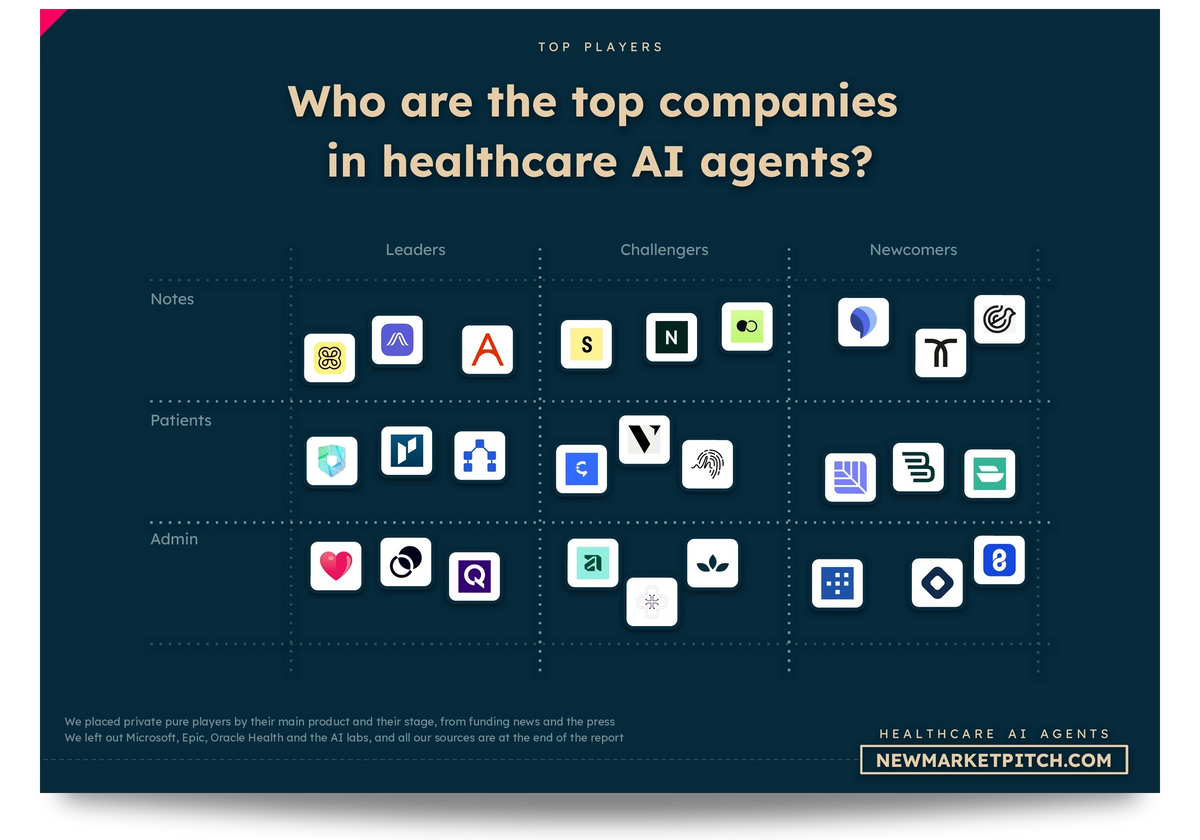
In our research about AI agents in healthcare, we turn what is vague and complex into simple, useful visuals. Market maps like this one show you at a glance where every startup stands.
Does Andreessen Horowitz actually lead healthcare AI deals?
Yes, Andreessen Horowitz was named as lead in every healthcare AI agent round we found involving the firm.
The largest round it joined was Abridge’s $300M financing in 2025. Announcements name lead investors more often than smaller participants, so rounds where the firm only followed may be missing from that count. Its portfolio also includes Ambience Healthcare, Tennr, Infinitus and Leona Health.
These companies have a practical connection. Abridge turns information from clinical conversations into documentation and coding workflows. Ambience adds coding-aware notes and documentation integrity within large hospitals. Tennr concentrates on referrals, while Infinitus automates complex healthcare phone and coordination workflows. The companies use AI to move clinical information into systems where staff can act on it.
Abridge's September 2026 launch of pre-bill review helps explain the attraction. It checks coded diagnoses against the original clinical record before a claim goes out. The product expansion connects the initial clinician-facing tool to a financial process with measurable consequences. That is the sort of expanding role that can justify repeated backing.
Has General Catalyst lost its lead in healthcare AI investing?
General Catalyst remains a major healthcare AI agent investor, but Andreessen Horowitz is ahead in both total and recent deal activity.
General Catalyst joined 9 rounds overall, including 3 last year, and none this year in the equity rounds we counted.
General Catalyst has also worked on healthcare agents outside the newest equity rounds. Its March 2024 announcement described helping create Hippocratic AI through its Health Assurance Ecosystem. Hippocratic AI's subsequent Series C release identified General Catalyst among the participating investors and described the deployment of patient-facing clinical agents across health systems and payers. General Catalyst is also connected to Fabric, which describes automating intake and virtual-care workflows for providers.
Not every financial relationship counts as a new equity round. Heidi Health's September 2026 announcement described a growth investment through General Catalyst's Customer Value Fund alongside a separately led equity round. Its existence is relevant to the firm's healthcare strategy, but it should not be silently added to an equity-round ranking.

Your time is limited. In our market report about AI agents in healthcare, we put numbers on each part of the market, so you can see where it makes sense to focus.
Is Y Combinator a bigger healthcare AI investor than specialist funds?
Y Combinator has joined 8 healthcare AI agent rounds, more than most specialist healthcare funds.
It focuses on early-stage startups rather than large funding rounds for established hospital vendors.
Y Combinator concentrates on seed and joined 1 Series A round in our research. Its portfolio includes Clarion, Parallel, Pharos, Taxo and Decoda Health. Clarion's own Y Combinator profile describes agents that handle scheduling, billing and prescription-refill inquiries, which makes the operational requirement clear: the software is expected to complete work inside a clinic rather than just answer a patient's question.
Compare that with Oak HC/FT, which participates more across Series A, B and C, or Optum Ventures, which joined 6 rounds and has a health-system operator's perspective. Y Combinator may meet a healthcare agent company before it has substantial revenue or enterprise distribution. Specialists may join when the startup needs large hospital customers and proof that its tools work there.
Are specialist healthcare investors losing to Silicon Valley generalists?
Healthcare specialist investors still play a major role in funding AI agents, even though generalist venture firms lead by round count.
Oak HC/FT, Optum Ventures, Transformation Capital, CVS Health Ventures and Flare Capital Partners all appear among the most active names.
Look at Oak HC/FT and Optum Ventures. Oak HC/FT was named as lead in every recorded round. Optum Ventures participated in 6 but led 1. Oak HC/FT led Regard's July 2024 financing and co-led Ambience Healthcare's July 2025 financing. Optum Ventures is named among Ambience's participating investors. Oak HC/FT frequently leads. Optum Ventures more often joins deals led by others.
Round counts alone do not capture what a healthcare specialist brings. Transformation Capital has focused on later clinical and administrative workflows, while Flare Capital Partners has backed smaller companies developing healthcare-specific agents. Founders who need hospital customers may value that experience more than a famous fund name.
The table below shows how selected healthcare specialists and other active investors differ in participation and named lead roles.
| Investor | Rounds joined | Rounds led |
|---|---|---|
| Oak HC/FT | 7 | 7 |
| Optum Ventures | 6 | 1 |
| Transformation Capital | 5 | 5 |
| CVS Health Ventures | 5 | 2 |
| Flare Capital Partners | 4 | 4 |
| Define Ventures | 3 | 3 |
| Headline | 3 | 3 |
Rounds led means rounds in which the investor was named as lead. Announcements name leads more consistently than smaller participants.
Which healthcare AI agents investors are still investing this year?
Andreessen Horowitz and Y Combinator are tied for the most healthcare AI agent rounds this year, with 4 each.
Among the 20 most active investors overall, 18 joined a round this year and 2 did not.
Andreessen Horowitz joined 3 rounds last year, and its latest recorded round is Ferry Health's, in September 2026. Y Combinator's recent activity includes Clarion and Parallel. Meanwhile, General Catalyst has not joined a round this year in our equity count, and SignalFire has also been absent. An old reputation tells founders little about who is writing new checks today.
Counting only rounds with at least one named investor, the market has 83 rounds this year, compared with 106 last year. Those are different periods because the current year is not complete, so they should not be turned into a full-year growth claim. What they do demonstrate is that a substantial number of healthcare agent startups are still getting financed, while investor participation is rotating among firms.
The table below shows, year by year, how many rounds 12 of the most active healthcare AI agents investors joined, so it is easy to see who is still investing and who has slowed down.
If you want to go more into detail and see which investors are still writing checks and which have slowed down, please check our healthcare AI agents report.
| Investor | 2024 | 2025 | 2026* | Total |
|---|---|---|---|---|
| Andreessen Horowitz | 3 | 3 | 4 | 10 |
| Y Combinator | 2 | 2 | 4 | 8 |
| Oak HC/FT | 2 | 2 | 3 | 7 |
| Optum Ventures | 2 | 1 | 3 | 6 |
| Flare Capital Partners | 1 | 3 | 4 | |
| New Enterprise Associates | 2 | 1 | 2 | 5 |
| Transformation Capital | 2 | 1 | 2 | 5 |
| Bain Capital Ventures | 3 | 2 | 5 | |
| Accel | 1 | 2 | 2 | 5 |
| Insight Partners | 1 | 2 | 3 | |
| Bessemer Venture Partners | 1 | 2 | 3 | |
| Lightspeed Venture Partners | 4 | 1 | 1 | 6 |
* 2026: January to 13 November. Darker cells mean more rounds that year. Data from January 2024 through 13 November 2026.
Is Andreessen Horowitz doubling down on healthcare AI agents?
Andreessen Horowitz is backing healthcare AI agents more often this year, joining 4 rounds compared with 3 last year.
Its portfolio spans connected clinical and administrative work, not just isolated AI features.
Abridge is a useful example because the company's product has moved from turning conversations into notes toward supporting coding and pre-bill review. Ambience Healthcare also links documentation to clinical documentation integrity and reimbursement. Infinitus, meanwhile, describes tools that automate prior authorization and patient-support actions after an AI conversation ends. These products solve different parts of a familiar problem: healthcare information sits in separate systems, and staff spend time moving it between them.
The fund's higher current participation is evidence of continuing interest, not proof that its capital committed to this sector has increased by a specific percentage. Our figures count rounds joined and led, not the value of each investor's own checks. Andreessen Horowitz is still joining new deals, rather than relying on its past reputation.

In our document detailing everything you need to know about healthcare AI agent, we always try to gather several sources and make estimates that make sense, so you can work with solid numbers.
Is Oak HC/FT becoming the healthcare AI specialist to watch?
Oak HC/FT is a standout healthcare AI agent specialist, named as lead in every round we found involving the firm.
Its portfolio includes Ambience Healthcare, Candid Health, Regard, Thesis Care and Courier Health.
Its portfolio shows why hospital experience matters. Regard builds clinical insights into provider workflows. Ambience supports documentation and coding across specialties, and its financing announcement named Cleveland Clinic, UCSF Health, Houston Methodist and Memorial Hermann as users. Candid Health tackles the billing and revenue cycle after care has been delivered. Each product handles sensitive clinical or financial data inside hospitals.
Oak HC/FT led Regard's Series B financing in July 2024 and co-led Ambience's Series C in July 2025. The announcements show Oak HC/FT repeatedly leading, rather than just appearing on investor lists. Andreessen Horowitz still has more joined rounds overall. Oak HC/FT remains an important specialist to compare against.
Do Lightspeed and Optum Ventures invest in healthcare AI the same way?
No, Lightspeed Venture Partners and Optum Ventures play different roles in healthcare AI agent funding despite joining 6 rounds each.
Lightspeed was named as lead in every round we found, whereas Optum Ventures led 1.
Lightspeed's holdings include Abridge, Assort Health, Tennr, Triomics and Anatomy Financial. Its own Assort Health portfolio page emphasizes replacing incoming telephone traffic with agents that schedule appointments, manage prescription requests and handle other patient-facing tasks. In comparison, Optum Ventures has backed Ambience Healthcare, Humata Health, Bunkerhill Health, Amigo AI and RISA Labs. Optum Ventures' portfolio identifies Ambience as a healthcare AI operating system and notes a relationship dating back well before the latest agent boom.
Their deal records show different roles, though not why they made each decision. Lightspeed backs founders across several healthcare workflows. Optum Ventures offers the possibility of commercial insight from the health insurance and care operations world. Neither role automatically tells us the size of its actual check, which is not disclosed by round participation counts.
Which healthcare AI agents investors back seed rounds, and which back growth rounds?
Y Combinator leads seed participation in healthcare AI agents with 7 rounds, while Series C has no single leading investor.
Among rounds with a named investor and a known stage, seed accounts for 113 of 254. There are 27 rounds at Series C or later. Andreessen Horowitz, Oak HC/FT and Memorial Hermann Health System are tied at Series C with 2 each.
At Series A, Andreessen Horowitz is most active with 4 rounds. At Series B, Transformation Capital leads with 3. Those differences reflect the kinds of companies each investor reaches: accelerator-backed founders working toward their first deployments, funds supporting product-market fit at health systems, and hospital-linked investors joining more mature clinical platforms.
Abridge and Ambience Healthcare show why later rounds attract different participants. Both moved beyond recording clinical speech into coding and revenue workflows, where reliability, integration and institutional purchasing become essential. Latent Health shows a related path in pharmacy operations: its recent announcement described an enterprise system spanning patient identification, medication access and follow-up. As startups grow, investors fund different problems: first deployment, hospital integration and reliable operations.
The table below shows, for 12 of the most active healthcare AI agents investors, how many rounds they joined at each stage, from seed to growth.
If you want to go more into detail and see where each investor places its bets, from seed to growth, please check our healthcare AI agents report.
| Investor | Seed | Series A | Series B | Series C | Series D+ | Growth |
|---|---|---|---|---|---|---|
| Andreessen Horowitz | 3 | 4 | · | 2 | 1 | · |
| General Catalyst | 6 | 2 | · | · | · | · |
| Y Combinator | 7 | 1 | · | · | · | · |
| Oak HC/FT | 1 | 2 | 2 | 2 | · | · |
| Lightspeed Venture Partners | 2 | 1 | 2 | 1 | · | · |
| Optum Ventures | · | 3 | 2 | 1 | · | · |
| New Enterprise Associates | 2 | 2 | 1 | · | · | · |
| Transformation Capital | · | 1 | 3 | 1 | · | · |
| Bain Capital Ventures | 1 | 2 | 1 | 1 | · | · |
| First Round Capital | 1 | 2 | 2 | · | · | · |
| Accel | 2 | 2 | 1 | · | · | · |
| CVS Health Ventures | 1 | 1 | · | 1 | 1 | · |
Most active at each stage, among all healthcare AI agents investors: Seed, Y Combinator · Series A, Andreessen Horowitz · Series B, Transformation Capital · Series C, Andreessen Horowitz, Oak HC/FT and Memorial Hermann Health System · Series D+, no investor joined more than one round · Growth, no investor joined more than one round. Bigger dots mean more rounds. Data from January 2024 through 13 November 2026.
Who can keep funding healthcare AI agents after the first check?
Andreessen Horowitz and Oak HC/FT have both backed healthcare AI agents beyond their earliest funding rounds.
Andreessen Horowitz joined 4 Series A rounds and 2 Series C rounds. Oak HC/FT joined Series A, Series B and Series C rounds.
Look at the startups these firms keep supporting. Abridge announced a large financing after landing enterprise health systems and later launched pre-bill review for coding teams. Ambience Healthcare moved from its original ambient documentation use case into an integrated clinical and administrative platform. Regard used a later financing to extend the functionality of its clinical insights software. In each case, the investment story becomes less about whether a model can write text and more about whether it can be adopted across an entire hospital or specialty.
There is no guarantee that the investor that funded a startup first will lead its later round. The parties change as companies move from pilots to wider procurement. Still, a firm that invests at both early and later stages is a very different partner from one that only writes small first checks.

Our report covering the healthcare AI agent market gets updated several times a month, so you always get the latest view of where things stand.
Are clinical documentation agents attracting the strongest investors?
Clinical documentation agents have drawn leading healthcare AI investors, including Andreessen Horowitz, Lightspeed Venture Partners and Oak HC/FT.
Optum Ventures, CVS Health Ventures and Kleiner Perkins also back companies such as Abridge and Ambience Healthcare.
Investors see more than a market for note-taking software. Abridge's 2025 company announcements emphasized health-system deployments and the connection between conversations, diagnosis documentation and reimbursement. Its September 2026 update added claim review before submission. Ambience Healthcare's own Series C announcement described coverage across more than 100 specialties and integrations with major electronic health record systems. Those developments matter because a stand-alone note generator is easier for an incumbent to copy than a series of connected, reviewed clinical tasks.
We should not read this concentration as proof that documentation will produce the largest investor returns. It does show why sophisticated investors often start with clinicians' daily documentation burden and expand toward the rest of the healthcare workflow. The business becomes harder to replace when hospitals embed it into coding, quality review and care coordination.
Who is backing AI agents that answer patients and schedule appointments?
Lightspeed Venture Partners, First Round Capital, Accel and Y Combinator are backing healthcare AI agents that schedule appointments and handle patient requests.
These products now do more than answer calls: they complete scheduling and follow-up work.
Assort Health is an example of that progression. Lightspeed lists Assort in its portfolio, and Forbes reported in June 2026 that the startup was reaching thousands of physicians while working through complex scheduling rules. Clarion, backed by Accel and Y Combinator, describes a product that completes scheduling, billing and refill interactions rather than only handling the first conversation. Other patient-access startups in the investor list, such as Leona Health and Ellipsis Health, address adjacent communication and clinical engagement needs.
Patient access starts with a familiar problem: missed calls, long waits and patients routed to the wrong appointment. What happens next is harder. Scheduling information must be recorded correctly, the patient must get a usable appointment, and exceptions must reach staff. Investors backing these systems are funding the completion of that process, not just fluent voice technology.
Which investors are betting on healthcare AI agents for claims and billing?
Transformation Capital, Oak HC/FT, Bain Capital Ventures, Insight Partners and CVS Health Ventures back healthcare AI agents for coding and billing.
These companies help providers avoid mistakes that can delay payment.
Transformation Capital has backed CodaMetrix, Alaffia Health and SmarterDx. Oak HC/FT backed Candid Health, while Bain Capital Ventures and Insight Partners appear in Charta Health's financing history. In November 2026, Charta announced a $55M Series B led by Insight Partners with Bain Capital Ventures participating. Charta described AI that checks medical charts against payer rules before claims are sent, while Nym and AKASA have published examples of automated coding inside hospital systems.
These companies work at different points of the revenue cycle. Some review clinical notes, some determine codes, and others address claims and denials. The investors' common bet is that healthcare providers will pay for reliable automation where mistakes can be costly. Hospitals need audit trails and human review before trusting automated claims.

In our research about AI agents in healthcare, we look at what the winners do differently, so you can learn from the best instead of guessing.
Are hospitals becoming important healthcare AI investors themselves?
Yes, hospital systems are investing directly in healthcare AI agents, particularly patient-facing products and more established clinical platforms.
Memorial Hermann Health System is tied for the lead at Series C. Universal Health Services and WellSpan Health have repeatedly backed Hippocratic AI together.
Hippocratic AI's March 2024 financing release named Universal Health Services and WellSpan Health among its earlier investors. Its November 2025 Series C announcement again listed major healthcare organizations alongside venture firms. That is important because the product handles patient interactions in settings where safety review, escalation rules and staff workflows matter as much as model performance. Hospital investors can understand these requirements as potential customers and operators.
But a hospital joining a round is not the same thing as a health system purchasing the software, and neither proves how much the hospital invested. We count the equity participation as an investor relationship. Separately, Hippocratic AI's announced customer partnerships and interaction volumes show the clinical-commercial setting in which the product must work. The two kinds of evidence should support, not replace, each other.
Which healthcare AI agents investors most often invest together?
Universal Health Services and WellSpan Health have joined the most healthcare AI agent rounds together: 3, all involving Hippocratic AI.
General Catalyst and Y Combinator have invested together in 2 rounds, across Pharos and Taxo.
The top pair is unusual because it involves healthcare operators rather than a familiar venture-capital combination. Hippocratic AI develops patient-facing agents for tasks such as outreach and follow-up. Healthcare operators participating repeatedly in its financing may bring knowledge of clinical supervision, workflow constraints and customer needs. That is different from a firm that appears only to support a financial round.
Several other repeat pairs are concentrated in a single company. Accel and Y Combinator joined 2 rounds involving Clarion, while Chemistry and First Round Capital joined 2 involving Assort Health. Repeat appearances often mean a startup has brought its earlier investors into another financing.
The table below lists the pairs of healthcare AI agents investors named together in at least two equity rounds, with the startups they backed together.
If you want to go more into detail and see which investor networks back the same startups, please check our healthcare AI agents report.
| Investor pair | Rounds together | Startups backed together |
|---|---|---|
| Universal Health Services + WellSpan HealthHippocratic AI | 3 | Hippocratic AI |
| General Catalyst + Y CombinatorPharos, Taxo | 2 | Pharos, Taxo |
| Accel + Y CombinatorClarion | 2 | Clarion |
| Chemistry + First Round CapitalAssort Health | 2 | Assort Health |
| First Round Capital + Left Lane CapitalBrellium | 2 | Brellium |
| Michael Boyer + Michael SolomonMedow Health AI | 2 | Medow Health AI |
Pairs of investors named in the same equity round. Data from January 2024 through 13 November 2026.
Do healthcare AI investors keep backing the same startups together?
Often, healthcare AI investors co-invest because they keep backing a particular company, not because they share a market-wide strategy.
Universal Health Services and WellSpan Health repeatedly backed Hippocratic AI. General Catalyst and Y Combinator appear together at Pharos and Taxo.
Look at the other pairs: Accel and Y Combinator both backed Clarion, Chemistry and First Round Capital both backed Assort Health, and First Round Capital and Left Lane Capital both backed Brellium. Each pairing can reflect a particular startup's financing history rather than a broad partnership between the investors. Brellium's October 2026 financing announcement, for example, named Left Lane Capital as lead with First Round Capital participating.
Founders should be careful about what repeat co-investment means. Seeing firms in one round together is evidence that they were willing to back that business under that set of circumstances. It does not demonstrate that they will co-invest in an unrelated hospital AI product. The best practical reading is to study the companies, stages and roles behind the shared names rather than treat a co-investment pair as a permanent alliance.
Are Khosla Ventures and Accel really involved in healthcare AI agents?
Yes, Khosla Ventures and Accel both back healthcare AI agents, even if neither matches Andreessen Horowitz’s round count.
Khosla Ventures joined 4 rounds and Accel 5, but they favor different sets of startups.
Khosla Ventures' companies include Ellipsis Health, Rad AI, Bunkerhill Health and TORTUS. The group reaches across clinical documentation, communication and healthcare operations. Accel's investments include Forus, Silna Health, Clarion and RapidClaims, leaning into medication access, patient communication, claims and administrative tasks. Its largest round is Forus's $125M Series B in May 2026. Clarion's public accelerator profile names both Accel and Y Combinator, confirming that generalist and accelerator capital can meet in a very young healthcare company.
Their presence is important because this market is not limited to investors who brand themselves as digital-health specialists. Software investors can recognize the economic appeal of repeatable tasks and recurring enterprise contracts. But the names alone do not establish who led a deal or how much money each firm contributed. Khosla Ventures was named as lead in all 4 of its rounds, while Accel led 4.

In our market report about AI agents in healthcare, we don't want to repeat what boring consulting reports say. Instead, we show you the real and latest market signals that matter.
Are Bain and First Round still backing healthcare AI agents?
Bain Capital Ventures and First Round Capital are still investing in healthcare AI agents, although both joined fewer rounds this year.
Bain Capital Ventures joined 2 rounds this year versus 3 last year. First Round Capital joined 1 versus 4.
That pattern should not be confused with total withdrawal. Bain Capital Ventures appeared as a continuing investor in Charta Health's November 2026 funding announcement, which described software that reviews charts before billing. First Round Capital was among the participants in Brellium's October 2026 funding announcement. Brellium develops tools that audit documentation and detect compliance gaps in clinical records. Both products target work that providers already pay staff to perform.
Founders should check whether a fund backs products like theirs. Bain Capital Ventures' holdings include Forus, Charta Health and Silna Health. First Round Capital's include Assort Health, Brellium and Assured Health. Their shared focus on healthcare operations does not make their current pace identical, and neither should be labeled inactive simply because it has fewer new rounds than during the previous year.
So, who are the biggest investors in healthcare AI agents today?
Andreessen Horowitz is the most active healthcare AI agent investor by rounds joined and rounds led.
General Catalyst is its closest overall competitor. Y Combinator leads at seed, while Oak HC/FT stands out among healthcare specialists.
The funds also bring different kinds of experience. A hospital system funding Hippocratic AI may contribute knowledge of safe patient workflows. Optum Ventures may participate without leading. A fund such as Transformation Capital may play a larger role in coding and payer automation than its overall position suggests. The most useful backer will depend on whether a startup works on documentation, appointments, pharmacy coordination or claims.
The table below shows what we found.
| Question | Answer |
|---|---|
| Do the famous generalists still dominate deal activity? | Yes, Andreessen Horowitz leads healthcare AI agent participation by round count. It joined 10 rounds, ahead of the closest rival. Specialist influence nevertheless becomes more visible when we examine individual workflows. |
| Is the busiest fund still active now? | Yes, Andreessen Horowitz remains active in new healthcare agent rounds. It joined 4 rounds this year, tied with Y Combinator. Its standing is not merely the legacy of earlier investments. |
| Has the closest rival stopped making equity deals? | General Catalyst has not appeared in this year's counted equity rounds. It joined 3 rounds last year, but none this year. Its broader healthcare work continues outside that narrow measure. |
| Does startup acceleration translate into early investment leadership? | It does for Y Combinator in healthcare AI agents. Andreessen Horowitz instead leads Series A with 4 rounds. That does not make the accelerator a leading later-stage backer. |
| Can specialists still lead major hospital software financings? | Yes, Oak HC/FT repeatedly takes named lead positions in healthcare AI. It led every round identified in the research. Its hospital-focused portfolio gives those figures useful commercial context. |
| Does an insurer-backed investor usually lead its rounds? | Not in the case of Optum Ventures' recorded activity. It joined 6 rounds but led 1. Corporate healthcare access and deal leadership are different investor contributions. |
| Is there a single winner in later-stage investing? | No, Series C leadership is shared among different investor types. Andreessen Horowitz, Oak HC/FT and Memorial Hermann Health System each joined 2. Mature clinical platforms attract both venture and healthcare operators. |
| Are coding and claims attracting fresh venture capital? | Yes, chart review continues to attract named institutional leads. Charta Health announced a $55M Series B led by Insight Partners. The product connects clinical records to payment decisions before claims leave. |
| Do hospital investors repeatedly support patient-facing agents? | Yes, healthcare operators have made repeat commitments to Hippocratic AI. Universal Health Services and WellSpan Health joined 3 rounds together. This concentrates their partnership in one company, not the whole market. |
| Do repeat investing pairs usually cover many startups? | Not always, since several recurring combinations center on one company. Accel and Y Combinator joined 2 rounds involving Clarion. The shared history is company-specific rather than proof of a standing alliance. |

Learning from others' mistakes is the cheapest lesson there is. In our document detailing everything you need to know about healthcare AI agent, we look at what broke startups before you, so you don't repeat it.
Our methodology
Our data runs through November 13, 2026. We systematically track healthcare AI agent equity rounds deal by deal from January 2024, a period long enough to identify active investors rather than only early pioneers. The market includes systems that perform connected clinical or administrative steps for healthcare organizations, including patient communication, care coordination, documentation and operational work with appropriate human oversight. Standalone note generators, basic chatbots and prediction-only products do not qualify. Borderline companies remain in scope when their agents execute downstream actions. Every company counted is a startup under our definition: a venture-scale technology business founded in 2007 or later that is private or recently listed, with recently acquired companies retained under our acquisition rule.
We count each equity round joined by an investor and separately identify rounds in which it was publicly named as lead; we do not claim to know an investor's own check size. IPOs and offerings after a listing are excluded because they are not private rounds joined by venture investors. We combine alternate names for the same firm, merge repeated reports of one financing, and use company announcements and reliable press coverage to identify named investors. Generic references to existing investors or unnamed angels do not create investor records.
Announcements name lead investors more reliably than smaller participants, so rounds that an investor joined without leading are undercounted and lead rates are an upper bound.
Rounds confirmed by a company announcement, a press article or a regulatory filing are counted in full. Where no article exists, a round is counted only when at least two recognised databases agree on its date (within one month) and amount (within 5%), and it is marked as low confidence; a round found in a single database stays in the company's history but is left out of totals. For companies that have raised more than $100M, every round counted is backed by an article.
We never accept an investor list copied from a commercial database as sufficient evidence on its own. Such lists can confuse grants, debt and equity or attach investors to the wrong round. Of the 281 rounds counted, 263 have at least one named investor, representing 94%, and every investor figure here is based on those 263 rounds. The other rounds remain in the market's deal totals but cannot enter an individual investor's participation count. A single round may appear under several investors, so summing investor participation figures is not the same as counting market financings.
A well-known healthcare specialist can therefore rank below a generalist without being less important to its portfolio companies. We deliberately rank actual, named participation rather than fund assets, investment publicity, commercial partnerships or guessed dollars committed. That is the clearest reproducible answer to who has joined and led healthcare AI agent equity deals recently, while acknowledging that publicly named participation is a floor, not an exhaustive account of every investor in every financing.
Key sources include Abridge Series E led by Andreessen Horowitz and its health-system footprint, Abridge expansion into pre-bill coding review, Oak HC/FT and Andreessen Horowitz co-lead Ambience financing, General Catalyst's founding role and Hippocratic AI financing, Hippocratic AI institutional and venture investor participation, Healthcare operators backing Hippocratic AI, Clarion workflow description and named early backers, Lightspeed's Assort Health portfolio description, Optum Ventures healthcare AI portfolio, Regard round led by Oak HC/FT, Transformation Capital co-leads Latent financing, Charta Health Series B, Insight Partners and Bain Capital Ventures, Brellium round with First Round Capital and Left Lane Capital, Heidi growth financing distinction and equity investors, Flare Capital's current healthcare agent investing activity, Infinitus multi-step agent products and healthcare integration, Healthcare coding and claims automation examples, and Nym's autonomous coding outcomes.

If you build or invest in the healthcare AI agent market, you need to know which business models pay off now and which ones are fading. That's why our report covering it has a whole section on it.
Written by the New Market Pitch teamWe track new markets so founders and investors can move faster. About us