
What are the top healthcare AI startups by total funding raised?
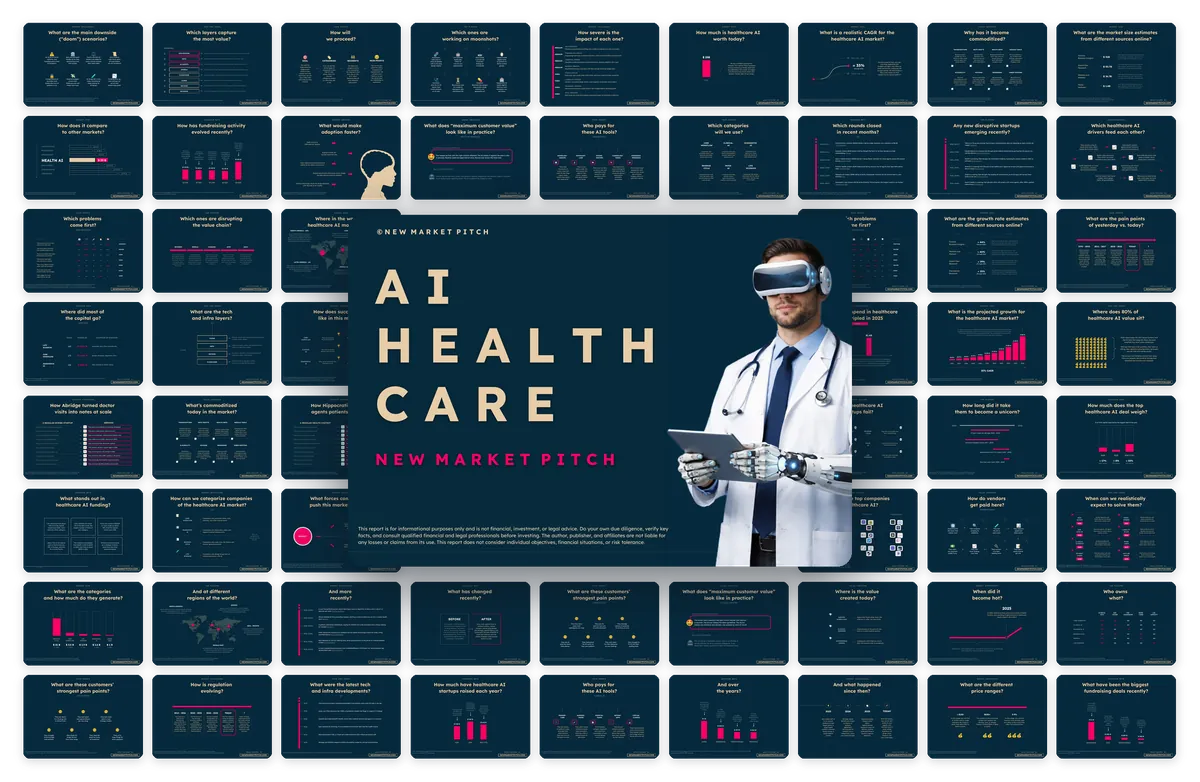
Building a startup or looking for your next investment in healthcare AI? Our report gives you the full picture.
Summary
Isomorphic Labs is currently the most heavily funded Healthcare AI company in our reconstruction, with roughly $2.7 billion in disclosed external equity funding after its latest $2.1 billion round.
The top of the market is unusually concentrated. Relay Therapeutics sits around $1.7 billion, while XtalPi, Freenome, Tempus, Commure and Xaira Therapeutics form a broad billion-dollar group once the relevant private and public equity transactions are included.
AI drug discovery dominates raw capital raised. Isomorphic Labs, Relay, XtalPi and Xaira all sit near the top because they are funding not only software and AI infrastructure, but also laboratories, preclinical work, manufacturing preparation and long therapeutic-development programs.
The two biggest financings are in a different league from ordinary large Healthcare AI rounds. Isomorphic Labs raised $2.1 billion in its Series B, while Xaira launched with roughly $1 billion from day one; after that, the ranking drops to rounds in the $300 million to $600 million range. Rounds this far above the rest are why we size the market ourselves in our healthcare AI market report.
Private-company rankings look different from lifetime funding rankings. Public companies such as Relay Therapeutics, Tempus, XtalPi and AbCellera have added IPO proceeds or follow-on offerings, which makes cumulative equity capital useful but not directly comparable with venture funding alone.
Clinical AI is the strongest software cluster underneath drug discovery. Abridge has raised roughly $750 million, OpenEvidence nearly $700 million, and Commure about $1 billion, while Ambience, Hippocratic AI, Tandem Health and others continue to raise large rounds around hospital and clinician workflows.
Funding and adoption do not move together. Isomorphic and Xaira have raised enormous sums to build drug pipelines, while OpenEvidence, Abridge and Tandem report large-scale physician or health-system usage despite raising much less capital.
Medical imaging is still well funded, but it looks more mature than ambient clinical AI or generative drug design. Aidoc has moved above $500 million in disclosed funding, while acquisitions involving Paige, Arterys, Caption Health, Zebra Medical Vision and Kheiron show that consolidation is already part of the category.
The market is also becoming more international. The United Kingdom, China, South Korea, Switzerland, France, Sweden, Denmark and India now all have Healthcare AI companies that have raised meaningful capital, even though many of the largest investors remain U.S.-based.
The clearest way to read the ranking is to separate capital intensity from commercial scale. The companies at the top are not automatically the ones with the most customers; in many cases, they are the companies pursuing the most expensive scientific or clinical strategies.

Written by the New Market Pitch teamWe track new markets so founders and investors can move faster. About us

In our report covering the healthcare AI market, you will always find fresh funding data, taken straight from our own verified funding database.
Top startups in the Healthcare AI ranked by total funding raised
Here is an updated table that ranks the top startups in the Healthcare AI based on the total amount of funding they have raised to date.
The table also includes the total number of funding rounds, the date and size of the latest round, the financing type (e.g. Series A, equity financing), key investors, the startup’s current status (active, IPO, acquired, or shut down), and a confidence score based on the data collected (we excluded startups with very low data confidence, to make sure everything is reliable).
If you need to dig deeper and get more detailed data, please check our report covering the Healthcare AI.
| # | Startup | What They Do | Total Raised ($) | Total Rounds | Last Round Date | Last Round Amount ($) | Last Round Type | Key Investors | Current Stage | Confidence |
|---|---|---|---|---|---|---|---|---|---|---|
| 1 | Relay Therapeutics | Computational precision drug discovery | $1.7B | 9 | May 2026 | $316M | Follow-on Public Offering | Public investors, Jefferies, TD Cowen | IPO | Full |
| 2 | XtalPi | AI drug discovery and automation | $1.3B | 10 | April 2025 | $268M | Post-IPO Equity | Tencent, Sequoia China, SoftBank | IPO | Strong |
| 3 | Freenome | Blood-based AI cancer detection | $1.3B | 7 | July 2026 | $240M | PIPE | Perceptive Advisors, RA Capital, Bain Capital Life Sciences | IPO | Strong |
| 4 | Tempus | AI precision medicine and diagnostics | $1.2B | 10 | April 2024 | $200M | Series G-5 | SoftBank | IPO | Strong |
| 5 | Xaira Therapeutics | AI-native drug discovery and development | $1.0B | 1 | April 2024 | $1.0B | Launch Financing | ARCH Venture Partners, Foresite Labs, F-Prime | Active | Full |
| 6 | AbCellera | AI-powered antibody drug discovery | $945M | 6 | August 2026 | $200M | Follow-on Public Offering | Public investors | IPO | Strong |
| 7 | Exscientia | AI-driven small-molecule drug discovery | $879M | 6 | October 2021 | $160M | Concurrent Private Placement | SoftBank Vision Fund, Gates Foundation | Acquired | Strong |
| 8 | Olive AI | Automated healthcare administrative workflows | $840M | 8 | July 2021 | $400M | Series H / Growth | Vista Equity Partners, Base10 Partners, Tiger Global | Shutdown | Partial |
| 9 | Commure | AI healthcare operations platform | $836M | 8 | May 2026 | $70M | Growth Equity | General Catalyst, Sequoia Capital, Morgan Stanley | Active | Partial |
| 10 | OpenEvidence | Clinical AI search for doctors | $767M | 6 | January 2026 | $250M | Series D | Thrive Capital, DST Global, ICONIQ | Active | Full |
| 11 | Abridge | AI clinical documentation from conversations | $758M | 7 | June 2025 | $300M | Series E | Andreessen Horowitz, Khosla Ventures | Active | Full |
| 12 | HeartFlow | AI coronary artery disease diagnostics | $756M | ~8 | April 2023 | $215M | Series F | Bain Capital Life Sciences, Janus Henderson, Baillie Gifford | IPO | Partial |
| 13 | Innovaccer | Healthcare data and AI platform | $651M | 8 | January 2025 | $275M | Series F | B Capital, Kaiser Permanente, M12 | Active | Strong |
| 14 | Generate:Biomedicines | Generative AI designs protein therapeutics | $643M | 2+ | September 2023 | $273M | Series C | Flagship Pioneering, Amgen, NVentures | Active | Strong |
| 15 | Chai Discovery | AI molecular design for drugs | $630M | 4 | July 2026 | $400M | Series C | Index Ventures, Kleiner Perkins, Sequoia Capital | Active | Full |
| 16 | Formation Bio | AI-native clinical drug development | $616M | 5 | June 2024 | $372M | Series D | Andreessen Horowitz, Sanofi, Sequoia | Active | Strong |
| 17 | Isomorphic Labs | AI-first drug discovery platform | $600M | 1 | March 2025 | $600M | First External Round | Thrive Capital, GV, Alphabet | Active | Full |
| 18 | Lunit | AI cancer imaging diagnostics | $591M | 11 | April 2026 | $148M | Rights Offering | Existing shareholders, Atinum Investment | IPO | Strong |
| 19 | Komodo Health | Healthcare data analytics platform | $586M | 8 | March 2025 | $50M | Series F | Undisclosed | Active | Strong |
| 20 | SOPHiA GENETICS | AI-driven precision medicine analytics | $570M | 9 | June 2026 | $58M | Follow-on Public Offering | Public investors, TD Cowen | IPO | Full |
| 21 | BenevolentAI | AI-enabled drug discovery platform | $534M | 4 | April 2022 | $242M | SPAC / PIPE | Odyssey investors, PIPE investors | IPO | Strong |
| 22 | Insilico Medicine | Generative AI drug discovery platform | $531M | 8 | June 2025 | $13M | Series E Extension | Value Partners Group, Prosperity7 Ventures, Grand Leader | IPO | Full |
| 23 | Medable | Digital decentralized clinical trial platform | $518M | 7 | October 2021 | $304M | Series D | Blackstone Growth, Tiger Global, GSR Ventures | Active | Strong |
| 24 | Aidoc | Clinical AI for medical imaging | $494M | 8 | April 2026 | $150M | Series E | Goldman Sachs Alternatives, General Catalyst, SoftBank Vision Fund 2 | Active | Strong |
| 25 | Pathos AI | AI-driven oncology drug development | $467M | ~5 | May 2025 | $365M | Series D | NEA, Revolution Growth, Lightbank | Active | Strong |
| 26 | Biofourmis | AI remote patient monitoring platform | $464M | 7 | August 2022 | $20M | Series D Extension | Intel Capital | Active | Full |
| 27 | Recursion Pharmaceuticals | AI-enabled industrialized drug discovery | $430M | 4 | September 2020 | $239M | Series D | Leaps by Bayer, Casdin Capital, Mubadala | IPO | Strong |
| 28 | Valo Health | AI-powered drug discovery platform | $400M | 3 | March 2021 | $110M | Series B Extension | Koch Disruptive Technologies | Active | Partial |
| 29 | Cleerly | AI coronary disease imaging | $389M | 6 | December 2024 | $106M | Series C Extension | Insight Partners, Battery Ventures | Active | Partial |
| 30 | Hippocratic AI | Generative AI healthcare agents | $387M | 5 | November 2025 | $126M | Series C | Avenir Growth, CapitalG, General Catalyst | Active | Partial |
| 31 | Ambience Healthcare | Ambient AI clinical workflow automation | $343M | 4 | July 2025 | $243M | Series C | Oak HC/FT, Andreessen Horowitz, OpenAI Startup Fund | Active | Strong |
| 32 | Clarify Health Solutions | Healthcare analytics and value-based care | $328M | 4 | April 2022 | $150M | Series D | SoftBank Vision Fund, BlackRock, Insight Partners | Active | Partial |
| 33 | Iambic Therapeutics | AI-designed small molecule therapeutics | $326M | 6 | February 2026 | $20M | Equity Extension | Ireland Strategic Investment Fund | Active | Strong |
| 34 | Exo | AI handheld ultrasound imaging | $320M | 4+ | July 2021 | $220M | Series C | RA Capital, BlackRock, Sands Capital | Active | Partial |
| 35 | Owkin | AI drug discovery and precision medicine | $304M | 3 | June 2022 | $80M | Series B / Strategic | Bristol Myers Squibb, Sanofi, Bpifrance | Active | Strong |
| 36 | Immunai | AI maps and reprograms immunity | $301M | 5* | October 2021 | $215M | Series B | Koch Disruptive Technologies, 8VC, Alexandria Venture Investments | Active | Partial |
| 37 | Huma | AI-enabled digital health platform | $300M | Multiple | July 2024 | $80M | Series D | AstraZeneca, Hitachi Ventures, Leaps by Bayer | Active | Partial |
| 38 | AliveCor | AI-powered personal ECG monitoring | $285M | 7 | August 2022 | $150M | Series F | GE HealthCare, Khosla Ventures, Qualcomm Ventures | Active | Partial |
| 39 | Iterative Health | AI-enabled clinical research network | $264M | 5 | April 2026 | $77M | Series C | Intrepid Growth Partners, GV, EDBI | Active | Partial |
| 40 | Genesis Therapeutics | AI small-molecule drug discovery | $256M | 3 | August 2023 | $200M | Series B | Andreessen Horowitz, Fidelity, NVentures | Active | Strong |
| 41 | PathAI | AI-powered digital pathology | $255M | 4 | May 2021 | $165M | Series C | D1 Capital Partners, Kaiser Permanente | Active | Strong |
| 42 | Viz.ai | AI disease detection care coordination | $251M | 5 | April 2022 | $100M | Series D | Tiger Global, Insight Partners, Kleiner Perkins | Active | Strong |
| 43 | Paige | AI-powered digital pathology diagnostics | $220M | 3 | March 2021 | $125M | Series C | KKR, Casdin Capital, Johnson & Johnson Innovation | Acquired | Full |
| 44 | AKASA | AI healthcare revenue-cycle automation | $205M | 4 | June 2024 | $120M | Series C | Coatue | Active | Strong |
| 45 | Cohere Health | AI prior authorization automation | $196M | 5 | May 2025 | $90M | Series C | Temasek, Deerfield Management, Polaris Partners | Active | Strong |
| 46 | Augmedix | Ambient AI clinical documentation | $184M | 9 | November 2023 | $25M | Public Equity | Institutional investors | Acquired | Partial |
| 47 | Qventus | AI hospital operations automation | $180M | 5 | January 2025 | $85M | Series D | KKR, Bessemer Venture Partners, Northwestern Medicine | Active | Strong |
| 48 | Atomwise | AI virtual drug discovery platform | $174M | 4 | August 2020 | $123M | Series B | B Capital, Sanabil, DCVC | Active | Full |
| 49 | Suki | AI voice assistant for clinicians | $168M | 6 | January 2025 | $3M | Strategic Equity | Zoom Ventures | Active | Strong |
| 50 | Eko Health | AI cardiac and pulmonary diagnostics | $161M | 5 | June 2024 | $41M | Series D | ARTIS Ventures, Highland Capital, Questa Capital | Active | Full |
| 51 | Tandem Health | AI assistant for European clinicians | $160M | 3 | September 2026 | $100M | Series B | EQT, Kinnevik, Northzone | Active | Full |
| 52 | BenchSci | AI software for preclinical research | $157M | ~8 | May 2023 | $70M | Series D | Generation Investment Management, Inovia, TCV | Active | Partial |
| 53 | Profluent | Generative AI designs functional proteins | $150M | 3 | November 2025 | $106M | Series B | Altimeter Capital, Bezos Expeditions, Spark Capital | Active | Full |
| 54 | Rad AI | AI automation for radiology workflows | $147M | ~7 | May 2025 | $8M | Series C Extension | Advocate Health, Atlantic Health, Corewell Health | Active | Strong |
| 55 | Healx | AI rare-disease drug discovery | $139M | ~6 | July 2025 | $2M | Strategic Equity | SCI Ventures | Active | Partial |
| 56 | Verge Genomics | AI discovers neurodegenerative disease drugs | $134M | 5* | September 2023 | Undisclosed | Strategic Equity | AstraZeneca, Alexion | Active | Partial |
| 57 | Unlearn | Digital twins for clinical trials | $131M | 6 | February 2024 | $50M | Series C | Altimeter Capital, Radical Ventures, Wittington Ventures | Active | Full |
| 58 | Proscia | Digital pathology software and AI | $129M | 7 | March 2025 | $50M | Series D | Insight Partners, Alpha Intelligence Capital, Triangle Peak | Active | Strong |
| 59 | Qure.ai | AI radiology diagnostics | $121M | 4 | September 2024 | $65M | Series D | Lightspeed, 360 ONE Asset | Active | Partial |
| 60 | Nabla | Ambient AI clinician assistant | $120M | 3+ | June 2025 | $70M | Series C | HV Capital, Highland Europe, DST Global | Active | Strong |
| 61 | Notable | AI healthcare workflow automation | $119M | 4 | November 2021 | $100M | Series B | ICONIQ Growth, Greylock, F-Prime Capital | Active | Strong |
| 62 | Ultromics | AI echocardiography heart diagnostics | $115M | 7 | December 2025 | Undisclosed | Series C Extension | AHA Go Red Venture Fund | Active | Partial |
| 63 | Aqemia | Physics-AI drug discovery platform | $110M | ~4 | December 2024 | $38M | Series A Extension | Cathay Innovation, Bpifrance, Wendel | Active | Strong |
| 64 | CodaMetrix | Autonomous AI medical coding | $107M | 3 | May 2025 | $12M | Series B Extension | Undisclosed | Active | Strong |
| 65 | Ibex Medical Analytics | AI pathology cancer diagnostics | $107M | 4 | September 2023 | $55M | Series C | 83North, Sienna Venture Capital, Octopus Ventures | Active | Full |
| 66 | RapidAI | AI neurovascular imaging workflow | $103M | 3 | July 2023 | $75M | Series C | Vista Credit Partners | Active | Partial |
| 67 | CytoReason | AI disease models for pharma | $102M | 5 | July 2024 | $80M | Growth / Series C | OurCrowd, NVIDIA, Pfizer | Active | Partial |
| 68 | Nym | Autonomous AI medical coding | $95M | 4 | October 2024 | $47M | Series C | PSG, Addition, GV | Active | Full |
| 69 | Causaly | AI biomedical research knowledge platform | $93M | 5 | July 2023 | $60M | Series B | ICONIQ Growth, Index Ventures, Marathon Venture Capital | Active | Strong |
| 70 | Corti | Clinical conversation AI copilot | $92M | 3 | September 2023 | $60M | Series B | Prosus Ventures, Atomico, Eurazeo | Active | Strong |
| 71 | METiS Therapeutics | AI drug discovery and delivery | $86M | 1 | December 2021 | $86M | Series A | PICC PE, China Life, Sequoia Capital China | Active | Full |
| 72 | Memora Health | AI-enabled digital care navigation | $83M | ~7-10 | June 2023 | Undisclosed | Series A Extension | Memorial Hermann | Acquired | Partial |
| 73 | TandemAI | AI-powered integrated drug discovery | $82M | 3 | November 2025 | $22M | Series A Extension | V-Capital, KHK & Partners, OrbiMed | Active | Full |
| 74 | Regard | AI clinical insights and documentation | $81M | 3+ | July 2024 | $61M | Series B | Oak HC/FT, Cedars-Sinai Health Ventures, Calibrate Ventures | Active | Strong |
| 75 | Lindus Health | AI-enabled clinical trial operations | $78M | 3 | January 2025 | $55M | Series B | Balderton Capital, Visionaries Club, Creandum | Active | Full |
| 76 | Arterys | Cloud AI medical imaging | $77M | 4 | April 2020 | $28M | Series C | Temasek, Fosun, Revelation Partners | Acquired | Strong |
| 77 | Saama | AI analytics for clinical trials | $75M | 2 | March 2019 | $40M | Growth / Series B | Perceptive Advisors | Acquired | Strong |
| 78 | SmarterDx | AI hospital revenue integrity | $71M | 3 | May 2024 | $50M | Series B | Transformation Capital, Bessemer, Flare Capital | Active | Strong |
| 79 | QuantHealth | AI clinical-trial simulation platform | $65M | 6 | August 2026 | $45M | Series B | Qumra Capital, Pitango HealthTech, Sanofi Ventures | Active | Strong |
| 80 | Janus AI | AI healthcare revenue-cycle automation | $64M | 3 | October 2024 | $10M | Series B / Extension | Enhanced Healthcare Partners, Ensemble Health Partners, Caduceus Capital | Active | Strong |
| 81 | Caption Health | AI-guided ultrasound software | $61M | 3 | July 2020 | $53M | Series B | DCVC, Atlantic Bridge, Edwards Lifesciences | Acquired | Strong |
| 82 | DeepScribe | Ambient AI medical documentation | $59M | 3 | November 2023 | $24M | Series B | Undisclosed investors | Active | Strong |
| 83 | Turbine | Virtual-cell simulations for drug discovery | $59M | 4 | February 2026 | $25M | Series B | Interactive Venture Partners, Beiersdorf Venture Capital, MSD GHI | Active | Partial |
| 84 | Zebra Medical Vision | AI medical imaging analytics | $57M | 5 | July 2018 | $3M | Series C Extension | aMoon, Aurum Ventures | Acquired | Partial |
| 85 | Aignostics | AI pathology and precision medicine | $54M | ~5 | October 2024 | $34M | Series B | ATHOS, Mayo Clinic, Wellington Partners | Active | Strong |
| 86 | Manas AI | AI-native cancer drug discovery | $51M | 2 | September 2025 | $26M | Seed Extension | Mosaic Ventures, Blitzscaling Ventures, The General Partnership | Active | Full |
| 87 | Deep 6 AI | AI clinical-trial patient matching | $50M | 4 | May 2022 | $27M | Series B | Iaso Ventures | Acquired | Partial |
| 88 | SigTuple | AI diagnostics for pathology | $50M | 7 | August 2024 | $4M | Series C Extension | SIDBI Venture Capital, Endiya Partners | Active | Partial |
| 89 | ClosedLoop | Healthcare predictive analytics platform | $48M | 3 | August 2021 | $34M | Series B | Telstra Ventures, Breyer Capital, Greycroft | Active | Strong |
| 90 | Ezra | AI full-body MRI screening | $43M | 3 | February 2024 | $21M | Series A Extension | Healthier Capital, FirstMark Capital, Allianz Life Ventures | Acquired | Full |
| 91 | Sift Healthcare | AI healthcare payment intelligence | $39M | ~6 | May 2024 | $20M | Series B | B Capital, Allos Ventures, First Trust Capital Partners | Active | Partial |
| 92 | Quris-AI | AI patient-on-chip drug prediction | $37M | 3 | December 2022 | $9M | Seed Extension | SoftBank Vision Fund 2, Welltech Ventures, iAngels | Active | Full |
| 93 | Empatica | AI wearable health monitoring | $32M | 5 | November 2022 | Undisclosed | Series B Extension | RA Capital, Sanofi Ventures, Black Opal Ventures | Active | Partial |
| 94 | Frontera Health | AI-enabled autism care platform | $32M | 1 | February 2025 | $32M | Seed | Lightspeed Venture Partners, Lux Capital, Menlo Ventures | Active | Full |
| 95 | Kheiron Medical Technologies | AI breast cancer screening | $22M | 2 | June 2023 | Undisclosed | Venture Round | Civilization Ventures | Acquired | Partial |
| 96 | Iktos | Generative AI drug discovery | $16M | 1 | March 2023 | $16M | Series A | M Ventures, Debiopharm Innovation Fund, Omnes Capital | Active | Full |
| 97 | Lantern Pharma | AI precision oncology drug development | $6M | 2 | March 2019 | $2M | Series A Extension | Bios Partners, GPG-related entities | IPO | Strong |
| 98 | OneThree Biotech | AI-driven oncology drug discovery | $4M | 3 | May 2023 | $1M | Seed | Umami Capital | Active | Low |
| 99 | Counterpart Health | AI physician enablement platform | $0M | 0 | N/A | N/A | N/A | N/A | Active | Strong |
Isomorphic Labs is now the most heavily funded Healthcare AI company we found, with roughly $2.7 billion in disclosed external equity funding after its latest $2.1 billion round.
That new financing changes the top of the ranking quite dramatically. Relay Therapeutics has raised about $1.7 billion across private and public equity financings, while XtalPi and Freenome are around $1.3 billion in our reconstruction. Tempus is around $1.2 billion. Xaira Therapeutics launched with roughly $1 billion, and Commure has also moved into the billion-dollar range depending on which historical financings are included.
The mix is revealing. Isomorphic Labs, Relay, XtalPi and Xaira are largely drug-discovery businesses. Freenome and Tempus sit closer to diagnostics and precision medicine. Commure operates healthcare workflow infrastructure. The companies raising the most money are solving very different problems, with very different capital needs.
| Company | Approx. disclosed equity funding | Main focus | Status |
|---|---|---|---|
| Isomorphic Labs | ~$2.7B | AI drug design | Private |
| Relay Therapeutics | ~$1.7B | Computational drug discovery | Public |
| XtalPi | ~$1.3B | AI drug discovery and automation | Public |
| Freenome | ~$1.3B | Blood-based cancer detection | Public |
| Tempus AI | ~$1.2B | Precision medicine and diagnostics | Public |
| Commure | ~$1B+ | Healthcare operations AI | Private |
| Xaira Therapeutics | ~$1.0B | AI-native drug development | Private |
| AbCellera | ~$945M | Antibody discovery | Public |
| Exscientia | ~$879M | AI drug discovery | Acquired |
| Olive AI | ~$840M+ | Healthcare administration automation | Shut down |

In our research about AI in healthcare, we turn what is vague and complex into simple, useful visuals. Market maps like this one show you at a glance where every startup stands.
Did Isomorphic Labs just become the most funded Healthcare AI company?
Yes. Isomorphic Labs has jumped to roughly $2.7 billion in external funding, putting it comfortably ahead of every other Healthcare AI company in our research.
The company first raised $600 million from Thrive Capital, GV and Alphabet. It then followed with a $2.1 billion Series B led by Thrive, joined by Alphabet, GV, MGX, Temasek, CapitalG and the UK Sovereign AI Fund.
The scale is unusual even for AI biotech. That latest round alone was larger than the entire lifetime funding of Relay Therapeutics, Xaira Therapeutics, Abridge, OpenEvidence or almost any other company in this market.
Isomorphic is using the money to expand its AI drug-design engine and advance its own therapeutic programs. The company is moving further from providing drug-discovery technology to pharmaceutical partners and deeper into the expensive process of developing medicines itself.
How much funding has Relay Therapeutics raised?
Relay Therapeutics has raised roughly $1.7 billion in equity financing, making it one of the most heavily financed AI drug-discovery companies even after Isomorphic Labs moved ahead.
Relay’s funding story stretches across private venture rounds, its IPO and subsequent public offerings. Most recently, the company raised approximately $316 million in gross proceeds from a follow-on offering after underwriters exercised their full option.
Its financial position shows what that financing means in practice. Relay reported about $911 million in cash, cash equivalents and investments after the offering, enough, according to management, to fund operations into 2029.
One quirk in the ranking is that Relay is a public biotech company today. Its $1.7 billion total is useful when measuring cumulative equity capital raised, but it should not be read as $1.7 billion of venture capital.

In our market report about AI in healthcare, we always try to gather several sources and make estimates that make sense, so you can work with solid numbers.
Which private Healthcare AI startups have raised the most funding?
Isomorphic Labs leads private Healthcare AI by a huge margin, while Xaira Therapeutics, Commure, Abridge and OpenEvidence form the next group of unusually well-funded private companies.
Xaira started with roughly $1 billion. Commure has reached around the billion-dollar level across its funding history. Abridge has raised roughly three-quarters of a billion dollars, while OpenEvidence says it has raised close to $700 million in about a year.
The differences between them are almost as interesting as the totals. Isomorphic and Xaira need capital for drug programs that can take years to reach patients. Abridge and OpenEvidence sell software into healthcare and can generate commercial revenue much earlier. Commure sits somewhere between conventional software and a broader healthcare operating platform. Drug programs that take years to earn anything and software that sells right away are different business models, which we compare in our market report about healthcare AI.
Once we isolate private companies, the ranking is less distorted by IPO proceeds, but it still mixes businesses with radically different cash requirements.
Why do AI drug-discovery startups raise so much money?
AI drug-discovery startups raise the biggest rounds in Healthcare AI because they have to pay for both sophisticated AI infrastructure and the expensive work of developing actual medicines.
Isomorphic Labs raised $2.1 billion in one round. Xaira launched with roughly $1 billion. Chai Discovery recently raised $400 million, Formation Bio raised $372 million and Pathos AI raised $365 million. Generate:Biomedicines raised $273 million in its Series C.
Those checks look enormous next to most healthcare software rounds, but drug development burns capital differently. Once an AI biotech owns therapeutic programs, it needs laboratories, scientists, preclinical studies, manufacturing work, regulatory preparation and eventually clinical trials. A successful molecule can still take years before producing revenue.
That is why the funding leaderboard leans so heavily toward biotech. Investors are financing long development pipelines, not simply larger engineering and sales teams.
| AI drug company | Major round | Amount |
|---|---|---|
| Isomorphic Labs | Series B | $2.1B |
| Xaira Therapeutics | Launch financing | ~$1.0B |
| Chai Discovery | Series C | $400M |
| Formation Bio | Series D | $372M |
| Pathos AI | Series D | $365M |
| Generate:Biomedicines | Series C | $273M |
| Genesis Therapeutics | Series B | $200M |
| Exscientia | IPO financing | $160M+ |
Did Xaira Therapeutics really raise $1 billion in one round?
Yes. Xaira Therapeutics launched with close to $1 billion of committed capital, an extraordinary amount for a company essentially starting from day one.
ARCH Venture Partners and Foresite Labs created the company with backing from investors including F-Prime and several major institutional funds. Rather than starting with a $20 million or $50 million early-stage round and raising progressively larger rounds later, Xaira was financed from the beginning to build a large AI-and-biotech organization.
The company combines machine learning, large biological datasets and experimental biology with an internal drug-development effort. That requires far more upfront capital than a typical software startup.
Xaira reached the billion-dollar funding club through one giant launch rather than a decade of fundraising. Very few Healthcare AI companies have followed anything close to that path.

Our document detailing everything you need to know about healthcare AI gets updated several times a month, so you always get the latest view of where things stand.
How much money has Abridge raised?
Abridge has raised roughly $750 million and has become one of the best-funded clinical AI companies outside drug discovery.
The pace has been fast. Abridge raised a $30 million Series B, followed by a $150 million Series C, a $250 million Series D and a $300 million Series E. Those last three rounds alone added $700 million.
The fundraising has come with a sharp rise in deployment. Abridge now says more than 300 enterprise health systems have adopted its technology, representing more than 250 million patients. The company expects its platform to support more than 100 million patient-clinician conversations over the year.
A very recent development gives that scale another dimension: Abridge was selected as an eligible provider under the U.S. Department of Veterans Affairs' nationwide ambient-AI enterprise contract. The contract has a ceiling of $775.72 million across all participating vendors, so that figure should not be confused with revenue awarded to Abridge. Still, the company is already operational across more than 75 VA medical centers.
Why is so much funding going into ambient clinical AI?
Ambient clinical AI is attracting hundreds of millions of dollars because hospitals are moving quickly from small documentation pilots to large enterprise deployments.
Abridge raised $550 million across its Series D and Series E. Ambience Healthcare added a $243 million Series C. Nabla raised $70 million in its Series C, while Suki, Corti, DeepScribe and several others have also attracted meaningful funding.
The products are getting broader too. Abridge has expanded beyond medical notes into coding, decision support and other clinical workflows. Ambience combines documentation with coding and clinical documentation integrity. Tandem Health is extending its product from an AI medical assistant toward what it calls an AI-native clinic operating system. Tools that grow from note-taking into coding and clinic operations blur the edges of the market, and we mark what counts in our report on healthcare AI.
The wider scope helps explain the money flowing into the category these days. Investors are increasingly betting that one of these products can become a core workflow layer inside a health system rather than remain a clever transcription tool.
Is OpenEvidence now one of the most funded Healthcare AI startups?
Yes. OpenEvidence has raised nearly $700 million and reached the top tier of private clinical AI at remarkable speed.
Its latest $250 million Series D valued the company at $12 billion. According to the company announcement, OpenEvidence went from roughly 3 million monthly clinical consultations a year earlier to about 18 million in one month, all from verified U.S. physicians.
The company also said it had passed $100 million in annual revenue after building out its commercial operation less than a year earlier. Its model is unusual because doctors can use the medical search product for free while OpenEvidence monetizes the audience commercially.
Much of its funding arrived after substantial product usage was already visible, whereas the biggest AI-biotech rounds are often financing years of development before meaningful product revenue appears.

In our report covering the healthcare AI market, we look at what the winners do differently, so you can learn from the best instead of guessing.
How much funding has Commure raised?
Commure has moved into roughly billion-dollar cumulative funding territory, making it one of the largest privately financed Healthcare AI platforms.
The company recently raised another $70 million at a $7 billion post-money valuation. General Catalyst led the round, with participation from Sequoia Capital, Morgan Stanley and Kirkland & Ellis. We follow which investors lead rounds like this one, and what they back next, in our report on healthcare AI.
Commure says its technology operates inside more than 500 healthcare organizations and more than 3,000 sites of care. Its products span clinical workflows, revenue-cycle management and administrative automation, giving the company a broader footprint than most single-purpose Healthcare AI tools.
Its financing history also includes acquisitions and combinations that make simple database totals less tidy than for a newly founded startup. Our reconstruction therefore puts more weight on identifiable equity rounds than on any single published cumulative number.
What are the biggest Healthcare AI funding rounds ever?
Isomorphic Labs' $2.1 billion Series B is now the standout Healthcare AI financing, followed by Xaira Therapeutics' roughly $1 billion launch round.
After those two, there is a large drop. Isomorphic's first external raise was $600 million. Chai Discovery raised $400 million, Formation Bio $372 million and Pathos AI $365 million. Relay Therapeutics' recent public offering brought in approximately $316 million, while Abridge raised $300 million in its Series E.
The gap is huge. A $250 million financing is enormous in most startup markets; here it does not come close to the very top.
| Company | Financing | Amount | Area |
|---|---|---|---|
| Isomorphic Labs | Series B | $2.1B | Drug discovery |
| Xaira Therapeutics | Launch financing | ~$1.0B | Drug discovery |
| Isomorphic Labs | First external round | $600M | Drug discovery |
| Chai Discovery | Series C | $400M | Molecular design |
| Formation Bio | Series D | $372M | Drug development |
| Pathos AI | Series D | $365M | Oncology |
| Relay Therapeutics | Follow-on offering | ~$316M | Drug discovery |
| Abridge | Series E | $300M | Clinical AI |
| Innovaccer | Series F | $275M | Healthcare data |
| Generate:Biomedicines | Series C | $273M | Protein therapeutics |
Which Healthcare AI startups have raised money most recently?
Healthcare AI funding is still moving quickly, with recent large rounds appearing across drug discovery, clinical workflows, medical imaging and clinical trials.
Isomorphic Labs raised $2.1 billion, Chai Discovery raised $400 million and Aidoc raised $150 million. Tandem Health then raised a $100 million Series B, while QuantHealth raised $45 million for its clinical-trial simulation platform. Public companies including Relay Therapeutics and AbCellera have also gone back to investors for fresh equity.
Tandem is worth watching because the company says its product is already used by 10,000 care organizations across 14 European markets. Aidoc's round took its disclosed total above $500 million. Hippocratic AI, meanwhile, raised $126 million in its Series C and said the round brought cumulative funding to $404 million, higher than the total in our initial dataset.
The activity is spread across enough categories that it is hard to describe this as one narrow funding boom. Investors are still writing large checks for several different versions of Healthcare AI.

In our research about AI in healthcare, we don't want to repeat what boring consulting reports say. Instead, we show you the real and latest market signals that matter.
Are investors still funding AI medical imaging startups?
Yes, although medical imaging now looks like a more mature Healthcare AI category than ambient AI or generative drug design.
Aidoc remains the standout private company. Its $150 million Series E pushed total funding above $500 million. Cleerly has raised close to $400 million for coronary imaging, Exo around $320 million for handheld ultrasound and Viz.ai roughly $250 million for disease detection and care coordination.
There is also a meaningful second group: Proscia, Qure.ai, Ibex Medical Analytics, RapidAI and Ultromics have all raised substantial capital for imaging or image-based diagnostics. How imaging and diagnostics companies fall into tiers is shown on the market grids in our healthcare AI market report.
The category has already produced several acquisitions. Tempus acquired Paige, while Arterys, Caption Health, Zebra Medical Vision and Kheiron Medical Technologies also ended up inside larger companies. Medical imaging is simply further along in its lifecycle than many newer generative-AI healthcare categories.
Who are the biggest investors in Healthcare AI startups?
Thrive Capital, Andreessen Horowitz, General Catalyst, SoftBank-related funds, Sequoia and several specialist life-sciences investors keep showing up in the largest Healthcare AI rounds.
Thrive led both of Isomorphic Labs' external rounds and co-led OpenEvidence's latest financing. Andreessen Horowitz backed Abridge, Ambience Healthcare, Formation Bio and Genesis Therapeutics. General Catalyst appears around Commure, Aidoc and Hippocratic AI. Sequoia has backed companies including Commure, Chai Discovery and Formation Bio.
SoftBank or the Vision Fund has appeared around XtalPi, Tempus, Exscientia, Aidoc and Clarify Health. On the biotech side, specialist investors such as ARCH Venture Partners, Foresite, RA Capital, Perceptive Advisors and Bain Capital Life Sciences play a much bigger role.
Strategic money is common too. Alphabet and GV backed Isomorphic Labs. NVIDIA's investment arm has participated in several Healthcare AI companies, while Sanofi, Amgen, AstraZeneca and Pfizer have invested around businesses touching drug discovery or development.
The breadth is striking. The same investor can back a drug-design company, a clinical documentation product and an operational healthcare platform because all three could become important layers of the healthcare technology stack.
Do IPOs make Healthcare AI funding rankings misleading?
They can. A cumulative equity-funding ranking stays useful, but public offerings can make mature Healthcare AI companies look directly comparable with private startups when they are actually raising capital at very different stages.
Relay Therapeutics recently raised about $316 million through a follow-on offering. AbCellera raised $200 million in an oversubscribed public offering. SOPHiA GENETICS closed a $57.5 million public offering. These are legitimate equity financings and belong in a cumulative capital total.
Freenome is another good example. Its move into the public markets brought approximately $310 million in gross proceeds, including a $240 million PIPE led by Perceptive Advisors and RA Capital. The company began trading publicly after the business combination closed.
Readers looking specifically for venture-backed private startups should use the private-company comparison above. Readers asking how much equity capital a Healthcare AI business has raised over its entire life should include public-market financing as well.

Learning from others' mistakes is the cheapest lesson there is. In our market report about AI in healthcare, we look at what broke startups before you, so you don't repeat it.
Do the most funded Healthcare AI startups also have the most customers?
No. Healthcare AI funding and real-world adoption diverge sharply once we compare drug developers with clinical software companies.
Isomorphic Labs has raised roughly $2.7 billion, but that money is largely funding an AI drug-design engine and therapeutic pipeline rather than a mature commercial drug business. Xaira's roughly $1 billion launch financing follows the same broad logic.
OpenEvidence, by comparison, says doctors generated about 18 million clinical consultations on its platform in a single month and that annual revenue had passed $100 million. Abridge says its technology is used across more than 300 enterprise health systems. Tandem Health reports 10,000 care organizations in 14 European markets despite raising only a fraction of Isomorphic's total.
Funding tells us how much capital investors have committed and how expensive a company's strategy is. It tells us much less about who has already reached the most users.
What happened to Olive AI after it raised more than $800 million?
Olive AI shut down after raising more than $800 million, making it the clearest warning in the Healthcare AI funding leaderboard.
Olive raised $225 million near the end of 2020 and another $400 million only months later, at which point its valuation reached about $4 billion. Different historical totals put cumulative funding around $840 million to more than $900 million depending on which transactions are counted.
The company later cut staff, sold major business units and wound down the rest of its operations. Its clearinghouse and patient-access businesses went to Waystar, while Humata Health bought the prior-authorization business. Olive AI's unwinding invites the question of what stalled startups had in common, and we ask it in our report covering the healthcare AI market.
Keeping Olive in a historical cumulative-funding ranking is useful precisely because the company failed. Investors once committed more capital to Olive than they have to most active Healthcare AI startups today, yet that capital did not produce a durable independent company.
Which well-funded Healthcare AI startups have already been acquired?
Healthcare AI has already produced a long list of acquisitions, especially in drug discovery, medical imaging, pathology and clinical workflow software.
Exscientia is one of the largest examples. Recursion completed its combination with the company, turning Exscientia into a wholly owned subsidiary. Tempus later acquired digital-pathology company Paige for $81.25 million, mostly in Tempus stock.
Our dataset also includes Augmedix, Memora Health, Arterys, Saama, Caption Health, Zebra Medical Vision, Deep 6 AI, Ezra and Kheiron Medical Technologies among acquired companies.
The acquisition pattern is especially visible among earlier imaging and workflow startups. New companies keep entering Healthcare AI while established players absorb parts of the previous generation.

If you build or invest in the healthcare AI market, you need to know which business models pay off now and which ones are fading. That's why our report covering it has a whole section on it.
Is Healthcare AI funding concentrated in a few startups?
Very much so. A small group of Healthcare AI companies has captured billions of dollars while most startups in the dataset remain below $500 million.
The gap has widened lately because a single financing can completely change the distribution. Isomorphic Labs added $2.1 billion in one round. Xaira arrived with roughly $1 billion from the start. Chai Discovery added $400 million in its Series C.
Further down the ranking, companies such as Qure.ai, Nabla, Proscia, Nym, Corti and Causaly sit around the $90 million to $130 million range. Those are substantial venture-backed businesses, yet Isomorphic has raised more than twenty times as much as several of them.
This is a heavily top-loaded market rather than one where funding is spread evenly across dozens of competitors.
Are Healthcare AI startups outside the US raising serious money?
Yes. The US still produces many of the most funded Healthcare AI companies, but several of the market's largest financings now belong to businesses founded or headquartered elsewhere.
UK-based Isomorphic Labs is the obvious example at roughly $2.7 billion. XtalPi, founded by Chinese scientists and operating across China and the US, has raised around $1.3 billion and listed in Hong Kong. South Korea's Lunit has accumulated hundreds of millions of dollars around cancer-imaging AI.
Europe has several other sizeable companies. Switzerland's SOPHiA GENETICS is publicly listed. France has Owkin and Aqemia in AI drug discovery. Sweden's Tandem Health recently raised $100 million while expanding across 14 European markets. Denmark's Corti has raised more than $90 million around clinical conversation AI. New rounds outside the United States are one of the signals we track and update every quarter in our report on healthcare AI.
India-founded Qure.ai has also raised more than $100 million for medical imaging. Healthcare AI capital remains heavily connected to American investors, but the companies themselves are increasingly international.
| Company | Home market | Approx. funding | Focus |
|---|---|---|---|
| Isomorphic Labs | United Kingdom | ~$2.7B | Drug discovery |
| XtalPi | China / US | ~$1.3B | Drug discovery |
| Lunit | South Korea | ~$591M | Cancer imaging |
| SOPHiA GENETICS | Switzerland | ~$570M+ | Precision medicine |
| Owkin | France / US | ~$304M | Drug discovery |
| Tandem Health | Sweden | ~$160M | Clinical assistant |
| Qure.ai | India / US | ~$121M | Radiology AI |
| Aqemia | France | ~$110M | Drug discovery |
| Corti | Denmark | ~$92M | Clinical conversation AI |
What types of Healthcare AI startups attract the most funding?
AI drug discovery attracts the most capital by far, while clinical workflow AI has become the strongest software funding cluster.
The drug group alone contains Isomorphic Labs, Relay Therapeutics, XtalPi, Xaira Therapeutics, Exscientia, Chai Discovery, Formation Bio, Generate:Biomedicines, BenevolentAI, Insilico Medicine, Pathos AI, Recursion, Valo Health, Owkin and several smaller companies. No other Healthcare AI segment has so many businesses that have raised hundreds of millions of dollars.
Clinical workflow AI is developing a different kind of funding cluster around Commure, Abridge, OpenEvidence, Innovaccer, Hippocratic AI, Ambience, AKASA, Cohere Health, Qventus, Tandem Health, Nabla and others. These companies can normally reach revenue much earlier than a drug developer, so investors are funding expansion rather than waiting for a molecule to survive clinical trials.
Medical imaging remains a sizeable third category, but much of its funding was accumulated over a longer period. Clinical-trial AI and healthcare data platforms form another meaningful layer below it.
There has also been a clear shift toward generative products. Chai Discovery and Generate:Biomedicines design molecules or proteins. Abridge, Ambience, Nabla, Corti and Tandem work with clinical conversations and medical language. Hippocratic AI is building patient-facing healthcare agents. OpenEvidence generates answers for clinicians from medical literature. Predictive AI is still everywhere in healthcare, but investors are paying far more attention now to systems that can generate, reason and act inside clinical or scientific workflows.

In our report covering the healthcare AI market, we like to show you the big picture. We know your time is precious, so we make every page quick to read and packed with as much learning as possible per minute.
So which Healthcare AI startups are really the most funded today?
Isomorphic Labs is the clear funding leader today, and the bigger story is that AI drug discovery has pulled far ahead of every other Healthcare AI category in raw capital raised.
Roughly $2.7 billion of external funding puts Isomorphic in its own tier. Relay Therapeutics follows around $1.7 billion, while XtalPi, Freenome, Tempus, Commure and Xaira form the next broad billion-dollar group depending on exactly which eligible equity transactions are included.
Below them, Healthcare AI splits into two very different races. Drug companies such as Chai Discovery, Formation Bio and Pathos AI are raising hundreds of millions to finance long scientific and clinical programs. Clinical AI companies such as Abridge, OpenEvidence, Aidoc, Ambience and Tandem Health are raising large rounds while already expanding across doctors, hospitals and health systems.
The distinction is the cleanest way to read the ranking. The largest funding total belongs to the biggest capital bet, not automatically to the company with the largest installed user base or the strongest commercial business. As of now, investors have placed their biggest Healthcare AI bets on the idea that AI can materially change how drugs are discovered and developed.
Our methodology
This ranking reconstructs cumulative equity funding across the healthcare AI market rather than repeating a single total from a venture database or article. We focus on companies whose core business genuinely sits inside Healthcare AI and add identifiable equity rounds across private financings, IPOs, follow-on offerings, PIPEs and other equity transactions.
Debt, grants and other non-equity capital are excluded. Mixed financings, extensions and transactions where the headline amount differs from the equity actually received are treated carefully, and older rounds remain in the calculation because the ranking is cumulative.
When sources disagree, we prioritize direct company disclosures, investor announcements, regulatory filings and other authoritative reporting, then reconstruct the financing history round by round. Where older rounds or extensions are incomplete, we keep the uncertainty visible instead of forcing false precision.
Public-market financings are included when the question is total lifetime equity raised, which is why companies such as Relay Therapeutics, Freenome, AbCellera and SOPHiA GENETICS can rank differently from a private-startup-only comparison. Acquired or shut-down companies can also remain in the historical table if their cumulative funding is relevant to understanding the market.
Key sources include Isomorphic Labs on its $2.1 billion Series B, Isomorphic Labs on its first $600 million external round, Relay Therapeutics on its recent offering and cash position, Relay's SEC filing, Abridge on its $300 million Series E, OpenEvidence on its $250 million Series D, cumulative funding, usage and revenue, Commure on its latest financing and deployment scale, Aidoc on its $150 million Series E, Ambience Healthcare on its $243 million Series C, Hippocratic AI on its $126 million Series C, Tandem Health on its $100 million Series B and European deployment, Freenome's SEC filing on its business combination and PIPE, Recursion on the Exscientia combination, Tempus on its acquisition of Paige, and Fierce Healthcare on Olive AI's shutdown.
For deeper market data, see our report covering the healthcare AI market.

When you build or invest in the healthcare AI market, you need clarity, not confusion. In our research about AI in healthcare, we always try to put numbers on and quantify whatever is usually vague and confusing.
Written by the New Market Pitch teamWe track new markets so founders and investors can move faster. About us