Biological age tests: which startup is ahead?
Everything we know about the longevity market, in one place. Get our report whether you build or invest.
Summary
Infinite Epigenetics is still ahead in biological age testing, with Generation Lab as the main challenger and GlycanAge as the strongest specialist. What has weakened is Infinite’s capital story, not its operating lead.
Infinite’s advantage comes from having the most complete operating platform, not from owning one supposedly unbeatable clock. TruDiagnostic brings the laboratory, research services and broad epigenetic reports, while Tally adds a simpler consumer product and a separate cheek-cell dataset.
The clearest evidence of commercial scale is Infinite’s disclosed base of more than 120,000 samples. That is more useful than a large waitlist or a long partner list because it reflects tests that have actually moved through the business. Waitlists prove little next to samples actually processed, so we look at who has real data and who only promises in our longevity market report.
Generation Lab still has the strongest growth story. SystemAge went from more than 275 clinics in October 2025 to more than 750, according to the company. It has not published a newer count, and the question remains whether those clinics become regular, high-volume customers.
The scientific race is closer than the business ranking. TruDiagnostic offers the broadest validated package, while Generation Lab’s Biological Noise approach is the most interesting attempt to move beyond conventional clocks trained mainly to predict chronological age.
No single test is best for every use. TruAge offers the broadest full report, SystemAge gives clinics the most detailed system-level view, TallyAge is easier to repeat, and GlycanAge is more directly focused on inflammation and immune aging.
The category’s biggest weakness is still clinical usefulness. A lower biological-age score can be informative, but no startup has shown that buying one of these tests consistently improves health outcomes, lowers medical costs or reliably proves that a longevity intervention worked.
CLIA-certified processing should not be confused with medical validation. These products remain mainly research, preventive-health and wellness tools, and a reported “heart age” or “brain age” is still a model output rather than a diagnosis of the organ itself.
Infinite also has the strongest moat because its data, laboratory operations, customer channels and research relationships reinforce one another. Published clocks can be licensed; years of consistently processed samples and repeat-testing data are much harder to recreate.
The $890 million Nano Dimension deal that was supposed to take Infinite public has stalled. The term sheet was non-binding, its 30-day exclusivity window ran out, and in July 2026 an activist investor won a board overhaul at Nano Dimension. No definitive agreement has been announced. Infinite’s lead now rests on samples, laboratory and channels, not on a big cash pile.
Our current ranking is Infinite Epigenetics first, Generation Lab second, GlycanAge third, Elysium Health fourth and NOVOS fifth. Generation Lab could threaten the lead by proving repeat clinic usage and independently validating its commercial claims, while GlycanAge could become the most clinically relevant player if its hospital rollout turns into routine care.

Written by the New Market Pitch teamWe track new markets so founders and investors can move faster. About us

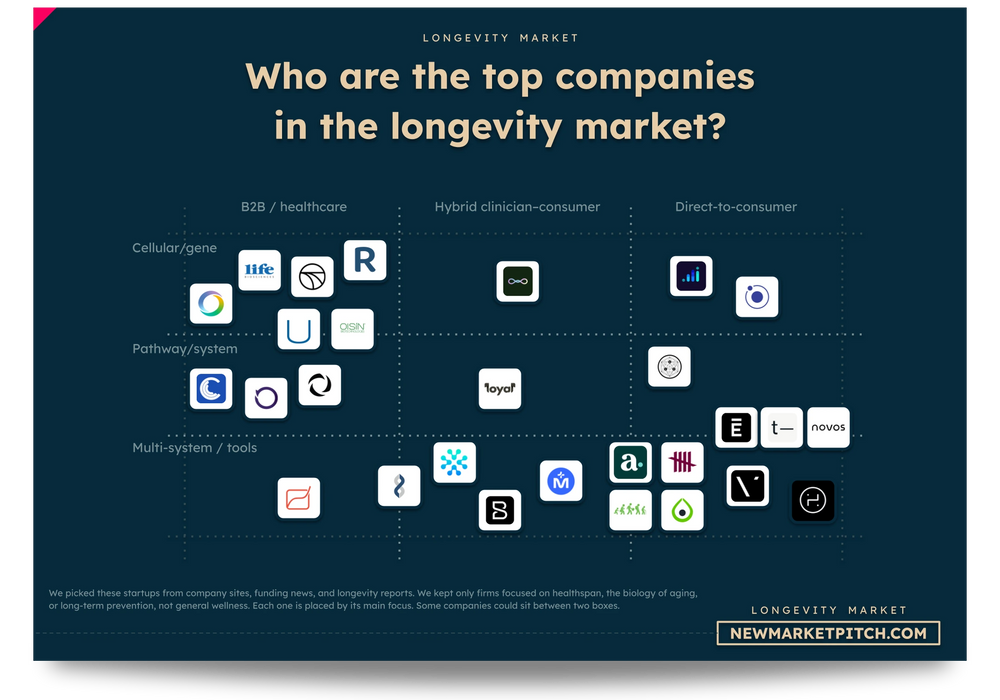
In our report covering the longevity market, we turn what is vague and complex into simple, useful visuals. Market maps like this one show you at a glance where every startup stands.
Which biological age testing startups are we actually comparing?
The serious end of the biological age testing market currently contains three focused startups, plus two broader longevity companies with credible testing products.
We include Infinite Epigenetics, the parent company of TruDiagnostic and Tally Health, because it owns laboratory infrastructure, consumer products and a large DNA methylation dataset. Generation Lab belongs in the comparison because SystemAge has spread quickly through longevity clinics and uses a different approach called Biological Noise. GlycanAge also qualifies because it has built a dedicated business around IgG glycan testing and is now entering hospitals.
Elysium Health and NOVOS sit slightly outside that leading group. Both sell legitimate biological age tests, but testing remains one product inside a wider longevity and supplements business. We still include them because consumers compare Index and NOVOS Age directly with TruAge, TallyAge and GlycanAge.
We exclude questionnaire scores, wearable-derived age estimates and routine blood-test calculators. Those products may be useful, but they do not own a comparable molecular assay or biological-age dataset. We also exclude myDNAge because its owner, Zymo Research, is an established laboratory supplier rather than a biological age startup.
Funding figures require careful reading. Infinite Epigenetics has not disclosed a conventional cumulative funding total, although Tally Health had raised $10 million before TruDiagnostic bought its assets in April 2026. Elysium’s much larger total funded supplements, research and several products, so it cannot be treated as investment in Index alone.
| Startup | Main biological age product | Position in the market | Publicly reported funding |
|---|---|---|---|
| Infinite Epigenetics | TruAge and TallyAge | Full epigenetic testing, data and laboratory platform | Undisclosed; Tally previously raised $10M |
| Generation Lab | SystemAge | Clinic-led, organ-specific Biological Noise testing | $15M, including an $11M seed led by Accel in October 2025 |
| GlycanAge | GlycanAge Test | Inflammation and immune-aging specialist | About €11.3M (a $4.2M seed in 2024 and $8.7M in December 2025) |
| Elysium Health | Index | Consumer saliva test inside a broader longevity company | About $71.2M company-wide |
| NOVOS | NOVOS Age | Consumer epigenetic test linked to supplements and an app | About $3.6M company-wide |
Is there a clear leader in biological age testing today?
Yes. Infinite Epigenetics is ahead overall, although Generation Lab is close enough to make it a real top-two race.
Infinite’s lead comes from the combination of TruDiagnostic and Tally Health. The group says it has collected more than 120,000 epigenetic samples, operates revenue-generating diagnostics businesses and processes tests through TruDiagnostic’s CLIA-certified laboratory. Its products cover blood testing, cheek-swab testing, research services and commercial partnerships. A certified lab and several product lines make a strong case; we study who leads and who trails in our longevity market report.
In April 2026, TruDiagnostic bought Tally Health’s assets for an undisclosed price. That deal added a simpler consumer test, a second brand and access to Tally’s cheek-cell methylation data. Infinite now covers both the research-heavy side of the market and the easier consumer experience that Tally was built around.
Generation Lab has closed much of the distribution gap. SystemAge was used by more than 275 clinics when the company raised its seed round in October 2025. Its website now says more than 750 clinics, and an earlier product announcement cited 18 countries. That is a large professional network for a platform that only became commercially available recently.
The market now has one broad platform leader, one fast-growing clinic challenger and one credible scientific specialist. Infinite leads across the full category. Generation Lab is moving faster. GlycanAge remains strongest in immune and inflammation-focused aging.

Our research about longevity companies gets updated several times a month, so you always get the latest view of where things stand.
Which biological age startup has the strongest commercial traction?
TruDiagnostic has the strongest proven commercial traction because it has processed the most disclosed biological age samples and built several ways to make money from the same laboratory.
Infinite Epigenetics says it has collected more than 120,000 samples since TruDiagnostic launched in 2020. Materials filed with the US Securities and Exchange Commission also describe TruDiagnostic and Tally as revenue-generating operations with growing sales. The companies have not published audited revenue, subscription retention or annual test volumes, but their evidence is still stronger than waitlists and partnership announcements.
TruDiagnostic sells directly to consumers, supplies longevity clinics, processes samples for researchers and supports companies developing epigenetic products. Its commercial-services materials list more than 25 commercial collaborators and over 80 research partnerships, while the April 2026 Tally announcement put research partnerships above 115. The same laboratory can therefore generate revenue from several customer groups.
Generation Lab has disclosed tens of thousands of users, although that figure has not been updated alongside its latest clinic count. A clinic may complete onboarding or place a small initial order without becoming a high-volume customer. Generation Lab has clearly found demand among longevity providers, but we still lack repeat-testing rates, revenue per clinic and annual sample volumes.
Tally once attracted a waitlist of more than 270,000 people. The company never revealed how many joined a paid membership or bought a test, so that number tells us more about early interest than commercial scale. GlycanAge, Elysium and NOVOS have also avoided publishing comparable cumulative testing volumes.
TruDiagnostic holds the commercial lead with medium confidence. The ranking is convincing, even though the precise revenue gap remains private.
Is Generation Lab still the fastest-growing biological age startup?
Probably yes, but the evidence is getting old. Generation Lab’s last disclosed jump took its clinic network up by roughly 173% in less than a year, and no newer figure has followed.
Generation Lab went from more than 275 clinics in October 2025 to more than 750. That represents around 475 additions, making SystemAge’s distribution footprint about 2.7 times larger. The 750 figure is company-stated and undated, and we found no independent count to confirm it.
The calculation assumes Generation Lab used the same definition of a clinic in both announcements. We cannot verify how many locations order regularly, but the expansion rate remains unusually high even after allowing for some lightly active accounts. The company has also expanded from 19 reported systems to 21, introduced male and female models, added skin and mitochondrial measures and built a longitudinal view for repeat testing.
Infinite Epigenetics is growing from a larger base, although its disclosures do not provide a comparable customer-growth series. Its sample figure was still “more than 120,000” in June 2026. Its recent progress has come through the Tally deal, new products and research partnerships.
GlycanAge is following a slower clinical path. It raised $8.7 million in December 2025, opened a US laboratory, started its first hospital deployment and, in June 2026, named a Malaysian longevity clinic as its representative for Southeast Asia. That strategy could create a more valuable diagnostic business, but adoption will take longer.
Generation Lab still wins on growth speed, on the numbers that exist. The silence since its last count is a small warning sign: a company growing that fast usually says so. The next test is whether those clinics become regular customers.

In our market report about longevity companies, we look at what the winners do differently, so you can learn from the best instead of guessing.
Which biological age startup has the strongest science?
TruDiagnostic currently offers the strongest all-round scientific package, while Generation Lab has developed the most interesting alternative to conventional epigenetic clocks.
TruDiagnostic’s main advantage is that TruAge does not depend on one biological-age output. Its reports include OMICmAge, DunedinPACE, system-age scores, immune-cell estimates, telomere information and other methylation-derived measures. Several of those algorithms have been studied through peer-reviewed research beyond the consumer product itself.
DunedinPACE was built from two decades of physiological measurements and then tested across additional cohorts. Researchers found associations with morbidity, disability and mortality, together with strong test-retest reliability. That makes DunedinPACE better suited to tracking the pace of aging than early clocks trained mainly to predict chronological age. Clocks built to track the pace of aging beat the early ones, and we follow which technologies are gaining ground in our longevity report.
TruDiagnostic’s 11 system-age scores gained stronger support when the underlying Systems Age research appeared in Nature Aging. The researchers used one blood methylation test to estimate aging across the heart, lungs, kidneys, liver, brain, immune system and other physiological systems. The models predicted relevant health outcomes and captured differences that a single whole-body score can miss.
Tally Health adds another credible piece of science. Its CheekAge model was trained on more than 8,000 cheek samples. Researchers later applied it to blood data from 1,513 participants in the Lothian Birth Cohorts, even though nearly half the original methylation inputs were unavailable. A one-standard-deviation increase in CheekAge was associated with a 21% increase in mortality risk, close to the 23% result produced by the established PhenoAge model.
Generation Lab takes a different route. Its Biological Noise approach measures how unstable methylation patterns become as people age or develop disease. Research led by Irina Conboy’s group argues that conventional linear clocks can struggle to separate healthy and diseased people of the same chronological age. Measuring variation may reveal biological disruption that a simple age prediction smooths over.
The scientific idea is credible and different. Generation Lab’s commercial claims still go beyond what outsiders can verify. SystemAge 2.1 is advertised as having 99% accuracy across 1,605 test cases, but the company has not explained the metric clearly enough for independent reproduction. It remains unclear whether the percentage refers to laboratory processing, classification performance, age estimation or another endpoint.
GlycanAge is grounded in another branch of biology. IgG glycans are linked with inflammation, immune function, hormones and several chronic conditions. The test can be especially responsive to menopause, weight change, stress and inflammatory interventions. Its narrower biological focus gives it a clear use case, while limiting its ability to describe whole-body aging.
Which biological age test is the most mature and useful?
TruDiagnostic’s TruAge is the most mature full biological age test, while TallyAge offers the easiest consumer experience and SystemAge gives clinics the most detailed system-level report.
TruAge measures more than one million methylation sites and returns an overall age, aging pace, 11 system ages and more than 75 additional markers. SystemAge reports more than 460 biomarkers across 21 systems and is designed for clinician-led interpretation. TallyAge uses a cheek swab and costs less than most comprehensive epigenetic tests, making it easier to repeat.
No test has proved that a $249 to $499 purchase, at current list prices, consistently improves health outcomes or lowers future medical costs. The result is most useful when someone repeats the same assay and reviews the change alongside conventional blood work, fitness, sleep, blood pressure and medical history.
| Test | Sample | Current price or model | Best use |
|---|---|---|---|
| TruAge | Finger-prick blood | $499 | Broadest mix of clocks and system measures |
| SystemAge 2.1 | Needle-free blood sample | Usually sold through clinics | Detailed clinician-led system tracking |
| TallyAge | Cheek swab | $249 | Easiest consumer baseline and retesting experience |
| NOVOS Age | Finger-prick blood | $349, or $299 per kit for two or more | Consumer package with guidance and several outputs |
| Elysium Index | Saliva | $299 | Convenient saliva test with nine system ages |
| GlycanAge | Finger-prick blood | Regional pricing | Inflammation, hormones and immune-aging monitoring |

In our document detailing everything you need to know about longevity, you will always find fresh funding data, taken straight from our own verified funding database.
Can biological age tests really show whether an intervention worked?
Biological age tests can track changes over time, but no startup has proved that one score can reliably judge every longevity intervention.
A recent review identified 41 human intervention studies using newer epigenetic clocks and found substantial differences between the results. DunedinPACE may be useful for following aging speed, while GlycanAge may respond more strongly to inflammation, hormones or weight change. A mortality-focused clock could remain stable after a short lifestyle program even when other health measures improve.
Generation Lab has reported large age reductions after stem-cell protocols and therapeutic plasma exchange, but those claims need complete sample sizes, control groups and outcome distributions. For consumers, a lower score carries more weight when blood pressure, glucose control, fitness and inflammatory markers improve at the same time.
Which biological age startup can actually operate at scale?
Infinite Epigenetics is currently best prepared for large-scale biological age testing because it controls laboratory processing, research services and two consumer brands.
TruDiagnostic operates a CLIA-certified laboratory and can process several methylation-array formats for outside researchers and product developers. Tally adds a simpler cheek-swab channel, while TruDiagnostic covers blood-based testing and more complex laboratory work.
Generation Lab has scaled distribution faster, but it has not disclosed annual processing capacity, failed-sample rates or throughput at high volume. GlycanAge has expanded its laboratory network and entered its first hospital, although those operations remain much smaller. Operations that stay much smaller than the leader's show how far behind some challengers are, a gap we look at in our report on longevity.
Infinite has built the strongest delivery engine so far, and that advantage does not depend on the Nano Dimension deal closing.
Which biological age startup has the best customers and partnerships?
TruDiagnostic currently has the deepest set of scientific and commercial relationships, while Generation Lab has recruited the broadest visible network of longevity clinics.
TruDiagnostic reports more than 80 research partnerships on its services page and over 25 commercial collaborators; its April 2026 release gave a higher figure of more than 115 research partnerships, and the company has not explained the gap. Its research relationships include institutions such as Harvard, Yale, Duke and Stanford. A recent collaboration with L’Oréal is examining the epigenetics of skin and hair aging, showing that the platform can support products beyond consumer longevity tests.
These relationships carry more weight than a simple list of logos because TruDiagnostic processes samples, develops biomarkers and participates in published research. The company still does not disclose the revenue, duration or exclusivity of most agreements.
Generation Lab names clinics including Boulder Longevity Institute, Eterna Health, BioReset Medical and Extension Health. Its presence across 18 countries shows that SystemAge has found a receptive professional audience. We still need evidence of repeat ordering and expansion inside individual clinics before treating the full network as deeply established demand.
GlycanAge has made the clearest move toward conventional healthcare. St Catherine Specialty Hospital in Zagreb became the first hospital reported to use glycan biomarkers in routine cardiometabolic risk screening. GlycanAge expects to enter more than ten hospitals across Europe and the Middle East, and its December 2025 round was raised for hospital networks in the US, Europe and the Middle East. We found no new named hospital since then, so most of those deployments remain planned.
No startup has announced a major insurer contract, national screening program or hospital-system agreement with clearly disclosed economics. Biological age testing still depends mainly on research groups, longevity clinics and self-paying consumers.

Learning from others' mistakes is the cheapest lesson there is. In our report covering the longevity market, we look at what broke startups before you, so you don't repeat it.
What gives the biological age testing leader a real moat?
Infinite Epigenetics’ strongest defense is the combination of proprietary data, laboratory infrastructure and several routes for collecting new samples.
Published aging clocks offer limited protection on their own. A competitor can license an algorithm, use a contract laboratory and design a polished consumer report. Recreating years of methylation samples, repeat tests, health information and research relationships takes much longer.
Infinite collects data through TruDiagnostic’s consumers, clinics, researchers and commercial customers. Tally adds a separate dataset built from cheek cells and a lower-friction consumer channel. Each new sample can support future model development when the health information and laboratory processing remain consistent.
The Tally deal also gave Infinite two distinct brands. TruDiagnostic can continue serving technical, professional and research customers, while Tally targets consumers who want a simpler experience and clearer lifestyle guidance.
Generation Lab’s defense comes from its Biological Noise method and its place inside clinic workflows. A clinic that has trained staff, created treatment protocols and accumulated repeat SystemAge results has a reason to stay. Larger methylation companies could eventually develop their own variability-based models, so execution will determine how durable that advantage becomes.
GlycanAge owns the most differentiated assay. DNA methylation companies cannot add IgG glycan testing through a software update because the laboratory method and scientific expertise are different. That gives GlycanAge a strong specialist position within a narrower market.
Will the Nano Dimension deal still fund Infinite Epigenetics?
Not on current evidence. The deal has stalled, so Generation Lab has the clearest committed startup funding, and Infinite’s path to a much larger capital base is uncertain.
Generation Lab has raised $15 million, including an $11 million seed round led by Accel. It has already converted that money into a launched product, a large clinic footprint and several product updates. Among the focused testing startups, it offers the clearest example of venture capital producing visible distribution.
GlycanAge has disclosed roughly €11.3 million across a €3.9 million seed round and a newer €7.4 million financing. The latest capital is intended for hospital deployment, clinical validation and laboratory-developed tests. That approach will take longer than selling wellness products, although successful clinical indications could create a more valuable company.
Infinite has not disclosed how much external capital funded TruDiagnostic. Public company databases have described TruDiagnostic as privately held without conventional institutional backing, although undisclosed financing remains possible. Building its laboratory and commercial operations with limited visible venture capital suggests strong capital efficiency.
In June 2026, Infinite signed a non-binding term sheet to combine with Nasdaq-listed Nano Dimension. The press release used a transaction value of $890 million, while the investor presentation filed the same day used $875 million. The deal also projected more than $400 million of cash in the combined company at closing. That capital would have exceeded Generation Lab’s total funding by more than 25 times.
The deal then ran into trouble. Activist shareholder Murchinson attacked it as a SPAC-like transaction without redemption rights. In July 2026, Nano Dimension settled with Murchinson, four directors resigned, Murchinson’s nominees joined the board and a new interim chief executive took over. The 30-day exclusivity period had already ended, and Nano Dimension’s August second-quarter results did not mention Infinite at all. No definitive agreement has been announced, and no formal termination either. Nano Dimension still reported about $433 million of cash and investments at the end of June, so the money exists, but there is no signed commitment to put it into Infinite.
The $890 million figure was always transaction arithmetic, not a market price. It is now best read as a ceiling that was proposed and not achieved.
Elysium has raised about $71.2 million, more than any independent competitor in this comparison. Most of that capital supports Elysium’s broader supplements and health business, and Index has not emerged as the category’s commercial leader.

In our research about longevity companies, we always try to gather several sources and make estimates that make sense, so you can work with solid numbers.
Are biological age tests becoming real medical diagnostics?
Biological age tests are moving closer to clinical use, but they currently remain research, preventive-health and wellness tools.
A CLIA-certified laboratory meets quality requirements for processing human samples. CLIA status does not show that a biological-age score can diagnose a disease, choose a treatment or improve patient outcomes. Consumers should avoid reading a “heart age” or “brain age” as a medical diagnosis. A lab certificate that cannot turn a score into a diagnosis is a real gap, and we cover the open problems in our longevity market report.
The field also lacks one accepted definition of biological age. A literature review covering 140 studies found no consensus on the best measurement method. DNA methylation, glycans, proteins, routine blood biomarkers and organ imaging can produce different results because they capture different biological processes.
Organ-specific testing introduces another layer of uncertainty. A blood methylation model may predict health outcomes associated with the brain or kidneys, but it does not inspect those organs directly. Recent academic reviews call for longitudinal testing, better reference ranges and stronger evidence that organ-age gaps are truly organ-specific.
GlycanAge’s first hospital deployment offers a more credible route into medicine. The test is being used alongside cardiometabolic risk screening rather than as a replacement for conventional diagnosis. That supporting role fits the current evidence much better than claims that one age score can detect disease before every symptom.
We have reasonable confidence in the market ranking, which rests on company disclosures rather than audited figures, and lower confidence in claims such as “most accurate,” “age reversal” and “early disease detection.” Those statements require prospective trials showing that the commercial test changes medical decisions and improves outcomes.
Does the same startup lead every type of biological age test?
Different startups currently lead different parts of biological age testing, although Infinite Epigenetics has the strongest overall position.
TruDiagnostic leads broad epigenetic testing, Generation Lab leads clinic-based Biological Noise analysis, Tally leads convenience and GlycanAge leads immune and inflammation-focused aging. Elysium Index and NOVOS Age occupy the middle of the consumer market with convenient collection and established algorithms.
The category can support several winners because clinicians and consumers are asking different questions. Aging speed, inflammation, organ-level risk and consumer convenience require different tests.
Who has momentum now that the Nano Dimension deal has stalled?
Generation Lab has the strongest organic momentum, and Infinite Epigenetics has lost its biggest strategic catalyst for now.
Generation Lab’s clinic expansion provides the cleanest evidence of acceleration. The company has also released SystemAge 2.1, expanded from 19 to 21 systems, introduced male and female versions and added longitudinal tracking. It has not announced a new round or a new clinic count since then.
Infinite’s recent moves depended more heavily on transactions. It bought Tally Health’s assets in April 2026 and signed the Nano Dimension term sheet in June. The Tally deal is done. The Nasdaq listing and the hundreds of millions of dollars for new diagnostics, clinical studies and acquisitions are not, and the change of control at Nano Dimension’s board makes them less likely in the near term.
The proposed deal still shows where Infinite wants to go next. The company is targeting earlier detection of cardiovascular disease, type 2 diabetes, chronic lung disease and metabolic liver disease. Success would push Infinite beyond longevity reports and into molecular diagnostics.
GlycanAge has gained momentum through fresh funding, its first hospital use and new distribution partners such as Longevity Clinic Malaysia in June 2026. The company expects to expand into more than ten hospitals, but completed deployments and routine testing volumes will matter more than the plan itself.
Elysium and NOVOS continue to sell and update their products, although neither has disclosed a recent test-specific milestone of similar scale. Most of the competitive movement now comes from Infinite, Generation Lab and GlycanAge.

If you build or invest in the longevity market, you need to know which business models pay off now and which ones are fading. That's why our market report about longevity companies has a whole section on it.
Which biological age testing startups are actually ahead?
Infinite Epigenetics remains the overall biological age testing leader, Generation Lab is a serious second-place challenger, and GlycanAge owns the strongest specialist position. The stalled Nano Dimension deal does not change the order, but it removes the scenario in which Infinite pulled far ahead on capital.
Infinite ranks first because it has the most complete business. It controls laboratory processing, sells through several channels, supports outside research and now operates both TruDiagnostic and Tally Health. As seen above, its disclosed base of more than 120,000 samples remains the strongest evidence of operating scale in the category.
Generation Lab ranks second. SystemAge has expanded to more than 750 clinics, up from 275 in less than a year, according to the company. No other focused startup has shown comparable recent distribution growth. Generation Lab could move closer to first place by publishing independent validation of the complete commercial product and showing strong repeat ordering across its clinics.
GlycanAge ranks third because it has chosen a clear and defensible scientific niche. Its glycan assay responds to immune and inflammatory biology that methylation platforms do not directly measure. The hospital strategy could eventually make GlycanAge more clinically important than general biological-age tests, although that transition remains early.
Elysium ranks fourth. Index has credible scientific origins, easy saliva collection and useful system-level outputs. The company has considerable funding and brand recognition, but it discloses little evidence that Index leads in volume, professional adoption or recent growth.
NOVOS ranks fifth by a small margin. NOVOS Age combines DunedinPACE, organ ages, telomeres and app-based guidance for $349. Its algorithms largely come from outside research, and the test supports a broader supplement platform instead of a distinctive diagnostics business.
Infinite’s lead currently looks substantial but manageable. Generation Lab sits one tier behind in total maturity and is moving much faster. GlycanAge remains smaller overall while building the clearest specialist position.
The ranking could change quickly. Generation Lab could take first place by sustaining clinic growth, proving repeat usage and validating its performance claims independently. Infinite could widen its lead if the Nano Dimension deal is revived and closes, or if it finds other capital to build regulated disease tests. GlycanAge could jump ahead in clinical relevance if its hospital rollout becomes part of routine care.
| Rank | Startup | Current position | Why it ranks here |
|---|---|---|---|
| 1 | Infinite Epigenetics | Convincing overall leader | Largest disclosed sample base, owned laboratory, several revenue channels, broad scientific portfolio and two consumer brands; public-listing plan stalled |
| 2 | Generation Lab | Fast-closing challenger | Rapid clinic growth, differentiated Biological Noise method and detailed system-level product, though no new traction figure has been published lately |
| 3 | GlycanAge | Specialist leader | Distinct glycan science, strong inflammation use case, fresh funding and the clearest move into hospitals |
| 4 | Elysium Health | Credible but less focused | Strong funding, reputable science and easy collection, with limited disclosed test-specific traction |
| 5 | NOVOS | Strong consumer alternative | Competitive price and product bundle, but less proprietary infrastructure and weaker evidence of category-scale adoption |

In our document detailing everything you need to know about longevity, we don't want to repeat what boring consulting reports say. Instead, we show you the real and latest market signals that matter.
Our methodology
There is no single metric that identifies the leader in biological age testing. We compared the companies across commercial traction, growth, scientific evidence, product maturity, scalability, customers and partnerships, defensibility, funding and progress toward clinical use.
For each dimension, we examined recent company disclosures, product information, scientific publications, regulatory records and completed business developments. We prioritized processed samples, active distribution, laboratory capabilities, peer-reviewed validation, completed funding rounds and deployed partnerships over waitlists, announced plans and promotional performance claims.
The companies disclose different types of evidence, so we did not force them into one numerical score. We assessed each dimension separately and gave more weight to companies that combined scientific, operational and commercial strength rather than leading through one headline figure.
We treated clinic counts as distribution evidence, not as proof of recurring revenue, because an onboarded clinic may order very little. We treated Infinite’s proposed Nano Dimension transaction as a stalled, non-binding proposal rather than completed funding, and company-wide funding at Elysium and NOVOS was not assigned entirely to their testing products.
For science, we separated validation of an underlying model from validation of the complete commercial test. We also treated CLIA certification as evidence of laboratory quality, not proof that a biological-age score can diagnose disease, guide treatment or improve patient outcomes.
Key sources used for this analysis include: the SEC-filed announcement of the Nano Dimension and Infinite Epigenetics term sheet, Nano Dimension’s announcement of its settlement with Murchinson, 3D Printing Industry on the Murchinson settlement and the stalled deal, Nano Dimension’s second-quarter 2026 results, Infinite Epigenetics’ announcement of the Tally Health acquisition, TruDiagnostic’s operating-scale disclosures, Generation Lab’s SystemAge product and clinic figures, Longevity.Technology on Generation Lab’s $11 million seed round, GlycanAge’s funding and hospital-expansion disclosures, the peer-reviewed CheekAge mortality study, and the original DunedinPACE validation study.

In our report covering the longevity market, we like to show you the big picture. We know your time is precious, so we make every page quick to read and packed with as much learning as possible per minute.
Written by the New Market Pitch teamWe track new markets so founders and investors can move faster. About us