
What’s the latest funding news in the MedTech market? (October 2026)
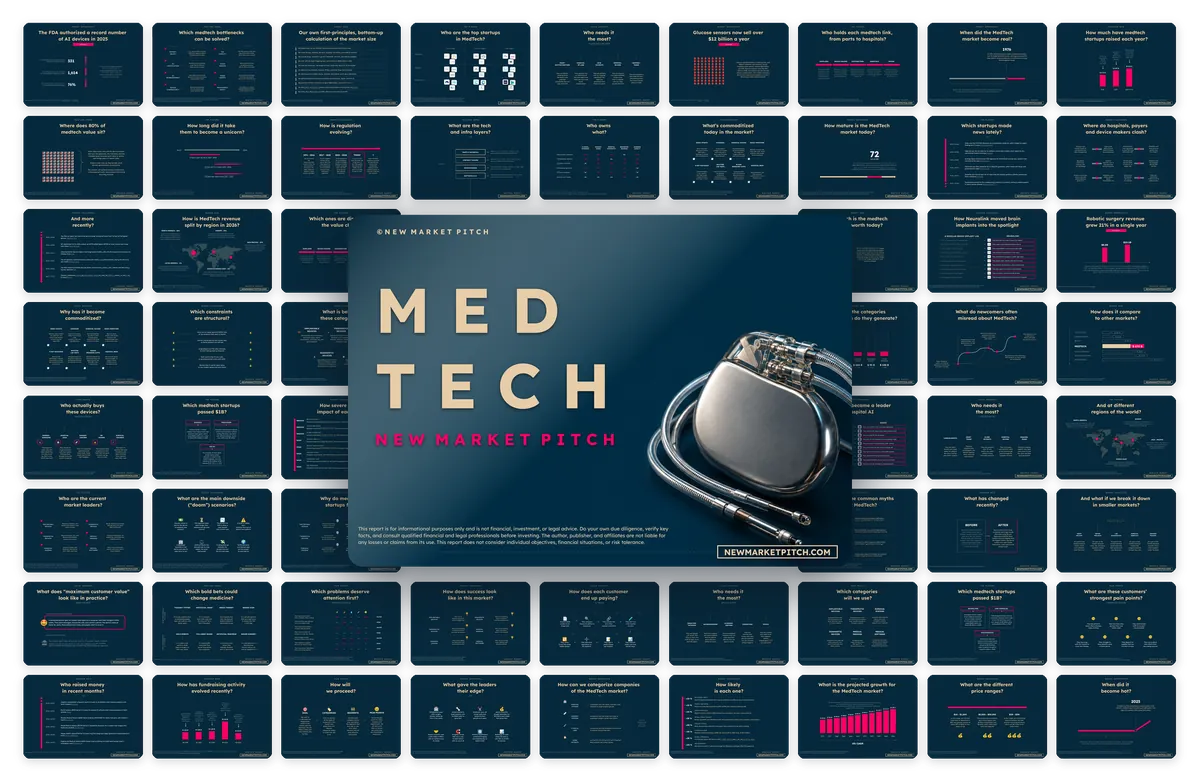
Whether you're building or investing in the MedTech market, our report covers everything you need to know: the players, the money, and what's coming next.
MedTech funding stayed active into early October 2026, with capital flowing across medical devices, diagnostics, neurotechnology, cardiovascular systems and regulated medical software.
The 12 deals below raised more than $575 million combined, led by Precision Neuroscience's $250 million Series D and HighLife's financing of more than $90 million.
The mix also shows how investors are backing companies at very different stages, from first human studies to FDA-approved products entering commercial scale-up.
And if you want to better understand this new industry, you can download our pitch covering the MedTech market.
Insights
- Late-stage MedTech absorbed most of the capital: Precision Neuroscience, HighLife, Anaconda Biomed, Zenflow and Piomic alone represented roughly four-fifths of the funding in this group.
- Neurotechnology was the largest category by dollars, mainly because Precision Neuroscience's $250 million Series D was almost ten times the median deal size in the sample.
- Commercialization is becoming as important as technical validation. Zenflow, UltraSight and HighLife all raised capital partly to expand adoption after reaching major regulatory or product milestones.
- Cardiovascular and neurovascular devices remain highly capital-intensive, with HighLife and Anaconda Biomed raising more than $145 million combined to support pivotal trials, approvals and market expansion.
- Diagnostics funding is spreading beyond centralized laboratories. 52North is developing a finger-prick oncology test, while Biotia is scaling metagenomic infectious-disease diagnostics across the United States.
- The funding landscape spans the full MedTech lifecycle, from Bridge Neurotech's first human research study to FDA-approved Zenflow and commercially deployed UltraSight.
- European MedTech remains well represented: 52North, Anaconda Biomed, HighLife, Dialybrid and Piomic all have significant European roots, while several are using new funding to pursue U.S. expansion.
- Investor appetite extends beyond conventional hardware. Arboretum, UltraSight and Biotia show that clinically focused diagnostics and regulated medical software can attract substantial MedTech capital alongside implants and surgical devices.

Written by the New Market Pitch teamWe track new markets so founders and investors can move faster. About us

In our report covering the medtech market, you will always find fresh funding data, taken straight from our own verified funding database.
Summary table of the latest funding deals in the MedTech market as of October 2026
We define the MedTech market as medical devices and technologies used to diagnose, monitor or treat health conditions.
We include diagnostic equipment, implants, surgical systems, monitoring devices and software with a medical purpose.
We exclude drugs, general wellness products and healthcare administration software without a medical function.
| Name | When | Amount in $ | Round Type | Category |
|---|---|---|---|---|
| Bridge Neurotech | October 7, 2026 | $13.5M | Launch financing | Neurotechnology & Brain-Computer Interface |
| Arboretum LifeSciences | October 6, 2026 | $30M | Series A | Molecular Diagnostics & Precision Medicine |
| Zenflow | October 5, 2026 | $52M | Series D | Urology & Therapeutic Implant |
| Biotia | October 1, 2026 | $9M | Financing | Infectious-Disease & Molecular Diagnostics |
| SedMed | October 1, 2026 | $4M | Financing | Assistive Medical Device & Mobility |
| 52North | September 29, 2026 | ~$4.24M | Equity financing | Point-of-Care & Oncology Diagnostics |
| Precision Neuroscience | September 24, 2026 | $250M | Series D | Neurotechnology & Brain-Computer Interface |
| UltraSight | September 23, 2026 | $24M | Series B2 | Cardiac Imaging & AI Medical Device |
| Anaconda Biomed | September 23, 2026 | $56M | Equity financing | Neurovascular & Thrombectomy Devices |
| HighLife | September 22, 2026 | >$90M | Financing | Structural Heart & Cardiovascular Implant |
| Dialybrid | September 22, 2026 | ~$17.2M | Series A | Dialysis Access & Vascular Implant |
| Piomic Medical | September 18, 2026 | $25M | Growth financing | Wound Care & Therapeutic Device |
All the latest funding deals in the MedTech market as of October 2026
Bridge Neurotech raised $13.5 million in October 2026 to develop its non-invasive brain-computer interface.
When was it?
Bridge Neurotech's funding was reported on October 7, 2026.
Who are they?
Bridge Neurotech is developing a non-invasive brain-computer interface that uses transcranial ultrasound to sense and decode brain activity.
Geographical focus?
Bridge Neurotech is based in Silicon Valley and is running its first human research study in Redwood City, California, although the technology has broader potential.
Why do we include them in the MedTech market?
Bridge Neurotech belongs in MedTech because its core platform is medical neurotechnology designed to measure brain activity, placing it in neurotechnology and brain-computer interfaces.
What is the company stage?
Bridge Neurotech is at a very early clinical research stage, with no commercial product and its first human study underway.
How much did they raise?
Bridge Neurotech raised $13.5 million in its launch financing.
What round is it?
Bridge Neurotech described the capital as launch funding and did not give the round a conventional seed or Series A label.
Why did they raise?
Bridge Neurotech raised the capital to advance human research and improve its ultrasound-based brain sensing and neural decoding technology.

In our research about medical devices, we turn what is vague and complex into simple, useful visuals. Market maps like this one show you at a glance where every startup stands.
Arboretum LifeSciences raised $30 million in October 2026 to expand precision genetic diagnostics for common diseases.
When was it?
Arboretum LifeSciences announced the Series A on October 6, 2026.
Who are they?
Arboretum LifeSciences combines genetic testing and AI to identify clinically important variants and help health systems use the results in patient care.
Geographical focus?
Arboretum LifeSciences is initially focused on U.S. healthcare systems and works with large American provider networks.
Why do we include them in the MedTech market?
Arboretum LifeSciences fits MedTech through its clinically focused genetic testing platform, placing it in molecular diagnostics and precision diagnostics.
What is the company stage?
Arboretum LifeSciences is at an early commercial stage and is already deploying its platform with healthcare partners.
How much did they raise?
Arboretum LifeSciences raised $30 million.
What round is it?
Arboretum LifeSciences raised a Series A round.
Why did they raise?
Arboretum LifeSciences raised the funding to expand genetic testing into more common diseases, automate clinical workflows and add healthcare partners.
Zenflow raised $52 million in October 2026 as it prepared to scale its FDA-approved urology implant.
When was it?
Zenflow announced the financing on October 5, 2026.
Who are they?
Zenflow makes the Spring System, a minimally invasive implant that opens the urethra to relieve symptoms of benign prostatic hyperplasia.
Geographical focus?
Zenflow's immediate commercial focus is the United States, supported by a distribution partnership with Cook Medical.
Why do we include them in the MedTech market?
Zenflow is a direct MedTech fit because its core product is a therapeutic urology implant used to treat benign prostatic hyperplasia.
What is the company stage?
Zenflow is at the commercial launch and growth stage after receiving FDA PMA approval for the Spring System in December 2025.
How much did they raise?
Zenflow raised $52 million in the equity round, with additional venture debt supporting the financing.
What round is it?
Zenflow raised a Series D round.
Why did they raise?
Zenflow raised the capital to accelerate the U.S. commercial launch of the Spring System following FDA approval.
Biotia raised $9 million in October 2026 to scale infectious-disease diagnostics in women's health and orthopedics.
When was it?
Biotia announced the new financing on October 1, 2026.
Who are they?
Biotia uses metagenomic sequencing and AI to identify pathogens and antimicrobial-resistance markers behind difficult infections.
Geographical focus?
Biotia is focused on the U.S. clinical diagnostics market, with its urine test available across all 50 states.
Why do we include them in the MedTech market?
Biotia belongs in MedTech because its products directly diagnose infectious disease, placing the company in molecular and infectious-disease diagnostics.
What is the company stage?
Biotia is at PMF and early growth stage, with a CLIA-certified laboratory and a diagnostic test already sold nationally.
How much did they raise?
Biotia raised $9 million in the new financing.
What round is it?
Biotia described the deal as an oversubscribed financing following its earlier Series A and did not assign a new numbered series.
Why did they raise?
Biotia raised the capital to scale its laboratory, launch more women's-health tests, expand into orthopedic infections and support commercialization.

In our market report about medical devices, we always try to gather several sources and make estimates that make sense, so you can work with solid numbers.
SedMed raised $4 million in October 2026 to expand access to its mobility-assistance medical device.
When was it?
SedMed's financing was announced on October 1, 2026.
Who are they?
SedMed sells a mechanical toilet lift that assists people with limited mobility when sitting down or standing up.
Geographical focus?
SedMed is primarily focused on U.S. home-care, aging and clinical markets.
Why do we include them in the MedTech market?
SedMed fits MedTech because its FDA-registered assistive device directly supports mobility-impaired patients and reduces fall and caregiver-lifting risks.
What is the company stage?
SedMed is at the commercial growth stage, with the Toilet Lift already available to customers.
How much did they raise?
SedMed secured a $4 million investment from 108 BioCapital.
What round is it?
SedMed described the deal as a financing round without a Series A, B or C designation.
Why did they raise?
SedMed raised the funding to expand commercial distribution and reach more older adults and mobility-limited users.
52North raised about $4.24 million in September 2026 to advance its rapid oncology diagnostic toward market launch.
When was it?
52North announced the £3.2 million financing on September 29, 2026.
Who are they?
52North is developing Neutrocheck, a finger-prick blood test that helps identify chemotherapy patients at risk of neutropenic sepsis.
Geographical focus?
52North's initial commercial focus is the United Kingdom and its cancer-care system.
Why do we include them in the MedTech market?
52North belongs in MedTech because Neutrocheck is a patient-facing diagnostic device, placing the company in point-of-care and oncology diagnostics.
What is the company stage?
52North is at the clinical validation and regulatory stage and is preparing for commercial introduction in the UK.
How much did they raise?
52North raised £3.2 million, equal to approximately $4.24 million at the time of the announcement.
What round is it?
52North announced an equity financing round without presenting it as a newly numbered venture series.
Why did they raise?
52North raised the capital to complete clinical validation, progress regulatory work and prepare Neutrocheck for UK commercialization.
Precision Neuroscience raised $250 million in September 2026 to advance its cortical brain-computer interface toward commercialization.
When was it?
Precision Neuroscience announced the financing on September 24, 2026.
Who are they?
Precision Neuroscience develops a high-density cortical electrode interface designed to let people with neurological conditions interact with digital systems through brain signals.
Geographical focus?
Precision Neuroscience is U.S.-led, with clinical procedures across major American medical institutions and manufacturing operations in Texas.
Why do we include them in the MedTech market?
Precision Neuroscience is a core MedTech company because it develops regulated implantable neurotechnology for neurological monitoring and brain-computer interaction.
What is the company stage?
Precision Neuroscience is at a late clinical, regulatory and pre-commercial scaling stage after completing more than 100 patient procedures.
How much did they raise?
Precision Neuroscience raised $250 million.
What round is it?
Precision Neuroscience raised an oversubscribed Series D round.
Why did they raise?
Precision Neuroscience raised the funding to expand clinical programs, progress further FDA review and build commercialization infrastructure.

Our document detailing everything you need to know about medtech gets updated several times a month, so you always get the latest view of where things stand.
UltraSight raised $24 million in September 2026 to scale AI-guided cardiac ultrasound across U.S. health systems.
When was it?
UltraSight announced the Series B2 on September 23, 2026.
Who are they?
UltraSight makes FDA-cleared AI software that guides clinicians while they capture diagnostic cardiac-ultrasound images.
Geographical focus?
UltraSight's immediate expansion is focused on hospitals and health systems in the United States.
Why do we include them in the MedTech market?
UltraSight fits MedTech because its regulated software directly supports diagnostic cardiac imaging, placing it in AI medical devices and cardiac imaging.
What is the company stage?
UltraSight is at PMF and early growth stage, with FDA-cleared products and commercial deployments already underway.
How much did they raise?
UltraSight raised $24 million.
What round is it?
UltraSight raised a Series B2 financing round.
Why did they raise?
UltraSight raised the funding to scale U.S. commercialization and develop cardiac-imaging workflows for intensive care and circulatory-support settings.
Anaconda Biomed raised $56 million in September 2026 to advance its stroke thrombectomy technology and pivotal clinical program.
When was it?
Anaconda Biomed announced the financing on September 23, 2026.
Who are they?
Anaconda Biomed develops self-expanding funnel catheters that help physicians capture and remove blood clots during mechanical thrombectomy procedures.
Geographical focus?
Anaconda Biomed is headquartered in Barcelona and combines European regulatory activity with a major U.S. pivotal clinical program.
Why do we include them in the MedTech market?
Anaconda Biomed is a direct MedTech fit because its portfolio consists of interventional neurovascular devices used to treat ischemic stroke.
What is the company stage?
Anaconda Biomed is at the late clinical and regulatory stage, with a CE-marked device and a pivotal U.S. IDE study underway.
How much did they raise?
Anaconda Biomed raised $56 million.
What round is it?
Anaconda Biomed announced an equity financing without assigning a numbered series in its public deal announcement.
Why did they raise?
Anaconda Biomed raised the capital to complete the ATHENA pivotal study, continue product development and pursue further regulatory approvals.
HighLife raised more than $90 million in September 2026 to expand its transcatheter mitral-valve replacement platform.
When was it?
HighLife announced the financing on September 22, 2026.
Who are they?
HighLife develops a transcatheter mitral-valve replacement system that replaces a failing mitral valve through a minimally invasive catheter procedure.
Geographical focus?
HighLife is expanding commercially in Europe while simultaneously advancing its pivotal clinical program in the United States.
Why do we include them in the MedTech market?
HighLife is a pure MedTech company because its core product is an implantable structural-heart device for treating mitral-valve disease.
What is the company stage?
HighLife is at early commercial growth stage in Europe and pivotal clinical stage in the United States.
How much did they raise?
HighLife raised €80 million, reported as more than $90 million.
What round is it?
HighLife described the transaction as a financing round without a numbered Series designation.
Why did they raise?
HighLife raised the funding to accelerate European commercialization and finance the U.S. pivotal study needed to support future FDA approval.

In our report covering the medtech market, we look at what the winners do differently, so you can learn from the best instead of guessing.
Dialybrid raised about $17.2 million in September 2026 to clinically validate its hemodialysis vascular graft.
When was it?
Dialybrid announced the financing on September 22, 2026.
Who are they?
Dialybrid is developing Silkothane, an implantable vascular graft designed to provide durable blood-vessel access for patients receiving hemodialysis.
Geographical focus?
Dialybrid is based in Italy and is conducting its first-in-human clinical program there while targeting a broader international device market.
Why do we include them in the MedTech market?
Dialybrid belongs in MedTech because its central product is an implantable vascular device used in renal and dialysis care.
What is the company stage?
Dialybrid is at the early clinical stage and has completed the first implant in its first-in-human study.
How much did they raise?
Dialybrid raised €15 million, equal to approximately $17.2 million at the time of the financing.
What round is it?
Dialybrid raised a Series A round.
Why did they raise?
Dialybrid raised the capital to validate the Silkothane vascular graft clinically and develop the material for additional vascular applications.
Piomic Medical raised $25 million in September 2026 to advance its wound-care device toward U.S. approval and launch.
When was it?
Piomic Medical announced the growth financing on September 18, 2026.
Who are they?
Piomic Medical makes COMS One, a portable device that uses combined physical stimulation to support healing in difficult-to-treat wounds.
Geographical focus?
Piomic Medical has European clinical activity and is using the financing to make the United States a major new commercial market.
Why do we include them in the MedTech market?
Piomic Medical fits MedTech because COMS One is a therapeutic physical device designed to treat chronic and non-healing wounds.
What is the company stage?
Piomic Medical is at late clinical and regulatory stage, with U.S. pivotal work underway and preparations for market approval.
How much did they raise?
Piomic Medical raised $25 million.
What round is it?
Piomic Medical described the transaction as a growth financing rather than a numbered venture round.
Why did they raise?
Piomic Medical raised the funding to complete clinical development, prepare its U.S. regulatory filing and support future market entry.

Theory only gets you so far. In our research about medical devices, we dig up the real signals from the field and show you the ones worth watching.
Written by the New Market Pitch teamWe track new markets so founders and investors can move faster. About us