What are the top military robotics startups by revenue?
Whether you're building or investing in the military robotics market, our report covers everything you need to know: the players, the money, and what's coming next.
Summary
Anduril is the number-one military robotics startup by revenue, with $2.2B of annual revenue for 2025. Auterion ranks second on ~$116M of annual revenue it disclosed without specifying the period. Shield AI is not ranked: Sacra estimates ~$300M of annual revenue, a single analyst estimate.
The two leaders sell different things. Anduril combines autonomous hardware, weapons and software, while Auterion supplies the control systems that other drone makers can use.
Europe's Quantum Systems, Helsing and TEKEVER follow with closely spaced segment figures. The figures do not cover identical parts of their businesses, and Quantum Systems' figure comes from older FY2024 accounts of its German operating company.
Military orders are growing faster than the public trail of recognized sales. A signed government contract can support years of work without becoming revenue on the day it is announced.
Ukraine has helped turn drone testing into large orders. Auterion's strike kits, Helsing's production of HX-2 systems and Quantum Systems' manufacturing partnerships show customers buying repeatable products, not just watching demonstrations.
Most of the visible startup sales come from aircraft, drones and the software that controls them. Ground vehicles and autonomous boats have won important awards too, but their makers publish fewer comparable sales figures.
That creates some surprising omissions. Skydio and Saildrone have analyst revenue estimates, but no independently confirmed military-only sales figure that qualifies them for a rank.
Saronic illustrates a different problem. Its naval production awards are substantial, but the public contract value tells us what may be built, not what the company has already earned.
Smaller names offer harder evidence. XTEND has U.S. regulatory filings, Origin Robotics has Latvian accounts, and PRENEU reports sales while supplying Korean military customers.
For now, Anduril's lead is clear. Below the largest companies, the names worth watching are those that can turn signed orders into delivered systems and publish the revenue to prove it.

Written by the New Market Pitch teamWe track new markets so founders and investors can move faster. About us

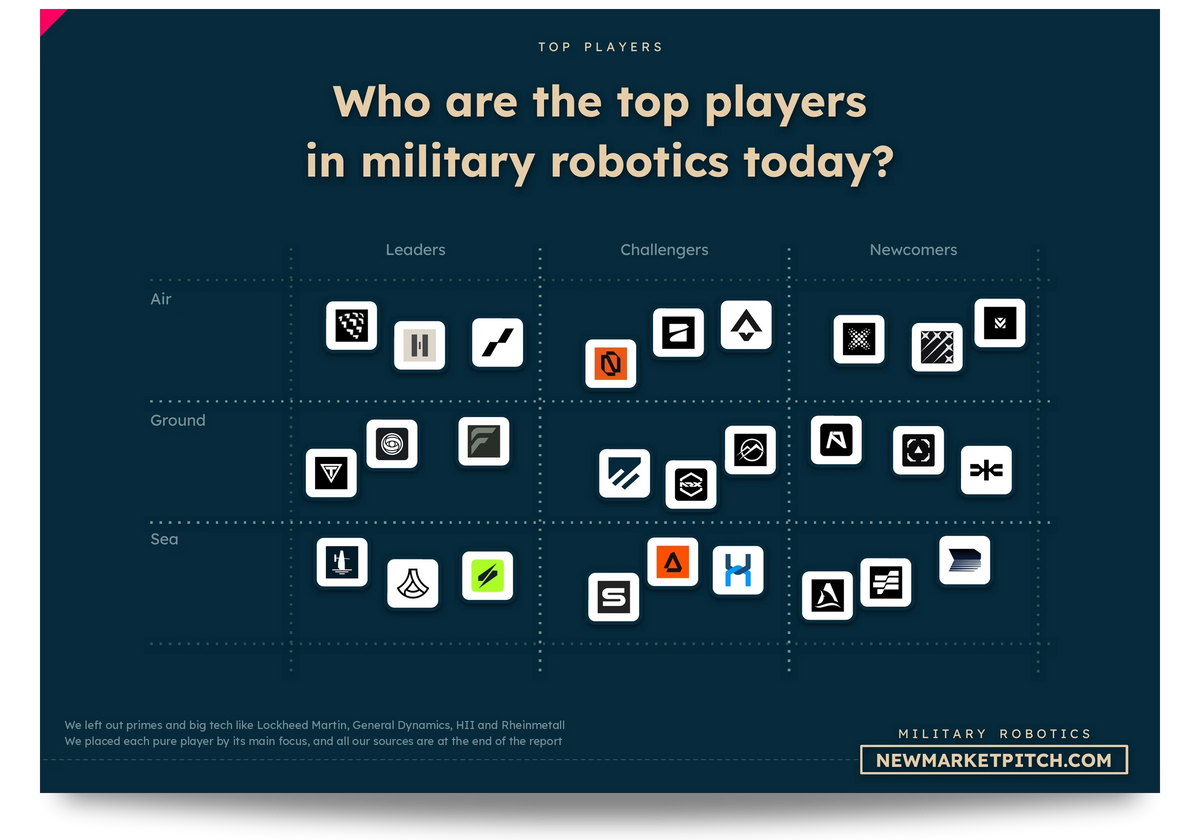
In our report covering the military robotics market, we turn what is vague and complex into simple, useful visuals. Market maps like this one show you at a glance where every startup stands.
The ranking of top startups in the military robotics market by revenue
Below is a table ranking the startups of this market by their current revenue scale. You can find our methodology at the end of this page.
If you want a deeper understanding of the market and its current dynamics, get our report on the military robotics market.
| Ranking | Company | Latest Metric | Metric Type | Freshness | Disclosed When | Source Quality | Confidence | Segment | Why This Ranking | Local Metric | Country |
|---|---|---|---|---|---|---|---|---|---|---|---|
| 1 | Anduril | $2.2B | Annual Revenue | Fresh · 11mo | May 13, 2026 | Company Disclosed | High | Robotic Combat Systems | The company disclosed $2.2B of annual revenue for 2025, a fresh full-year figure that establishes the strongest reported sales scale. | us | |
| 2 | Auterion | ~$116M | Annual Revenue | Period not stated · collected 12mo ago | Period not stated | Company Disclosed | Low | Robotic Mission Control Systems | The company disclosed ~$116M of annual revenue without stating the period. The undated operating period keeps confidence low despite a company-originated figure. | ~EUR 100M (~$115M at Nov 2025 FX) | us |
| 3 | Quantum Systems | ~$97.8M | Segment Revenue | Aging · 23mo | Oct 12, 2026 | Company Disclosed | Medium | Uncrewed Aerial Systems | Revenue of one segment for the year to Dec 2024 disclosed by the company. It covers only part of the year or of the business, so it is ranked as a minimum. | EUR 94.1M | de |
| 4 | Helsing | ~$94.6M | Segment Revenue | Fresh · 11mo | Aug 12, 2026 | Filed / Audited | Medium | Robotic Mission Control Systems | Filed accounts show ~$94.6M of FY2025 segment revenue. That is a documented portion of the business, not a full-company annual total. | GBP 70.3M | de |
| 5 | TEKEVER | ~$92.9M | Segment Revenue | Fresh · 11mo | Oct 5, 2026 | Filed / Audited | Medium | Uncrewed Aerial Systems | Filed accounts show ~$92.9M of FY2025 segment revenue. The figure covers a defined portion of activity and is not the full group's annual sales. | GBP 69M | pt |
| 6 | XTEND | $19.7M | Annual Revenue | Fresh · 11mo | May 2026 | Filed / Audited | High | Robotic Mission Control Systems | A regulatory filing reports $19.7M of annual revenue for 2025. More recent partial-period activity does not replace the completed annual result. | us | |
| 7 | Origin Robotics | ~$10.2M | Fiscal-Year Revenue | Fresh · 11mo | May 20, 2026 | Filed / Audited | High | Uncrewed Aerial Systems | Latvian filed accounts report ~$10.2M of FY2025 fiscal-year revenue, a fresh completed-year figure. | EUR 8.65M | lv |
| 8 | PRENEU | ~$7.82M | Fiscal-Year Revenue | Fresh · 11mo | Nov 2, 2026 | Company Disclosed | High | Uncrewed Aerial Systems | The company disclosed ~$7.82M of FY2025 fiscal-year revenue. It is a fresh company figure, not a forecast of later military drone orders. | KRW 11.3B | kr |
| 9 | Sagar Defence Engineering | ~$4.68M | Fiscal-Year Revenue | Historical · 32mo | Aug 21, 2026 | Credible Reported | Low | Uncrewed Surface Vessels | The press reported ~$4.68M of fiscal-year revenue for the year ended March 2024. Its age limits what it says about current sales. | in | |
| 10 | Boresight | ~$4.66M | Fiscal-Year Revenue | Very Fresh · 5mo | Jul 31, 2026 | Company Disclosed | High | Uncrewed Aerial Systems | Fiscal-year revenue for the year ended Jun 2026 disclosed by the company. Close to Sagar Defence Engineering, at ~$4.66M against ~$4.68M. | AUD 6.76M | au |
| 11 | SR Robotics | ~$3.91M | Fiscal-Year Revenue | Fresh · 11mo | Filed / Audited | High | Uncrewed Underwater Vehicles | Polish filed accounts report ~$3.91M of FY2025 fiscal-year revenue for its underwater robotics business. | PLN 14M | pl | |
| 12 | Monopulse | ~$3.52M | Annual Revenue | Fresh · 11mo | Oct 2026 | Company Disclosed | High | Uncrewed Aerial Systems | The company disclosed ~$3.52M of annual revenue for calendar 2025, documenting sales of its tactical drone systems. | EUR 3M | lt |
| NR | Shield AI | ~$300M | Annual Revenue | Aging · 20mo | Mar 2026 | Third-Party Estimate | Low | Uncrewed Aerial Systems | Sacra estimates ~$300M of annual revenue for the year to March 2025. A single analyst estimate with no second independent source does not establish a rank. | us | |
| NR | Skydio | $180M | Annual Revenue | Aging · 23mo | Jul 13, 2025 | Third-Party Estimate | Low | Uncrewed Aerial Systems | Sacra estimated $180M of annual revenue for 2024, but a single analyst estimate and no verified military-only split do not establish a rank. | us | |
| NR | Saildrone | $43M | Annual Revenue | Aging · 23mo | Jun 10, 2025 | Third-Party Estimate | Low | Uncrewed Surface Vessels | Sacra estimated $43M of annual revenue for 2024. A single analyst estimate does not isolate verified defense sales or justify a rank. | us | |
| NR | Mach Industries | $37M | Annual Revenue | Undated | Third-Party Estimate | Low | Robotic Combat Systems | Growjo's $37M annual-revenue estimate has no stated period or independent confirmation, so it receives no rank. | us | ||
| NR | Raphe mPhibr | $10.3M–$31.3M | Fiscal-Year Revenue | Aging · 20mo | Sep 4, 2026 | Third-Party Estimate | Low | Uncrewed Aerial Systems | Third-party estimates of FY2025 fiscal-year revenue disagree across $10.3M–$31.3M. The unresolved range is not ranked. | INR 2.68B | in |
| NR | NewSpace Research & Technologies | ~$12.1M | Fiscal-Year Revenue | Aging · 20mo | Oct 2026 | Third-Party Estimate | Low | Uncrewed Aerial Systems | A company-data service estimated ~$12.1M of FY2025 fiscal-year revenue. With no independent corroboration, it remains unranked. | INR 1.03B | in |
| NR | HavocAI | $11.1M | Annual Revenue | Undated | Third-Party Estimate | Low | Uncrewed Surface Vessels | Growjo's $11.1M annual-revenue estimate has no stated period, making its age unverifiable and leaving it unranked. | us | ||
| NR | Six Robotics | ~$9.16M | Fiscal-Year Revenue | Fresh · 11mo | Oct 2026 | Third-Party Estimate | Low | Robotic Mission Control Systems | A company-data service estimated ~$9.16M of FY2025 fiscal-year revenue. No agreeing independent estimate establishes a rank. | NOK 92.3M | no |
| NR | Harmattan AI | $6.4M | Annual Revenue | Fresh · 11mo | Sep 2, 2026 | Third-Party Estimate | Low | Uncrewed Aerial Systems | GetLatka estimated $6.4M of annual revenue for 2025. The single automated estimate does not qualify for a rank. | fr | |
| NR | Unmanned Defense Systems | ~$872K | Fiscal-Year Revenue | Fresh · 11mo | Nov 4, 2026 | Third-Party Estimate | Low | Uncrewed Aerial Systems | A company-data service estimated ~$872K of FY2025 fiscal-year revenue. The small, uncorroborated estimate remains unranked. | EUR 742K | lt |
| NR | Orbotix Industries | ~$68K | Fiscal-Year Revenue | Fresh · 11mo | Jun 2026 | Derived / Implied | Low | Uncrewed Aerial Systems | A registry-based estimate indicates ~$68K of FY2025 fiscal-year revenue. It is not a company-disclosed sales figure and remains unranked. | PLN 245K | pl |
| NR | Saronic | ~$787M (contract value, not revenue) | Contract Value | Period not stated · collected 8mo ago | Period not stated | Third-Party Estimate | Low | Uncrewed Surface Vessels | Sacra estimated ~$787M of contract value for an unstated period. Contract value is not recognized revenue and cannot receive a sales rank. | us | |
| NR | STARK Defence | ~$310M (contract value, not revenue) | Contract Value | Period not stated · collected 8mo ago | Period not stated | Credible Reported | Medium | Uncrewed Aerial Systems | The press reported ~$310M of contract value for an unstated period. Purchase commitments are not revenue, so the company is unranked. | EUR 270M | de |
| NR | Forterra | $114M (contract value, not revenue) | Contract Value | Period not stated · collected 12mo ago | Period not stated | Company Disclosed | Medium | Uncrewed Ground Vehicles | The company disclosed $114M of contract value for an unstated period. That is potential or awarded work rather than recorded revenue. | us | |
| NR | Neros Technologies | >$100M (contract value, not revenue) | Contract Value | Period not stated · collected 2mo ago | Period not stated | Company Disclosed | Medium | Uncrewed Aerial Systems | The company disclosed >$100M of contract value in September 2026. An order is not revenue, so it is not ranked. | us | |
| NR | Allen Control Systems | >$120M (contract value, not revenue) | Contract Value | Very Fresh · 5mo | Jun 5, 2026 | Company Disclosed | Medium | Robotic Combat Systems | The company disclosed >$120M of outstanding contract value as of June 2026. It is not recorded annual revenue. | us | |
| NR | Performance Drone Works (PDW) | $20.9M (contract value, not revenue) | Contract Value | Fresh · 12mo | Nov 20, 2025 | Company Disclosed | Medium | Uncrewed Aerial Systems | The company disclosed $20.9M of contract value tied to a November 2025 Army award. Contract value does not establish sales earned. | us | |
| NR | Kraken Technology Group | $49M (contract value, not revenue) | Contract Value | Period not stated · collected 7mo ago | Period not stated | Company Disclosed | Medium | Uncrewed Surface Vessels | The company disclosed $49M of contract value for an unstated period. It remains unranked without recognized revenue. | gb | |
| NR | Firestorm Labs | $4.15M (contract value, not revenue) | Contract Value | Fresh · 8mo | Mar 27, 2026 | Third-Party Estimate | Low | Uncrewed Aerial Systems | A third-party award record estimates $4.15M of contract value tied to March 2026. The award amount is not revenue. | us | |
| NR | Overland AI | $25M (contract value, not revenue) | Contract Value | Very Fresh · 1mo | Oct 6, 2026 | Company Disclosed | Medium | Uncrewed Ground Vehicles | The company disclosed $25M of expanded contract value in October 2026. Awarded work is not recognized annual revenue. | us | |
| NR | Fortem Technologies | $18M (contract value, not revenue) | Contract Value | Period not stated · collected 14mo ago | Period not stated | Third-Party Estimate | Low | Robotic Combat Systems | An automated government-contract record estimated $18M of contract value, with no stated period. It is not a revenue figure. | us | |
| NR | Scout AI | $11M (bookings, not revenue) | Bookings | Period not stated · collected 7mo ago | Period not stated | Company Disclosed | Medium | Robotic Mission Control Systems | The company disclosed $11M of bookings for an unstated period. Bookings are orders, not recognized revenue. | us | |
| NR | Heaviside Industries | $99M (contract value, not revenue) | Contract Value | Very Fresh · 3mo | Aug 31, 2026 | Company Disclosed | Medium | Robotic Combat Systems | The company disclosed $99M of contract value in August 2026. That value is not realized revenue and receives no rank. | us | |
| NR | Roboteam | >$20M (bookings, not revenue) | Bookings | Fresh · 12mo | Nov 25, 2025 | Company Disclosed | Medium | Uncrewed Ground Vehicles | The company disclosed >$20M of November 2025 bookings, not revenue; Ondas Holdings acquired it in December 2025. | il | |
| NR | Swarm Aero | >$10M (contract value, not revenue) | Contract Value | Very Fresh · 3mo | Aug 10, 2026 | Company Disclosed | Medium | Uncrewed Aerial Systems | The company disclosed >$10M of contract value in August 2026. Contract value does not establish earned sales. | us | |
| NR | ARX Robotics | 30 vehicles delivered | Other Scale Signal | Fresh · 11mo | Company Disclosed | Medium | Uncrewed Ground Vehicles | The company disclosed 30 vehicles delivered in 2025. Vehicle count indicates deployment, not a published revenue figure. | de |

Our research about military robots gets updated several times a month, so you always get the latest view of where things stand.
Is Anduril really the biggest military robotics startup by revenue?
Anduril currently leads military robotics startup revenue by a wide margin, with documented sales rather than just a large order book.
The company disclosed $2.2B of annual revenue for 2025, according to Reuters. Its business includes autonomous aircraft, counter-drone systems, other defense hardware and the software behind them. That broader mix helps explain why its sales are much larger than those of startups selling one type of robot.
The U.S. Army made the difference between revenue and future business especially clear in March 2026. It announced one enterprise purchasing agreement for Anduril technologies, replacing more than 120 separate procurement actions. Government buyers can use the agreement to order hardware, software and support over time. The ceiling is large, but only completed work becomes sales. We give more weight to Anduril's published annual result than to the money the Army could spend in the future.
Has Shield AI caught up with Anduril on military robotics sales?
No, Shield AI has no confirmed revenue figure that we can rank, and the estimate available sits far below Anduril's reported sales.
Sacra estimates ~$300M of annual revenue for Shield AI for the year to March 2025. That is a single analyst estimate with no second independent source, so the company stays unranked. The company sells the V-BAT vertical-takeoff aircraft and Hivemind autonomy software, which can also run on other aircraft.
There is also a services business to consider. In April 2026, Shield AI said the U.S. Navy had chosen it to compete for intelligence and surveillance work under a program worth up to $800 million across eligible suppliers. The Navy can pay a contractor to operate and maintain drones instead of buying each aircraft outright. That can bring repeat business, although winning eligibility is still different from winning tasks and completing them. Shield AI already has real sales, and the Navy opportunity shows where more could come from.

In our market report about military robots, we look at what the winners do differently, so you can learn from the best instead of guessing.
Can Auterion make serious money without manufacturing military drones?
Auterion has built a substantial military robotics business by selling the software and controls that other manufacturers put inside drones.
The company disclosed ~$116M of annual revenue without identifying the period. We therefore treat the amount as a low-confidence snapshot of its size, even though the disclosure came from the company. Auterion's Skynode technology can work across multiple airframes, which lets the company reach customers without building every aircraft itself.
In July 2025, Auterion announced a U.S.-backed contract worth $50 million to supply 33,000 autonomous strike kits to Ukraine. Reuters later reported that Rheinmetall had invested in Auterion, and in February 2026 Auterion announced a German-Ukrainian production venture with Airlogix. These are different routes to the same customer: makers need control technology, armies need drones that work, and integration can be sold repeatedly. The model still requires engineers and field support, so it is hardly effortless software income. But Auterion proves that selling the drone's control system can build a business without making the entire aircraft.
Are Quantum Systems, Helsing and TEKEVER already close to $100M in sales?
Quantum Systems, Helsing and TEKEVER all have military robotics segment figures near $100M, although the accounts behind those figures differ.
Quantum Systems has ~$97.8M of FY2024 segment revenue from the published accounts of its German operating company. Helsing shows ~$94.6M of FY2025 segment revenue in filed accounts, and TEKEVER shows ~$92.9M of FY2025 segment revenue in filed accounts. Each figure describes part of a business, and Quantum Systems' number is also a year older than the other two. The displayed amounts are close enough that we would not claim one has decisively outsold the others on like-for-like terms.
Their products explain why the comparison is worth making. Quantum Systems builds surveillance drones and is entering interception and ground robotics. Helsing combines strike drones with autonomy software. TEKEVER sells long-endurance reconnaissance aircraft. Military customers are buying different answers to the same problem: finding targets and operating remotely in contested areas. For these three companies, upcoming filed sales will tell us more than a small difference between the current segment figures.

In our document detailing everything you need to know about military robotics, you will always find fresh funding data, taken straight from our own verified funding database.
Are military drones where robotics startups make most of their money?
Military drones account for much of the visible startup revenue, but Anduril's company-wide sales also include other defense systems.
Shield AI builds autonomous aircraft, TEKEVER supplies long-range surveillance drones, and XTEND sells tactical robotic systems. Quantum Systems makes uncrewed aircraft and is moving into other vehicles. Helsing connects autonomous strike drones with mission software. Auterion makes the control technology instead of the airframes. Those companies already sell products linked directly to military flight.
Airborne systems are also easier to buy in batches. Armies can order small drones, train crews and replace losses more quickly than they can build a fleet of autonomous ships. That helps explain why aerial suppliers have more visible sales today, without proving that ground and naval robotics will stay smaller. Anduril is the reminder that a broad defense business should not be described as drone revenue alone.
The table below shows how seven companies make money from different military robotics products.
| Company | Main product | Sales scope |
|---|---|---|
| Anduril | Multi-domain systems | Company-wide |
| Shield AI | Military aircraft | Estimate only |
| Auterion | Drone controls | Company-wide |
| Quantum Systems | Uncrewed aircraft | One segment |
| Helsing | Strike systems | One segment |
| TEKEVER | Surveillance aircraft | One segment |
| XTEND | Tactical drones | Company-wide |
Does Anduril's $20B Army agreement mean $20B in revenue?
Anduril's $20 billion U.S. Army agreement sets a purchasing ceiling, while its actual military robotics revenue is earned as work is delivered.
The Army announced the enterprise agreement in March 2026 to simplify how its units buy Anduril's technology. It includes products, software, infrastructure and support. A ceiling gives buyers room to place orders; it does not mean the Army has already bought everything allowed under the agreement.
This distinction comes up repeatedly in military robotics. The U.S. Navy gives suppliers a chance to compete for surveillance services, while the British Army has signed a long-term program for TEKEVER aircraft. In each case, the company must still deliver a product or perform a service before recording sales. Large procurement agreements help explain why investors expect future growth. They cannot tell us how much a military robotics startup makes today.

Learning from others' mistakes is the cheapest lesson there is. In our report covering the military robotics market, we look at what broke startups before you, so you don't repeat it.
Is Saronic already making hundreds of millions from robotic warships?
Saronic has won important U.S. Navy work, but its known contract values do not prove hundreds of millions in annual military robotics revenue.
Sacra associates Saronic with ~$787M of estimated contract value for an unstated period. That is a measure of contracts, not recorded sales, so Saronic remains without a revenue rank. In September 2026, the Navy selected Saronic, HII and Galliano Marine Services for production agreements covering 30 medium unmanned surface vessels. Saronic's award covers 10 ships, with first deliveries planned before the end of fiscal 2027. The Navy cited an average procurement cost of $40 million per vessel across the program, not a company-specific revenue figure.
This is a real step beyond testing: the Navy ran trials and then chose builders. But ships take time to manufacture, equip and accept. Until Saronic publishes a sales figure tied to a clear period, we can call it a major naval production winner without pretending the contract is revenue already earned.
Is Skydio already one of the biggest military drone sellers?
Skydio may sell a lot of drones, but its public revenue estimate cannot establish where it ranks among military robotics startups.
Sacra estimated $180M of annual revenue for 2024. Skydio has not published a corresponding military-only revenue figure, and one analyst estimate does not meet our threshold for a ranked result. Skydio also serves civilian inspection and public-safety customers, which means its total business could be significantly broader than its defense sales.
Skydio has real military products and customers, so leaving it without a rank says nothing about the quality of its drones. It says something narrower: a company-wide estimate cannot reveal how much of the business comes from military robots. We would rather leave that comparison open than put a familiar name ahead of a company whose military sales appear in filed accounts.

In our research about military robots, we always try to gather several sources and make estimates that make sense, so you can work with solid numbers.
How much money does Saildrone actually make from military customers?
Saildrone has a growing autonomous-ship business, but its publicly estimated sales do not separate military work from civilian ocean services.
Sacra estimated $43M of annual revenue for 2024. That is one analyst's estimate, with no second independent confirmation that qualifies it for a rank. Saildrone's vessels collect ocean data and support surveillance, and not every mission is military. The company could have a meaningful naval business without that number representing naval revenue.
The U.S. Navy's decision to order medium unmanned vessels after at-sea trials shows that maritime customers are moving toward production. Saildrone's own revenue, however, still needs a more specific disclosure before it can be compared with defense-only manufacturers. As things stand, its technology is easier to evaluate than its military sales.
Are European military robotics startups catching up with American sellers?
European military robotics startups are now selling serious systems, but Anduril and Auterion still sit ahead on the reported figures we can compare.
The American leaders have company-wide annual revenue disclosures. Europe's most visible group includes Quantum Systems, Helsing and TEKEVER, whose figures cover specific segments and have different levels of certainty. That does not support a clean country-by-country race. It does show that European military robotics companies have paying customers and active production lines.
Germany is funding interceptor production involving Quantum Systems in Ukraine. The British Army selected TEKEVER's AR5 to replace Watchkeeper, while Helsing is producing strike drones for Ukraine. Origin Robotics has also delivered interceptors to NATO countries, according to a Latvian government release. Europe is no longer waiting for prototypes to find buyers. It still needs more full-company sales disclosures before anyone can claim that its startups have overtaken the American names.

If you build or invest in the military robotics market, you need to know which business models pay off now and which ones are fading. That's why our report covering it has a whole section on it.
Has the war in Ukraine turned military robot trials into actual sales?
The war in Ukraine has pushed military robotics companies into repeated orders and production, though those orders still do not show how much revenue each supplier has earned.
In July 2025, Auterion announced a large program to supply autonomous drone strike kits. Helsing had already announced production of 6,000 additional HX-2 strike drones, building on earlier work. Quantum Systems has since expanded Ukrainian partnerships, with German financing announced for interceptor production in October 2026. Different manufacturers are now making aircraft, control kits and interceptors for battlefield use.
The scale of those orders matters because militaries are buying replacement systems and building local manufacturing capacity, rather than placing a single test order. But an agreement signed today can cover deliveries made across many months. A Ukrainian partner may manufacture the product, and the company named in an announcement might book only part of the sale. We can say the war has created real paying customers for military robots. We cannot turn every announced quantity into revenue.
Is Quantum Systems turning its military drone orders into revenue yet?
Quantum Systems is already generating military robotics sales, but its expanding factories and new contracts have not yet produced a verified full-company revenue total.
Quantum Systems has ~$97.8M of FY2024 segment revenue, taken from the published accounts of Quantum-Systems GmbH, its German operating company. That figure covers part of the business, so it is a floor rather than proof of current group sales. It places Quantum Systems third, just ahead of Helsing, only because the figure is slightly larger, even though Helsing's ~$94.6M covers the more recent FY2025. In April 2026, Quantum Systems announced German-Ukrainian partnerships covering air defense and ground robots. A June partnership with Tencore announced an initial order for 2,000 TerMIT ground vehicles for Ukraine.
In October, German-backed interceptor production added another line of military demand. These orders tell us which products armies want and where the company plans to build them. The open question is how many systems have been accepted and invoiced, and how much of that money belongs to the segment in the reported figure. The factories make Quantum Systems a serious production company; updated accounts will show how big its sales have become.

Theory only gets you so far. In our document detailing everything you need to know about military robotics, we dig up the real signals from the field and show you the ones worth watching.
Is Helsing selling real military drones or mainly AI software?
Helsing now sells physical military strike drones alongside the autonomy software that makes them work.
Filed accounts report ~$94.6M of FY2025 segment revenue, although that figure does not reveal the entire group's sales. Helsing introduced its HX-2 autonomous strike drone in December 2024 and announced production of 6,000 additional systems for Ukraine in February 2025. The company has described a German facility making these systems and its Altra software for coordinating drones while retaining human control.
Helsing therefore has to do more than license algorithms. It builds hardware, handles components and supports defense customers in the field. Buyers increasingly receive software and drones as one working system, so splitting every sale into a hardware part and an AI part would be misleading without an official breakdown. The available accounts establish a revenue-producing defense robotics business, even though they do not tell us which product contributes most.
Has TEKEVER's British Army deal already increased its reported revenue?
TEKEVER's British Army contract gives the drone maker substantial future business, but the signed agreement does not add its full value to reported revenue today.
TEKEVER has ~$92.9M of FY2025 segment revenue from filed accounts. The UK government confirmed a CORVUS contract worth up to £400 million in September 2026 for TEKEVER's AR5 surveillance aircraft. The initial order covers six aircraft and can grow to 24 by 2029. TEKEVER will build them in Swindon to replace the Army's Watchkeeper fleet.
This is more convincing than an early-stage test because a military customer has chosen a replacement for an existing capability. It can also produce manufacturing, training and support work over several years. Still, a multi-year contract does not turn into years of sales on signing day. The next accounts will tell us how much of CORVUS has moved from committed spending into delivered aircraft and services.

In our report covering the military robotics market, we don't want to repeat what boring consulting reports say. Instead, we show you the real and latest market signals that matter.
Which smaller military robotics startups are actually making sales?
Several smaller military robotics startups have clearer published sales than some of the industry's famous, heavily financed names.
XTEND disclosed annual revenue in U.S. regulatory materials. Origin Robotics has filed Latvian accounts, PRENEU has reported fiscal-year sales, and Boresight publishes company figures. Sagar Defence Engineering has an older figure reported by the press; SR Robotics has Polish filed accounts; and Monopulse has a company-originated annual result. These figures describe completed periods rather than unsigned opportunities or possible contract ceilings.
The companies sell very different products: tactical aircraft, small training targets, maritime vehicles and underwater robots. Their results should not be mistaken for evidence that every category grows at the same speed. They do show that small companies can have paying military customers and traceable financial results before they become familiar names.
The table below shows seven smaller military robotics companies and the sales figures we retained.
| Company | Figure | Measure | Period |
|---|---|---|---|
| XTEND | $19.7M | Annual revenue | 2025 |
| Origin Robotics | ~$10.2M | Fiscal-year revenue | FY2025 |
| PRENEU | ~$7.82M | Fiscal-year revenue | FY2025 |
| Sagar Defence Engineering | ~$4.68M | Fiscal-year revenue | FY2024 |
| Boresight | ~$4.66M | Fiscal-year revenue | FY2026 |
| SR Robotics | ~$3.91M | Fiscal-year revenue | FY2025 |
| Monopulse | ~$3.52M | Annual revenue | CY2025 |
Sagar Defence Engineering's reported figure covers an older fiscal year than Boresight's; the nearby amounts are not same-period results.
Is XTEND really selling military drones, or just announcing contracts?
XTEND has documented military robotics revenue, so its business has moved beyond product demonstrations and contract announcements.
A 2026 U.S. Securities and Exchange Commission transaction presentation reports $19.7M of annual revenue for 2025. XTEND sells tactical robotic aircraft together with its XOS operating system, which allows operators to control different systems through common software. The filing describes defense and security customers across multiple countries.
XTEND has also announced contracts involving Israel's defense ministry and customers in Asia-Pacific. Those agreements add evidence that buyers want its systems, but the sales figure in the filing remains the stronger measure of what it earned in a completed year. We would not add a future sales pipeline to annual revenue or move XTEND higher because of an announced order. The business has proven it can sell; the question now is how much of its new work turns into deliveries.

In our research about military robots, we like to show you the big picture. We know your time is precious, so we make every page quick to read and packed with as much learning as possible per minute.
Can PRENEU and Boresight make money from cheaper military drones?
PRENEU and Boresight already make sales from practical military drones and training aircraft, without relying on expensive flagship programs.
PRENEU disclosed ~$7.82M of FY2025 fiscal-year revenue. The Korean company builds reconnaissance and tactical aircraft and said in October 2026 that it had won an Army order for approximately 4,000 training drones. That points to a business driven partly by volume and repeat purchases.
Boresight disclosed ~$4.66M of fiscal-year revenue for the year ended June 2026. The Australian company makes aerial targets used in counter-drone training, and its updates describe deliveries to allied customers and expansion of U.S. manufacturing. Armies use up training targets, which can create follow-on orders even when individual units cost far less than advanced surveillance aircraft. Both companies show that defense robotics sales are not restricted to expensive autonomous platforms. Training and replenishment can support a business too.
Are military ground-robot startups making real money yet?
Military ground-robot startups are winning paid government work, but they publish far fewer usable annual revenue figures than drone manufacturers.
Overland AI disclosed $25M of expanded contract value in October 2026, while Forterra has publicized $114M of contract value. ARX Robotics reported delivering 30 military ground vehicles in 2025. Those figures describe awards and vehicles, not sales earned over a completed year, so the three companies remain without a revenue rank.
There is no shortage of practical use cases. Ground robots can move supplies, scout dangerous routes and keep soldiers out of exposed positions. Overland AI's expanded contract is with the U.S. Marine Corps, and Quantum Systems' partnership with Tencore announced an order for 2,000 TerMIT vehicles. But governments may first pay for testing and integration, then buy vehicles once they pass acceptance. Ground robotics has moved well past laboratory demos. What is still missing is consistent public reporting of the sales that follow.

When you build or invest in the military robotics market, you need clarity, not confusion. In our market report about military robots, we always try to put numbers on and quantify whatever is usually vague and confusing.
Are military underwater robots and autonomous boats bringing in revenue?
Military maritime robotics includes companies with reported sales, although the biggest new ship programs are still waiting for deliveries.
Sagar Defence Engineering has ~$4.68M of fiscal-year revenue for the year ended March 2024, reported by YourStory. Its work covers autonomous surface craft and aerial platforms, so that company-wide figure spans several products. Poland's SR Robotics has ~$3.91M of FY2025 fiscal-year revenue from filed accounts and builds underwater systems used for inspection and mine countermeasures.
The U.S. Navy's recent medium-vessel awards show where this business might grow next. Unlike disposable drones, autonomous vessels need shipyard capacity, sea trials and acceptance before a buyer takes delivery. Saildrone also has an analyst estimate covering a wider ocean-services business, which cannot be counted as military-only revenue. The maritime market already has paying customers, but big naval orders will take time to show up as reported sales.
So, which military robotics startups make the most money today?
Anduril is the number-one military robotics startup by revenue today, followed by Auterion and Quantum Systems.
Anduril sells across several defense product lines, while Auterion sells the control systems that can go inside different drones. Shield AI, a major aircraft and autonomy supplier, has only an analyst estimate of ~$300M, so it is not ranked. Quantum Systems, Helsing and TEKEVER form a closely spaced European group on narrower segment figures. Further down, XTEND, Origin Robotics and smaller suppliers publish evidence of sales that several better-known companies do not.
Military drones and their autonomy systems currently have the clearest record of startup revenue. Naval and ground robots have serious buyers too, but Saronic's ship orders, Overland AI's awards and Skydio's analyst estimate cannot be treated as the same thing as a company revenue statement. For now, the revenue winner is clear; the next changes depend on actual delivery and clearer financial reporting.
The table below shows what we found.
| Question | Answer |
|---|---|
| Does Anduril's sales lead rest on actual business? | Yes, Anduril has the clearest large reported military robotics business. Anduril disclosed $2.2B of annual revenue for 2025. That matters more than a ceiling on future government purchases. |
| Has Shield AI closed the commercial gap? | Not on the figures we can verify. Sacra estimates ~$300M of annual revenue for Shield AI. Without a confirmed figure, Shield AI stays unranked. |
| Can autonomy software earn money without aircraft factories? | Auterion proves that the drone's controls can sell on their own. Auterion disclosed ~$116M of annual revenue for an unstated period. Multiple aircraft partners give its software more places to sell. |
| Are Europe's best-known drone makers tied financially? | Their published segment figures are close, but the sources differ. Quantum Systems has ~$97.8M of FY2024 segment revenue. Newer FY2025 results for Helsing and TEKEVER make precise comparisons difficult. |
| Has Ukraine created repeat military drone customers? | Yes, governments are ordering products for repeated battlefield deployment. Helsing announced 6,000 additional HX-2 strike drones for Ukraine. Production orders still become sales only as work is completed. |
| Do giant Army deals count as earned revenue? | No, a ceiling lets agencies buy later without spending everything. Anduril's Army agreement allows up to $20 billion of purchasing. Actual orders and fulfilled work decide recognized revenue. |
| Are autonomous warships already generating huge reported sales? | Saronic has a real shipbuilding award, but no comparable revenue disclosure. The Navy ordered 30 medium unmanned vessels across three builders. Delivery schedules will determine when the big work is recognized. |
| Can famous commercial drone brands be ranked fairly? | Skydio sells into civilian and defense markets without disclosing their split. Sacra estimated $180M of annual revenue for 2024. Without verified military-only sales, that estimate gets no rank. |
| Are smaller drone companies proving there are paying customers? | Yes, several suppliers report completed fiscal-year sales rather than projections. Origin Robotics has ~$10.2M of FY2025 fiscal-year revenue. Smaller businesses can offer harder evidence than better-funded rivals. |
| Are army ground robots already a major sales business? | Ground robot companies are winning contracts, but revenue remains harder to verify. Overland AI disclosed $25M of expanded contract value. That figure cannot be treated as annual sales. |
| Are maritime robots getting beyond trials and announcements? | Some underwater and surface-robot makers already publish real sales. SR Robotics reported ~$3.91M of FY2025 fiscal-year revenue. New ship awards could change the scale after delivery. |

In our report covering the military robotics market, we try to remove everything that could confuse you, especially if you're investing or building in this market.
Our methodology
Our data runs through November 14, 2026. We then reviewed this article and updated its answers on November 17, 2026, the date shown under the title. We define military robotics as uncrewed military vehicles and the dedicated onboard autonomy, vehicle-control and fleet-control systems that operate them, across air, land and sea. We include credible boundary cases rather than hide overlaps with military drones or maritime autonomy. Every ranked company meets our fixed startup definition: founded in 2000 or later, independent or recently acquired, growth-oriented, and funded by investors, grants or founders; recently listed businesses remain eligible for five years and acquisitions for three years. Established defense groups are not ranked.
We reviewed company disclosures, annual reports, regulatory filings, investor materials and reputable reporting over the past ten years. Companies describe operating scale through full-year revenue, annual recurring revenue, run-rates, segment sales and partial periods, which we preserve as reported rather than convert into interchangeable numbers. Bookings, contract ceilings, cumulative orders, forecasts, gross merchandise value and user counts never become revenue just because they suggest demand.
We choose one figure per company, favoring a period ending within 18 months, then the strongest evidence, from filings or the company to credible reporting, independent analysts and automated sources. When otherwise comparable, we favor full-year revenue over ARR or run-rate, then partial or segment revenue. Companies are ordered by the retained figure; a range is positioned using its geometric midpoint, and a minimum at its lower bound. A figure more than three years old, or one that is not revenue, receives no rank. These rankings compare the best disclosed indicators, not perfectly matched accounting statements.
We mark freshness as Very Fresh, Fresh, Aging or Historical according to elapsed months since the period ended. High confidence requires a recent, exact full-year figure from a filing or the company; Medium covers ARR, run-rates, partial periods, minimums, press figures or periods 18 to 30 months old; Low covers estimates, wide ranges and periods older than 30 months. Non-dollar amounts are translated using European Central Bank reference rates at the relevant period end, while their original currencies remain visible. A lone analyst or automated estimate remains unranked, two agreeing independent estimates can rank at Low confidence, and conflicting estimates remain an unranked range. A company disclosure without a stated period can rank at Low confidence; an undated estimate cannot.
We also leave a company unranked if its only published sales cover a wider civilian-and-military business without a defensible military split, or if it reports only bookings, contract value or delivery quantities. A partial period or segment represents only that disclosed scope and may understate the total business. Our company rankings look across each company's reporting history rather than a single market-wide fiscal year; contract and funding trackers use different periods for different questions.
The strongest objection is that a segment estimate and a company filing can sit next to each other in one ordered list. They can, because a single perfect measure does not exist across privately held defense companies. We keep the reported order, label the source, period, scope and confidence, and explain the limitations instead of replacing a weaker figure with a fabricated full-company number. The result identifies who has visible sales today and where the evidence remains too thin for a stronger claim.
Key sources include Reuters report of Anduril's 2025 sales announcement, Army explanation of Anduril's enterprise procurement framework, Shield AI's V-BAT Navy service selection, Auterion's Ukraine strike-kit program, Reuters reporting on Rheinmetall's Auterion stake, Auterion and Airlogix manufacturing venture, Quantum Systems' German-Ukrainian production partnerships, Initial TerMIT ground-vehicle order, German-backed Quantum Systems interceptor production, Helsing HX-2 production announcement, Helsing's December 2024 HX-2 launch, UK military confirmation of TEKEVER AR5 deal and delivery plan, XTEND 2025 revenue and commercial pipeline in SEC materials, PRENEU's Korean Army training-drone order, PRENEU's revenue history and export plans, Baltic government report on Origin Robotics deliveries, Boresight's production, deliveries and manufacturing updates, Navy's autonomous-surface-vessel procurement decision, Neros drone order distinguished from recorded revenue, Overland AI ground-robot contract expansion, Polish government account of SR Robotics' underwater systems, SEC filing confirming Ondas acquisition of Roboteam, Monopulse sales disclosure and NATO customer context, and Company-data record of Quantum Systems GmbH segment revenue.

It's easy to get lost in the details. In our research about military robots, we give you some perspective first, so you see the whole market before you make a move.
Written by the New Market Pitch teamWe track new markets so founders and investors can move faster. About us