What’s funding like in the PC and console gaming market right now?
Whether you're building or investing in the PC and console gaming market, our report covers everything you need to know: the players, the money, and what's coming next.
Summary
PC and console gaming funding is picking up, but calling it a boom would be a stretch. We found 25 deals worth at least $273M in the last 12 months, and ModRetro led with a $145M financing in March 2026.
In the 12 months before, 16 deals brought in at least $176M. More companies found money this time, though the earlier period is too small to support reliable growth rates.
The headline total rests on one company. ModRetro, which sells retro handhelds, raised $145M in a single round. Leave out rounds above $100M and the last 12 months bring in at least $128M, against at least $176M in the 12 months before.
Take out the rounds above $50M instead and the two periods sit close together, at least $128M against at least $120M. Ordinary-size checks still happen, but they don't explain most of the headline total.
Smaller developers have not been shut out. Premium and indie game studios received 10 deals in the last 12 months, including financing for teams with released games and teams still building their first major titles.
Publishers also got attention. Much of that activity came from repeat investments in 4Divinity, which shows why several deals do not always mean several companies.
Cloud services, developer tools and handheld makers each drew money for different products. Investors are backing more than game content, even though game studios remain central to the market.
The geographic picture is wider than the capital total suggests. Asia-Pacific recorded 8 deals and North America and Europe 7 each, while American startups took most disclosed money.
There is still a harder truth behind the checks. GDC's recent industry survey found self-funding far more common than private investment among studio workers, even as Newzoo expects consumer spending on PC and console games to grow.
As of now, we see more opportunities to raise, alongside a market that can still turn on a few very large deals. The recovery is real enough to notice, but far too narrow to call secure.

Written by the New Market Pitch teamWe track new markets so founders and investors can move faster. About us

In our report covering the PC and console gaming market, you will always find fresh funding data, taken straight from our own verified funding database.
All funding deals in the PC and console gaming market over the last 24 months
Below is the table listing all the deals. You can find our methodology at the end of this page.
If you want a deeper understanding of the market and its current dynamics, get our PC and console gaming market report.
| Company | Category | Date | Stage | Deal size | What they do | Region | Lead investors | Country | Rank |
|---|---|---|---|---|---|---|---|---|---|
| Lambda Studios | Premium and indie game studios | November 2026 | Unknown | $1.3M | Develops and publishes games, expanding from Roblox onto PC distribution via Steam. | Middle East | Merak Capital | Saudi Arabia | |
| Gardens Interactive | Multiplayer and live-service studios | October 2026 | Series B | $35M+ | Creates shared online fantasy adventure games | North America | Not disclosed | United States | |
| 1312 Interactive | PC and console publishing | September 2026 | Seed | $1M | Publishes globally distributed indie and AA games | Asia-Pacific | T-Accelerate Capital, Chimera VC | India | |
| ARC | PC and console gaming hardware | September 2026 | Seed | $1.1M | Handheld gaming console and operating system | Asia-Pacific | Chimera VC, MIXI Global Investments | India | |
| W4 Games | Game development infrastructure | August 2026 | Series B | $18M | Godot engine support and console ports | Europe | Tencent | Ireland | |
| Entity | Cloud and remote-play services | August 2026 | Seed | $5.8M | Browser platform for console-quality games | Europe | ACT, Delta Partners, Elkstone | Ireland | |
| Pretty Cool Games | Premium and indie game studios | August 2026 | Unknown | Undisclosed | Develops physics-based cooperative puzzle games | Europe | Coreblazer | United Kingdom | |
| Blacknut | Cloud and remote-play services | August 2026 | Growth Equity | Undisclosed | Cloud gaming subscription for consumers | Europe | Digital Alpha | France | |
| 4Divinity | PC and console publishing | August 2026 | Unknown | $9M | Publishes PC and console action games | Asia-Pacific | ADATA Technology | Singapore | |
| Majestic Mind Games | Premium and indie game studios | August 2026 | Unknown | $1.5M | Develops Steam PC games including Tri Survive | Middle East | Merak Capital, Impact46 | Saudi Arabia | |
| Ash Games Studio | Premium and indie game studios | July 2026 | Seed | $1.5M | Develops folklore-inspired PC and console adventures | Middle East | Merak Capital, Impact46 | Saudi Arabia | |
| Hypercent | Multiplayer and live-service studios | July 2026 | Seed | Undisclosed | Creates cooperative horror games for Steam | Asia-Pacific | Not disclosed | South Korea | |
| Magic Potion Games | Premium and indie game studios | July 2026 | Series A | $3.7M | Develops original video games | North America | Not disclosed | United States | |
| Welevel | Premium and indie game studios | June 2026 | Unknown | $8.5M | Video game development studio | Europe | Not disclosed | Germany | |
| 4Divinity | PC and console publishing | May 2026 | Unknown | $10M | Publishes PC and console action games | Asia-Pacific | ADATA Technology | Singapore | |
| Odd Meter | Premium and indie game studios | May 2026 | Unknown | $5M | Develops narrative adventure game INDIKA | Asia-Pacific | Not disclosed | Kazakhstan | |
| Distinct Possibility Studios | Multiplayer and live-service studios | April 2026 | Unknown | Undisclosed | Creates multiplayer PC and console games | North America | Decasonic | United States | |
| Playruo | Cloud and remote-play services | April 2026 | Unknown | $2.5M | Browser cloud streaming for game demos and playtests | Europe | Kameha Ventures, Blast Club | France | |
| ModRetro | PC and console gaming hardware | March 2026 | Unknown | $145M | Retro handheld gaming consoles and cartridges | North America | Not disclosed | United States | |
| Ironwood Studios | Premium and indie game studios | February 2026 | Seed | $4M | Develops survival driving game Pacific Drive | North America | Lifelike Capital | United States | |
| 4Divinity | PC and console publishing | January 2026 | Unknown | $10M | Publishes PC and console action games | Asia-Pacific | ADATA Technology | Singapore | |
| Sound Games | PC and console publishing | January 2026 | Seed | $6.5M | Publisher of buy-once cross-platform premium games | North America | Point72 Ventures | United States | |
| Magic Potion Games | Premium and indie game studios | December 2025 | Unknown | $675K | Develops original video games | North America | Not disclosed | United States | |
| 4Divinity | PC and console publishing | December 2025 | Unknown | $3M | Publishes PC and console action games | Asia-Pacific | ADATA Technology | Singapore | |
| Torpor Games | Premium and indie game studios | November 2025 | Seed | Undisclosed | Narrative political role-playing video games | Europe | Not disclosed | Germany | |
| Fictions | PC and console publishing | November 2025 | Unknown | $17M | Publishes PC and console games including LEGO Party | North America | Not disclosed | United States | |
| Galaxy Grove | Premium and indie game studios | October 2025 | Seed | $1M | Develops 3D management and building games | Europe | Not disclosed | Netherlands | |
| PolyDream Studio | Premium and indie game studios | October 2025 | Seed | $500K | PC and console game development | Europe | Not disclosed | Azerbaijan | |
| Studio Lassa | Premium and indie game studios | August 2025 | Unknown | $7.2M | Develops original console games for global audiences | Asia-Pacific | Wemade | South Korea | |
| Starvania Studio | Premium and indie game studios | August 2025 | Unknown | $1.1M | Console and PC game development | Middle East | Merak Capital, Impact46 | Saudi Arabia | |
| Shortgun Games | Premium and indie game studios | August 2025 | Seed | $1M | PC and console action games | Asia-Pacific | Not disclosed | India | |
| Distinct Possibility Studios | Multiplayer and live-service studios | July 2025 | Unknown | $31M+ | Creates multiplayer PC and console games | North America | BITKRAFT Ventures, Brevan Howard Digital | United States | |
| BetaDwarf | Multiplayer and live-service studios | July 2025 | Unknown | Undisclosed | Creates cooperative multiplayer games including Minion Masters | Europe | Square Enix | Denmark | |
| Emptyvessel | Premium and indie game studios | June 2025 | Series A | Undisclosed | PC and console game development | North America | NCSoft, 1AM Gaming | United States | |
| Diversion | Game development infrastructure | May 2025 | Seed | $4.5M | Cloud version control for game development | Middle East | Konvoy | Israel | |
| Amplitude Studios | Premium and indie game studios | May 2025 | Series A | $14M | Strategy and action video games | Europe | Griffin Gaming Partners | France | |
| Human Computer | Premium and indie game studios | March 2025 | Seed | $5.7M | Independent PC and console game studio | North America | Not disclosed | United States | |
| Welevel | Premium and indie game studios | March 2025 | Seed | $5.7M | Video game development studio | Europe | BITKRAFT Ventures | Germany | |
| Beamable | Game development infrastructure | February 2025 | Series A | $14M | Supplies backend services and live operations tools | North America | BITKRAFT Ventures | United States | |
| Bonfire Studios | Multiplayer and live-service studios | January 2025 | Series B | $56M | Develops multiplayer action games including Arkheron | North America | Andreessen Horowitz | United States | |
| ModRetro | PC and console gaming hardware | December 2024 | Unknown | $19M | Retro handheld gaming consoles and cartridges | North America | Not disclosed | United States |

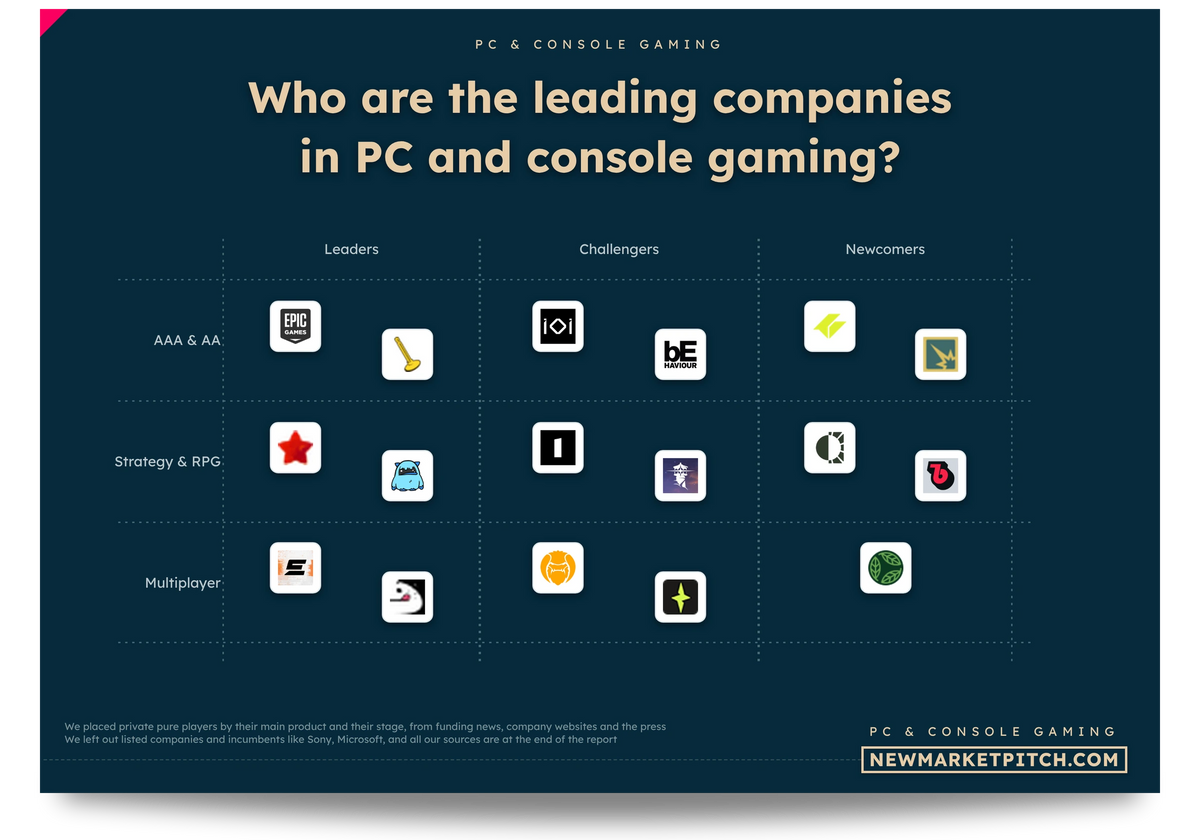
In our research about PC and console gaming startups, we turn what is vague and complex into simple, useful visuals. Market maps like this one show you at a glance where every startup stands.
Is PC and console gaming funding finally coming back?
Yes, PC and console gaming startups are raising money more often now, but a full funding recovery is still unproven.
We tracked 25 deals worth at least $273M in the last 12 months, compared with 16 deals worth at least $176M in the 12 months before. The recent period also had no month without a qualifying deal across its 11 completed months, against 2 empty months in the earlier period. There is more activity, not just one announcement in an otherwise quiet market. Still, the earlier period has too few deals for reliable percentage comparisons, and the largest transactions have an unusually strong effect on the money total.
The strange part is that the games business looks healthier than the people making games often feel. Newzoo's August 2026 forecast puts PC revenue at $45.9 billion and console revenue at $46.9 billion for 2026. Yet GDC's November 2026 industry survey found 34% of respondents had experienced a layoff in the previous two years. Investors can believe in growing player spending while remaining nervous about financing another studio.
Look at the variety of recent recipients: ModRetro sells handhelds, Gardens Interactive is building an online game, and W4 Games sells tools and support to developers. That is encouraging breadth, but it tells us little about the odds facing an unknown studio pitching its first game.
Is ModRetro making the PC and console gaming comeback look bigger than it is?
ModRetro makes PC and console gaming funding look much stronger than the typical game studio would recognize.
The retro-handheld company closed a $145M round of undisclosed stage in March 2026, the largest qualifying deal of the last 12 months. ModRetro is Palmer Luckey's company, and a US securities filing and Financial Times reporting show how big his hardware plans are. ModRetro sells devices and cartridges; it is not a studio raising money to finish a new title.
There were serious game-development checks too. Gardens Interactive raised a Series B of at least $35M in October 2026 for its shared online world, the next-largest amount of the last 12 months. That shows developers can still attract large backers, though Gardens is trying to build something far more expensive than a small premium game.
In the 12 months before, Bonfire Studios' $56M Series B in January 2025 was the largest deal, and ModRetro already raised $19M in December 2024. The top spot has shifted from a multiplayer developer to a handheld maker. That is a big reason the market's headline number now tells us less about how easy game development is to fund.
Would PC and console gaming funding still look good without giant rounds?
Only partly. Without the giant checks, PC and console gaming funding is roughly level with the earlier period, and without ModRetro's round it falls behind.
Excluding rounds above $50M leaves at least $128M in the last 12 months, against at least $120M in the 12 months before. Excluding only rounds above $100M leaves at least $128M and at least $176M, respectively. The two tests disagree because ModRetro's $145M was the only round above $100M, while Bonfire Studios' earlier $56M sits between the two thresholds. The earlier deal sample is also too thin to turn either result into a confident growth rate.
The difference between a giant check and an ordinary one matters in practice. ModRetro needs to make and sell physical hardware. Gardens Interactive wants to keep players in a shared online world. Ironwood Studios' $4M Seed in February 2026, by contrast, followed a commercially proven premium game. Investors are solving different problems with very different budgets.
If another enormous hardware round arrives tomorrow, the total could jump again without helping a modest independent developer. We would take continued smaller financing across many studios much more seriously than another outsized announcement. For now, the smaller deals are present, but the money still sits heavily at the top.
Are more PC and console gaming startups getting funded, or just the usual names?
More individual PC and console gaming businesses found backers, though repeat investments inflated the deal count.
We identified 21 companies in the last 12 months, versus 16 in the 12 months before. That answers part of the question: investors did reach a wider set of businesses. But 4Divinity received separate investments in December 2025, January 2026, May 2026 and August 2026. Magic Potion Games also raised twice inside the recent window. Neither became a new company each time the financing was announced.
There are signs of wider participation beyond the companies themselves. We identified 17 distinct lead investors in the latest period, against 11 earlier, and businesses across more categories received funding. Some leading investors appeared several times, so that wider roster should not be mistaken for a guarantee that every startup can now find a willing lead.
The table below shows how far the recent funding reached compared with the previous period.
| Measure | Last 12 months | 12 months before |
|---|---|---|
| Deals | 25 | 16 |
| Companies | 21 | 16 |
| Repeat companies | 2 | 0 |
| Undisclosed rounds | 5 | 2 |
| Named lead investors | 17 | 11 |
| Active categories | 6 | 5 |
| Countries | 10 | 10 |
| Regions | 4 | 4 |
| Investors identified | 48 | 30 |
Can a brand-new PC or console studio still get its first investment?
A new PC or console game studio can still get a first check, but we cannot claim that the door has opened widely.
Lambda Studios' $1.3M round of undisclosed stage in November 2026 is the financing we could clearly identify as a company's first in the last 12 months. Merak Capital backed the Saudi developer as it expanded from Roblox into PC games. Having experience with an existing game platform may give a young team something tangible to show investors before its first PC release.
That's one confirmed first round, not a count of every first round in the market. We could not firmly classify the financing histories of 24 recent deals as first checks or follow-ons. The median age of companies receiving funding was 3 years in each period, but that doesn't tell us how many founders were raising for the first time.
For context, GDC's November 2026 survey reported that 50% of studio-worker respondents relied primarily on self-funding, compared with 5% who named private investment. The survey covers more than venture-backed startups, but it explains why raising venture capital remains an unusual route for many game makers. Lambda Studios proves a first round can happen; its deal cannot show how easy the process has become.
Are small PC and console gaming funding rounds getting easier to land?
Small PC and console gaming checks are more visible now, but there is no proof they have become easy to get.
The last 12 months included 10 disclosed rounds under $5M, versus 5 in the 12 months before. Those checks made up 50% of rounds with published amounts, compared with 36% earlier. The median disclosed round was $4.5M recently and $6.4M before. So the larger overall funding total has not translated into a bigger typical check.
Some of the smaller bets are quite different. Ironwood Studios raised a $4M Seed in February 2026 after releasing Pacific Drive. Magic Potion Games raised a $3.7M Series A in July 2026, after a $675K round in December 2025. ARC's $1.1M Seed in September 2026 backed a handheld console and its operating system. Developers and hardware founders can both find investors at this size.
But counting the successful raises tells us nothing about the rejected pitches. We do not know how many teams tried, how long they spent fundraising or what terms they accepted. Founders looking for a modest check have live examples to point to, not evidence that the fundraising grind is suddenly over.
Do investors fund PC and console games before anyone can play them?
Yes, investors still back unreleased PC and console games, although the biggest pre-launch checks go to unusually convincing teams.
Gardens Interactive's Series B of at least $35M in October 2026 backed a social role-playing world approaching launch. Backers included Lightspeed, Index and Accel. The game still has to show that players want to spend time together over months, which a trailer cannot establish.
Bonfire Studios had already shown the same pre-release confidence in the earlier period. Its $56M Series B in January 2025, the largest deal of those 12 months, supported Arkheron while the game was still in development. Investors were backing a team and a plan before the game had proved itself with players.
A released hit can make the pitch easier. Ironwood Studios had already shipped Pacific Drive before securing fresh funding, and the studio reported in February 2026 that it had reached 3 million players across purchases and subscription access. These examples tell us there is no universal rule requiring a hit first. Experienced teams can raise on promise; others have stronger evidence once people are playing.

In our market report about PC and console gaming startups, we always try to gather several sources and make estimates that make sense, so you can work with solid numbers.
Can indie PC and console developers still raise serious money?
Independent PC and console game developers still raise money, but mostly in modest checks, and the stronger pitches give investors a concrete reason to believe the next game will sell.
Premium and indie game studios drew 10 deals and at least $26M in the last 12 months, against 9 deals and at least $36M in the 12 months before. The category's median check was $2.6M. Some developers are building ambitious new franchises, while others are trying to turn the reputation of a distinctive released game into a lasting studio business.
Ironwood Studios is the clearest example of the latter. Its February 2026 announcement said Pacific Drive had sold over 1.5 million copies. A game that people have already bought is useful evidence when a studio asks for another round. Welevel's $8.5M round of undisclosed stage in June 2026 and Odd Meter's $5M round of undisclosed stage in May 2026 also show investors putting money into different kinds of independent development.
The catch is distribution. Newzoo's March 2026 PC and console analysis found room for premium and mid-priced games, but also tougher competition for attention. A studio can make a good game and still struggle to get noticed. Money is available for standout teams; the commercial problem they must solve has not become any easier.
Are PC and console game publishers getting funded instead of studios?
PC and console publishers drew more disclosed money than independent studios recently, but most of it went to one publisher, so developers have not been pushed aside.
Publishing accounted for 6 deals and $40M of disclosed capital in the last 12 months, while premium and indie game studios drew 10 deals and at least $26M. The publishing lead is real, but it owes a lot to a repeated relationship rather than a broad rush toward every new label.
Singapore-based 4Divinity took four separate investments from ADATA Technology in the recent period. GCL Global Holdings' corporate announcement described plans to acquire rights to more games and extend digital distribution. For a publisher, spreading money across several titles can be more useful than betting everything on a single launch. That business model differs from a developer's need to pay its team until a game ships.
Sound Games offers another approach. Its $6.5M Seed in January 2026 backed a publisher promoting buy-once ownership across devices. Instead of buying a bigger catalog, it is trying to change how consumers purchase premium games. Both models found financing. Neither provides evidence that ordinary indie labels now have a straightforward path to venture capital.
Are investors still willing to bet big on multiplayer PC games?
Investors still write large checks for multiplayer PC and console games, but they are choosing their projects carefully.
Multiplayer and live-service studios attracted 3 deals worth at least $35M in the last 12 months, compared with 3 deals worth at least $87M in the 12 months before. The same number of transactions brought in much less disclosed money. There is interest in persistent online games without the level of financial commitment seen in the earlier period.
Gardens Interactive's Series B of at least $35M in October 2026 targets a social fantasy experience built around players spending time together. Hypercent, a South Korean studio making cooperative horror games for Steam, raised a Seed of undisclosed size in July 2026. Bonfire Studios' earlier Arkheron financing shows the same basic attraction: build something people can return to, not just play once.
There is a brutal catch with games that need large communities. Newzoo's 2026 research says keeping existing players engaged is becoming more important as player growth slows. Launch buzz helps, but it cannot pay the bills if a multiplayer community disappears. Investors still like the potential rewards; they have plenty of reasons to fear the failure rate.
Is building a console a better bet than making PC games?
Console hardware now takes the biggest share of disclosed PC and console gaming startup money, but that does not make it the better bet for most founders.
PC and console gaming hardware received $146M across 2 deals in the last 12 months, or 54% of the money with a public amount. Most of that money went to ModRetro, a retro-handheld company. A category dominated by one unusually large transaction tells us almost nothing about the odds of success for the next device startup.
The other recent hardware example makes the gap obvious. ARC raised a $1.1M Seed in September 2026 to build a handheld and dedicated operating system. The company described a first-batch delivery target of Q1 2027. It still has to deliver the product, find enough buyers and support the device after launch. Those are expensive problems that a game studio does not face in the same form.
Nintendo's official figures through September 2026 show that Switch 2 has found a large audience. The comparison is useful only up to a point: Nintendo is an established, publicly traded platform owner with its own games and distribution. Startup hardware can attract ambitious investors today, but the economics of a giant console business are no shortcut for a newcomer.
Can a cloud gaming startup raise money without making games?
Yes, cloud gaming startups can still raise money, especially when they make PC and console games easier to reach or test.
Cloud and remote-play services recorded 3 deals worth at least $8.3M in the last 12 months. Entity's $5.8M Seed in August 2026 supported an Irish browser platform for console-quality games; the Irish Times reported that it was aiming to launch in 2027. Its bet is that removing the need for dedicated hardware will help players try games they would otherwise skip.
Playruo tackles a different frustration. Its $2.5M round of undisclosed stage in April 2026 supported streaming tools for playable previews, tests and quality checks, according to investor Ventech. Publishers can use those services to reach players or testers without making everyone download a full game. That customer is quite different from someone buying a monthly gaming subscription.
Blacknut's growth-equity round of undisclosed amount in August 2026 adds the subscription business to this picture. The company also announced a broader investment and infrastructure package, but we do not treat the entire package as disclosed equity financing. These businesses have distinct customers and risks. Cloud gaming still attracts backers; there is no single cloud model investors have already crowned the winner.
Have investors stopped funding game-development tools?
No, game-development software startups still get funded, although fewer PC and console gaming tool startups raised money in the last 12 months.
Game development infrastructure drew 1 deal worth $18M in the last 12 months, compared with 2 deals worth $18M in the 12 months before. The same money went to fewer startups. It doesn't tell us that game makers have lost interest in tools that save them time or help games run reliably.
W4 Games' $18M Series B in August 2026 was led by Tencent. The company sells commercial support and enterprise technology around the open-source Godot engine, and said it would expand internationally. Its customers already know the engine; W4 wants to make that software workable for larger development teams. GDC's November 2026 survey also found growing use of Godot among indie developers, even as Unreal and Unity remained widely used.
The previous period had two different examples: Beamable's $14M Series A in February 2025 supported backend and live-operations services, while Diversion's $4.5M Seed in May 2025 backed cloud version control. Their products solve dull but costly problems for game teams. Investors have funded those businesses before and are still funding some now, even if there are fewer rounds to point to.

Our document detailing everything you need to know about PC and console gaming gets updated several times a month, so you always get the latest view of where things stand.
Are PC and console gaming startups raising their next round faster now?
Some PC and console gaming companies are raising again very quickly, but we cannot say founders generally get their next check faster.
Among the financing gaps we could measure, the median interval was 9 months in the last 12 months and 70 months in the 12 months before. Those numbers look dramatic side by side. But the recent measure covered just 36% of deals, and the earlier one covered 19%. A comparison built from those limited histories can swing when a few companies raise repeatedly.
Of the measured gaps in the latest period, 56% were shorter than 12 months. That describes intervals between two rounds by the same company, not the proportion of companies able to raise that fast. The successive ADATA-backed 4Divinity financings are a good example of how one continuing investor relationship can create short gaps.
A founder trying to raise again after shipping a game faces a different test from a publisher drawing staged investments from an existing partner. The data proves quick repeat checks happen in PC and console gaming. It does not prove an industry-wide change in how long a second round takes.
Are American startups getting nearly all the PC and console gaming money?
American PC and console gaming startups still receive most disclosed money, even though deals now reach far beyond the United States.
The United States recorded 7 deals worth at least $195M in the last 12 months, or 71% of the disclosed capital. Asia-Pacific recorded 8 deals worth at least $39M, and Europe 7 deals worth at least $35M. Asia-Pacific has the most deals, but four of them went to one publisher, 4Divinity, and American recipients received much bigger checks.
Look at what was funded elsewhere. Ireland's W4 Games sells Godot support, Germany's Welevel develops games, Singapore's 4Divinity publishes them, and India's ARC is trying to ship a handheld. These companies sell different products to different customers. The geographic spread is more interesting than a simple contest over which region got the biggest check.
ModRetro alone explains much of the American funding advantage. Counting dollars makes the US lead look overwhelming; counting funded businesses makes the PC and console gaming market feel much more international. Both views are accurate, but they answer different questions.
Is Saudi Arabia actually backing independent PC and console game studios?
Saudi Arabia is funding independent PC and console game developers, although the recent startup checks are still modest.
We recorded 3 Saudi Arabian deals worth $4.3M in the last 12 months. Lambda Studios' $1.3M round of undisclosed stage in November 2026 supported a move toward PC games. Majestic Mind Games' $1.5M round of undisclosed stage in August 2026 backed a studio developing Steam titles, and Ash Games Studio raised a $1.5M Seed in July 2026 for PC and console adventures.
Those checks are easy to miss beside Saudi Arabia's much larger gaming headlines. Investments in established global publishers, esports events or mobile-only products do not automatically mean young PC studios are funded. These deals went to real studios making PC and console games.
The backers also have a local focus. Merak Capital led 3 rounds in the latest period, and Impact46 led 2. Both have described efforts to finance Saudi gaming businesses. That creates a path for young teams to find an investor with some knowledge of the industry. We still need released games and successful follow-on funding before calling it a durable studio ecosystem.
Does Singapore really have a growing PC and console startup scene?
Singapore's recent PC and console gaming funding looks busy, but the deals come from one publisher rather than a wave of new startups.
The country recorded 4 deals totaling $32M in the last 12 months, all involving 1 company: 4Divinity. The publisher raised $3M in December 2025, $10M in January 2026, $10M in May 2026 and $9M in August 2026. Every transaction was a round of undisclosed stage led by ADATA Technology. This is repeat backing, not four newly funded teams.
GCL Global Holdings, the publicly traded group behind the publisher, said in its August 2026 announcement that the investment would help acquire games and expand distribution. That helps explain why one business kept receiving checks. It does not provide evidence of other locally based studios attracting investors.
For readers interested in Singapore, the conclusion is straightforward: a publishing business secured meaningful financing, but the deal count alone overstates the breadth of the local startup market. Other game studios could still succeed there; this particular set of financings does not prove they are all attracting capital.
Are venture investors getting pickier about PC and console games?
Not fewer of them, but choosier about the business: more investors led PC and console gaming rounds recently, and each one backed a company with a clear way to make money.
We counted 17 active lead investors in the last 12 months and 11 in the 12 months before. That is wider participation, although the earlier deal sample is small and named leads were available for only 68% of recent deals. It would be a mistake to treat these figures as proof that investors have become less selective.
The investors' choices are revealing. Point72 Ventures led Sound Games' Seed for a buy-once publisher. Tencent backed enterprise services around the Godot engine through W4 Games. ADATA Technology repeatedly supported 4Divinity's publishing activity. Merak Capital financed smaller Saudi game developers. They were not all looking for another blockbuster studio in the same mold.
In the earlier period, BITKRAFT Ventures was the busiest lead investor with 3 rounds. ADATA Technology led the recent period with 4 rounds, all of them in 4Divinity. Rather than announce that traditional game funds have disappeared, we see investors choosing businesses with very different reasons to exist: a future hit, a reliable tool, publishing access or a hardware product. That variety matters more than trying to name one fashionable corner of gaming.
If players spend more on games, why is funding still so hard for studios?
Players are spending more on PC and console games, but most studios cannot turn that market growth into an easy venture check.
Newzoo forecasts $92.8 billion of PC and console game revenue in 2026. That money does not flow evenly to developers: established franchises, platform stores, publishers and successful live games take a big share. A founder seeking funding must still convince investors that a particular new game can win enough attention to make the bet worthwhile.
GDC's November 2026 survey shows how difficult the business feels from inside. It found 34% of respondents had been laid off in the previous two years. Among studio workers, 50% said self-funding was their primary source of project money, while 5% chose private investment. GDC cautioned that people affected by layoffs were unusually well represented, but the financing results still show why venture rounds are hardly the normal way games get made.
The games getting attention are also competing against a large back catalog and persistent online hits. Newzoo's March 2026 PC and console study stressed how hard it is for new releases to win players' time. A growing market makes a hit more valuable; it does not make creating a hit less risky. That is why impressive funding announcements can sit alongside layoffs and cash-strapped studios.
So, what does PC and console gaming funding look like right now?
PC and console gaming funding is improving, but it still depends too heavily on exceptional deals to count as a healthy boom.
More independent businesses received financing, small checks kept arriving, and investors backed publishers, game studios, cloud services, development tools and handhelds. ModRetro was the largest recipient, while ADATA Technology led the most recent-period rounds. But the earlier comparison period is too small for dependable percentage changes, and repeat investments make deal counts look broader than the underlying company count.
To change our verdict, we would want to see more ordinary studio financings, more clearly verified first checks and a wider set of companies successfully raising again after shipping products. Another giant round alone would prove very little. Right now, there is enough life in PC and console gaming finance to reject the idea of a shutdown, but not enough consistency to declare the hard times over.
The table below shows what we found.
| Question | Answer |
|---|---|
| Are ordinary studios sharing in the comeback? | Studio financing is alive, but the market remains selective today. Premium and indie developers received 10 deals in the latest period. A completed game can strengthen a pitch without guaranteeing funding. |
| Are giant checks making recovery look easier? | Yes, major financings still dominate the money raised across gaming. ModRetro secured $145M in a single recent handheld funding round. Most small developers cannot use that transaction as their benchmark. |
| Does growth survive without the biggest rounds? | Barely, and the two periods sit close together. Deals excluding rounds above $50M brought in $128M+ recently. The earlier period reached $120M+ on the same basis. |
| Are more companies actually finding investors now? | The money reached a wider range of companies this time. We counted 21 financed businesses during the latest comparison period. Repeated checks still make the headline deal count look larger. |
| Can first-time PC developers still raise money? | Yes, but it is hard to say how often. Lambda Studios raised a $1.3M first round in November 2026. Self-funding is still far more common than venture money for studios. |
| Do modest game funding checks still exist? | Yes, small checks remain a normal part of recent activity. There were 10 disclosed rounds under $5M during the period. That says nothing about how many unsuccessful pitches investors rejected. |
| Are multiplayer projects still landing serious backing? | Investors still back online games with hopes of lasting communities. Multiplayer and live-service studios received 3 deals during the period. Future player retention will decide whether those checks paid off. |
| Are publishing totals boosted by repeated investors? | Yes, a recurring corporate backer shaped the publishing activity. 4Divinity raised $32M across 4 recent financing rounds. Several rounds can represent one continuing relationship rather than multiple winners. |
| Can gaming cloud services find venture money? | Cloud gaming businesses still have investors when the product solves problems. The category recorded 3 deals worth $8.3M+ in the latest period. Browser play, previews and subscriptions face different commercial tests. |
| Is America still absorbing most disclosed funding? | American startups still received most of the published capital. US recipients took $195M+ during the latest comparison period. Other regions matched its transaction count without matching the check sizes. |
| Are studios getting repeat checks much faster? | Some are, but the available histories are far too limited. The measured recent median gap was 9 months between rounds. Sparse coverage makes a market-wide speedup impossible to establish confidently. |

In our report covering the PC and console gaming market, we look at what the winners do differently, so you can learn from the best instead of guessing.
Our methodology
Our data runs through November 19, 2026. We then reviewed this article and updated its answers on November 24, 2026, the date shown under the title. We compared the last 12 months, November 20, 2025 to November 19, 2026, with the 12 months before, November 20, 2024 to November 19, 2025. We tested this 12-month comparison, which yielded 25 and 16 deals. We could not extend it to 18 months against 18 months because the earlier window would precede January 2024, when our complete market coverage begins. Both periods used fall within that coverage.
We counted qualifying equity financings of private companies of at least $300K. Debt, grants, loans, unconverted convertible instruments, SAFEs and public offerings are excluded. We focused on businesses whose primary offering is PC or console games or specialized products and services closely serving those players and developers, including premium studios, multiplayer studios, publishing, development tools, gaming discovery, remote play and dedicated hardware. Borderline PC/console-oriented companies are included rather than silently discarded, while primarily mobile, XR, gambling, esports-only, token-speculation and general technology businesses fall outside the market.
We counted as startups independent growth-oriented businesses founded in 2007 or later, including recently listed companies within the applicable five-year window and recently acquired businesses under the three-year rule. We count a franchise through its developer, not as a separate startup. Each financing appears once, even when several reports describe the same announcement; separate completed investments count as separate transactions. Undisclosed rounds count toward deal totals but contribute no published amount, so our capital figures are minimums.
We classified each company by its principal gaming activity and the headquarters country reported for that business, then grouped countries into regions. Stages follow reported round labels; seed and Series A count as early-stage, while Series B and subsequent named growth stages count as later-stage. The early-versus-later split uses only deals with a named stage. We leave stages unknown when reporting does not establish one, rather than guessing. For subsequent-round velocity, we measure gaps between qualifying events for the same company, only where sufficient history exists.
Rounds confirmed by a company announcement, a press article or a regulatory filing are counted in full. Where no article exists, a round is counted only when at least two recognised databases agree on its date (within one month) and amount (within 5%), and it is marked as low confidence; a round found in a single database stays in the company's history but is left out of totals. For companies that have raised more than $100M, every round counted is backed by an article.
We prioritized company announcements, official filings, investor disclosures and reliable press over secondary database summaries. Comparisons of disclosed money always exclude undisclosed amounts, and category shares of money refer to disclosed capital only. The earlier period contains fewer than 20 deals, making this a thin comparison: we therefore report the direction and the exact values side by side, without presenting percentage changes or multiples as reliable conclusions.
A press total may differ because it includes acquisitions, debt, mobile-only games, old rounds or financings below our threshold. A well-known publisher or platform may be absent because it is not an eligible startup or because its transaction was not qualifying equity funding. Likewise, a quiet latest month is not, by itself, evidence of collapse: the dataset stops partway through November. Our focus here is the last 12 months against the 12 months before; separate articles use other time spans for full-history rankings and funding trends.
Key sources include Newzoo's August 2026 PC and console revenue forecasts and market conditions, Newzoo's March 2026 report on premium games, platforms and player attention, GDC's November 2026 survey on layoffs and how studios finance games, ModRetro's 2026 Form D equity offering, Financial Times reporting on ModRetro's retro-console ambitions, Gardens Interactive's October 2026 Series B and game-launch plans, Bonfire Studios Series B and Arkheron publishing agreement, Ironwood Studios' released-game sales and player reach, Sound Games' original explanation of its cross-platform single-purchase model, Point72 Ventures' portfolio entry confirming Sound Games as a seed investment, W4 Games' Series B and Godot enterprise-services expansion, Entity's browser gaming platform and planned launch, Playruo's instant gaming tests, previews and cloud services, Blacknut's August 2026 Digital Alpha investment announcement, ARC X1 handheld preorders and first-batch delivery target, Nintendo's official Switch 2 hardware and software sales, Impact46's dedicated Saudi early-stage gaming fund, Merak Capital's Saudi gaming fund and investment program, GCL announcement on 4Divinity's August 2026 ADATA investment, and GCL annual filing detailing 4Divinity's ownership and publishing operations.

Learning from others' mistakes is the cheapest lesson there is. In our research about PC and console gaming startups, we look at what broke startups before you, so you don't repeat it.
Written by the New Market Pitch teamWe track new markets so founders and investors can move faster. About us