What are the latest funding trends in PC and console gaming?
Whether you're building or investing in the PC and console gaming market, our report covers everything you need to know: the players, the money, and what's coming next.
Summary
PC and console gaming startups are raising more money, and more companies are getting funded. We counted 22 deals worth at least $269M this year to date. ModRetro raised the most, with $145M for its handheld gaming business.
The change is real, though the market is still small. The same period of 2025 had 15 deals worth at least $157M, while the equivalent period of 2024 had 12 deals worth at least $189M. The number of companies getting checks has grown alongside the money.
This partial year has also overtaken the disclosed minimum for all of 2025, when 18 deals brought in at least $161M. Those are different lengths of time, and undisclosed rounds prevent an exact comparison of every dollar invested. Still, the current minimum has already cleared the earlier benchmark.
Big checks explain a lot of the difference. Hardware startups secured 2 deals totaling $146M. Meanwhile, the typical disclosed funding round was $5.4M, down from $5.7M at the same point last year. Most founders are not suddenly raising enormous rounds.
Game makers remain busy. Premium and indie studios attracted funding across several genres, while specialist publishers secured 5 deals and $37M. Investors are backing both games and the businesses that help get them to players.
Multiplayer games tell a less cheerful story. Studios in that category raised at least $35M across 3 deals, compared with at least $87M across 3 deals in the comparable period last year. Big multiplayer bets still happen, but last year's large rounds have not become routine.
Investors are looking farther afield, too. Asia-Pacific recorded 7 deals this year, and North America and Europe 6 each. North America still took the biggest checks, with at least $194M, while Europe and Asia-Pacific raised much smaller totals.
The stage picture is patchy. Seed funding continues, but many startups do not announce a recognizable round stage. Calling this a sudden move into late-stage gaming would go beyond what the deals show.
There has not been a smooth climb from quarter to quarter. Q1 2026 attracted $166M across 4 deals, while Q3 2026 recorded 11 deals and at least $42M. More activity later in the year did not bring bigger checks.
Our conclusion is straightforward: investors currently back a wider range of PC and console gaming businesses, but they still reserve their largest bets for a few companies. That helps explain why stronger funding can coexist with layoffs, canceled games and a difficult market for many studios.

Written by the New Market Pitch teamWe track new markets so founders and investors can move faster. About us

In our report covering the PC and console gaming market, you will always find fresh funding data, taken straight from our own verified funding database.
All funding deals in the PC and console gaming market over the last years
Below is the table listing all the deals. You can find our methodology at the end of this page.
If you want a deeper understanding of the market and its current dynamics, get our PC and console gaming market report.
| Company | Category | Date | Stage | Deal size | What they do | Region | Lead investors | Country | Rank |
|---|---|---|---|---|---|---|---|---|---|
| Lambda Studios | Premium and indie game studios | November 2026 | Unknown | $1.3M | Develops and publishes games, expanding from Roblox onto PC distribution via Steam. | Middle East | Merak Capital | Saudi Arabia | |
| Gardens Interactive | Multiplayer and live-service studios | October 2026 | Series B | $35M+ | Creates shared online fantasy adventure games | North America | Not disclosed | United States | |
| 1312 Interactive | PC and console publishing | September 2026 | Seed | $1M | Publishes globally distributed indie and AA games | Asia-Pacific | T-Accelerate Capital, Chimera VC | India | |
| ARC | PC and console gaming hardware | September 2026 | Seed | $1.1M | Handheld gaming console and operating system | Asia-Pacific | Chimera VC, MIXI Global Investments | India | |
| W4 Games | Game development infrastructure | August 2026 | Series B | $18M | Godot engine support and console ports | Europe | Tencent | Ireland | |
| Entity | Cloud and remote-play services | August 2026 | Seed | $5.8M | Browser platform for console-quality games | Europe | ACT, Delta Partners, Elkstone | Ireland | |
| Pretty Cool Games | Premium and indie game studios | August 2026 | Unknown | Undisclosed | Develops physics-based cooperative puzzle games | Europe | Coreblazer | United Kingdom | |
| Blacknut | Cloud and remote-play services | August 2026 | Growth Equity | Undisclosed | Cloud gaming subscription for consumers | Europe | Digital Alpha | France | |
| 4Divinity | PC and console publishing | August 2026 | Unknown | $9M | Publishes PC and console action games | Asia-Pacific | ADATA Technology | Singapore | |
| Majestic Mind Games | Premium and indie game studios | August 2026 | Unknown | $1.5M | Develops Steam PC games including Tri Survive | Middle East | Merak Capital, Impact46 | Saudi Arabia | |
| Ash Games Studio | Premium and indie game studios | July 2026 | Seed | $1.5M | Develops folklore-inspired PC and console adventures | Middle East | Merak Capital, Impact46 | Saudi Arabia | |
| Hypercent | Multiplayer and live-service studios | July 2026 | Seed | Undisclosed | Creates cooperative horror games for Steam | Asia-Pacific | Not disclosed | South Korea | |
| Magic Potion Games | Premium and indie game studios | July 2026 | Series A | $3.7M | Develops original video games | North America | Not disclosed | United States | |
| Welevel | Premium and indie game studios | June 2026 | Unknown | $8.5M | Video game development studio | Europe | Not disclosed | Germany | |
| 4Divinity | PC and console publishing | May 2026 | Unknown | $10M | Publishes PC and console action games | Asia-Pacific | ADATA Technology | Singapore | |
| Odd Meter | Premium and indie game studios | May 2026 | Unknown | $5M | Develops narrative adventure game INDIKA | Asia-Pacific | Not disclosed | Kazakhstan | |
| Distinct Possibility Studios | Multiplayer and live-service studios | April 2026 | Unknown | Undisclosed | Creates multiplayer PC and console games | North America | Decasonic | United States | |
| Playruo | Cloud and remote-play services | April 2026 | Unknown | $2.5M | Browser cloud streaming for game demos and playtests | Europe | Kameha Ventures, Blast Club | France | |
| ModRetro | PC and console gaming hardware | March 2026 | Unknown | $145M | Retro handheld gaming consoles and cartridges | North America | Not disclosed | United States | |
| Ironwood Studios | Premium and indie game studios | February 2026 | Seed | $4M | Develops survival driving game Pacific Drive | North America | Lifelike Capital | United States | |
| 4Divinity | PC and console publishing | January 2026 | Unknown | $10M | Publishes PC and console action games | Asia-Pacific | ADATA Technology | Singapore | |
| Sound Games | PC and console publishing | January 2026 | Seed | $6.5M | Publisher of buy-once cross-platform premium games | North America | Point72 Ventures | United States | |
| Magic Potion Games | Premium and indie game studios | December 2025 | Unknown | $675K | Develops original video games | North America | Not disclosed | United States | |
| 4Divinity | PC and console publishing | December 2025 | Unknown | $3M | Publishes PC and console action games | Asia-Pacific | ADATA Technology | Singapore | |
| Torpor Games | Premium and indie game studios | November 2025 | Seed | Undisclosed | Narrative political role-playing video games | Europe | Not disclosed | Germany | |
| Fictions | PC and console publishing | November 2025 | Unknown | $17M | Publishes PC and console games including LEGO Party | North America | Not disclosed | United States | |
| Galaxy Grove | Premium and indie game studios | October 2025 | Seed | $1M | Develops 3D management and building games | Europe | Not disclosed | Netherlands | |
| PolyDream Studio | Premium and indie game studios | October 2025 | Seed | $500K | PC and console game development | Europe | Not disclosed | Azerbaijan | |
| Studio Lassa | Premium and indie game studios | August 2025 | Unknown | $7.2M | Develops original console games for global audiences | Asia-Pacific | Wemade | South Korea | |
| Starvania Studio | Premium and indie game studios | August 2025 | Unknown | $1.1M | Console and PC game development | Middle East | Merak Capital, Impact46 | Saudi Arabia | |
| Shortgun Games | Premium and indie game studios | August 2025 | Seed | $1M | PC and console action games | Asia-Pacific | Not disclosed | India | |
| Distinct Possibility Studios | Multiplayer and live-service studios | July 2025 | Unknown | $31M+ | Creates multiplayer PC and console games | North America | BITKRAFT Ventures, Brevan Howard Digital | United States | |
| BetaDwarf | Multiplayer and live-service studios | July 2025 | Unknown | Undisclosed | Creates cooperative multiplayer games including Minion Masters | Europe | Square Enix | Denmark | |
| Emptyvessel | Premium and indie game studios | June 2025 | Series A | Undisclosed | PC and console game development | North America | NCSoft, 1AM Gaming | United States | |
| Diversion | Game development infrastructure | May 2025 | Seed | $4.5M | Cloud version control for game development | Middle East | Konvoy | Israel | |
| Amplitude Studios | Premium and indie game studios | May 2025 | Series A | $14M | Strategy and action video games | Europe | Griffin Gaming Partners | France | |
| Human Computer | Premium and indie game studios | March 2025 | Seed | $5.7M | Independent PC and console game studio | North America | Not disclosed | United States | |
| Welevel | Premium and indie game studios | March 2025 | Seed | $5.7M | Video game development studio | Europe | BITKRAFT Ventures | Germany | |
| Beamable | Game development infrastructure | February 2025 | Series A | $14M | Supplies backend services and live operations tools | North America | BITKRAFT Ventures | United States | |
| Bonfire Studios | Multiplayer and live-service studios | January 2025 | Series B | $56M | Develops multiplayer action games including Arkheron | North America | Andreessen Horowitz | United States | |
| ModRetro | PC and console gaming hardware | December 2024 | Unknown | $19M | Retro handheld gaming consoles and cartridges | North America | Not disclosed | United States | |
| Ruckus Games | Multiplayer and live-service studios | November 2024 | Series A | $19M | Builds cooperative third-person action shooters | North America | Krafton | United States | |
| Radical Forge | Premium and indie game studios | November 2024 | Unknown | $3.3M | PC and console game development studio | Europe | Mercia Ventures | United Kingdom | |
| Outlier Games | Premium and indie game studios | October 2024 | Seed | $634K | Creates inventive strategy video games | Europe | Not disclosed | Ireland | |
| Eschatology Entertainment | Premium and indie game studios | August 2024 | Series A | $11M | PC and console action games | Europe | Krafton | Cyprus | |
| Medal | Player communities and discovery | July 2024 | Series D+ | $13M | Gaming clips and video sharing | North America | Not disclosed | United States | |
| Mystic Forge | PC and console publishing | July 2024 | Seed | $2.2M | Publishes independent strategy PC and console games | Europe | ForsVC, ROM Utrecht Region | Netherlands | |
| Red Rover Interactive | Multiplayer and live-service studios | April 2024 | Series A | $15M | Multiplayer survival game development studio | Europe | Krafton | United Kingdom | |
| Gamestream | Cloud and remote-play services | March 2024 | Unknown | $4.9M | White-label cloud gaming platform | Europe | Audacia | France | |
| ROAR Games | Premium and indie game studios | March 2024 | Seed | $1.5M | Develops Tenet of the Spark action game | North America | The Games Fund | United States | |
| Jabali | Game development infrastructure | March 2024 | Seed | $5M | Creates playable games from natural-language prompts | North America | BITKRAFT Ventures | United States | |
| Magic Potion Games | Premium and indie game studios | February 2024 | Seed | $3.3M | Develops original video games | North America | Not disclosed | United States | |
| Build A Rocket Boy | Premium and indie game studios | January 2024 | Series D+ | $110M+ | PC and console video game studio | Europe | RedBird Capital Partners | United Kingdom |

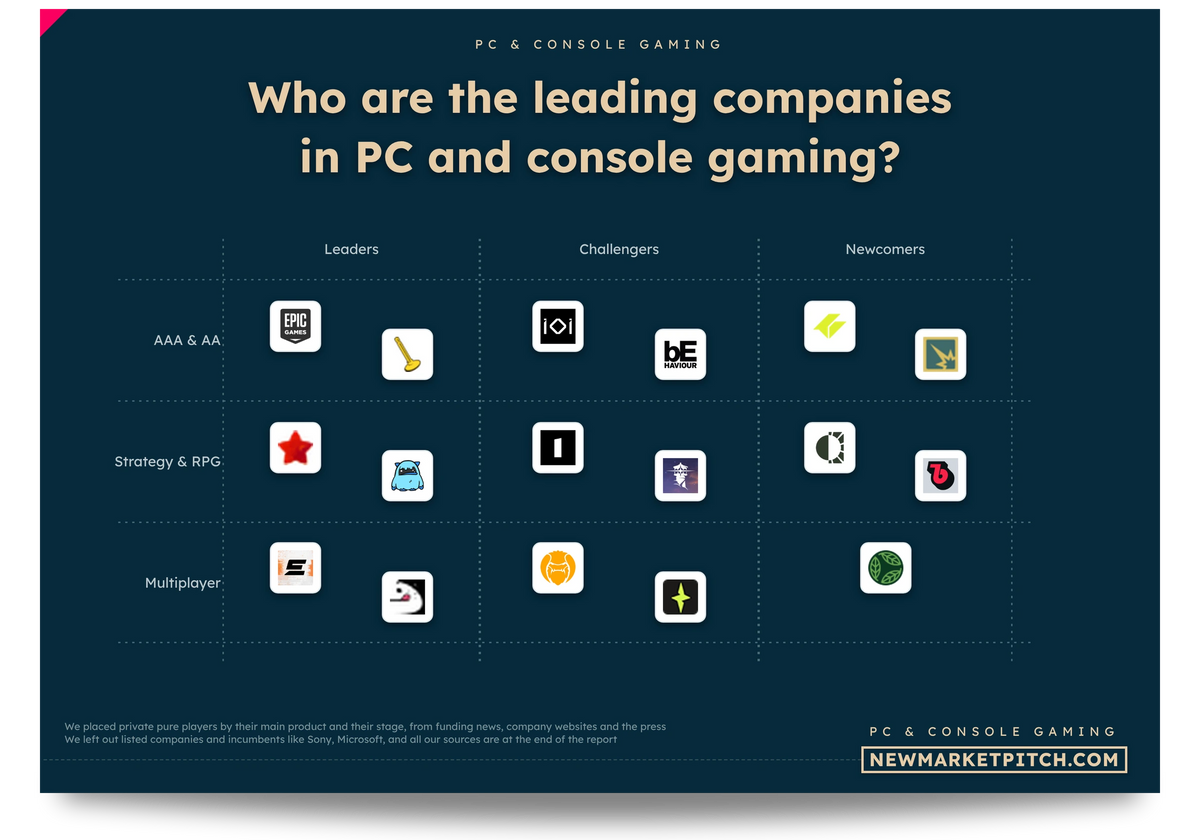
In our research about PC and console gaming startups, we turn what is vague and complex into simple, useful visuals. Market maps like this one show you at a glance where every startup stands.
Is PC and console gaming startup funding finally growing again?
Yes, PC and console gaming startups are raising more money, and more of them are getting funded.
We tracked 22 deals involving 20 companies this year, worth at least $269M. At the same point in 2025, 15 companies raised at least $157M across 15 deals. The comparable part of 2024 brought 12 deals involving 12 companies and at least $189M. These are small groups, so we would not treat the gap between them as proof of a long-term boom. Still, the improvement is visible in the number of companies receiving checks as well as the amount announced.
That is striking given what game developers have been dealing with. S&P Global Market Intelligence's August 2026 discussion of the industry described layoffs, rising costs and investors who were becoming pickier. Those pressures have not vanished just because a few companies raised sizable rounds.
The interesting change is the variety of businesses getting support. The deals cover original games, publishers, engine technology, cloud access and handheld devices. For now, investors appear willing to fund specific ideas they believe in, even while the wider industry struggles.
Has PC and console gaming funding already beaten last year's full-year total?
PC and console gaming startups have already passed last year's full-year minimum for disclosed funding.
Across the whole of 2025, we recorded 18 deals involving 18 companies and at least $161M. Full-year 2024 had 13 deals involving 13 companies and at least $208M. This year is still incomplete, so the comparison uses a partial year against two complete years. We can say the recorded minimum is higher, but unknown amounts in each period mean we cannot say exactly how much money changed hands.
Last year, more companies received financing than in 2024, but the disclosed funding total was lower. Build A Rocket Boy's round of at least $110M in January 2024 explains that gap. This year, one round did most to change the pattern: ModRetro's $145M round of undisclosed stage in March 2026 backed retro handheld hardware. Gardens Interactive's Series B of at least $35M in October 2026 backed game development, and smaller studios also kept raising.
The 2026 Game Developers Conference survey reported widespread layoffs and continued financial pressure on game makers. So beating a full-year funding minimum says something useful about investor spending today. It does not mean developing and selling a successful game has become any easier.
Are hardware startups driving the PC and console gaming funding recovery?
Partly. Hardware has attracted the most disclosed money in PC and console gaming this year, while game studios still receive more individual checks.
PC and console gaming hardware received 2 deals worth $146M, or 54% of the money with a public amount. Premium and indie game studios brought in 8 deals, and multiplayer and live-service studios secured 3 deals worth at least $35M. Look at the number of transactions, and developers remain central. Look at dollars, and a large hardware check dominates.
The handheld opportunity has a real commercial backdrop. Nintendo's official sales figures in September 2026 showed 26.35 million Switch 2 systems sold since launch. The 2026 GDC survey also found 40% of respondents interested in making games for Steam Deck. Neither number says how much independent hardware startups will earn, but both show that portable play has an established audience and developer support.
We should be careful about calling hardware the industry's new favorite. The category includes very few financings, so one exceptional deal can put it ahead of every kind of software business. The recovery stretches beyond devices, even though devices explain much of its size.

In our market report about PC and console gaming startups, we always try to gather several sources and make estimates that make sense, so you can work with solid numbers.
Is PC and console gaming funding still up this year without ModRetro?
No. Without ModRetro's handheld-console round, this year's PC and console gaming funding falls below the same point of 2025.
ModRetro's $145M round of undisclosed stage in March 2026 was this year's largest recorded deal. The company makes modern retro handhelds and physical cartridges, a very different product from a new multiplayer game. A filing with the US Securities and Exchange Commission documents an equity offering, while the Financial Times reported in March on the company's plans for modern versions of classic consoles.
Excluding rounds above $100M, which removes only ModRetro, leaves at least $124M this year, compared with at least $157M in the same period of 2025. Excluding rounds above $50M also removes Bonfire Studios' $56M round from 2025, and then this year leads, with at least $124M against at least $101M. The two tests point in opposite directions, and we would not put too much weight on changes between such small samples.
There are therefore two things happening at once: more businesses are getting funded, and one extraordinary deal is pulling the dollar total up. ModRetro explains the second part far better than the first.
Can a new gaming handheld really compete with Nintendo or Steam Deck?
New PC and console handheld startups can attract investors today, but competing with Nintendo or Valve at scale remains unproven.
ModRetro is selling a modern take on cartridge-based portable gaming. ARC is taking another route, building a handheld console and operating system after raising a $1.1M Seed round in September 2026. One company is leaning into nostalgia and physical ownership; the other is trying to establish a new device platform. Those businesses face different customers, price points and development challenges.
Nintendo's published Switch 2 sales show how large the established market can be. Steam Deck's presence in the GDC developer survey adds evidence that portable play is becoming a serious target for PC studios. Yet the presence of customers does not guarantee that a small manufacturer can secure parts, manage inventory or convince developers to support another system.
Hardware founders have to solve problems that software-only studios can avoid: production, shipping, retail returns and repairs. Investors are plainly prepared to fund attempts at new gaming devices. Whether any of them can build a lasting platform beside the incumbents is still the harder question.

Our document detailing everything you need to know about PC and console gaming gets updated several times a month, so you always get the latest view of where things stand.
Can independent PC and console studios still raise money for original games?
Yes, independent PC and console studios are still getting checks, especially when they can show why their game deserves attention.
Premium and indie game studios secured 8 deals this year, against 9 in the comparable period of 2025 and 6 by this point in 2024. They raised at least $25M in the current period, against at least $36M in the equivalent period last year. Their median round was $3.7M, versus $3.4M. Neither the deal count nor the money has taken off, so this looks like steady, selective funding of particular teams rather than a wave of new studio money.
Ironwood Studios offers a concrete example. Its $4M Seed in February 2026 followed the release of Pacific Drive; the studio said the game had sold 1.5 million copies and reached 3 million players. Odd Meter, known for INDIKA, and Welevel are building different kinds of original games. The common thread is a recognizable creative direction, not one genre that everyone has rushed to finance.
Steam's October 2026 Next Fest highlighted popular demos from a wide spread of genres. There are many ways to get noticed, but also many competing games. Investors keep backing some independent teams, but getting funded remains selective.
Are seed investors giving up on PC and console game startups?
No, Seed funding for PC and console gaming is still active, even if fewer rounds are clearly labeled Seed as a share of all deals.
We recorded 7 Seed deals this year, compared with 6 by the same point in 2025 and 5 by that point in 2024. Seed rounds made up 32% of current transactions, down from 40% in the equivalent period last year. However, 11 rounds this year have no published stage, accounting for 50% of deals. It would be misleading to assign those rounds to later stages without an announcement.
The checks cover very different projects. Sound Games raised a $6.5M Seed round in January 2026 to build a publisher for premium, buy-once games. Ironwood Studios raised its Seed after releasing a successful title. ARC's September Seed backed a device rather than a game. A common funding label does not mean investors expect these companies to follow the same path.
Venture capital was never the only way to make a PC game. Seed investors remain involved, even though most new studios still cannot count on a check.
Are investors moving toward late-stage PC and console gaming startups?
Only partly. Larger PC and console gaming financings are happening, but there is little proof of a broad shift toward mature, late-stage studios.
Among deals with a named stage, early-stage rounds accounted for 73% of transactions this year, versus 90% by the same point last year. This year brought 1 Series A deal, 2 Series B deals and 1 Growth Equity deal. There was no Series C or Series D+ deal in the period. Meanwhile, many substantial financings have no announced stage, so the publicly labeled rounds cannot tell the whole story.
W4 Games' $18M Series B in August 2026 backed an engine-support business rather than a game. Gardens Interactive's Series B of at least $35M in October 2026 went toward a shared fantasy-game project and continued operation after launch. Neither deal is evidence that investors have broadly moved into established, late-stage publishers.
Investors have written big checks at several stages of game development. There is little evidence that mature studios have suddenly become their main target.

In our report covering the PC and console gaming market, we look at what the winners do differently, so you can learn from the best instead of guessing.
Are there more $50M rounds in PC and console gaming this year?
No. PC and console gaming rounds above $50M remain the exception, with just one by this point in each of the last three years.
This year's only such round was ModRetro's $145M in March 2026, or 5% of deals. By the comparable point in 2025 there had been 1, Bonfire Studios' $56M Series B in January 2025. The equivalent period of 2024 also had 1: Build A Rocket Boy's Series D of at least $110M in January 2024. What changed this year is the size of the largest check, not the number of very large rounds.
The projects are hardly interchangeable. Bonfire Studios introduced its multiplayer game Arkheron after years of work. Build A Rocket Boy raised for a portfolio of linked games and creation tools, then stopped operating in October 2026. ModRetro manufactures handheld consoles. Investors can write very large checks for different reasons, but only a few teams have persuaded them to do so.
For comparison, this year's median disclosed round was $5.4M. Most startups raising money for PC and console gaming are working with much smaller budgets than the big announcements suggest.
Is PC and console gaming funding accelerating every quarter?
Quarterly PC and console gaming funding has been uneven, and the busiest quarter was far from the richest.
Q1 2026 recorded 4 deals worth $166M. Q2 2026 had 5 deals worth at least $26M. Q3 2026 then brought 11 deals but at least $42M. More deals therefore do not automatically mean bigger checks. Q4 2026 is still partial and should not be treated as a finished quarter.
The difference in typical deal size helps explain the third-quarter burst. The median disclosed round in Q3 2026 was $2.6M, versus $8.3M in Q1 2026. August 2026 was the busiest completed month, with 6 deals. W4 Games' $18M Series B, Entity's $5.8M Seed and ARC's $1.1M Seed show the range: investors funded an engine-support business, browser gaming and a new handheld.
The history is choppy too. Build A Rocket Boy's large financing lifted Q1 2024, and Bonfire Studios had a similar effect on Q1 2025. What we see now is a wider set of projects getting funded across the year, not a steady climb in investment dollars.
The table below shows the quarterly funding path, with the unfinished quarter identified.
| Period | Deals | Companies | Capital |
|---|---|---|---|
| Q1 2024 | 5 | 5 | $125M+ |
| Q2 2024 | 1 | 1 | $15M |
| Q3 2024 | 3 | 3 | $26M |
| Q4 2024 | 4 | 4 | $42M |
| Q1 2025 | 4 | 4 | $81M |
| Q2 2025 | 3 | 3 | $18M+ |
| Q3 2025 | 5 | 5 | $40M+ |
| Q4 2025 | 6 | 6 | $22M+ |
| Q1 2026 | 4 | 4 | $166M |
| Q2 2026 | 5 | 5 | $26M+ |
| Q3 2026 | 11 | 11 | $42M+ |
| Q4 2026 (partial) | 2 | 2 | $36M+ |
A plus sign means at least that amount; some financings do not disclose their size.

Learning from others' mistakes is the cheapest lesson there is. In our research about PC and console gaming startups, we look at what broke startups before you, so you don't repeat it.
Are investors losing interest in multiplayer PC and console games?
Multiplayer and live-service PC and console studios are raising less disclosed money than last year, though a few big projects still get funded.
The category recorded 3 deals worth at least $35M this year. At the same point in 2025, 3 deals were worth at least $87M. Two announcements made that earlier period unusually strong: Bonfire Studios' $56M Series B in January 2025 and Distinct Possibility Studios' round of at least $31M, with undisclosed stage, in July 2025. The smaller current total does not mean the category has gone quiet, but it does puncture the idea that every ambitious multiplayer studio can raise a huge round.
Gardens Interactive's Series B of at least $35M in October 2026 shows where investors are still willing to take a chance. The studio is building a shared fantasy adventure and wants players to spend time together in a persistent world. That is a hard type of game to deliver: the team must produce something people want to try, then give them enough reason to return.
Investors still find individual multiplayer teams worth backing. Last year's unusually large checks set a high bar for any comparison.
Are investors backing PC and console game publishers again?
Specialist PC and console publishers are getting more checks today, even though one company accounts for several of the recent deals.
PC and console publishing recorded 5 deals worth $37M this year. The equivalent period of 2025 had 1 deal worth $17M, and the comparable period of 2024 had 1 worth $2.2M. The small sample makes it hard to predict what will happen next, but publishers have clearly become more visible among funded companies.
4Divinity received $10M in a round of undisclosed stage in January 2026, another $10M in May 2026 and $9M in August 2026, each led by ADATA Technology. Its parent company said the investment would support game rights, distribution and an international portfolio. Sound Games took a different approach with its January Seed round, building a business around premium games that players buy outright. In September, India's 1312 Interactive raised a $1M Seed round to help indie and AA games reach players worldwide.
There is a clear business problem behind these checks. A good game still needs stores, promotion, localization and an audience. Publishers can spread that work across several titles, although their fortunes still depend on whether those games sell. The recent return of funding is real; it has not yet become a broad wave of unrelated publishers raising money.
Can game development tools still attract big investors?
Companies building tools for PC and console games still attract major backers, although there have been fewer infrastructure deals this year.
Game development infrastructure recorded 1 deal this year, compared with 2 deals worth $18M by this point last year. W4 Games raised $18M in a Series B in August 2026, with Tencent leading the round. W4 makes commercial support and console-porting tools for Godot, the open-source game engine. Its announcement also described a plan with Tencent to grow use of the engine in Asia.
Studios need working technology long after the initial game idea. W4 can serve many developers rather than depend on the release of one title. That is a different bet from backing an indie studio, but it comes with competition from established engines. In the 2026 GDC survey, 42% of developers said they primarily used Unreal Engine and 30% used Unity. Godot has room to grow, though these results do not tell us whether W4 itself will capture that growth.
Beamable's February 2025 Series A backed game backends, while Diversion's May 2025 Seed financed cloud version control. Investors have supported several kinds of developer tools, but the recent activity is far too limited to call the entire category hot.

If you build or invest in the PC and console gaming market, you need to know which business models pay off now and which ones are fading. That's why our report covering it has a whole section on it.
Is cloud gaming finally winning over startup investors?
Cloud gaming startups are getting funded again, but investors are placing relatively small bets on browser play, trials and remote access.
Cloud and remote-play services recorded 3 deals worth at least $8.3M this year, accounting for 3% of disclosed PC and console gaming capital. There was no deal in the comparable period of 2025; the same period of 2024 had 1 deal worth $4.9M. We can see renewed interest, not a rush of enormous checks.
The funded products also solve different problems. Entity raised a $5.8M Seed round in August 2026 and told The Irish Times it wanted console-quality games to run inside a browser. Playruo raised $2.5M in a round of undisclosed stage in April 2026 for streamed demos and playtesting. Blacknut announced a Growth Equity investment of undisclosed size in August 2026 to support its subscription cloud-gaming business overseas.
A streamed demo can help somebody try a game without downloading it; a subscription service has to persuade people to pay regularly. Customers make different decisions in those two cases. Treating both as one category can make cloud gaming look more mature than it is. Current funding supports useful niches, but it gives little reason to expect downloaded PC and console games to disappear.
Is the United States taking most of the PC and console gaming investment?
Yes, American PC and console gaming startups are taking most of the disclosed funding dollars, even though their share of the deals has dropped.
The United States recorded 6 deals worth at least $194M this year, or 72% of disclosed capital and 27% of all deals. At the same point in 2025, American companies had 6 deals worth at least $122M, representing 78% of disclosed capital and 40% of transactions. Two years earlier, the United States had 5 deals and $42M. These numbers suggest that the biggest checks have returned to American startups, while the number of countries producing funded companies has grown.
ModRetro sells handheld hardware, Gardens Interactive makes multiplayer experiences and Sound Games publishes buy-once premium games. The three businesses share a headquarters country but little else. Their rounds show that investors will spend serious money in the United States across different corners of gaming.
Europe recorded as many deals as North America this year, and Asia-Pacific one more. The American lead is clear in dollars, not in the number of startups getting funded. That is a useful distinction for developers outside the United States who are deciding whether investors have stopped looking at their market.
Is Europe losing its place in PC and console gaming funding?
No, European PC and console gaming startups are still raising money; they simply have not matched this year's biggest American rounds.
Europe recorded 6 deals worth at least $35M in the current period, up in count and disclosed dollars from 5 deals worth at least $21M at the same point last year. The comparison with 2024 looks less flattering: Europe had 7 deals and at least $147M by this stage that year. Build A Rocket Boy's large British financing had a lot to do with that earlier dollar figure.
Recent European investments are spread across different businesses. W4 Games works on game development tools in Ireland, and Entity is trying to bring demanding games to browsers. France's Playruo helps studios stream playable demos. Germany's Welevel develops games. They are smaller rounds than the headline American checks, but they support products with clear buyers or audiences.
Europe has credible developers and technology suppliers; the missing piece this year is a giant financing that changes the region's total. It would be a mistake to confuse that with developers giving up or investors disappearing.

In our document detailing everything you need to know about PC and console gaming, we like to show you the big picture. We know your time is precious, so we make every page quick to read and packed with as much learning as possible per minute.
Are Asian gaming startups catching up with the United States?
Asia-Pacific has overtaken North America in the number of PC and console gaming deals, but American startups are still raising far more disclosed money.
Asia-Pacific had 7 deals involving 5 companies and at least $36M this year. The same point in 2025 had 2 deals involving 2 companies and $8.2M. One company explains part of the increase: Singapore-based 4Divinity received 3 rounds worth $29M in the current period. Those repeat transactions are meaningful for the publisher, but they should not be mistaken for many unrelated studios raising at once.
India's 1312 Interactive is developing a publishing business for indie and AA games. ARC, also based in India, wants to sell its own handheld. South Korea's Hypercent works on cooperative horror games for Steam, while 4Divinity focuses on distributing PC and console titles. That range makes the region more interesting than the headline total alone suggests.
The next test is whether more of these companies can persuade investors to support later products and larger launches. So far, Asia-Pacific has spread into more kinds of gaming businesses and more transactions. It has yet to close the funding gap with North America.
Can Saudi Arabia build its own PC and console game studios?
Saudi Arabia is already financing homegrown PC and console studios, but those startups still need to prove they can sell games beyond their local market.
Saudi Arabia recorded 3 deals involving 3 companies and $4.3M this year. Ash Games Studio raised a $1.5M Seed in July 2026 to make games inspired by regional folklore. Majestic Mind Games raised $1.5M in a round of undisclosed stage in August 2026 while working on Steam titles. Lambda Studios raised $1.3M in a round of undisclosed stage in November 2026 as it expanded from Roblox onto PC. These are real development checks. Saudi founders have money to make games rather than merely promises of support.
Merak Capital led the three rounds, with Impact46 also backing Ash Games Studio and Majestic Mind Games. Merak has publicly described a plan to help Saudi developers create their own game properties and reach international buyers. That gives the capital a clear purpose: build local teams that can make and sell recognizable games.
The investments are still small beside those in the United States. Whether Saudi Arabia becomes a major source of PC and console games will depend less on funding announcements than on whether players abroad buy and keep playing what these studios release.

When you build or invest in the PC and console gaming market, you need clarity, not confusion. In our report covering the PC and console gaming market, we always try to put numbers on and quantify whatever is usually vague and confusing.
Are traditional gaming venture funds losing out to bigger technology investors?
Not entirely. Specialist gaming funds still back PC and console startups, but technology companies and generalist investors are now active alongside them.
We identified 46 investors involved in this year's tracked rounds, compared with 30 at the same point in 2025 and 27 by this point in 2024. ADATA Technology and Merak Capital led the most rounds this year, 3 each. ADATA's 3 rounds, all for 4Divinity, add up to $29M, while Merak Capital's went to Saudi studios. Those sums measure the whole rounds led, not the individual checks written by each investor.
The announcements show how different the motivations can be. Tencent led W4 Games' Series B and described work to expand Godot tools in Asia. ADATA financed 4Divinity while its parent talked about publishing rights and distribution. Andreessen Horowitz had led Bonfire Studios' large Series B the year before. Gaming specialists still participate, but companies with technology and distribution interests have reasons to invest, too.
There is no basis for saying corporate backers now control game startup funding: the disclosed deals do not reveal every investor's motive, and some lead investors are unknown. What has changed is who turns up at the table.
Does better gaming startup funding mean the layoffs are finally ending?
No, increased PC and console gaming startup funding has not ended layoffs or made game development secure for most studios.
The Game Developers Conference survey published at the start of 2026 found that 28% of respondents had been laid off during the previous two years. In August 2026, S&P Global Market Intelligence also described continued job losses and the difficulty laid-off developers faced finding new investment-backed employers. These findings concern the wider industry; our deal totals cover only selected private companies. Both can be true at once.
A studio might get a check for its next title while another cancels a project after years of work. Ironwood Studios secured financing after Pacific Drive found an audience. Gardens Interactive raised money for a social game still in development. Success for those teams says little about the chance that another studio can pay its staff or secure a publisher.
Fundraising does tell us investors are prepared to take some gaming risks again. Hiring, studio survival and profitable releases would tell us whether the industry's day-to-day health is improving. Today's bigger financing total cannot answer those questions on its own.
So, what are the latest PC and console gaming funding trends?
PC and console gaming funding is recovering and reaching more businesses, but a few unusually large rounds still account for much of the money.
The current partial year has already passed the previous full year's disclosed minimum, and investors are financing companies across studios, publishing, game technology and portable devices. The typical round remains modest. The quarter with the most deals also had much less capital than the quarter dominated by giant checks. Those facts leave us with a fairly clear picture: more founders can attract backing, while very large commitments remain exceptional.
The United States still leads in dollars, but Asia-Pacific now has more deals and Europe as many. We also see more investors with interests beyond traditional gaming venture capital. None of this has resolved the industry's layoffs or the commercial risks of launching games. Investors are currently paying for certain teams, products and routes to players. They have not declared the whole PC and console business safe again.
The table below shows what we found.
| Question | Answer |
|---|---|
| Are more gaming startups actually getting funded? | Yes, PC and console startups are receiving more checks. We counted 22 deals worth at least $269M. The increase reaches beyond the companies raising giant rounds. |
| Has funding cleared the prior full-year benchmark? | Yes, the current partial year has passed it. Full-year 2025 had 18 deals worth at least $161M. Unknown round amounts still prevent an exact dollar comparison. |
| Are handheld makers now winning the biggest checks? | Hardware currently leads the disclosed PC and console funding totals. The hardware category recorded 2 deals worth $146M. One especially large round strongly influences that result. |
| Is ordinary gaming funding rising as fast? | No, the typical gaming deal remains much smaller today. This year's disclosed median round is still just $5.4M. The large announcements do not describe most founders' experience. |
| Can indie studios still attract investors? | Yes, but mostly with modest checks. Premium and indie studios raised at least $25M across 8 deals. Backers continue choosing particular games and experienced teams. |
| Have big multiplayer bets disappeared altogether? | No, substantial multiplayer gaming deals still happen today. Gardens Interactive secured at least $35M in its October 2026 Series B. One successful round cannot prove a wider revival. |
| Are publishers getting paid to solve discovery problems? | Yes, publishers are drawing new money into gaming. PC and console publishing recorded 5 deals worth $37M. The repeat funding of one company limits that breadth. |
| Can developer tools win over major technology companies? | Yes, specialized game technology has attracted large backers. W4 Games raised $18M in its August 2026 Series B. Tencent also wants to grow Godot's reach in Asia. |
| Has cloud play become a huge funding category? | No, investment in cloud gaming remains small for now. The category recorded 3 deals worth at least $8.3M. Browser demos and access look more promising than sweeping replacement. |
| Are US studios winning virtually every deal? | No, the American advantage is mainly in dollars. North America recorded 6 deals worth at least $194M. Asia-Pacific recorded 7 deals and Europe 6. |
| Are Saudi studios getting real startup checks? | Yes, Saudi game developers now receive real startup checks. Saudi Arabia recorded 3 PC and console deals worth $4.3M. Selling games internationally will be their next major test. |
| Does stronger startup funding fix game industry layoffs? | No, new financing has not made jobs secure. GDC found 28% of respondents had experienced layoffs. Raising money and improving industry employment remain separate questions. |

A good product starts with a real problem. In our research about PC and console gaming startups, we show you the ones customers still live with.
Our methodology
Our data runs through November 19, 2026. We then reviewed this article and updated its answers on November 24, 2026, the date shown under the title. We examine rounds announced from January 1, 2024 to that date. For funding trends, the main comparison is January 1 to November 19 in 2026, 2025 and 2024, so each year-to-date period covers the same calendar window. We use complete 2024 and 2025 only when explicitly comparing the current partial year with an earlier full year; we never annualize.
We include equity financings of private companies with a disclosed or verified minimum round size of at least $300K. We exclude debt, grants, loans, unconverted convertible notes, SAFEs and public offerings. A round with an undisclosed amount can count when the round meets the inclusion rules, but it cannot be added as a dollar value. Consequently, capital totals sometimes represent minimums rather than complete investment.
We define PC and console gaming as businesses building, publishing, distributing and operating games principally for PCs, dedicated consoles and gaming handhelds, plus specialist infrastructure, community, cloud and device companies whose businesses are tied to that ecosystem. We include substantial PC/console operations of multiplatform companies and assess borderline cases rather than excluding them automatically. We leave out mobile-first casual games with incidental PC ports, headset-first XR businesses, gambling, esports-only operations and general-purpose technology suppliers whose core customers are elsewhere.
Every counted company meets our startup definition: founded in 2007 or later, independently established to grow around a new product or technology, financed privately or by founders, and not publicly listed more than five years ago. A recent acquisition can remain in scope for three years as part of the acquirer. We consolidate duplicate reporting, count each financing only once and treat a franchise as part of its developer rather than a separate business.
Rounds confirmed by a company announcement, a press article or a regulatory filing are counted in full. Where no article exists, a round is counted only when at least two recognised databases agree on its date (within one month) and amount (within 5%), and it is marked as low confidence; a round found in a single database stays in the company's history but is left out of totals. For companies that have raised more than $100M, every round counted is backed by an article.
We classify rounds using announced Seed, Series A, Series B and later-stage labels, retaining an undisclosed-stage category rather than guessing. Our separate categories distinguish premium studios, multiplayer studios, publishers, development tools, player discovery, cloud services and PC/console hardware. Regions follow each company's headquarters country, not the location of customers or investors. We first use company announcements, filings and dependable reporting, applying the two-database rule only where primary articles are absent.
Readers may find different totals in wider industry reports because those reports may include mobile-only developers, acquisitions, public issuers, rounds below our threshold or broader software services. Our comparisons deliberately keep a consistent PC/console startup boundary. A quiet latest month or partial quarter is not evidence that a full period has collapsed, and undisclosed sums do not become estimated financing in our published totals.
Key sources include ModRetro SEC Form D equity offering and first-sale information., Financial Times reporting on ModRetro's retro console product strategy., Gardens Interactive's October Series B and planned social role-playing game., W4 Games' August Series B and Tencent partnership., GCL's disclosure of ADATA's August investment in 4Divinity., GCL's May investment update and plans for 4Divinity., GCL's January investment announcement for 4Divinity., Entity's browser gaming plan and financing., Playruo's streamed testing, demos and publishing use cases., Blacknut's Digital Alpha investment and international cloud-gaming ambitions., Nintendo's official Switch 2 hardware and software unit sales., GDC 2026 developer survey on layoffs, PC priorities and engines., S&P Global's August 2026 gaming employment and investor analysis., Ironwood Studios' February update on Pacific Drive's audience and sales., Valve's October Steam Next Fest most-played demos., 1312 Interactive's September publisher financing and strategy., Merak Capital's own statement about backing Ash Games Studio., Merak Capital's description of Saudi gaming investment priorities., Build A Rocket Boy's January 2024 Series D and product plans., Bonfire Studios' January 2025 description of Arkheron., and Odd Meter's press announcement on its new game and funding date..

In our market report about PC and console gaming startups, we try to remove everything that could confuse you, especially if you're investing or building in this market.
Written by the New Market Pitch teamWe track new markets so founders and investors can move faster. About us