LAST UPDATED: October 31, 2026

Get a reality check on the AI in banking market

Banks spent years on AI pilots, now regulators want proof. AI agents now vet new clients, reconcile trades and draft credit memos. The question is whether they can satisfy regulators and actually lower costs. This report gets you up to speed on every part of the market.

  • 190+ pages
  • 12 sections
  • verified data only
Get a reality check on the AI in banking market market report cover

What’s inside the report?

12 sections to help founders and investors understand the AI in banking market with clarity

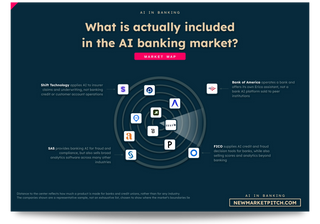
Radar map of the AI in banking market showing which companies count as part of it, which sit on its edge and which stay outside: What is actually included in the AI banking market? (AI in Banking Market, NewMarketPitch)
Market Definition

What does this market really cover?

AI in banking gets confused with fintech apps and with general AI tools that banks happen to use, so we begin by setting clear borders.

A model that helps a credit union approve car loans is in. So is software that screens payments for money laundering, or an agent that answers customers inside a bank's app. A consumer budgeting app is out, and so is a general chatbot a bank buys off the shelf with nothing built for banking.

With those borders in place, the market size and the company comparisons all refer to the same thing.

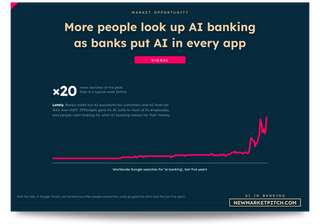
Google Trends curve of worldwide searches over five years for the AI in banking market: More people look up AI banking as banks put AI in every app (AI in Banking Market, NewMarketPitch)
Market Opportunity

Why is everyone looking at this market now?

AI in banking is hot right now, and the back office is where it is moving fastest.

We've found a lot of interesting signals. For example, in February 2026, Goldman Sachs said it had spent six months building AI agents with Anthropic to handle trade accounting and client onboarding. And in May, Standard Chartered said it expects to cut more than 15% of its corporate-function roles by 2030 as it uses more automation and AI, which Reuters put at more than 7,000 jobs. The biggest banks are handing core back-office work to AI, and some already plan for fewer people.

In this section, we look at which banking jobs AI is taking on first, why the back office moved before lending decisions, and what these plans mean for vendors selling to smaller banks and credit unions.

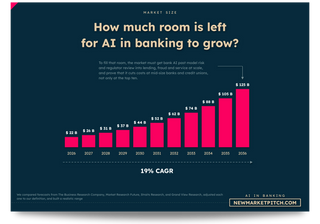
Bar chart of the AI in banking market size year by year to 2036, with its growth rate: How much room is left for AI in banking to grow? (AI in Banking Market, NewMarketPitch)
Market Size

How big could this market get?

AI in banking numbers online swing a lot. Some include every dollar banks spend on technology, others add fintech lenders, and many never say what they count.

We build our own estimate, starting from what banks and credit unions pay for AI in each function, from lending to compliance. Then we compare it with other sources and explain every assumption, so you can follow how we got there.

And we show a cautious case and an ambitious one, so you can see what would have to happen for each.

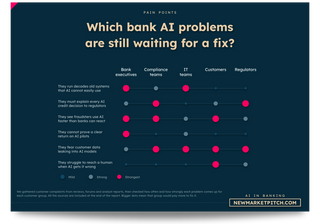
Matrix of the problems AI in banking customers still face, rated for each type of buyer: Which bank AI problems are still waiting for a fix? (AI in Banking Market, NewMarketPitch)
Pain Points

What are the pain points, and for whom?

Banks spend fortunes on work customers never see: checking new clients, reviewing alerts, reading loan files and answering the same questions every day.

We compare six kinds of AI banking vendors, from lending and credit tools to anti-money laundering, customer service, personalization and back-office automation. Their buyers range from global banks to community banks and credit unions. For each, we rank the pains that matter most, like money laundering alerts that are mostly false alarms, loan decisions that take days and call centers swamped by simple requests.

This shows which problems a bank will pay to fix now, and which ones it will wait for its core banking vendor to solve.

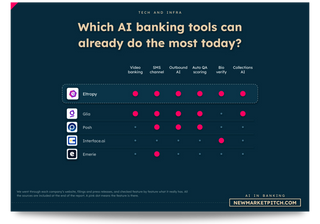
Comparison table of the tech offered by leading AI in banking companies: Which AI banking tools can already do the most today? (AI in Banking Market, NewMarketPitch)
Tech & Infra

What is the latest tech and infrastructure?

A smart model is the easy part. Inside a bank, AI has to work with decades-old core systems, strict data rules and model risk teams that check everything.

We map the stack layer by layer, from core banking and data platforms to models, agents and the controls that monitor them. We also show where things get stuck, like data locked in old cores, credit models a bank can't explain to a rejected borrower, and agents that need human sign-off at every step.

You'll see what AI already does every day inside banks, and what is still stuck in testing.

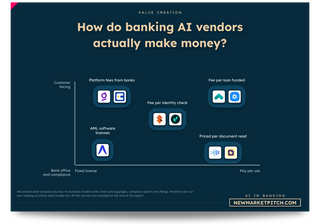
Map of AI in banking business models with company logos: How do banking AI vendors actually make money? (AI in Banking Market, NewMarketPitch)
Value Creation

How is value created and monetized exactly?

Licenses per bank or per seat, fees per loan decision or per alert, shares of the losses avoided, and AI sold inside a core banking contract: banking AI vendors get paid in several ways.

We compare who pays and how much it takes to serve each buyer. A global bank signs big contracts but takes a year to decide and often builds its own tools. A credit union pays less and needs the product to work out of the box. Fees per loan grow with lending, then shrink when rates rise. And every vendor pays for security reviews and model validation before the first dollar comes in.

You'll see which models grow as banks use them more, and which ones get absorbed when the core banking vendors add AI at no extra cost.

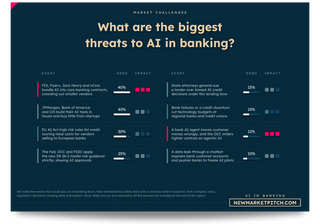
Table of the events that could slow the AI in banking market, with their odds and impact: What are the biggest threats to AI in banking? (AI in Banking Market, NewMarketPitch)
Market Challenges

What could slow this market down?

A few brakes are obvious: slow procurement, strict regulators and core systems that are hard to connect.

Others only show up once you're inside a bank. Model risk teams can hold a tool for months. Fair lending rules make credit models hard to change. The biggest banks build directly with the AI labs. And one public mistake, like an agent giving a customer the wrong answer about their money, can freeze projects across the industry.

We look at each risk in turn, rate how likely it is, and show which banking AI vendors it would hit hardest.

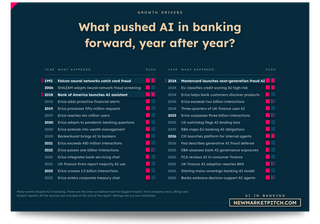
Timeline of the events that pushed the AI in banking market forward, with their impact: What pushed AI in banking forward, year after year? (AI in Banking Market, NewMarketPitch)
Growth Drivers

What are the growth drivers in this market?

Banks have many reasons to spend more on AI, and some matter far more than others. We sort out which ones really move budgets.

The visible drivers are pressure to cut costs, growing compliance work and customers who expect instant answers. Others feed each other. Each loan decision a model makes adds data for the next one. When one large bank shows lower costs, its shareholders ask the others why they can't. And once a model risk team approves one AI tool, the second one tends to go through faster.

Before building or investing, you should know what convinces a bank to let AI touch money, customers or compliance, and what keeps it renewing after the first audit.

Investor Bets

Where are investors placing their bets today?

Investors no longer fund banking AI as a nice extra. They want tools that cut real costs inside regulated banks.

We compare recent rounds across lending and credit tools, anti-money laundering, customer service and AI for investment banking work. We also look at whether investors favor startups selling to large banks or to community banks and credit unions, and we flag newer bets, like agents that prepare a credit memo or a compliance review from start to finish.

You'll see which banking AI startups are raising money now, from large rounds for AI built for bankers to strategic checks from credit unions. We also look at what a younger vendor needs to show before a bank signs.

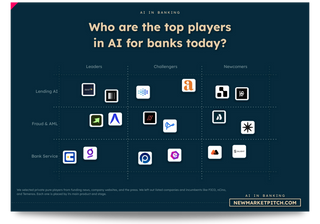
Market grid of the top AI in banking startups and companies by segment: Who are the top players in AI for banks today? (AI in Banking Market, NewMarketPitch)
Top Players

Who are the top startups and companies?

nCino and Upstart are the names many bankers know, but AI in banking reaches far beyond loan software.

A lot of the interesting work happens far from the bank's app. Some startups only review money laundering alerts for mid-size banks. Others read business tax returns for small business loans, answer the phones for credit unions, or predict which borrowers will fall behind before they miss a payment.

Comparing them is tricky. Banks rarely name their vendors, and many tools reach banks through core banking providers or consultants. Two startups with the same pitch can serve very different banks, one with a few branches and one with millions of customers.

Below, you'll find the market grids and ecosystem maps we've built to show which banking jobs each company handles, and where new players are breaking in.

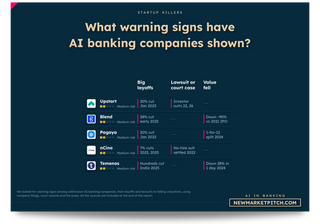
Table of AI in banking startups that shut down or struggled, and why: What warning signs have AI banking companies shown? (AI in Banking Market, NewMarketPitch)
Startup Killers

What could kill a startup in this market?

Banks love a demo and dread a new vendor. Getting through security review, model validation and procurement can take longer than a seed round lasts.

So we studied why banking AI startups fail or stall. Some sell to an innovation team that can't buy. Others build a feature that the core banking vendor adds a year later. And some win one large bank, then spend all their time on its custom requests.

If you're building, you'll see why passing bank reviews, fitting the core system and finding a real budget owner matter more than a better model. If you're investing, you'll know what to check about sales cycles, dependence on one bank and what the core vendors could copy.

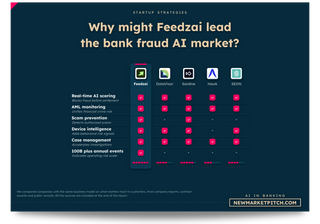
Scorecard showing what sets the leading AI in banking company apart: Why might Feedzai lead the bank fraud AI market? (AI in Banking Market, NewMarketPitch)
Startup Strategies

How do you win in this market?

Zest AI, interface.ai, Rogo… a few AI vendors have won real work inside banks and credit unions.

Zest AI helps lenders, many of them credit unions, approve more loans without taking more risk, and its own customers led its latest round. Interface.ai answers members' calls and chats for credit unions and community banks. Rogo, newer, does research, models and slide decks for investment bankers, and raised $160M at a $2B valuation in April 2026. Each found one clear job inside the bank, though none has yet shown it can cover a large bank end to end.

We'll look at how these teams chose one banking job to own, got through the reviews that stop most vendors, and widened their product from there.

Questions?

Who is this market report actually for?+

It's for founders, investors, bank and credit union leaders, core banking vendors and strategists who want a clear view of AI in banking.

It helps you choose where to start, from lending to compliance or customer service, decide whether to build with the AI labs or buy from specialists, and understand the full market: demand, technology, business models, funding, competitors and risks.

How many pages are in the report?+

It has 190+ pages. It is designed to be comprehensive enough to support serious market evaluation, while still being fast to read and easy to use.

We prioritize signal, structure, and visual clarity over unnecessary length.

What do you include in the AI in banking market?+

We define the AI in banking market as AI products designed for banks and credit unions.

We include bank-specific AI for lending and credit, fraud detection, AML and compliance, customer service, risk and treasury, operations and collections.

We exclude general-purpose AI, consumer finance apps and insurance-only products.

Do you list your sources clearly?+

Yes. All key data points and assumptions are explained and sourced in the document.

All sources are tier-1: company filings, funding databases, public datasets, expert interviews, industry reports, etc.

Is the data up to date?+

Yes. The report was last updated on October 31, 2026 with the latest market signals.

Is this a one-time payment?+

Yes. This is a one-time purchase. There is no subscription required to access the document.

I want to buy several market reports, can I get a discount code?+

Yes. You can use NEWMARKET for 20% off when purchasing two reports, or NEWMARKETMAX for 30% off when purchasing five or more.

I’m interested in a market but I can’t find it here+

If a market you care about is not currently on the list, email us at team@newmarketpitch.com and we may be able to cover it.

I have more questions for you+

No problem. You can reach out directly and we respond within 24 hours.

LAST UPDATED: October 31, 2026

Want to know what's really going on in the AI in banking market?

A bank can test an AI model in a week and still need a year to let it near a real customer. This report gives you the full picture of AI in banking: its size and buyers, the technology, business models, funding, competitors, risks and the openings that remain.

PRO
$49
One-time payment
  • ✓ Market Definition
  • ✓ Market Opportunity
  • ✓ Market Size
  • ✓ Pain Points
  • ✓ Tech & Infra
  • ✓ Value Creation
  • ✓ Market Challenges
  • ✓ Growth Drivers
  • ✓ Investor Bets
  • ✓ Top Players
  • ✓ Startup Killers
  • ✓ Startup Strategies
PRO+
$79
One-time payment
  • ✓ Market Definition
  • ✓ Market Opportunity
  • ✓ Market Size
  • ✓ Pain Points
  • ✓ Tech & Infra
  • ✓ Value Creation
  • ✓ Market Challenges
  • ✓ Growth Drivers
  • ✓ Investor Bets
  • ✓ Top Players
  • ✓ Startup Killers
  • ✓ Startup Strategies
PRO++
$99
One-time payment
  • ✓ Market Definition
  • ✓ Market Opportunity
  • ✓ Market Size
  • ✓ Pain Points
  • ✓ Tech & Infra
  • ✓ Value Creation
  • ✓ Market Challenges
  • ✓ Growth Drivers
  • ✓ Investor Bets
  • ✓ Top Players
  • ✓ Startup Killers
  • ✓ Startup Strategies
Use code MARKETPITCH for 10% off your order