LAST UPDATED: November 22, 2026

Make smarter decisions on the AI inference market

Training got the headlines, inference is where the money is. Running models is where the bills now pile up. Every app wants faster answers at a lower price per token, and serving platforms are racing to deliver both. This report brings you up to speed on the whole inference market.

  • 190+ pages
  • 12 sections
  • verified data only
Make smarter decisions on the AI inference market market report cover

What’s inside the report?

12 sections to help founders and investors understand the AI inference market with clarity

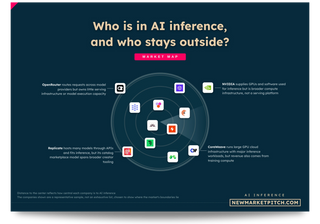
Radar map of the AI inference market showing which companies count as part of it, which sit on its edge and which stay outside: Who is in AI inference, and who stays outside? (AI Inference Market, NewMarketPitch)
Market Definition

What does this market really cover?

Inference gets mixed up with AI chips, GPU clouds and the apps built on top, so we start by drawing a clear line.

A platform that serves an open model to an app through an API is in. So is software that makes the same model run faster on fewer GPUs. A chatbot app with no serving offering of its own is out, and so is a cluster used only to train models.

So every number and every company in the report counts the same thing.

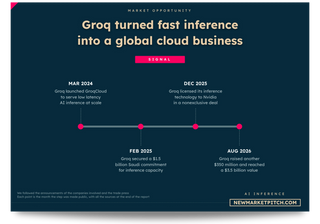
Timeline of the dated steps showing how the AI inference market is moving, with one key signal: Groq turned fast inference into a global cloud business (AI Inference Market, NewMarketPitch)
Market Opportunity

Why is everyone looking at this market now?

AI inference is very hot right now, but it's a strange kind of hot: usage is exploding while the price of each answer keeps falling.

We've found a lot of interesting signals. For example, Baseten, which runs models for AI apps, raised $300M at a $5B valuation in January 2026, then $1.5B at $13B in June. And the creators of vLLM, the open-source engine many teams use to serve models, launched Inferact with a $150M seed round at an $800M valuation. Investors are now betting big on the companies that run models every day, not only on the ones that train them or make the chips.

In this section, we look at why inference demand is growing so fast, from chat to agents and video, and why falling token prices make it hard to turn that demand into profit.

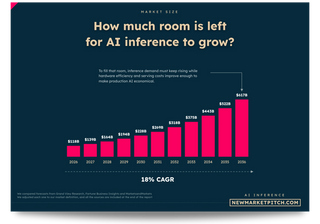
Bar chart of the AI inference market size year by year to 2036, with its growth rate: How much room is left for AI inference to grow? (AI Inference Market, NewMarketPitch)
Market Size

How big could this market get?

Inference market numbers online often lump in AI chips, whole cloud bills or even the apps themselves. Few of them measure the same thing.

We size the market from first principles, starting from how much AI is actually served and what it costs to serve it. Then we compare our result with other sources and show every assumption.

We also show how the number changes in a cautious and an optimistic case, depending on how fast token prices fall.

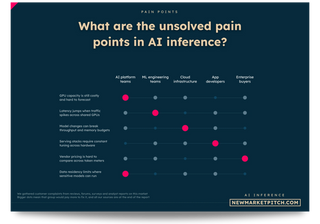
Matrix of the problems AI inference customers still face, rated for each type of buyer: What are the unsolved pain points in AI inference? (AI Inference Market, NewMarketPitch)
Pain Points

What are the pain points, and for whom?

Every new user, agent or video clip is one more request a model has to answer, fast. Serving that traffic without burning money is now a daily headache.

AI app makers, enterprises running their own models, model labs, GPU clouds and device makers all hit inference limits in different ways, from slow responses and surprise bills to GPUs that sit idle at night. We compare six types of companies and rank the pains that matter most to each.

This shows which problems teams will pay to fix now, like speed and cost, and which ones they still prefer to handle themselves.

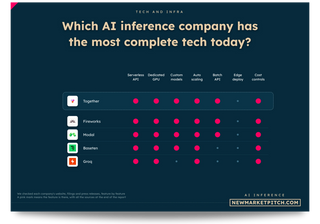
Comparison table of the tech offered by leading AI inference companies: Which AI inference company has the most complete tech today? (AI Inference Market, NewMarketPitch)
Tech & Infra

What is the latest tech and infrastructure?

A fast model is only half the story. Serving it well takes the right engine, smart batching, compressed weights and routing that sends each request to the cheapest place that can answer in time.

We go layer by layer, from hardware and runtimes to compilers, quantization tools and the APIs developers call. We also show where things get stuck: memory that fills up on long prompts, slow cold starts on serverless platforms, and models that lose quality when shrunk too far.

You'll see which tricks already cut costs in production today, and which ones are still research papers.

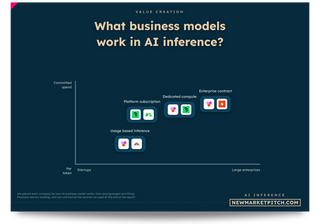
Map of AI inference business models with company logos: What business models work in AI inference? (AI Inference Market, NewMarketPitch)
Value Creation

How is value created and monetized exactly?

Pay per token, pay per GPU hour, pay per second of serverless compute, a license for an engine, or an enterprise contract for dedicated capacity: inference companies charge in many ways.

We compare who pays and what each model really costs to run. A token API lives on the gap between its price and its GPU bill. A dedicated deployment trades lower margins for steadier revenue. Software vendors skip the GPU bill but compete with free open-source engines.

You'll see which models keep their margins as token prices fall, and which ones grow mostly by reselling GPU time with little left over.

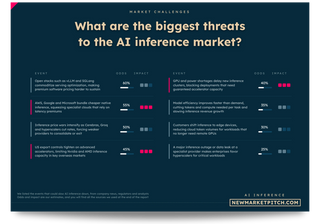
Table of the events that could slow the AI inference market, with their odds and impact: What are the biggest threats to the AI inference market? (AI Inference Market, NewMarketPitch)
Market Challenges

What could slow this market down?

Some brakes are easy to see: GPU shortages, a few model labs that serve most of the traffic themselves, and token prices that keep dropping.

Others get less attention. The big clouds bundle inference with everything else they sell. Free open-source engines make paid software harder to sell. A new model can change hardware needs overnight. And many platforms rely on a handful of AI apps for most of their revenue.

We go through each risk, rate how likely it is, and show which kinds of inference companies would feel it most.

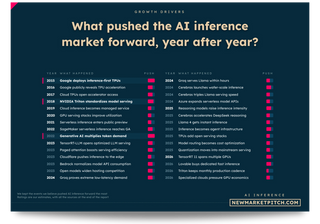
Timeline of the events that pushed the AI inference market forward, with their impact: What pushed the AI inference market forward, year after year? (AI Inference Market, NewMarketPitch)
Growth Drivers

What are the growth drivers in this market?

Inference grows every time someone uses AI, but a few specific forces decide how fast. We go through them here.

Some drivers are plain to see: more AI apps, agents that call a model dozens of times per task, and video and voice that need far more compute per answer. Others feed each other. Cheaper tokens let developers add more AI features, which creates more traffic, which pays for better serving software. And as open models catch up, more companies want to run their own.

Before building or investing, you should know what makes a company move its traffic to a new inference provider, and what makes it stay.

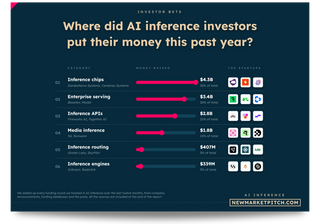
Bar chart of where investors put their money in AI inference, by category: Where did AI inference investors put their money this past year? (AI Inference Market, NewMarketPitch)
Investor Bets

What are investors betting on now?

Inference has become one of the busiest places in AI funding, and valuations are climbing fast.

We compare recent rounds across serving platforms, open-source engine companies and tools that route traffic between models. We also look at what investors want to see first, from token volume to revenue per GPU, and flag newer bets in edge inference and model compression.

We'll look at the latest rounds, including Baseten's, to show which inference businesses investors are backing now, and what a smaller platform has to prove first, from steady traffic to margins that hold.

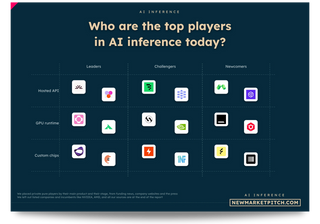
Market grid of the top AI inference startups and companies by segment: Who are the top players in AI inference today? (AI Inference Market, NewMarketPitch)
Top Players

Who are the top startups and companies?

Modal and vLLM come up first when developers talk about serving models, but they're only one part of the inference market.

Many of the most interesting players work one layer down. Some write the code that makes a model run faster on a given chip. Others shrink models so they fit on a phone or in a car, or send each request to whichever provider is cheapest that minute.

They're hard to spot because the end user never sees their work. A faster chatbot rarely credits the engine underneath, and many of these firms sell through the clouds or as open-source projects with a paid version on top.

Below, you'll find the market grids and ecosystem maps we built to show who serves which models, on which hardware, and where new players are getting in.

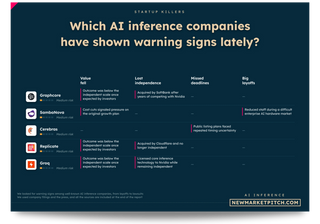
Table of the warning signs shown by leading AI inference companies: Which AI inference companies have shown warning signs lately? (AI Inference Market, NewMarketPitch)
Startup Killers

What could kill a startup in this market?

In inference, your price list can be out of date next month. When a rival or a big cloud cuts token prices, customers can move their traffic with a few lines of code.

So we studied why inference startups fail or stall. Some resell GPU time with a thin software layer and get squeezed on both sides. Others lock in expensive GPUs just before prices fall. And some depend on one large AI app that later builds its own serving stack.

If you're building, you'll see why real gains in speed or cost matter more than reselling capacity. If you're investing, you'll know what to check about GPU contracts, customer concentration and margin per token.

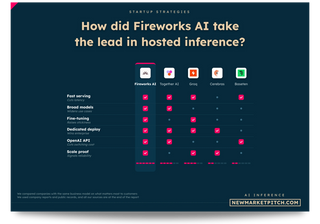
Scorecard showing what sets the leading AI inference company apart: How did Fireworks AI take the lead in hosted inference? (AI Inference Market, NewMarketPitch)
Startup Strategies

How do you win in this market?

OpenRouter, fal, Fireworks AI… a few inference companies already handle huge volumes of real traffic.

OpenRouter lets developers reach hundreds of models through one API and routes the traffic for them. fal focuses on fast image and video generation. Fireworks AI serves open models for companies that want speed without running their own GPUs. Each found a clear job to do, though falling prices mean none has proven its margins for good.

We'll look at how these teams picked one narrow job first, won developers' trust on speed and uptime, and kept some margin while the price of a token kept falling.

Questions?

Who is this market report actually for?+

It's for founders, investors, AI engineers, cloud and chip companies, and strategy teams who want a clear view of the AI inference market.

Use it to choose between a token API, dedicated GPUs and your own serving stack, to compare open-source engines with paid platforms, or to understand demand, technology, pricing, funding, competitors and risks across the whole market.

How many pages are in the report?+

It has 190+ pages. It is designed to be comprehensive enough to support serious market evaluation, while still being fast to read and easy to use.

We prioritize signal, structure, and visual clarity over unnecessary length.

What do you include in the AI inference market?+

We define the AI inference market as specialist companies whose main product runs trained AI models for third parties in production, or provides the engines and optimization software needed to serve those models efficiently.

We include hosted inference APIs, dedicated endpoints, enterprise model-serving platforms, serverless inference, inference runtimes, compilers and kernels, model optimization, on-device execution software, and GPU scheduling built for inference.

We exclude chip vendors selling only processors, GPU clouds renting capacity without a differentiated inference service, model labs selling mainly their own model, generic MLOps and evaluation tools, gateways that only route to outside providers, applications that consume models, and incumbent divisions.

Do you list your sources clearly?+

Yes. All key data points and assumptions are explained and sourced in the document.

All sources are tier-1: company filings, funding databases, public datasets, expert interviews, industry reports, etc.

Is the data up to date?+

Yes. The report was last updated on November 22, 2026 with the latest market signals.

Is this a one-time payment?+

Yes. This is a one-time purchase. There is no subscription required to access the document.

I want to buy several market reports, can I get a discount code?+

Yes. You can use NEWMARKET for 20% off when purchasing two reports, or NEWMARKETMAX for 30% off when purchasing five or more.

I’m interested in a market but I can’t find it here+

If a market you care about is not currently on the list, email us at team@newmarketpitch.com and we may be able to cover it.

I have more questions for you+

No problem. You can reach out directly and we respond within 24 hours.

LAST UPDATED: November 22, 2026

Before you build or invest in the AI inference market, read this

Inference demand is soaring, yet the price of each token keeps falling, so more traffic doesn't always mean more profit. This report covers the whole AI inference market, from size and buyers to technology, business models, funding, key players, risks and the openings that remain.

PRO
$49
One-time payment
  • ✓ Market Definition
  • ✓ Market Opportunity
  • ✓ Market Size
  • ✓ Pain Points
  • ✓ Tech & Infra
  • ✓ Value Creation
  • ✓ Market Challenges
  • ✓ Growth Drivers
  • ✓ Investor Bets
  • ✓ Top Players
  • ✓ Startup Killers
  • ✓ Startup Strategies
PRO+
$79
One-time payment
  • ✓ Market Definition
  • ✓ Market Opportunity
  • ✓ Market Size
  • ✓ Pain Points
  • ✓ Tech & Infra
  • ✓ Value Creation
  • ✓ Market Challenges
  • ✓ Growth Drivers
  • ✓ Investor Bets
  • ✓ Top Players
  • ✓ Startup Killers
  • ✓ Startup Strategies
PRO++
$99
One-time payment
  • ✓ Market Definition
  • ✓ Market Opportunity
  • ✓ Market Size
  • ✓ Pain Points
  • ✓ Tech & Infra
  • ✓ Value Creation
  • ✓ Market Challenges
  • ✓ Growth Drivers
  • ✓ Investor Bets
  • ✓ Top Players
  • ✓ Startup Killers
  • ✓ Startup Strategies
Use code MARKETPITCH for 10% off your order