LAST UPDATED: October 31, 2026

Here is your reality check on the AI toys market

Talking toys are here, parents aren't sure they want them. Teddy bears that talk back and robots that learn a child's name are now on store shelves. So are new laws and safety reports. The hard part is building toys parents trust and kids keep playing with. This report gives you the full view of the AI toys market today.

  • 190+ pages
  • 12 sections
  • verified data only
Here is your reality check on the AI toys market market report cover

What’s inside the report?

12 sections to help founders and investors understand the AI toys market with clarity

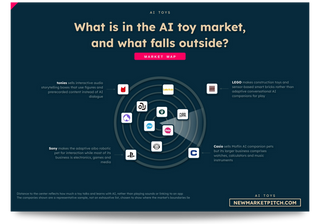
Radar map of the AI toys market showing which companies count as part of it, which sit on its edge and which stay outside: What is in the AI toy market, and what falls outside? (AI Toys Market, NewMarketPitch)
Market Definition

What is this market, exactly?

AI toys get confused with kids' apps, classic electronic toys and home robots, so we start by saying exactly what we count.

A plush toy that holds a real conversation with a child is in. So is a small robot that reacts to a child's mood, or a coding toy that adapts its lessons. A companion app on a tablet is out, and so is a doll that plays the same ten recorded phrases, or a home robot built to clean.

That way, our numbers and company comparisons all describe the same kind of toy.

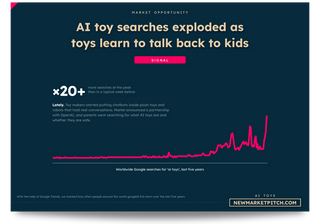
Google Trends curve of worldwide searches over five years for the AI toys market: AI toy searches exploded as toys learn to talk back to kids (AI Toys Market, NewMarketPitch)
Market Opportunity

What changed for this market lately?

AI toys are moving fast, and so are the people trying to keep children safe.

We've found a lot of interesting signals. For example, in November 2025, FoloToy pulled its Kumma teddy bear from sale after a consumer group found it talking about sex and telling children where to find knives. A month later, Mattel said its first product with OpenAI would not come out that holiday season. And in September 2026, California's governor signed a law that bans toys with companion chatbots for children under 16, for four years starting in 2027. Demand is real, but toymakers now have to prove their toys are safe before they can sell them.

In this section, we look at why toymakers keep adding AI anyway, which kinds of toys face the most pressure, and what the new rules mean for companies selling in the US and beyond.

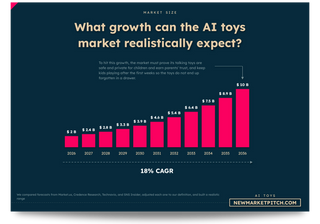
Bar chart of the AI toys market size year by year to 2036, with its growth rate: What growth can the AI toys market realistically expect? (AI Toys Market, NewMarketPitch)
Market Size

How big could this market get?

AI toy market sizes are all over the place. Some count every electronic toy, others every robot sold to a family.

We start from first principles: we build our own estimate, compare it with other sources and show each assumption, so you can test the number yourself.

We also show how it shifts in a cautious scenario, where new rules slow sales, and in an optimistic one.

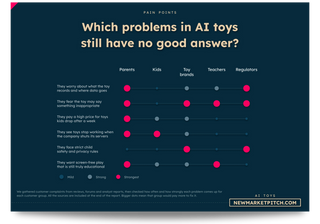
Matrix of the problems AI toys customers still face, rated for each type of buyer: Which problems in AI toys still have no good answer? (AI Toys Market, NewMarketPitch)
Pain Points

What are the pain points, and for whom?

Parents want toys that teach and entertain without another screen. They also want to know what the toy says, and where the recordings go.

We compare six kinds of AI toy companies, from talking plush toys and dolls to learning companions, robot pets, coding kits, game devices and storytelling toys. Their buyers range from parents and grandparents to schools and toy retailers. For each, we rank the biggest pains, like screen time, toys that bore kids within weeks, unsafe answers and unclear data practices.

This shows what parents will actually pay for, and what makes them return a toy after the holidays.

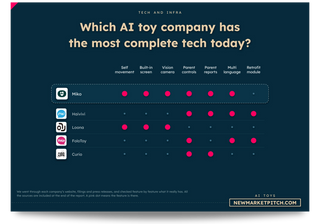
Comparison table of the tech offered by leading AI toys companies: Which AI toy company has the most complete tech today? (AI Toys Market, NewMarketPitch)
Tech & Infra

What is the latest tech and infrastructure?

A toy that talks needs more than a chatbot stuffed in a teddy bear. It needs a microphone and speaker that work in a noisy room, fast answers and filters built for children.

We map the stack layer by layer, from chips, batteries and voice hardware to the AI models, child-safety filters, parent apps and the cloud that stores the conversations. We also show where things get stuck, like delays that break the conversation, filters that miss risky topics, toys that go silent when a server shuts down, and voice data covered by children's privacy laws.

You'll see what AI already does well in toys today, and what still goes wrong when a five-year-old asks the questions.

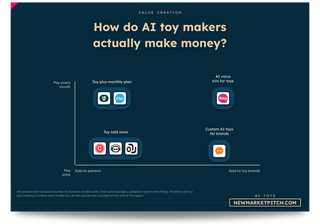
Map of AI toys business models with company logos: How do AI toy makers actually make money? (AI Toys Market, NewMarketPitch)
Value Creation

How is value created and monetized exactly?

One-time hardware sales, monthly subscriptions for new content, licensed characters, sales to schools and deals to put AI inside big toy brands: AI toy companies make money in several ways.

We compare who pays and what it costs. A toy sold once must cover the hardware, the retailer's cut and years of AI costs. A subscription brings steady revenue, but parents cancel when kids lose interest. Licensed characters sell more toys but take a share of each sale. And every conversation costs money to run, long after the toy leaves the shelf.

You'll see which models can pay for the AI behind the toy, and which ones lose money once the holiday rush ends.

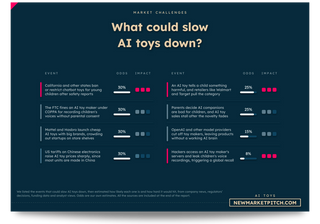
Table of the events that could slow the AI toys market, with their odds and impact: What could slow AI toys down? (AI Toys Market, NewMarketPitch)
Market Challenges

What could slow this market down?

Some brakes are easy to see: new state laws, safety reports from consumer groups, and parents worried about what the toy hears and says.

Others are easier to miss. Many toys run on models from big AI companies whose terms don't allow young children. Kids get bored fast, so returns can be high. Retailers may drop a toy after one bad headline. And if the company behind it shuts down, the toy can stop talking.

We go through each risk, rate how likely it is, and explain which toymakers would be hit hardest.

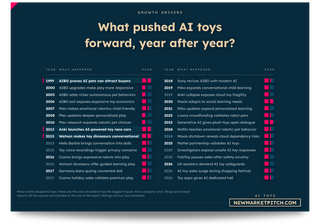
Timeline of the events that pushed the AI toys market forward, with their impact: What pushed AI toys forward, year after year? (AI Toys Market, NewMarketPitch)
Growth Drivers

What are the growth drivers in this market?

A forecast is just a number until you know what moves it. Here are the forces behind AI toys.

Some drivers are plain to see: cheaper chips and models, parents looking for screen-free play, and big toy brands adding AI to characters kids already love. Others build on each other. Toys that remember a child's name and favorite games keep kids playing longer. More playtime gives makers a reason to sell new stories and content. And clear safety rules can make retailers and parents more willing to buy.

Before building or investing, you should know what makes parents trust a talking toy, and what keeps children playing with it months after it is unwrapped.

Investor Bets

What are investors backing right now?

AI toys went from a novelty to a category that investors and big toy brands watch closely, especially in China.

We compare recent rounds across talking plush toys, robot pets and learning companions. We also look at whether investors favor companies with their own hardware and characters, or those that add AI to other brands' toys. And we flag newer bets, like toys designed from day one around the new child-safety rules.

You'll see which AI toy companies investors are funding now, and how much proof, in units sold and kids still playing months later, a younger company needs before it can raise.

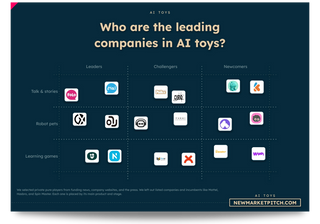
Market grid of the top AI toys startups and companies by segment: Who are the leading companies in AI toys? (AI Toys Market, NewMarketPitch)
Top Players

Who are the top startups and companies?

Curio and FoloToy make most of the headlines in AI toys, for better and for worse, but they're only a small part of the market.

Many interesting players stay out of the spotlight. Some only make an AI box that clips onto a child's own teddy bear. Others build robot pets that learn tricks, storytelling toys that invent a new bedtime story each night, or the chips and software that big toy brands put inside their characters.

They're hard to spot because many sell mostly in China or through online stores, not big toy chains. Others build the AI behind famous characters, so their name never appears on the box.

Below, you'll find the market grids and ecosystem maps we've built to show who makes what, from the chips to the characters, and where new players are getting in.

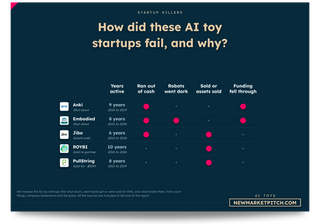
Table of AI toys startups that shut down or struggled, and why: How did these AI toy startups fail, and why? (AI Toys Market, NewMarketPitch)
Startup Killers

What could kill a startup in this market?

One bad answer can end an AI toy. Parents share the screenshots, retailers pull the stock, and the brand rarely recovers.

So we studied why AI toy startups fail or stall. Some sell well at Christmas but lose kids' interest by February. Others pay AI costs on every conversation with no subscription to cover them. And some build on a model provider that changes its rules or cuts off access.

If you're building, you'll see why safe answers, play that lasts and AI costs you can cover matter more than a viral launch. If you're investing, you'll know what to check about returns, compliance with children's laws and how much each conversation really costs.

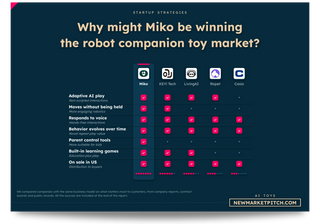
Scorecard showing what sets the leading AI toys company apart: Why might Miko be winning the robot companion toy market? (AI Toys Market, NewMarketPitch)
Startup Strategies

How do you win in this market?

Haivivi, KEYi Technology, Miko… a few AI toy makers already sell in real numbers.

Haivivi sold more than 200,000 BubblePal pendants, which make a child's existing plush toy talk. KEYi Technology has sold over 90,000 Loona robot pets worldwide. Miko sells companion robots in more than 140 countries and adds a paid subscription for content. Each found a format parents will buy, though none has yet shown that kids keep playing for years, or that the business stays profitable once AI costs are paid.

We'll look at how these companies chose their first format, earned parents' trust, and kept kids coming back after the novelty wore off.

Questions?

Who is this market report actually for?+

It's for founders, investors, toy companies, retailers, licensing teams and strategists who want a clear view of AI toys.

Use it to choose between your own characters and licensed ones, to decide which ages and countries to target under the new child-safety rules, to compare one-time sales and subscriptions, or to understand demand, technology, funding, competitors and risks across the whole market.

How many pages are in the report?+

It has 190+ pages. It is designed to be comprehensive enough to support serious market evaluation, while still being fast to read and easy to use.

We prioritize signal, structure, and visual clarity over unnecessary length.

What do you include in the AI toys market?+

We define the AI toys market as physical toys that use AI to provide adaptive play or interaction.

We include conversational toys, AI learning companions and interactive robotic toys designed primarily for play.

We exclude software-only companion apps, conventional electronic toys and household robots whose main purpose is practical work.

Do you list your sources clearly?+

Yes. All key data points and assumptions are explained and sourced in the document.

All sources are tier-1: company filings, funding databases, public datasets, expert interviews, industry reports, etc.

Is the data up to date?+

Yes. The report was last updated on October 31, 2026 with the latest market signals.

Is this a one-time payment?+

Yes. This is a one-time purchase. There is no subscription required to access the document.

I want to buy several market reports, can I get a discount code?+

Yes. You can use NEWMARKET for 20% off when purchasing two reports, or NEWMARKETMAX for 30% off when purchasing five or more.

I’m interested in a market but I can’t find it here+

If a market you care about is not currently on the list, email us at team@newmarketpitch.com and we may be able to cover it.

I have more questions for you+

No problem. You can reach out directly and we respond within 24 hours.

LAST UPDATED: October 31, 2026

Build or invest in the AI toys market with clear eyes

A talking toy can be a holiday hit and a headline risk in the same month. This report gives you the bigger picture of AI toys: market size and structure, parents and other buyers, technology, business models, funding, competition, risks and where new companies can still find room.

PRO
$49
One-time payment
  • ✓ Market Definition
  • ✓ Market Opportunity
  • ✓ Market Size
  • ✓ Pain Points
  • ✓ Tech & Infra
  • ✓ Value Creation
  • ✓ Market Challenges
  • ✓ Growth Drivers
  • ✓ Investor Bets
  • ✓ Top Players
  • ✓ Startup Killers
  • ✓ Startup Strategies
PRO+
$79
One-time payment
  • ✓ Market Definition
  • ✓ Market Opportunity
  • ✓ Market Size
  • ✓ Pain Points
  • ✓ Tech & Infra
  • ✓ Value Creation
  • ✓ Market Challenges
  • ✓ Growth Drivers
  • ✓ Investor Bets
  • ✓ Top Players
  • ✓ Startup Killers
  • ✓ Startup Strategies
PRO++
$99
One-time payment
  • ✓ Market Definition
  • ✓ Market Opportunity
  • ✓ Market Size
  • ✓ Pain Points
  • ✓ Tech & Infra
  • ✓ Value Creation
  • ✓ Market Challenges
  • ✓ Growth Drivers
  • ✓ Investor Bets
  • ✓ Top Players
  • ✓ Startup Killers
  • ✓ Startup Strategies
Use code MARKETPITCH for 10% off your order