LAST UPDATED: November 20, 2026

Get a reality check on the AI tutoring market

AI tutors are everywhere, do students actually learn more? Governments now want an AI tutor for pupils who can't afford a human one, and big tech wants to be that tutor. Nobody has fully proven yet that students learn more. This report gives you a clear view of the whole AI tutoring market, from products and buyers to money and risks.

  • 190+ pages
  • 12 sections
  • verified data only
Get a reality check on the AI tutoring market market report cover

What’s inside the report?

12 sections to help founders and investors understand the AI tutoring market with clarity

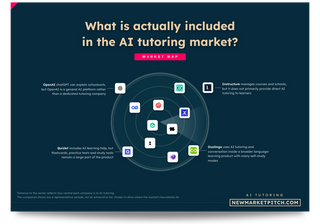
Radar map of the AI tutoring market showing which companies count as part of it, which sit on its edge and which stay outside: What is actually included in the AI tutoring market? (AI Tutoring Market, NewMarketPitch)
Market Definition

What is this market, exactly?

AI tutoring is easy to confuse with chatbots, online courses and tools for teachers, so we start by saying exactly what we count.

An app that walks a student through a math problem step by step, without handing over the answer, is in. So is a reading tutor that listens to a child read aloud, or a language app where learners practice speaking with an AI. A general chatbot is out, and so are recorded video lessons, or software that helps teachers grade.

This way, our numbers and company comparisons all refer to the same kind of product.

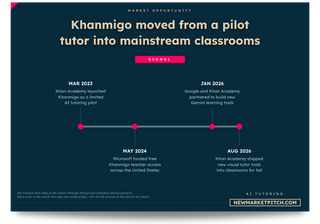
Timeline of the dated steps showing how the AI tutoring market is moving, with one key signal: Khanmigo moved from a pilot tutor into mainstream classrooms (AI Tutoring Market, NewMarketPitch)
Market Opportunity

Why is everyone looking at this market now?

AI tutoring is drawing in governments and big tech, while the proof that it helps students learn is still catching up.

We've found a lot of interesting signals. For example, in January 2026, Google added free SAT practice tests to Gemini, with hints and feedback on each question, and started showing Khan Academy lessons and exercises when students ask for help. A few days later, the UK government announced AI tutoring tools for up to 450,000 disadvantaged pupils a year, with trials in secondary schools later in 2026 and tests for safety and effectiveness before a wider rollout. Big tech and public money are now backing the same idea, and buyers want evidence that it works.

In this section, we look at why AI tutors are spreading now, which subjects and ages move first, and what it means for startups when governments and tech giants enter the same market.

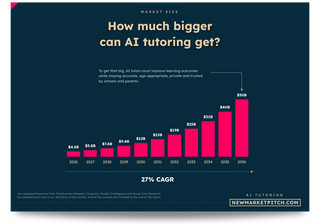
Bar chart of the AI tutoring market size year by year to 2036, with its growth rate: How much bigger can AI tutoring get? (AI Tutoring Market, NewMarketPitch)
Market Size

How big could this market get?

AI tutoring market sizes are hard to trust. Some count every education app, others the whole private tutoring industry.

We build our own estimate from the ground up, compare it with other sources and explain every assumption, so you can see how we got there.

Then we show how the number moves if schools and families adopt AI tutors slowly, and if they adopt them fast.

Matrix of the problems AI tutoring customers still face, rated for each type of buyer: What are the unsolved pain points in AI tutoring? (AI Tutoring Market, NewMarketPitch)
Pain Points

What are the pain points, and for whom?

A good human tutor works, but most families can't pay for one and schools can't hire enough. Teachers can't sit with every student who gets stuck either.

We compare six kinds of AI tutoring companies, from K-12 homework help and math tutors to language, test prep, university and workplace tutors. Their buyers range from parents and students to schools, districts, universities and employers. Then we rank what they need most, like help at the moment a student gets stuck, answers that teach instead of giving the solution away, and proof that grades go up.

This shows who will actually pay for an AI tutor, and what makes a school renew or a parent cancel.

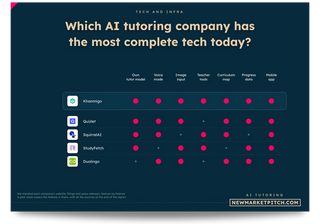
Comparison table of the tech offered by leading AI tutoring companies: Which AI tutoring company has the most complete tech today? (AI Tutoring Market, NewMarketPitch)
Tech & Infra

What is the latest tech and infrastructure?

A tutor that just gives the answer is a homework shortcut. A real AI tutor needs to know the curriculum, spot where a student went wrong and nudge them toward the next step.

We map the stack layer by layer, from the AI models and speech tools to curriculum content, progress tracking and the apps students use. We also show where things get stuck, like math mistakes delivered with confidence, tutors that give away answers, weak support for young children and less common languages, and student data covered by privacy laws.

You'll see which kinds of teaching AI already handles well today, and where a human tutor still does better.

Map of AI tutoring business models with company logos: What business models work in AI tutoring? (AI Tutoring Market, NewMarketPitch)
Value Creation

How is value created and monetized exactly?

Monthly subscriptions paid by parents, school and district licenses, per-student pricing, government contracts, bundles with textbooks or test prep, and free apps with paid upgrades: AI tutoring companies make money in many ways.

We compare who pays and what each session costs. A consumer app can win users cheaply but must keep them after exam season. A school license brings bigger contracts, but sales are slow and districts want proof of results. Every conversation costs money to run, and voice tutors cost more than text. Free tools from big tech also put pressure on what anyone will pay.

You'll see which models cover the cost of each tutoring session, and which ones lose users as soon as a free option shows up.

Table of the events that could slow the AI tutoring market, with their odds and impact: What are the biggest threats to the AI tutoring market? (AI Tutoring Market, NewMarketPitch)
Market Challenges

What could slow this market down?

Some brakes are easy to see: worries about cheating, student privacy rules, and school budgets that change every year.

Others are easier to miss. Free study modes inside general chatbots can make a paid tutor hard to sell. One confident mistake can cost a tutor a teacher's trust. Studies of learning gains take years. And many products rely on models from big AI companies that may build the same feature.

We look at each risk, score how likely it is, and say which tutoring models it would hurt most.

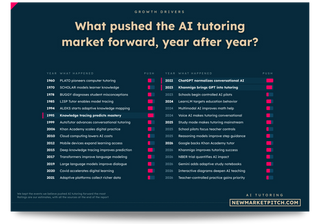
Timeline of the events that pushed the AI tutoring market forward, with their impact: What pushed the AI tutoring market forward, year after year? (AI Tutoring Market, NewMarketPitch)
Growth Drivers

What are the growth drivers in this market?

Growth numbers are only half the story. The other half is why students, parents and schools would keep using AI tutors.

Some drivers are plain to see: better and cheaper models, a shortage of teachers and tutors, and governments looking for ways to help students who fall behind. Others build on each other. Each session shows the tutor where a student struggles, so the next one can be more useful. Students who see progress come back more often. And once a school trusts a tutor in one subject, it is more likely to try it in the next.

Before building or investing, you should know what makes students keep learning with an AI tutor, and what convinces the people paying that it works.

Bar chart of where investors put their money in AI tutoring, by category: Where did AI tutoring investors put their money this past year? (AI Tutoring Market, NewMarketPitch)
Investor Bets

What are investors betting on now?

Investors like AI tutoring because it promises one-to-one teaching at the price of an app. They are also more careful after the last edtech boom.

We compare recent rounds across consumer tutoring apps, tutors sold to schools, and tools for languages, test prep and workplace skills. We also look at whether investors favor companies with their own curriculum and data, or those built mostly on the big AI models. And we flag newer bets, like voice tutors and reading tutors for young children.

You'll see which AI tutoring startups investors are backing now that Google and governments are in the market, and what a younger company needs to show, from active students to measured learning gains, before it can raise.

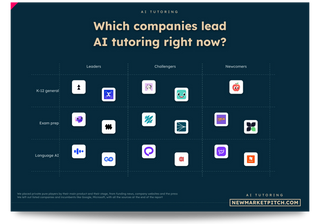
Market grid of the top AI tutoring startups and companies by segment: Which companies lead AI tutoring right now? (AI Tutoring Market, NewMarketPitch)
Top Players

Who are the top startups and companies?

Gauth, ByteDance's homework app, and Squirrel AI in China are among the best-known AI tutors, but the market goes much further.

The smaller players are often the more specialized ones. Some only listen to young children read aloud, or coach students for one exam. Others teach a single language through conversation, prepare professionals for certification exams, or support students with dyslexia and other learning differences.

They're hard to compare because every tutor looks good in a demo. The real test is whether students learn more over a school term, and few companies publish those results. Many also sell to schools and districts, so families never see their name.

Below, you'll find the market grids and ecosystem maps we've built to show who teaches what, to whom, and where new players are finding room.

Table of the warning signs shown by leading AI tutoring companies: Which AI tutoring companies have shown warning signs lately? (AI Tutoring Market, NewMarketPitch)
Startup Killers

What could kill a startup in this market?

Students are great at finding the shortcut. If an AI tutor hands over the answer, it becomes a cheating tool. If it refuses too often, students go back to a free chatbot.

So we studied why AI tutoring startups fail or stall. Some grow fast during exam season and lose users right after. Others win school pilots that never become paid contracts. And some build a thin layer on top of a big AI model, then watch that model's maker launch the same feature for free.

If you're building, you'll see why real learning results, a reason to come back after exams, and something a free chatbot can't copy matter more than fast sign-ups. If you're investing, you'll know what to check about retention, school renewals and how much the product depends on someone else's model.

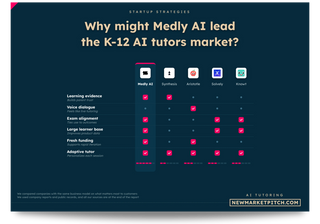
Scorecard showing what sets the leading AI tutoring company apart: Why might Medly AI lead the K-12 AI tutors market? (AI Tutoring Market, NewMarketPitch)
Startup Strategies

How do you win in this market?

Amira Learning, Praktika, Third Space Learning… a few AI tutoring companies have found students and schools willing to pay.

Amira Learning listens to children read aloud and sells its reading tutor to schools, and merged with Istation to reach more classrooms. Praktika teaches languages through AI avatar tutors in an app that learners pay for themselves. Third Space Learning started with human maths tutors for UK schools and now offers Skye, an AI tutor that talks pupils through problems. Each found a clear buyer. Whether their results hold across subjects, ages and countries is still being tested.

We'll look at how these companies picked their first subject and buyer, showed that their tutor helps, and kept students coming back.

Questions?

Who is this market report actually for?+

It's for founders, investors, education companies, school and district leaders, publishers and strategists who want a clear view of AI tutoring.

Use it to choose between selling to families and selling to schools, to pick which subjects and ages to start with, to compare subscriptions and school licenses, or to understand demand, technology, funding, competitors and risks across the whole market.

How many pages are in the report?+

It has 190+ pages. It is designed to be comprehensive enough to support serious market evaluation, while still being fast to read and easy to use.

We prioritize signal, structure, and visual clarity over unnecessary length.

What do you include in the AI tutoring market?+

We define the AI tutoring market as technology-led companies whose core product uses AI to give an individual learner personalized, interactive instruction, guided practice or corrective feedback across subjects, exams, languages, literacy and skills.

We include AI-native conversational tutors, adaptive math and subject tutoring, language conversation and pronunciation coaching, personalized test prep, reading tutors, agents that coach students directly for institutions, and hybrid human and AI tutoring when the AI tutor is central.

We exclude generic AI assistants and search engines, lesson creation and marking tools for teachers, school administration software, course marketplaces and human-only tutor marketplaces, flashcards and quizzes without adaptive instruction, and AI infrastructure sold to tutoring vendors.

Do you list your sources clearly?+

Yes. All key data points and assumptions are explained and sourced in the document.

All sources are tier-1: company filings, funding databases, public datasets, expert interviews, industry reports, etc.

Is the data up to date?+

Yes. The report was last updated on November 20, 2026 with the latest market signals.

Is this a one-time payment?+

Yes. This is a one-time purchase. There is no subscription required to access the document.

I want to buy several market reports, can I get a discount code?+

Yes. You can use NEWMARKET for 20% off when purchasing two reports, or NEWMARKETMAX for 30% off when purchasing five or more.

I’m interested in a market but I can’t find it here+

If a market you care about is not currently on the list, email us at team@newmarketpitch.com and we may be able to cover it.

I have more questions for you+

No problem. You can reach out directly and we respond within 24 hours.

LAST UPDATED: November 20, 2026

Make smarter decisions about the AI tutoring market

An AI tutor can explain fractions at midnight, but it still has to prove that students learn more and come back after the exam. This report covers the whole AI tutoring market, from who buys and why to technology, pricing models, funding, key players, risks and the gaps new companies can still fill.

PRO
$49
One-time payment
  • ✓ Market Definition
  • ✓ Market Opportunity
  • ✓ Market Size
  • ✓ Pain Points
  • ✓ Tech & Infra
  • ✓ Value Creation
  • ✓ Market Challenges
  • ✓ Growth Drivers
  • ✓ Investor Bets
  • ✓ Top Players
  • ✓ Startup Killers
  • ✓ Startup Strategies
PRO+
$79
One-time payment
  • ✓ Market Definition
  • ✓ Market Opportunity
  • ✓ Market Size
  • ✓ Pain Points
  • ✓ Tech & Infra
  • ✓ Value Creation
  • ✓ Market Challenges
  • ✓ Growth Drivers
  • ✓ Investor Bets
  • ✓ Top Players
  • ✓ Startup Killers
  • ✓ Startup Strategies
PRO++
$99
One-time payment
  • ✓ Market Definition
  • ✓ Market Opportunity
  • ✓ Market Size
  • ✓ Pain Points
  • ✓ Tech & Infra
  • ✓ Value Creation
  • ✓ Market Challenges
  • ✓ Growth Drivers
  • ✓ Investor Bets
  • ✓ Top Players
  • ✓ Startup Killers
  • ✓ Startup Strategies
Use code MARKETPITCH for 10% off your order