LAST UPDATED: November 2, 2026

Building or investing in the anti-obesity drugs market?

Ozempic went viral, now every drugmaker wants one. Dozens of drugmakers are now chasing the two leaders, as weight-loss drugs move from weekly shots to daily pills and cash prices come down. The race is no longer only about who loses the most weight, but about who can make, price and keep patients on a drug for years. This report lays out the whole market, from the drugs already sold to the ones still in trials.

  • 190+ pages
  • 12 sections
  • verified data only
Building or investing in the anti-obesity drugs market? market report cover

What’s inside the report?

12 sections to help founders and investors understand the anti-obesity drugs market with clarity

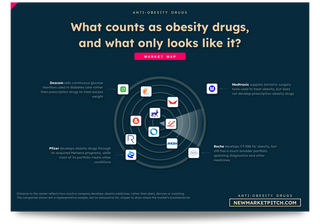
Radar map of the anti-obesity drugs market showing which companies count as part of it, which sit on its edge and which stay outside: What counts as obesity drugs, and what only looks like it? (Anti-Obesity Drugs Market, NewMarketPitch)
Market Definition

What does this market really cover?

Obesity drugs get mixed up with diabetes drugs, supplements and diet programs, so we start by setting clear limits.

A weekly shot or a daily pill prescribed to treat obesity is in, and so is a drug still in trials for weight loss. A diabetes drug with no obesity use is out, and so are supplements, diet programs and bariatric surgery.

It matters because the same molecule is often sold under one name for diabetes and another for obesity. Our figures only count the obesity side.

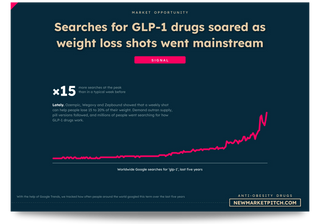
Google Trends curve of worldwide searches over five years for the anti-obesity drugs market: Searches for GLP-1 drugs soared as weight loss shots went mainstream (Anti-Obesity Drugs Market, NewMarketPitch)
Market Opportunity

Why is everyone looking at this market now?

The anti-obesity drug market is red hot right now, and the fight is moving from shots to pills.

We've found a lot of interesting signals. For example, Pfizer closed its purchase of Metsera, worth up to $10B, in November 2025, after a bidding war with Novo Nordisk. Then the FDA approved the first two obesity pills: Wegovy in December 2025, and Lilly's Foundayo in April 2026. Big drugmakers are paying billions to get in, and the leaders are racing to make treatment easier to take.

In this section, we look at why the market is shifting now, what pills and lower prices mean for demand, and where newcomers can still find room.

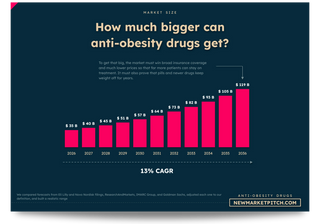
Bar chart of the anti-obesity drugs market size year by year to 2036, with its growth rate: How much bigger can anti-obesity drugs get? (Anti-Obesity Drugs Market, NewMarketPitch)
Market Size

How big could this market get?

Obesity drug forecasts online vary widely, and many mix in diabetes sales of the same molecules.

We build our own estimate from the ground up, compare it with other sources, and explain every assumption, so you can see how we got there.

Because prices and insurance coverage are moving fast, we also show a cautious and an optimistic scenario.

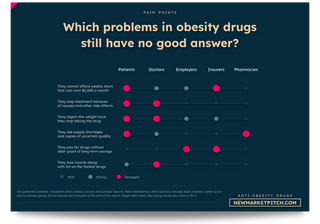
Matrix of the problems anti-obesity drugs customers still face, rated for each type of buyer: Which problems in obesity drugs still have no good answer? (Anti-Obesity Drugs Market, NewMarketPitch)
Pain Points

What are the pain points, and for whom?

Obesity drives heart disease, diabetes and joint problems, yet most people who could benefit from these drugs still don't take them.

We look at six types of companies, from incretin drug makers and oral pill developers to amylin, muscle-preserving and brain-targeting programs. Those who pay include employers, insurers, government programs and patients paying cash. For each, we rank the biggest pains, like high prices, side effects that make people stop, muscle loss and factories that have to keep up with demand.

This shows which problems payers and patients will pay to solve, and why a new drug needs more than a bit more weight loss to stand out.

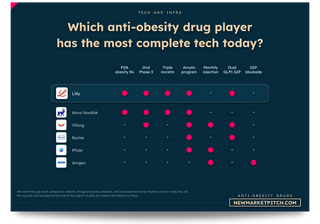
Comparison table of the tech offered by leading anti-obesity drugs companies: Which anti-obesity drug player has the most complete tech today? (Anti-Obesity Drugs Market, NewMarketPitch)
Tech & Infra

What is the latest tech and infrastructure?

Weight loss alone no longer impresses. New drugs compete on pill or shot, how often people take them, how much muscle they spare, and how well people tolerate them.

We map the science and the supply chain, from drugs that mimic one gut hormone or several to small-molecule pills and long-acting shots. We also show where things get stuck, like peptide production, injection pen capacity, and nausea that pushes patients to quit.

You'll see which approaches are already on the market, which are in late trials, and which are still early.

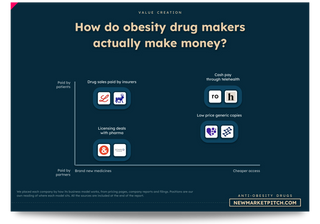
Map of anti-obesity drugs business models with company logos: How do obesity drug makers actually make money? (Anti-Obesity Drugs Market, NewMarketPitch)
Value Creation

How is value created and monetized exactly?

Obesity drug companies make money through prices paid by insurers, cash sales straight to patients, deals with governments, and licensing a promising drug to a bigger partner.

We compare who pays and what it costs to serve them. Insurers want lower net prices and proof of fewer heart attacks or less diabetes. Cash sales through company websites skip the middlemen, but at lower prices. Small-molecule pills can be cheaper to make at scale than peptide shots. And a biotech that licenses its drug gets cash early but gives up most of the upside.

You'll see which models still make good money as prices fall, and which depend on insurers who may stop paying.

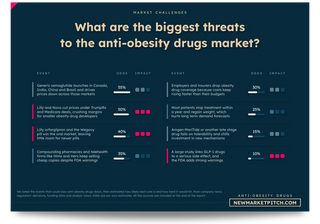
Table of the events that could slow the anti-obesity drugs market, with their odds and impact: What are the biggest threats to the anti-obesity drugs market? (Anti-Obesity Drugs Market, NewMarketPitch)
Market Challenges

What could slow this market down?

The obvious brakes are price cuts, insurers who limit coverage, and side effects that make many patients stop.

Others are easier to miss. Cheaper copies of semaglutide are arriving in countries where its patents are running out. Patients often regain weight when they stop treatment. Governments can push prices down in a single deal. And a safety problem with one drug could hurt the whole class.

We list each risk, estimate how likely it is, and show who it would hit first, from the leaders to smaller developers.

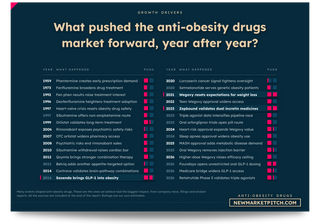
Timeline of the events that pushed the anti-obesity drugs market forward, with their impact: What pushed the anti-obesity drugs market forward, year after year? (Anti-Obesity Drugs Market, NewMarketPitch)
Growth Drivers

What are the growth drivers in this market?

Our growth numbers depend on a few forces that need to keep working. We take them one at a time.

Some drivers are plain to see: more people living with obesity, pills that are easier to take than shots, and lower prices. Others build on each other. Each trial that shows fewer heart or kidney problems makes insurers more willing to pay. More coverage brings more patients. And more patients justify bigger factories, which help bring prices down again.

Before building or investing, you should know what keeps patients on these drugs for years, and who will keep paying for them.

Investor Bets

What are investors betting on now?

Obesity is one of the few areas where big pharma, venture funds and Chinese biotechs all chase the same kind of drug.

We compare recent rounds and licensing deals across pills, multi-hormone drugs and amylin programs. We also look at how much buyers pay for drugs licensed from China, and which newer bets, like muscle-preserving drugs or monthly shots, are starting to get funded.

You'll see where obesity money is going after deals like Pfizer's purchase of Metsera, and what data a smaller developer needs before it can raise.

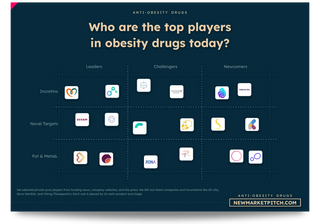
Market grid of the top anti-obesity drugs startups and companies by segment: Who are the top players in obesity drugs today? (Anti-Obesity Drugs Market, NewMarketPitch)
Top Players

Who are the top startups and companies?

Novo Nordisk and Eli Lilly hold most of this market today, but dozens of companies are trying to take a share.

Some of the most interesting players work on narrow problems. Some try to protect muscle while patients lose fat. Others develop monthly shots, pills that are simpler to manufacture, or drugs that help people keep the weight off after they stop. Several license drugs first discovered in China.

They're hard to compare because their trials differ. Studies run for different lengths, in different patients, at different doses, so a headline weight-loss number rarely tells the full story.

Below, you'll find the market grids and ecosystem maps we've built to show who works on which mechanism, and where new players are getting in.

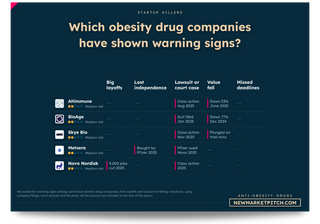
Table of anti-obesity drugs startups that shut down or struggled, and why: Which obesity drug companies have shown warning signs? (Anti-Obesity Drugs Market, NewMarketPitch)
Startup Killers

What could kill a startup in this market?

Matching the leaders isn't enough here. A new obesity drug has to beat two giants on price, convenience or side effects, or nobody switches.

So we studied why obesity drug startups fail or stall. Some chase a slightly bigger weight-loss number while patients care more about nausea and price. Others can't afford the huge trials that regulators and insurers now expect, or depend on one partner to make and sell their drug.

If you're building, you'll see why a clear edge on side effects, convenience or cost matters more than a headline number. If you're investing, you'll know what to check about trial size, cash needs and who will make and sell the drug.

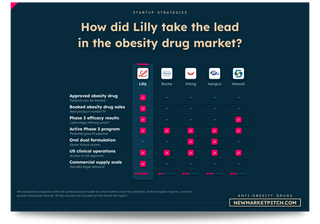
Scorecard showing what sets the leading anti-obesity drugs company apart: How did Lilly take the lead in the obesity drug market? (Anti-Obesity Drugs Market, NewMarketPitch)
Startup Strategies

How do you win in this market?

Zealand Pharma, Viking Therapeutics, Structure Therapeutics… a few challengers are getting closer to the leaders. None has an obesity drug on the market yet.

Their routes differ. Zealand Pharma teamed up with Roche to take its amylin drug, petrelintide, into phase 3. Viking Therapeutics is running its own phase 3 trials of an injectable drug, VK2735. Structure Therapeutics is developing a small-molecule pill and preparing it for phase 3. Each picked a different way to stand out, and none has proven it yet.

We'll look at how these companies chose their edge, found money for very large trials, and decided whether to partner or go alone.

Questions?

Who is this market report actually for?+

It's for founders, investors, pharma and biotech teams, insurers, employers and strategists who want a clear view of anti-obesity drugs.

Use it to compare pills, shots and new mechanisms, to judge how falling prices and insurance coverage change demand, to decide between partnering and going alone, or to understand technology, funding, competitors and risks across the whole market.

How many pages are in the report?+

It has 190+ pages. It is designed to be comprehensive enough to support serious market evaluation, while still being fast to read and easy to use.

We prioritize signal, structure, and visual clarity over unnecessary length.

What do you include in the anti-obesity drugs market?+

We define the anti-obesity drugs market as prescription medicines developed to reduce excess body weight or treat obesity.

We include approved and investigational obesity therapies, including incretin-based medicines and other mechanisms.

We exclude dietary supplements, bariatric surgery and diabetes drugs without an obesity development program or use.

Do you list your sources clearly?+

Yes. All key data points and assumptions are explained and sourced in the document.

All sources are tier-1: company filings, funding databases, public datasets, expert interviews, industry reports, etc.

Is the data up to date?+

Yes. The report was last updated on November 2, 2026 with the latest market signals.

Is this a one-time payment?+

Yes. This is a one-time purchase. There is no subscription required to access the document.

I want to buy several market reports, can I get a discount code?+

Yes. You can use NEWMARKET for 20% off when purchasing two reports, or NEWMARKETMAX for 30% off when purchasing five or more.

I’m interested in a market but I can’t find it here+

If a market you care about is not currently on the list, email us at team@newmarketpitch.com and we may be able to cover it.

I have more questions for you+

No problem. You can reach out directly and we respond within 24 hours.

LAST UPDATED: November 2, 2026

Everyone talks about obesity drugs, few understand them

Everyone wants a piece of the obesity market, but two companies still set the prices and the pace. This report covers the whole anti-obesity drugs market, from size and patients to science, pricing, funding, competitors, risks and where newcomers can still win.

PRO
$49
One-time payment
  • ✓ Market Definition
  • ✓ Market Opportunity
  • ✓ Market Size
  • ✓ Pain Points
  • ✓ Tech & Infra
  • ✓ Value Creation
  • ✓ Market Challenges
  • ✓ Growth Drivers
  • ✓ Investor Bets
  • ✓ Top Players
  • ✓ Startup Killers
  • ✓ Startup Strategies
PRO+
$79
One-time payment
  • ✓ Market Definition
  • ✓ Market Opportunity
  • ✓ Market Size
  • ✓ Pain Points
  • ✓ Tech & Infra
  • ✓ Value Creation
  • ✓ Market Challenges
  • ✓ Growth Drivers
  • ✓ Investor Bets
  • ✓ Top Players
  • ✓ Startup Killers
  • ✓ Startup Strategies
PRO++
$99
One-time payment
  • ✓ Market Definition
  • ✓ Market Opportunity
  • ✓ Market Size
  • ✓ Pain Points
  • ✓ Tech & Infra
  • ✓ Value Creation
  • ✓ Market Challenges
  • ✓ Growth Drivers
  • ✓ Investor Bets
  • ✓ Top Players
  • ✓ Startup Killers
  • ✓ Startup Strategies
Use code MARKETPITCH for 10% off your order