LAST UPDATED: October 31, 2026

Building or investing in the antibody-drug conjugate market?

ADCs are moving from last-resort cancer care into earlier treatment, and big pharma keeps paying billions for new payloads and linkers. The hard part is making them safer, easier to manufacture and better than the ADCs already sold. This report walks you through the whole ADC market as it is today.

  • 190+ pages
  • 12 sections
  • verified data only
Building or investing in the antibody-drug conjugate market? market report cover

What’s inside the report?

12 sections to help founders and investors understand the antibody-drug conjugate market with clarity

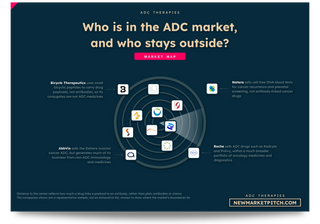
Radar map of the antibody-drug conjugate market showing which companies count as part of it, which sit on its edge and which stay outside: Who is in the ADC market, and who stays outside? (Antibody-Drug Conjugate Market, NewMarketPitch)
Market Definition

What is this market, exactly?

ADCs get lumped in with plain antibodies, radioactive drugs and contract manufacturing, so we start by saying exactly what counts.

A drug that links a cell-killing payload to an antibody is in. So is a company that sells the antibody, linker, payload or conjugation method other teams use to build ADCs. An antibody with nothing attached is out, and so is a radiopharmaceutical, or a plant that makes ADCs for anyone without its own ADC technology.

So when we size the market or compare companies, we're always counting the same thing.

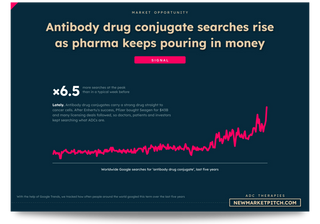
Google Trends curve of worldwide searches over five years for the antibody-drug conjugate market: Antibody drug conjugate searches rise as pharma keeps pouring in money (Antibody-Drug Conjugate Market, NewMarketPitch)
Market Opportunity

What changed for this market lately?

ADCs are one of the hottest areas in cancer drugs right now, and the money is following the newer platforms.

We've found a lot of interesting signals. For example, Gilead bought Tubulis, a German ADC startup, for $3.15B upfront and up to $5B in total, and closed the deal in May 2026. That same month, the FDA approved Enhertu for early-stage HER2-positive breast cancer, both before and after surgery. Big pharma is paying for the next generation of ADC technology, and these drugs are reaching patients earlier in their disease.

In this section, we look at why ADCs are drawing so much money now, which targets and payloads buyers want most, and what deals this size mean for smaller platform companies.

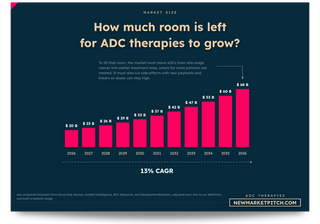
Bar chart of the antibody-drug conjugate market size year by year to 2036, with its growth rate: How much room is left for ADC therapies to grow? (Antibody-Drug Conjugate Market, NewMarketPitch)
Market Size

How big could this market get?

ADC market figures online often mix in every antibody drug, radiopharmaceuticals or the contract manufacturers that make them.

We use first principles to build our own estimate, then compare it with outside sources and show every assumption, so you can follow the math.

Then we show how that number moves in a cautious case and an optimistic one.

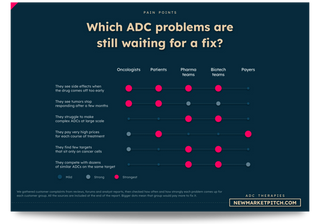
Matrix of the problems antibody-drug conjugate customers still face, rated for each type of buyer: Which ADC problems are still waiting for a fix? (Antibody-Drug Conjugate Market, NewMarketPitch)
Pain Points

What are the pain points, and for whom?

Chemotherapy hits healthy cells along with the tumor. ADCs promise to aim the poison better, but many patients still face serious side effects.

We compare six types of ADC companies, from integrated drug developers to antibody, linker and payload platforms and the teams behind new conjugation methods. Their buyers range from big pharma oncology teams to biotechs that license a platform. Then we rank their biggest pains, like side effects that cap the dose, tumors that stop responding, and molecules that are hard to make the same way every time.

This shows which problems drug makers will pay a platform to solve, and which ones they prefer to handle in-house.

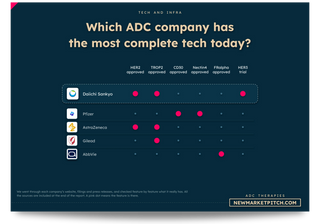
Comparison table of the tech offered by leading antibody-drug conjugate companies: Which ADC company has the most complete tech today? (Antibody-Drug Conjugate Market, NewMarketPitch)
Tech & Infra

What is the latest tech and infrastructure?

An ADC is three parts working together: an antibody that finds the tumor, a linker that holds on until the right moment, and a payload that kills the cell.

We map the stack from target choice and antibody design to linkers, payloads, conjugation and manufacturing. We also show where things get stuck, like payloads that break loose in the blood, uneven drug loading, tumors with too little of the target, and the special plants needed to handle toxic payloads.

You'll see what already works in approved ADCs, and where newer ideas stand, like ADCs that hit two targets or carry new kinds of payloads.

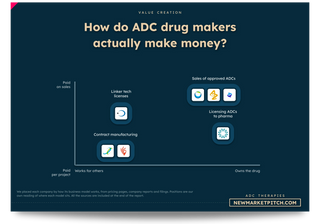
Map of antibody-drug conjugate business models with company logos: How do ADC drug makers actually make money? (Antibody-Drug Conjugate Market, NewMarketPitch)
Value Creation

How is value created and monetized exactly?

Drug sales, licensing deals with upfront cash and milestones, platform fees per program, royalties and outright sales to big pharma: ADC companies make money in very different ways.

We compare who pays, when the money arrives and what each model costs. A drug developer keeps the upside but pays for years of trials. A linker or payload platform can sign many partners, yet most of its money arrives only if their drugs succeed. Manufacturing adds its own costs, because toxic payloads need dedicated sites. And Chinese biotechs now license many of their ADCs to Western drug makers, which changes how deals are priced.

You'll see when licensing out a platform is worth more than owning a drug, and when it's the other way around.

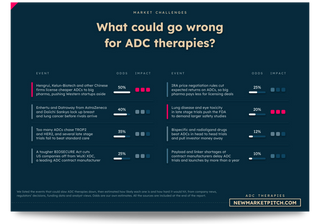
Table of the events that could slow the antibody-drug conjugate market, with their odds and impact: What could go wrong for ADC therapies? (Antibody-Drug Conjugate Market, NewMarketPitch)
Market Challenges

What could slow this market down?

Some brakes are easy to see: side effects like lung damage and eye problems, failed trials, and a crowded race on the same few targets.

Others are easier to miss. Patent fights over linkers and payloads. Too few plants able to handle toxic payloads. US rules that make some Chinese partners and suppliers harder to use. And pressure on cancer drug prices that cuts the return on each new approval.

For each risk, we estimate how likely it is and which kinds of ADC companies it would hurt most.

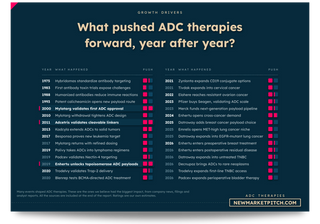
Timeline of the events that pushed the antibody-drug conjugate market forward, with their impact: What pushed ADC therapies forward, year after year? (Antibody-Drug Conjugate Market, NewMarketPitch)
Growth Drivers

What are the growth drivers in this market?

Strong trial data explains part of the growth, not all of it. Here, we go through what actually drives the ADC market.

Some drivers are plain to see: more approvals, use in earlier stages of cancer, and big pharma needing new drugs as older patents run out. Others feed each other. Each approved ADC shows which targets and payloads work, which makes the next deal easier to sign. Better linkers allow stronger doses with fewer side effects. And pairing ADCs with immunotherapy opens new uses, as it already has in bladder cancer.

Before building or investing, you should know what it takes for an ADC to beat the treatments doctors already trust, and to be made safely at scale.

Investor Bets

Where are investors placing their bets today?

ADCs became one of the busiest corners of cancer dealmaking, for venture investors and big pharma alike.

We'll compare funding for full ADC drug developers, linker and payload platforms, and teams building ADCs that hit two targets. We'll also look at how many deals now start with a license from China, and newer bets such as ADCs for immune diseases.

You'll see which ADC platforms investors trust today, based on recent rounds and deals like Gilead's purchase of Tubulis. We'll also look at the data a younger team needs, often early results in patients, before it can raise.

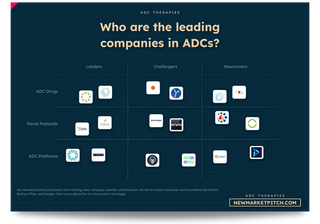
Market grid of the top antibody-drug conjugate startups and companies by segment: Who are the leading companies in ADCs? (Antibody-Drug Conjugate Market, NewMarketPitch)
Top Players

Who are the top startups and companies?

Daiichi Sankyo and Seagen, now part of Pfizer, built the ADCs most people know, but they're only part of the story.

Some of the most interesting ADC players are little known. A few only make linkers or payloads and license them to many drug makers. Others attach the drug at one exact spot on the antibody so every molecule comes out the same, or design payloads that wake up the immune system instead of only killing cells.

They're hard to spot because their work often carries someone else's name. A linker from a small platform can end up inside a big pharma drug, and the deal terms are rarely public. Many of the newest ADCs also come from Chinese biotechs that few people in the West have heard of.

Below, you'll find the market grids and ecosystem maps we've built to show who makes which part of an ADC, and where newer teams are getting in.

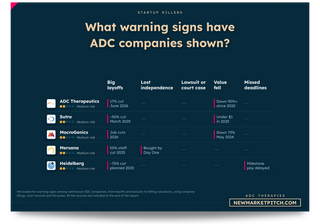
Table of antibody-drug conjugate startups that shut down or struggled, and why: What warning signs have ADC companies shown? (Antibody-Drug Conjugate Market, NewMarketPitch)
Startup Killers

What could kill a startup in this market?

In ADCs, the payload is both the point and the problem. Let a little of it loose in the blood, and the side effects can sink the drug.

So we studied why ADC startups fail or stall. Some chase the same target as five bigger rivals and lose the race. Others license their platform for small fees and never see the milestones. And some reach the clinic, then find their drug can't be made consistently enough to scale.

If you're building, you'll see why safety, a target where you can still win and a reliable way to make the drug matter more than a clever linker. If you're investing, you'll know what to check about crowded targets, deal terms and manufacturing.

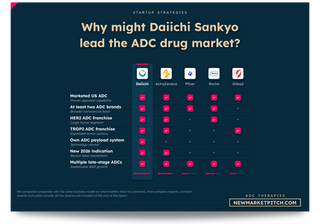
Scorecard showing what sets the leading antibody-drug conjugate company apart: Why might Daiichi Sankyo lead the ADC drug market? (Antibody-Drug Conjugate Market, NewMarketPitch)
Startup Strategies

How do you win in this market?

Kelun-Biotech, DualityBio, Synaffix… a few ADC companies have turned their technology into approvals, big partnerships or a strong exit. They took very different paths.

Kelun-Biotech won approvals in China and licensed its TROP2 ADC to Merck for most of the world. DualityBio built a pipeline of ADCs, signed partners like BioNTech and went public in Hong Kong. Synaffix licensed its linker and conjugation technology to many drug makers before Lonza bought it. No single route has proven best.

We'll look at how these teams chose between owning drugs and licensing parts, and picked partners who could take their ADCs to patients.

Questions?

Who is this market report actually for?+

It's for founders, investors, pharma and biotech teams, business development leads and strategists who want a clear view of antibody-drug conjugates.

Use it to choose between building your own ADCs and licensing a platform, to compare linker and payload technologies, to judge a licensing deal, or to understand demand, technology, funding, competitors and risks across the whole market.

How many pages are in the report?+

It has 190+ pages. It is designed to be comprehensive enough to support serious market evaluation, while still being fast to read and easy to use.

We prioritize signal, structure, and visual clarity over unnecessary length.

What do you include in the antibody-drug conjugate market?+

We define the antibody-drug conjugate (ADC) market as therapies that attach a drug payload to an antibody for targeted delivery.

We include ADC drug developers and dedicated antibody, linker and payload platforms used to create ADC therapies.

We exclude unconjugated antibodies, radiopharmaceuticals and general contract manufacturing without an ADC-development focus.

Do you list your sources clearly?+

Yes. All key data points and assumptions are explained and sourced in the document.

All sources are tier-1: company filings, funding databases, public datasets, expert interviews, industry reports, etc.

Is the data up to date?+

Yes. The report was last updated on October 31, 2026 with the latest market signals.

Is this a one-time payment?+

Yes. This is a one-time purchase. There is no subscription required to access the document.

I want to buy several market reports, can I get a discount code?+

Yes. You can use NEWMARKET for 20% off when purchasing two reports, or NEWMARKETMAX for 30% off when purchasing five or more.

I’m interested in a market but I can’t find it here+

If a market you care about is not currently on the list, email us at team@newmarketpitch.com and we may be able to cover it.

I have more questions for you+

No problem. You can reach out directly and we respond within 24 hours.

LAST UPDATED: October 31, 2026

Make sense of the antibody-drug conjugate market

An ADC can shrink tumors in a trial and still fail on side effects, a crowded target or a plant that can't make it. This report lays out the whole ADC market: its size, buyers, technology, deal models, funding, key players, risks and where newer platforms still fit.

PRO
$49
One-time payment
  • ✓ Market Definition
  • ✓ Market Opportunity
  • ✓ Market Size
  • ✓ Pain Points
  • ✓ Tech & Infra
  • ✓ Value Creation
  • ✓ Market Challenges
  • ✓ Growth Drivers
  • ✓ Investor Bets
  • ✓ Top Players
  • ✓ Startup Killers
  • ✓ Startup Strategies
PRO+
$79
One-time payment
  • ✓ Market Definition
  • ✓ Market Opportunity
  • ✓ Market Size
  • ✓ Pain Points
  • ✓ Tech & Infra
  • ✓ Value Creation
  • ✓ Market Challenges
  • ✓ Growth Drivers
  • ✓ Investor Bets
  • ✓ Top Players
  • ✓ Startup Killers
  • ✓ Startup Strategies
PRO++
$99
One-time payment
  • ✓ Market Definition
  • ✓ Market Opportunity
  • ✓ Market Size
  • ✓ Pain Points
  • ✓ Tech & Infra
  • ✓ Value Creation
  • ✓ Market Challenges
  • ✓ Growth Drivers
  • ✓ Investor Bets
  • ✓ Top Players
  • ✓ Startup Killers
  • ✓ Startup Strategies
Use code MARKETPITCH for 10% off your order