LAST UPDATED: October 30, 2026

Make smarter decisions on the application security market

AppSec is caught between AI coders and AI hackers. Developers ship code faster than ever with AI, and AI models are now finding bugs that sat unnoticed for decades. Security teams are stuck in the middle, with more code to check and more alerts than they can fix. This report gives you a full, up-to-date picture of the market.

  • 190+ pages
  • 12 sections
  • verified data only
Make smarter decisions on the application security market market report cover

What’s inside the report?

12 sections to help founders and investors understand the application security market with clarity

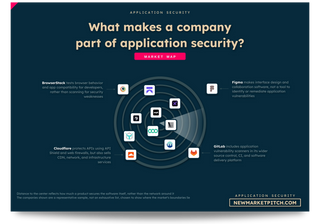
Radar map of the application security market showing which companies count as part of it, which sit on its edge and which stay outside: What makes a company part of application security? (Application Security Market, NewMarketPitch)
Market Definition

Where does this market start and stop?

Application security overlaps with cloud security, testing tools and developer platforms, so we start by saying exactly what we count.

A scanner that flags a vulnerable open-source package before a developer merges the code is in. So is a tool that tests a live API for broken access rules, or one that blocks an attack inside the running app. A firewall that protects the whole network is out, and so is a testing tool that only checks whether the code works.

That way, the market size and every company we compare cover the same ground.

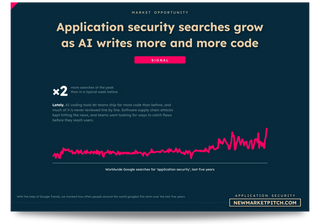
Google Trends curve of worldwide searches over five years for the application security market: Application security searches grow as AI writes more and more code (Application Security Market, NewMarketPitch)
Market Opportunity

Why is everyone looking at this market now?

Application security is hot right now, and the big AI labs have just walked in.

We've found a lot of interesting signals. For example, OpenAI unveiled Aardvark in October 2025, an AI agent that reads code, finds vulnerabilities and proposes fixes. In February 2026, Anthropic launched Claude Code Security, and cybersecurity stocks fell the same day. Two months later, its Project Glasswing gave about fifty companies and open-source groups an unreleased model that had found thousands of serious flaws, including one that had sat in OpenBSD for 27 years. Finding bugs in code is becoming something AI does at scale, and the biggest AI companies want a piece of it.

Here, we explain why AI changes both sides of the fight, what it means for scanner vendors when an AI lab offers bug hunting of its own, and where that leaves the startups in between.

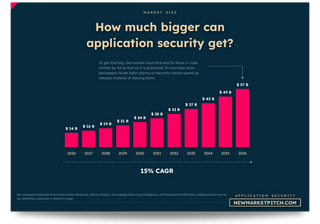
Bar chart of the application security market size year by year to 2036, with its growth rate: How much bigger can application security get? (Application Security Market, NewMarketPitch)
Market Size

How big could this market get?

Application security market sizes online often fold in all of cloud security, or every testing tool a developer uses.

We build our own estimate from the ground up, compare it with outside sources, and write down each assumption, so you can follow how we got there.

We also show how the number changes if AI makes scanning much cheaper, or if it makes the need for security much bigger.

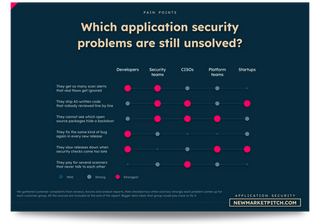
Matrix of the problems application security customers still face, rated for each type of buyer: Which application security problems are still unsolved? (Application Security Market, NewMarketPitch)
Pain Points

What are the pain points, and for whom?

Developers write code faster than security teams can review it, and most scanners answer with a wall of alerts.

We compare six kinds of application security companies, from code scanners and open-source checks to API protection and tools that guard the running app. Their buyers range from developers and security teams to platform engineers. Then we rank what each needs most: fewer false alarms, a fix that comes with the alert, and a clear view of which flaws an attacker can really reach.

This shows which problems teams will pay to fix this year, and which ones keep getting pushed to the next sprint.

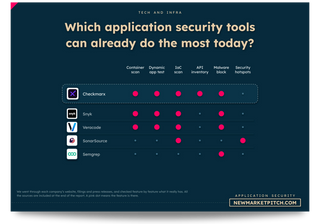
Comparison table of the tech offered by leading application security companies: Which application security tools can already do the most today? (Application Security Market, NewMarketPitch)
Tech & Infra

What is the latest tech and infrastructure?

A scanner on its own is no longer enough. Teams now need tools that see how code, open-source packages and APIs connect, and AI that can explain and fix what it finds.

We map the stack from the developer's editor to the build pipeline, the package registry and the running app. We also show where things get stuck, like scanners that flag thousands of issues nobody can reach, packages poisoned upstream, AI-written code nobody reviewed, and fixes that break the build.

You'll see what AI already does well in finding and fixing bugs today, and where people still have to check its work.

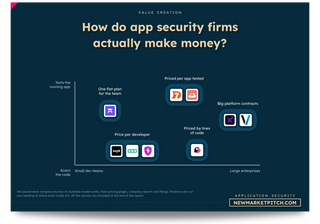
Map of application security business models with company logos: How do app security firms actually make money? (Application Security Market, NewMarketPitch)
Value Creation

How is value created and monetized exactly?

Per-developer seats, per-app or per-scan pricing, platform bundles, usage fees for AI fixes, and free open-source tools with a paid enterprise layer: application security companies charge in many ways.

We compare who pays and what each model costs to run. Per-developer pricing grows with the engineering team, but buyers push back when headcount shrinks. AI fixes cost money in model calls on every scan. Open-source tools spread fast, but only a small share of users ever pay. And platform bundles win big deals, often at a steep discount.

You'll see which models still make money when AI labs offer bug hunting cheaply, and which ones rely on customers never comparing prices.

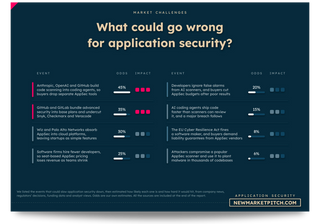
Table of the events that could slow the application security market, with their odds and impact: What could go wrong for application security? (Application Security Market, NewMarketPitch)
Market Challenges

What could slow this market down?

Some brakes are easy to see: crowded categories, alert fatigue, and big platforms adding code scanning to bundles customers already pay for.

Others are easier to miss. AI can find bugs faster than teams can patch them, so more findings can mean more frustration, not more safety. Attackers use the same models. Open-source maintainers are flooded with AI-generated bug reports. And when coding agents write the code, it's not always clear who is supposed to review it.

We map each of these risks, rate how likely it is, and show which kinds of companies it would hurt most.

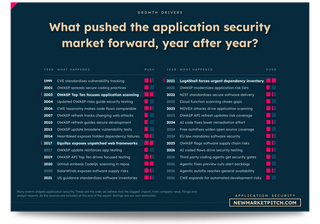
Timeline of the events that pushed the application security market forward, with their impact: What pushed the application security market forward, year after year? (Application Security Market, NewMarketPitch)
Growth Drivers

What are the growth drivers in this market?

Growth numbers say little without the reasons behind them. Here, we explain what pushes this market forward.

Some drivers are plain to see: more code, more open-source packages, and more attacks on the software supply chain. Others feed each other. Rules like Europe's Cyber Resilience Act make software makers answer for flaws in their products. AI coding tools create more code to check. And the better AI gets at finding bugs, the more pressure there is to fix them quickly.

Before building or investing, you should know what makes a security tool part of how developers ship code, rather than one more report they ignore.

Investor Bets

Where are investors placing their bets today?

Investors still like application security. What they're asking now is whether AI makes it a bigger market or a cheaper one.

We compare recent rounds across code scanners, software supply chain tools and API security. We also look at how investors treat platforms that bundle many scanners against specialists that do one job very well. And we flag the newer bets, like tools that check AI-written code or secure the AI agents built into apps.

You'll see which application security startups are raising now, after a run of unicorn rounds, and what a younger company has to prove when AI labs offer bug hunting of their own.

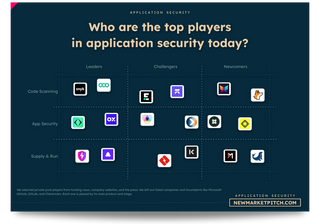
Market grid of the top application security startups and companies by segment: Who are the top players in application security today? (Application Security Market, NewMarketPitch)
Top Players

Who are the top startups and companies?

Checkmarx and Veracode are the names security teams have known for years, but the application security market goes far beyond them.

A lot of the interesting work happens in narrow corners. Some only check open-source packages for malware before they reach a build. Others test APIs for broken access rules, catch passwords and keys left in code, or rebuild common software images so they ship with no known flaws.

They're hard to compare because every vendor says it finds more bugs. One counts every theoretical issue, another only the ones an attacker can reach, and few publish results you can check. Many also sell through code platforms or cloud marketplaces, so buyers see the platform's name, not theirs.

Below, you'll find the market grids and ecosystem maps we've built to show who protects which part of the software, and where newcomers are finding room.

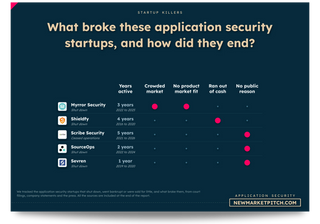
Table of application security startups that shut down or struggled, and why: What broke these application security startups, and how did they end? (Application Security Market, NewMarketPitch)
Startup Killers

What could kill a startup in this market?

Developers don't complain about bad security tools. They switch them off. A scanner that slows the build or cries wolf doesn't last long.

So we studied why application security startups fail or stall. Some sell a feature that GitHub or a big platform later adds for free. Others drown customers in alerts and never get their fixes merged. And some win developers over with a free tool but never find the security budget that pays for it.

If you're building, you'll see why low noise, fixes developers accept and a clear path from free users to a paying security team matter more than finding the most bugs. If you're investing, you'll know what to check about bundling risk, false alarm rates and how many free users turn into paying accounts.

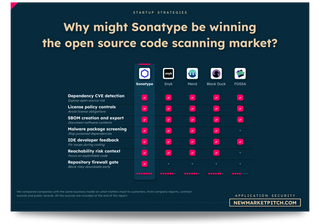
Scorecard showing what sets the leading application security company apart: Why might Sonatype be winning the open source code scanning market? (Application Security Market, NewMarketPitch)
Startup Strategies

How do you win in this market?

Semgrep, Chainguard, Aikido… a few application security companies are growing fast with paying customers. None has yet shown it can replace the incumbents across a whole company.

Semgrep started with an open-source scanner developers could tune themselves, then sold it to security teams. Chainguard sells software images that start with no known flaws, so teams spend less time chasing them. Aikido bundles many scanners into one simple product for smaller teams. Each began with a problem developers already felt, not a compliance checkbox.

We'll show how these teams got developers to keep their tools switched on, and how they turned that daily use into contracts with security teams.

Questions?

Who is this market report actually for?+

It's for founders, investors, CISOs, security and engineering leaders, platform teams and software vendors who want a clear view of application security.

Use it to choose between one platform and several specialist scanners, to decide where AI fits in finding and fixing flaws, to compare per-developer and usage pricing, or to understand demand, technology, funding, competitors and risks across the whole market.

How many pages are in the report?+

It has 190+ pages. It is designed to be comprehensive enough to support serious market evaluation, while still being fast to read and easy to use.

We prioritize signal, structure, and visual clarity over unnecessary length.

What do you include in the application security market?+

We define the application security market as products that find and prevent security weaknesses in software applications.

We include code scanning, software supply-chain security, application testing and runtime application protection.

We exclude general network security, non-security software testing and infrastructure tools without an application-security role.

Do you list your sources clearly?+

Yes. All key data points and assumptions are explained and sourced in the document.

All sources are tier-1: company filings, funding databases, public datasets, expert interviews, industry reports, etc.

Is the data up to date?+

Yes. The report was last updated on October 30, 2026 with the latest market signals.

Is this a one-time payment?+

Yes. This is a one-time purchase. There is no subscription required to access the document.

I want to buy several market reports, can I get a discount code?+

Yes. You can use NEWMARKET for 20% off when purchasing two reports, or NEWMARKETMAX for 30% off when purchasing five or more.

I’m interested in a market but I can’t find it here+

If a market you care about is not currently on the list, email us at team@newmarketpitch.com and we may be able to cover it.

I have more questions for you+

No problem. You can reach out directly and we respond within 24 hours.

LAST UPDATED: October 30, 2026

Before you build or invest in application security, read this

A scanner that finds ten thousand flaws is useless if developers ignore all of them. This report covers the whole application security market: its size and buyers, the technology, how companies charge, who is raising, who leads, and the risks ahead.

PRO
$49
One-time payment
  • ✓ Market Definition
  • ✓ Market Opportunity
  • ✓ Market Size
  • ✓ Pain Points
  • ✓ Tech & Infra
  • ✓ Value Creation
  • ✓ Market Challenges
  • ✓ Growth Drivers
  • ✓ Investor Bets
  • ✓ Top Players
  • ✓ Startup Killers
  • ✓ Startup Strategies
PRO+
$79
One-time payment
  • ✓ Market Definition
  • ✓ Market Opportunity
  • ✓ Market Size
  • ✓ Pain Points
  • ✓ Tech & Infra
  • ✓ Value Creation
  • ✓ Market Challenges
  • ✓ Growth Drivers
  • ✓ Investor Bets
  • ✓ Top Players
  • ✓ Startup Killers
  • ✓ Startup Strategies
PRO++
$99
One-time payment
  • ✓ Market Definition
  • ✓ Market Opportunity
  • ✓ Market Size
  • ✓ Pain Points
  • ✓ Tech & Infra
  • ✓ Value Creation
  • ✓ Market Challenges
  • ✓ Growth Drivers
  • ✓ Investor Bets
  • ✓ Top Players
  • ✓ Startup Killers
  • ✓ Startup Strategies
Use code MARKETPITCH for 10% off your order