LAST UPDATED: October 27, 2026

Make smarter decisions on the B2B payments market

B2B payments still run on paper checks, not for long. Plenty of businesses still pay their suppliers by check, manual bank transfer and a chain of approval emails. Now accounting software, card companies and investors all want to own the moment a bill gets paid. This report covers the whole B2B payments market, from the invoice to the payout.

  • 190+ pages
  • 12 sections
  • verified data only
Make smarter decisions on the B2B payments market market report cover

What’s inside the report?

12 sections to help founders and investors understand the B2B payments market with clarity

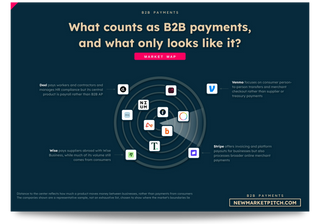
Radar map of the B2B payments market showing which companies count as part of it, which sit on its edge and which stay outside: What counts as B2B payments, and what only looks like it? (B2B Payments Market, NewMarketPitch)
Market Definition

Where does this market start and stop?

B2B payments can mean anything from a bank wire to a full finance software suite, so we draw the line before we count anything.

A platform that pays a company's suppliers is in. So is a tool that collects invoices, a corporate card, a service that pays sellers on a marketplace, and a business transfer sent abroad. Software that only does bookkeeping is out, and so are consumer payments, payroll and loans with no payment attached.

With that line set, every number and every company comparison in the report refers to the same market.

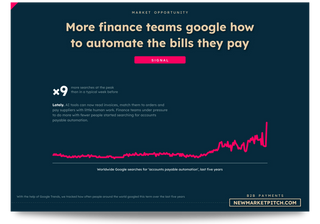
Google Trends curve of worldwide searches over five years for the B2B payments market: More finance teams google how to automate the bills they pay (B2B Payments Market, NewMarketPitch)
Market Opportunity

What changed for this market lately?

B2B payments are consolidating fast, as bigger players buy the tools that small and mid-size firms use to pay their bills.

We've found a lot of interesting signals. For example, in October 2025, Xero completed its $2.5B purchase of Melio, a bill-pay platform for US small businesses. The same month, TPG and Corpay closed their $2.2B takeover of AvidXchange, which automates bill payments for mid-size firms, and took it off the stock market. Accounting software and payment companies want to own the point where a bill turns into a payment.

In this section, we look at why payments are moving into the software where bills get approved, which firms still pay by check, and what this wave of deals means for independent players.

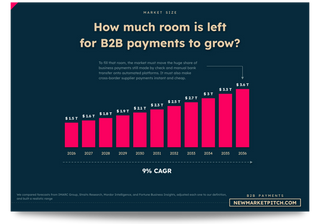
Bar chart of the B2B payments market size year by year to 2036, with its growth rate: How much room is left for B2B payments to grow? (B2B Payments Market, NewMarketPitch)
Market Size

How big could this market get?

B2B payment figures online often quote the total value of money moved, which is huge, instead of what payment companies actually earn on it.

So we build our own estimate. We set it next to other published figures and walk you through each assumption, so you can judge it yourself.

We then show a cautious and an optimistic case, and what each one assumes about how fast firms leave checks and manual transfers behind.

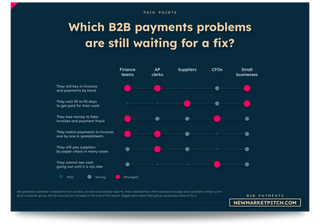
Matrix of the problems B2B payments customers still face, rated for each type of buyer: Which B2B payments problems are still waiting for a fix? (B2B Payments Market, NewMarketPitch)
Pain Points

What are the pain points, and for whom?

Paying a supplier sounds simple. In practice, it means approvals by email, bank details typed by hand, late fees and invoices nobody can find.

We compare six types of B2B payment companies, from supplier payment and collections platforms to corporate cards, marketplace payouts and payment APIs. Their buyers range from small business owners to finance teams at large companies. Then we rank their biggest pains, like slow approvals, payment fraud, customers who pay late and cash stuck in transit.

This shows which problems finance teams will pay to fix now, and which ones they'll keep handling in a spreadsheet.

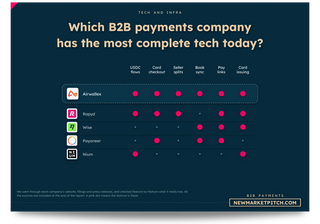
Comparison table of the tech offered by leading B2B payments companies: Which B2B payments company has the most complete tech today? (B2B Payments Market, NewMarketPitch)
Tech & Infra

What is the latest tech and infrastructure?

Moving business money takes more than a payment button. It needs invoice capture, approval flows, links to accounting software and several ways to pay.

We map the stack layer by layer, from ERP and accounting connections to card issuing, bank transfers, instant payment rails and supplier networks. We also show where things get stuck, like suppliers who refuse cards, bank details changed by fraudsters, invoices that don't match the order, and old ERPs that are hard to connect.

You'll see which steps of a payment already run on their own today, and where finance teams still step in by hand.

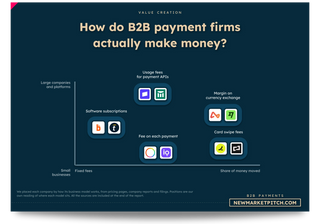
Map of B2B payments business models with company logos: How do B2B payment firms actually make money? (B2B Payments Market, NewMarketPitch)
Value Creation

How is value created and monetized exactly?

Software subscriptions, fees per payment, a share of card fees on virtual cards, currency margins and interest on money in transit: B2B payment companies make money in several ways.

We compare who pays and how much each model keeps. Virtual cards earn the most, but the supplier pays the card fee and may push back. Bank transfers cost little to send and earn little too. Subscriptions are steady but hard to raise. And money waiting to be paid out earns interest only while rates stay high.

You'll see which models keep their margins when suppliers refuse card fees or rates come down.

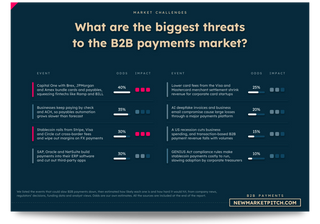
Table of the events that could slow the B2B payments market, with their odds and impact: What are the biggest threats to the B2B payments market? (B2B Payments Market, NewMarketPitch)
Market Challenges

What could slow this market down?

Some brakes are easy to see: finance teams that change tools slowly, suppliers who like checks, and banks that already offer cheap transfers.

Others are easier to miss. Every new payment tool has to connect to a company's ERP, which takes time. Fraudsters go after supplier bank details. Card networks and regulators may cut the fees that make virtual cards profitable. And accounting software firms now sell payments themselves.

We look at each of these risks, rate how likely it is, and explain which business models would feel it most.

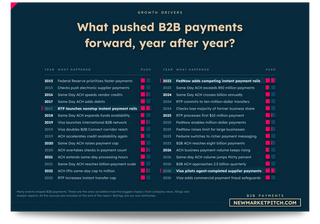
Timeline of the events that pushed the B2B payments market forward, with their impact: What pushed B2B payments forward, year after year? (B2B Payments Market, NewMarketPitch)
Growth Drivers

What are the growth drivers in this market?

Growth numbers alone don't tell you much. So we look at what is pushing more business payments online.

The obvious drivers are instant payment rails, e-invoicing rules in more countries, and finance teams asked to do more with fewer people. Others reinforce each other. Once a company pays through a network, its suppliers join it too, which makes the next company easier to sign. Cleaner payment data makes it easier to offer financing. And every payment that moves online makes the remaining paper look slower.

Before building or investing, you should know what makes a finance team move its bills to a new platform, and what makes its suppliers follow.

Investor Bets

What are investors backing right now?

Investors still back B2B payments, but buyouts and takeovers now matter as much as venture rounds.

We compare recent deals across bill pay for small businesses, collections software, corporate cards and payment APIs. We also look at whether investors prefer companies that own the finance software or those that only move the money, and flag newer bets like tools that let AI agents pay bills within set limits.

You'll see where the money is going after deals like Xero's purchase of Melio, and what a younger payments company needs to show, from payment volume to revenue per customer, before it can raise.

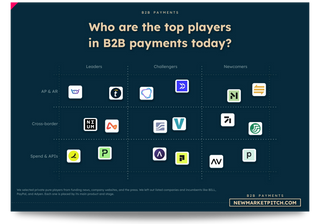
Market grid of the top B2B payments startups and companies by segment: Who are the top players in B2B payments today? (B2B Payments Market, NewMarketPitch)
Top Players

Who are the top startups and companies?

Tipalti and American Express come up first when finance teams talk about paying suppliers, but B2B payments go much further.

Many interesting players work out of sight. Some only pay subcontractors for construction firms or vendors for property managers. Others turn paper checks into electronic payments, check supplier bank details before money leaves, or pay out sellers on online marketplaces.

They're hard to spot because many sell through banks, accounting software or ERPs, under someone else's name. And payment volume is easy to quote but says little about what a company actually keeps.

Below, you'll find the market grids and ecosystem maps we've built to show who sends, collects and settles business payments, and where newer players fit.

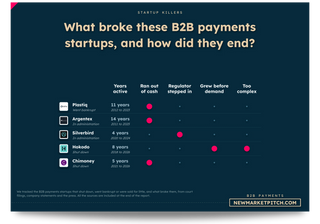
Table of B2B payments startups that shut down or struggled, and why: What broke these B2B payments startups, and how did they end? (B2B Payments Market, NewMarketPitch)
Startup Killers

What could kill a startup in this market?

Finance teams don't switch payment tools for fun. If yours breaks during the month-end close, you won't get a second chance.

So we studied why B2B payment startups fail or stall. Some win customers with free payments, then can't start charging. Others rely on card fees that suppliers refuse to pay. And some sell to small firms one by one, while an accounting platform adds the same feature for free.

If you're building, you'll see why ERP connections, supplier adoption and pricing that survives cheaper transfers matter more than a slick dashboard. If you're investing, you'll know what to check about take rate, supplier acceptance and dependence on accounting partners.

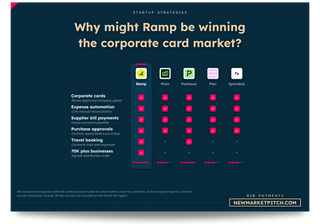
Scorecard showing what sets the leading B2B payments company apart: Why might Ramp be winning the corporate card market? (B2B Payments Market, NewMarketPitch)
Startup Strategies

How do you win in this market?

Bill, Billtrust, HighRadius… a few companies have built large businesses around getting invoices paid.

Bill helps small and mid-size firms pay suppliers and collect from customers in one place. Billtrust helps suppliers send invoices and get paid faster. HighRadius sells software that automates collections and cash forecasting for large companies. Each started with one side of the invoice, and none has found a model that fits every company.

We'll look at how these teams picked which side of the invoice to own, got suppliers to join, and kept customers once payments became a feature of every finance tool.

Questions?

Who is this market report actually for?+

It's for founders, investors, finance leaders, banks, accounting and ERP software companies, and strategists who want a clear view of B2B payments.

Use it to choose between building payments into your software and partnering, to decide which side of the invoice to serve first, to compare card, transfer and subscription revenue, or to understand demand, technology, funding, competitors and risks across the whole market.

How many pages are in the report?+

It has 190+ pages. It is designed to be comprehensive enough to support serious market evaluation, while still being fast to read and easy to use.

We prioritize signal, structure, and visual clarity over unnecessary length.

What do you include in the B2B payments market?+

We define the B2B payments market as products and services that move money between businesses.

We include supplier payments, business collections, cross-border transfers and payment-focused accounts payable and receivable platforms.

We exclude consumer-only payments, payroll to individuals and lending without a business-payment function.

Do you list your sources clearly?+

Yes. All key data points and assumptions are explained and sourced in the document.

All sources are tier-1: company filings, funding databases, public datasets, expert interviews, industry reports, etc.

Is the data up to date?+

Yes. The report was last updated on October 27, 2026 with the latest market signals.

Is this a one-time payment?+

Yes. This is a one-time purchase. There is no subscription required to access the document.

I want to buy several market reports, can I get a discount code?+

Yes. You can use NEWMARKET for 20% off when purchasing two reports, or NEWMARKETMAX for 30% off when purchasing five or more.

I’m interested in a market but I can’t find it here+

If a market you care about is not currently on the list, email us at team@newmarketpitch.com and we may be able to cover it.

I have more questions for you+

No problem. You can reach out directly and we respond within 24 hours.

LAST UPDATED: October 27, 2026

Get the full picture of the B2B payments market

Every business pays bills, but most B2B payment companies keep only a sliver of the money they move. This report covers the whole B2B payments market: its size, buyers, technology, business models, funding, key players, risks and the openings that remain.

PRO
$49
One-time payment
  • ✓ Market Definition
  • ✓ Market Opportunity
  • ✓ Market Size
  • ✓ Pain Points
  • ✓ Tech & Infra
  • ✓ Value Creation
  • ✓ Market Challenges
  • ✓ Growth Drivers
  • ✓ Investor Bets
  • ✓ Top Players
  • ✓ Startup Killers
  • ✓ Startup Strategies
PRO+
$79
One-time payment
  • ✓ Market Definition
  • ✓ Market Opportunity
  • ✓ Market Size
  • ✓ Pain Points
  • ✓ Tech & Infra
  • ✓ Value Creation
  • ✓ Market Challenges
  • ✓ Growth Drivers
  • ✓ Investor Bets
  • ✓ Top Players
  • ✓ Startup Killers
  • ✓ Startup Strategies
PRO++
$99
One-time payment
  • ✓ Market Definition
  • ✓ Market Opportunity
  • ✓ Market Size
  • ✓ Pain Points
  • ✓ Tech & Infra
  • ✓ Value Creation
  • ✓ Market Challenges
  • ✓ Growth Drivers
  • ✓ Investor Bets
  • ✓ Top Players
  • ✓ Startup Killers
  • ✓ Startup Strategies
Use code MARKETPITCH for 10% off your order