LAST UPDATED: November 1, 2026

It's time to better understand the brain-computer interface market

Brain implants were sci-fi, now patients type with them. Paralyzed patients in trials now type, and even speak, through an implant, and China has cleared the first one for sale. Payment, surgery, and AI decoders that lose accuracy over time still decide who gets one. This report walks you through the whole market as it stands today.

  • 193+ pages
  • 12 sections
  • verified data only
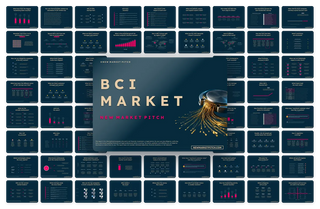
It's time to better understand the brain-computer interface market market report cover

What’s inside the report?

12 sections to help founders and investors understand the brain-computer interface market with clarity

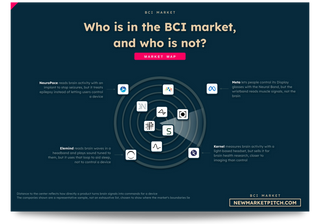
Radar map of the Brain-Computer interface market showing which companies count as part of it, which sit on its edge and which stay outside: Who is in the BCI market, and who stays outside? (Brain-Computer Interface Market, NewMarketPitch)
Market Definition

What does this market really cover?

Before anything else, we draw a clear line around the market: what counts as a BCI, what doesn't, and which markets sit right next to it.

A brain implant that lets a paralyzed person type and a headband that tracks focus can both be called BCIs. But they don't have the same buyers, rules, or prices. And a device that only stimulates the brain, without reading it, is not a BCI at all.

That way, every number in the report refers to the same thing.

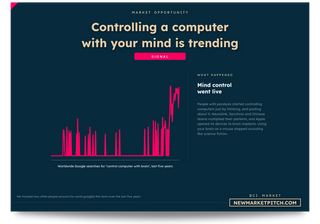
Google Trends curve of worldwide searches over five years for the Brain-Computer interface market: More and more people want to know how to control a computer with their brain (Brain-Computer Interface Market, NewMarketPitch)
Market Opportunity

Why is everyone looking at this market now?

In 2026, brain-computer interfaces are hot, and they are finally turning into products people can buy.

We've found a lot of interesting signals. For example, China approved Neuracle's NEO, the first brain implant cleared for commercial sale. And Merge Labs, co-founded by Sam Altman, raised a $252M seed round with OpenAI among its investors. Approvals are arriving, and the biggest names in AI want a seat at the table.

Here, we'll look at what these approvals and rounds really change, why China is moving so fast, and which parts of the market are closest to real revenue.

Donut chart splitting the brain-computer interface market size between its main categories, with leading companies: Which brain-computer interface category takes the biggest share? (Brain-Computer Interface Market, NewMarketPitch)
Market Size

How big could this market get?

Search for the BCI market size online and you'll find figures that are several times apart. Some count only medical implants, others add a long list of nearby devices.

We used first principles to build our own estimate, starting from what companies actually sell today: headsets, lab systems, rehab devices, and the first approved implants. Then we checked it against other sources and laid out every assumption, so you can see how we got there.

It also helps you tell today's revenue apart from the huge potential figures that make headlines.

Matrix of the problems Brain-Computer interface customers still face, rated for each type of buyer: Which problems would brain implant patients pay to solve? (Brain-Computer Interface Market, NewMarketPitch)
Pain Points

What are the pain points, and for whom?

BCIs exist because some problems are brutal. People with ALS lose their voice. People with spinal injuries lose the use of their hands.

But patients aren't the only ones in pain. Neurosurgeons, rehab clinics, research labs, headphone brands, and the teams building decoders all face their own problems. We go through each group and rank the issues that matter most to them.

That way, you can build or back a product for a problem someone will actually pay to fix.

Comparison table of the tech offered by leading Brain-Computer interface companies: Which BCI company has the most complete tech today? (Brain-Computer Interface Market, NewMarketPitch)
Tech & Infra

What is the latest tech and infrastructure?

Reading brain signals is only the start. Better implants, wearable sensors and AI decoders are changing what brain interfaces can do.

We regularly update this section with what's approved, what's in human trials, and what's still in the lab. We also show which bottlenecks can be fixed, like decoders that drift or electrodes that wear out, and roughly when.

A clear snapshot of where brain interfaces really stand today.

Map of Brain-Computer interface business models with company logos: How does the brain interface market actually make money? (Brain-Computer Interface Market, NewMarketPitch)
Value Creation

How is value created and monetized exactly?

Implants paid per procedure, lab equipment, rehab sessions billed by clinics, consumer headsets, and sensor licenses for headphone brands: BCI companies make money in very different ways.

We compare these models side by side. An implant can cost around $200K all in, but it needs a surgeon, a hospital, and a payer. A headset sells for a few hundred dollars, but many users stop wearing it after a few weeks.

You'll see who pays at each step and where the margins really sit, so you don't bet on a device that works but never gets paid for.

Table of the events that could slow the Brain-Computer interface market, with their odds and impact: What are the biggest threats to brain-computer interfaces? (Brain-Computer Interface Market, NewMarketPitch)
Market Challenges

What could slow this market down?

Some brakes on the BCI market are easy to spot: long trials, risky brain surgery, and very few surgeons trained to place implants.

Others are less obvious. US insurers don't cover implants yet. Decoders lose accuracy within weeks. Brain data rules differ from one state to the next. And makers can stop supporting older devices, leaving patients with nobody to call.

In this section, we lay out the main risks and estimate how likely each one is, so you know which ones to plan for first.

Timeline of the events that pushed the Brain-Computer interface market forward, with their impact: What kept brain-computer interfaces moving forward, year after year? (Brain-Computer Interface Market, NewMarketPitch)
Growth Drivers

What are the growth drivers in this market?

We give you a realistic growth rate for the BCI market. But a number alone doesn't tell you much, so we also explain what would make that growth happen.

Some drivers are clear: better AI decoders, the first approval for sale in China, and bigger funding rounds. Others build up over time. Each new payment code makes the next one easier to win. Each new user adds brain data that improves the decoder for everyone.

Before building or investing, you should know what has to happen for brain interfaces to reach many more patients, and who will pay for them.

Bar chart of where investors put their money in Brain-Computer interface, by category: Where did brain-computer interface investors put their money this past year? (Brain-Computer Interface Market, NewMarketPitch)
Investor Bets

What are investors betting on now?

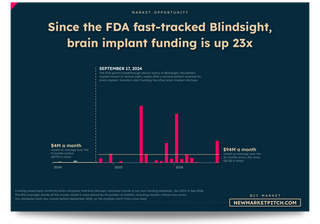
BCI funding has changed fast. A few years ago, most of the money went to a handful of US implant makers. Now, rounds come from everywhere, and China closes dozens of seed deals every quarter.

In this section, we'll show you who is raising and what investors are looking for. Is it implants close to approval, ultrasound devices that skip surgery, or EEG wearables with real users? We'll also cover the growing role of AI labs and the new ideas investors are starting to fund.

You'll see what the latest rounds say about which BCI companies investors trust to reach patients, from large implant rounds to the wave of Chinese seed deals.

Market grid of the top Brain-Computer interface startups and companies by segment: Who are the top companies in brain-computer interfaces? (Brain-Computer Interface Market, NewMarketPitch)
Top Players

Who are the top startups and companies?

Neuracle won the first approval to sell a brain implant, and BrainCo sells EEG headbands to more than 150,000 users. But they are only two pieces of a much wider BCI market.

Many of the most interesting startups rarely make headlines. Some build ultrasoft electrodes, others decode speech, sell arrays to research labs, or help stroke survivors move their hands again. They're worth watching.

BCIs aren't one kind of business. A brain implant, a focus headband, and a lab amplifier have different buyers, different rules, and very different timelines. So the companies are hard to compare, and the good ones are easy to miss.

That's why we share the market grids and ecosystem maps we've built, so you can see who does what and where the market is moving.

Comparison of what Brain-Computer interface survivors do and which companies missed it: What separates brain-computer interface survivors from failures? (Brain-Computer Interface Market, NewMarketPitch)
Startup Killers

What could kill a startup in this market?

In BCI, a record in the lab is not a product. Most implants still have only a handful of users, and the cash often runs out before the first sale.

So we studied why BCI startups fail. Some run trials that drag on for years. Others sell headsets that people stop wearing after a month, or build decoders that implant makers end up making themselves.

If you're building, you'll see why a strong lab result still needs a payer, a surgeon, and users who stick with the device. If you're investing, you'll know what to check about trial timelines, cash, and daily use.

Scorecard showing what sets the leading Brain-Computer interface company apart: What makes Muse the brain wearable leader today? (Brain-Computer Interface Market, NewMarketPitch)
Startup Strategies

How do you win in this market?

BrainCo, g.tec, StairMed… a few BCI companies are pulling ahead, each for a different reason.

Some already sell at scale, like EEG wearables and stroke rehab systems used in many countries. Others have raised large rounds for implants that still need approval. Attention and funding are not the same as a proven business, and we show where each model really stands.

We'll look at how BCI companies earn revenue while their long-term implant matures, and why real daily use counts more than lab records.

Questions?

Who is this market report actually for?+

It's for founders, investors, medical device companies, hospitals, research teams, and strategic teams who want a clear view of the brain-computer interface market.

It's useful if you're choosing between implants, ultrasound, or EEG wearables, planning a trial or a payment strategy, or trying to understand buyers, funding, competition, and risks across the whole market.

How many pages are in the report?+

It has 193+ pages. It is designed to be comprehensive enough to support serious market evaluation, while still being fast to read and easy to use.

We prioritize signal, structure, and visual clarity over unnecessary length.

What do you include in the brain-computer interface market?+

We define the brain-computer interface market as systems that translate brain activity into commands or feedback for an external device.

We include invasive and non-invasive brain interfaces, neural decoding software and dedicated interface hardware for clinical, research or consumer use.

We exclude general brain imaging, muscle-controlled interfaces and neurostimulation without a brain-signal interface.

Do you list your sources clearly?+

Yes. All key data points and assumptions are explained and sourced in the document.

All sources are tier-1: company filings, funding databases, public datasets, expert interviews, industry reports, etc.

Is the data up to date?+

Yes. The report was last updated on November 1, 2026 with the latest market signals.

Is this a one-time payment?+

Yes. This is a one-time purchase. There is no subscription required to access the document.

I want to buy several market reports, can I get a discount code?+

Yes. You can use NEWMARKET for 20% off when purchasing two reports, or NEWMARKETMAX for 30% off when purchasing five or more.

I’m interested in a market but I can’t find it here+

If a market you care about is not currently on the list, email us at team@newmarketpitch.com and we may be able to cover it.

I have more questions for you+

No problem. You can reach out directly and we respond within 24 hours.

LAST UPDATED: November 1, 2026

Before you build or invest in brain-computer interface, read this

A brain implant can give someone their voice back and still struggle to find a hospital that gets paid to place it. This report covers the whole BCI market, from technology and patients to market size, business models, funding, competitors, regulation, and the risks ahead.

PRO
$49
One-time payment
  • ✓ Market Definition
  • ✓ Market Opportunity
  • ✓ Market Size
  • ✓ Pain Points
  • ✓ Tech & Infra
  • ✓ Value Creation
  • ✓ Market Challenges
  • ✓ Growth Drivers
  • ✓ Investor Bets
  • ✓ Top Players
  • ✓ Startup Killers
  • ✓ Startup Strategies
PRO+
$79
One-time payment
  • ✓ Market Definition
  • ✓ Market Opportunity
  • ✓ Market Size
  • ✓ Pain Points
  • ✓ Tech & Infra
  • ✓ Value Creation
  • ✓ Market Challenges
  • ✓ Growth Drivers
  • ✓ Investor Bets
  • ✓ Top Players
  • ✓ Startup Killers
  • ✓ Startup Strategies
PRO++
$99
One-time payment
  • ✓ Market Definition
  • ✓ Market Opportunity
  • ✓ Market Size
  • ✓ Pain Points
  • ✓ Tech & Infra
  • ✓ Value Creation
  • ✓ Market Challenges
  • ✓ Growth Drivers
  • ✓ Investor Bets
  • ✓ Top Players
  • ✓ Startup Killers
  • ✓ Startup Strategies
Use code MARKETPITCH for 10% off your order