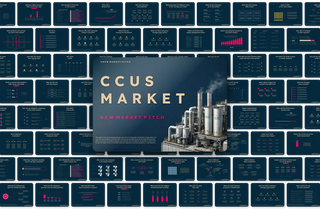
CCUS Market Pitch Deck

LAST UPDATED: June 18, 2026

Here's what's happening
in carbon capture

Carbon capture is no longer just a technology story. The harder questions now sit around storage access, hub economics, policy durability, transport infrastructure, and which projects can actually move from announcement to scale. This report will help you understand the market as it stands now.

What’s inside the deck?

12 sections to help founders and investors understand
the CCUS market with clarity

CCUS market europe asia africa usa world
Market Definition

What is this market about?

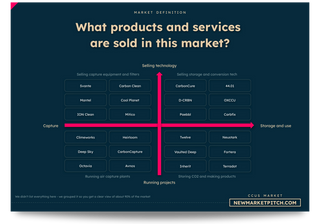
First, we make the market definition super clear: what’s included, what’s not, what are the adjacent markets, what we consider out of scope, etc.

We do this because people often mean different things when they talk about this market.

It saves you time and makes the rest of the deck easier to trust.

carbon-capture chart
Market Opportunity

Why this market now?

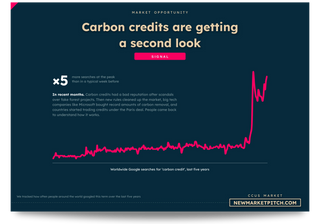
In 2026, and you're probably aware of it, the CCUS market is one of the hottest areas in climate tech.

ExxonMobil is launching new carbon capture hubs in Louisiana and India committed $2.2 billion USD to CCUS development. At the same time, global capture capacity is expected to grow more than tenfold by 2030, supported by U.S. 45Q tax credits.

In this section, we'll give you strong data and tell you which signals make CCUS especially attractive right now.

CCUS market cagr growth rate market size
Market Size

How big could this market get?

There are tons of CCUS market size and CAGR numbers online, and they’re all over the place. It’s tough to know what to trust.

We built our own estimate using first-principles analysis, validated with aggregated sources, and we lay out every assumption and step so you can trust the result.

The goal is a quick, reliable sanity check on whether this market is worth pursuing.

CCUS market revenue breakdown segments
Pain Points

What are the pain points, and for whom?

There are growing problems in how we handle carbon emissions. Industrial emitters, energy companies, governments, and carbon credit buyers all face challenges that carbon capture, utilization, and storage solutions can address.

We break down who the stakeholders are and what's driving their interest in CCUS.

Knowing who needs what helps you create or fund solutions that reduce emissions and generate real returns.

carbon-capture tech chart
Tech & Infra

What is the latest tech and infrastructure?

If you're tracking the CCUS market, you know how much changes year to year. New capture chemistries, transport solutions, storage monitoring tools, and utilization pathways keep emerging.

This section stays current with what's operational, what's in pilot programs, and what's still in the lab. Point-source capture, direct air capture, CO2 transport infrastructure, and the full measurement and verification stack, all covered.

Your regularly refreshed guide to a market scaling up against tight climate deadlines.

CCUS market business models startups
Value Creation

How is value created and monetized exactly?

It can be hard to understand exactly where CCUS companies capture value (the capture technology, transport infrastructure, storage sites, or the credits generated?).

We will make it as clear as possible which business models are working right now, and why some segments deliver 10x better unit economics than others.

Whether you're building or investing, you'll see which strategies turn carbon removal into bankable revenue, and which ones stay stuck waiting for policy and offtake certainty.

CCUS market challenges
Market Challenges

What could slow this market down?

Let's also be honest about what can slow the CCUS market: high capture costs, long project timelines, and policy dependency, among other factors.

Then there are the quieter risks, like storage liability concerns, inconsistent carbon credit pricing, and public opposition to CO2 transport infrastructure.

In this section, we map the challenges and how likely they are, so you can plan ahead before you invest or build.

CCUS market consumer adoption chart
Growth Drivers

What are the growth drivers in this market?

Knowing the growth rate and market size of the CCUS market is one thing. But these numbers do not mean much if you do not understand what is actually pushing the market forward, and what has to change for projects to scale.

Some drivers are easy to see: tighter emissions regulations, corporate net-zero commitments, and government subsidies like 45Q. But CCUS growth often hinges on quieter enablers such as bankable offtake agreements, transport and storage infrastructure buildout, reliable MRV standards, and permitting reform that reduces project timelines.

Before building or investing, you should know which enablers matter most, and what needs to happen for them to kick in.

CCUS market fundraising investors
Investor Bets

What are investors chasing right now?

Some investors love the CCUS market because it sits at the intersection of policy tailwinds, industrial decarbonization, and massive infrastructure buildout.

In this section, we'll show you where money is flowing and what's actually getting funded right now. You'll see which companies are raising, plus what those rounds have in common: the approaches investors keep leaning into, what they're excited about today, and what they've mostly stopped backing. We'll also flag the newer theses starting to gain traction.

Use this to understand where conviction is building, so you can invest with context or build toward the milestones capital is rewarding.

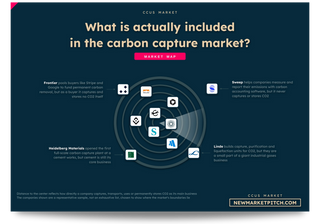
CCUS market map top startups
Top Players

Who are the top startups and companies?

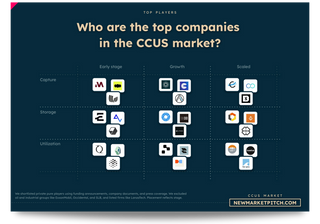
Climeworks and Occidental's 1PointFive have captured global attention, but the CCUS landscape is far broader than direct air capture and a few mega-projects.

Startups are building across the full chain: from point-source capture and CO2 transport to utilization pathways, storage monitoring, and MRV infrastructure.

In speaking with entrepreneurs and investors across this market, we keep hearing the same thing: the space is promising but confusing, especially around project economics, policy dependency, and which technologies actually scale. That's exactly why we built this section.

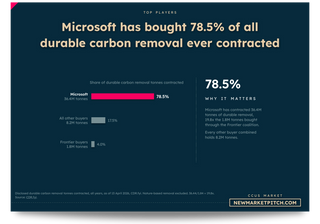
Here, we share the market grids and ecosystem maps we've developed to help you understand what's happening and where the opportunities are emerging.

CCUS market pain points customers
Startup Killers

What could kill a startup in this market?

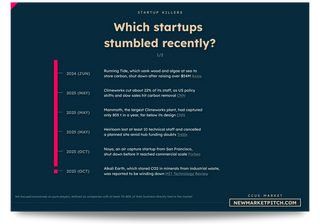
The CCUS market isn't a guaranteed goldmine. It can be brutally unforgiving: massive capex, long project timelines, policy dependency, and a real gap between announced capacity and operational projects.

So we studied CCUS startups that failed and pulled out the non-obvious patterns: the quiet traps you don't see in generic startup advice, like treating government incentives as guaranteed revenue, underestimating permitting complexity, or building capture tech without a storage or offtake plan.

This way, if you're building, you start ahead. If you're investing, you can spot the red flags much earlier.

CCUS market market share
Startup Strategies

How do you win in this market?

Climeworks, Occidental's 1PointFive, Carbon Clean… CCUS has its share of emerging leaders.

How did they advance from pilots to real projects while so many carbon capture ventures stay stuck in feasibility studies? The winners lock three things early: offtake certainty, site-specific engineering, and a financing structure that de-risks the build.

We've mapped the patterns behind the projects that are actually moving, and in this section we'll share the cheat codes you can apply right away.

Questions?

Who is this market report actually for?+

This deck is built for founders, investors, operators, and strategists who need a clearer view of the market before they build, invest, partner, or reposition.

It is especially useful if you are trying to understand where the opportunity is real, how the market is evolving, and what separates the promising segments from the fragile ones.

How many pages are in the deck?+

The deck is around 210+ pages. It is designed to be comprehensive enough to support serious market evaluation, while still being fast to read and easy to use.

We prioritize signal, structure, and visual clarity over unnecessary length.

What do you include in the CCUS market?+

We define the CCUS market as the set of products and services that enable capturing CO₂, conditioning it, moving it, and then either using it or storing it to prevent atmospheric release.

We include CO₂ capture (point-source and direct air), compression/conditioning, CO₂ transport infrastructure and services, utilization pathways, and geological storage (including monitoring and verification directly tied to storage or durable utilization).

We exclude general decarbonization advisory, corporate carbon accounting not tied to specific CCUS projects, trading of carbon credits as a standalone activity, and CO₂ uses that are primarily for short-lived consumption without durable storage.

Do you list your sources clearly?+

Yes. All key data points and assumptions are explained and sourced in the deck.

All sources are tier-1: company filings, funding databases, public datasets, expert interviews, industry reports, etc.

Is the data up to date?+

Yes. The deck was last updated on June 18, 2026 with the latest market signals.

Is this a one-time payment?+

Yes. This is a one-time purchase. There is no subscription required to access the deck.

I want to buy several market reports, can I get a discount code?+

Yes. You can use NEWMARKET for 20% off when purchasing two reports, or NEWMARKETMAX for 30% off when purchasing five or more.

I’m interested in a market but I can’t find it here+

If a market you care about is not currently on the list, email us at team@newmarketpitch.com and we may be able to cover it.

I have more questions for you+

No problem. You can reach out directly and we respond within 24 hours.

Get the CCUS market report

The cost of misreading a market is high, especially in a category as nuanced as this one. This deck helps you understand where the market is real, where it is moving, and what matters most before you commit time, capital, or strategy

PRO
$49
One-time payment
  • Market Definition
  • Market Opportunity
  • Market Size
  • Pain Points
  • Tech & Infra
  • Value Creation
  • Market Challenges
  • Growth Drivers
  • Investor Bets
  • Top Players
  • Startup Killers
  • Startup Strategies
PRO+
$79
One-time payment
  • Market Definition
  • Market Opportunity
  • Market Size
  • Pain Points
  • Tech & Infra
  • Value Creation
  • Market Challenges
  • Growth Drivers
  • Investor Bets
  • Top Players
  • Startup Killers
  • Startup Strategies
PRO++
$99
One-time payment
  • Market Definition
  • Market Opportunity
  • Market Size
  • Pain Points
  • Tech & Infra
  • Value Creation
  • Market Challenges
  • Growth Drivers
  • Investor Bets
  • Top Players
  • Startup Killers
  • Startup Strategies
Use code MARKETPITCH for 10% off your order