LAST UPDATED: October 30, 2026

Make better decisions on the carbon removal market

Carbon removal has one big buyer, it needs many more. Rules, plants and delivered tonnes are now in place, but one tech company still signs most of the checks. The big question is who else will pay. This report gives you the full picture of the market as it stands now.

  • 190+ pages
  • 12 sections
  • verified data only
Make better decisions on the carbon removal market market report cover

What’s inside the report?

12 sections to help founders and investors understand the carbon removal market with clarity

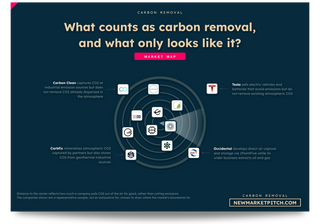
Radar map of the carbon removal market showing which companies count as part of it, which sit on its edge and which stay outside: What counts as carbon removal, and what only looks like it? (Carbon Removal Market, NewMarketPitch)
Market Definition

What is this market, exactly?

Carbon removal often gets confused with carbon capture at factories, with offsets and with emissions accounting, so we start by setting firm limits.

A machine that pulls CO2 out of the air and stores it underground is in. So is a biomass plant that captures its CO2 and buries it, biochar mixed into soil, or crushed rock that locks carbon into minerals. A credit for a forest that wasn't cut is out, and so is capture on a gas plant's chimney.

With that line drawn, every tonne and every company in the report means the same thing.

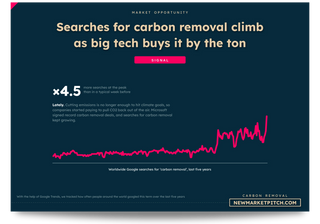
Google Trends curve of worldwide searches over five years for the carbon removal market: Searches for carbon removal climb as big tech buys it by the ton (Carbon Removal Market, NewMarketPitch)
Market Opportunity

What changed for this market lately?

Carbon removal is growing up, but it still leans far too hard on a single buyer.

We've found a lot of interesting signals. For example, in April 2026, Microsoft reportedly told suppliers it was pausing new carbon removal purchases, after buying roughly 80% of all removal contracted so far. A month later, it still signed a deal for up to 650,000 tonnes with BioCirc, a Danish biogas company that stores its CO2 under the North Sea. And in February, the European Commission adopted the first EU certification methods for direct air capture, BECCS and biochar. The market can't keep living on one company's budget, and common rules are a first step toward more buyers.

In this section, we look at why other buyers are still hesitant, which removal methods keep winning contracts, and what the new EU rules could change for prices and demand.

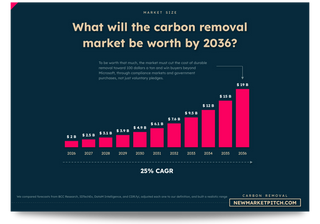
Bar chart of the carbon removal market size year by year to 2036, with its growth rate: What will the carbon removal market be worth by 2036? (Carbon Removal Market, NewMarketPitch)
Market Size

How big could this market get?

Carbon removal market sizes online often mix in industrial carbon capture, avoided deforestation credits and the whole voluntary carbon market.

We don't borrow a figure from someone else. We build our own estimate, check it against outside sources, and show every assumption, so you can see how the number was made.

We also show how the market could grow if governments start buying removals, and how it looks if they don't.

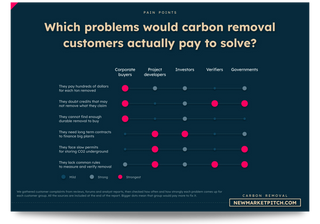
Matrix of the problems carbon removal customers still face, rated for each type of buyer: Which problems would carbon removal customers actually pay to solve? (Carbon Removal Market, NewMarketPitch)
Pain Points

What are the pain points, and for whom?

Removing a tonne of CO2 is expensive, and proving it stays removed is just as hard. Sellers and buyers both feel it.

We compare six kinds of removal companies: direct air capture, BECCS, biochar, rock weathering, mineralization and ocean-based methods. Their buyers range from tech companies and airlines to governments and credit brokers. For each, we rank the pains that hurt most, like the cost per tonne, long waits before delivery, and doubts about whether the carbon really stays stored.

This shows which removals a buyer will pay a premium for, and which ones still struggle to convince anyone.

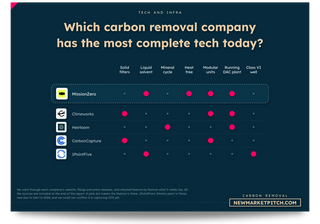
Comparison table of the tech offered by leading carbon removal companies: Which carbon removal company has the most complete tech today? (Carbon Removal Market, NewMarketPitch)
Tech & Infra

What is the latest tech and infrastructure?

Every removal method has the same two jobs: pull carbon out of the air and keep it out for a very long time. They go about it in very different ways.

We map the stack, from air contactors, pyrolysis units and rock spreading to CO2 pipelines, storage wells and the measurement tools that prove each tonne. We also show where things get stuck, like the energy a DAC plant needs, the limited supply of waste biomass, and how hard it is to measure carbon in soil or seawater.

You'll see which methods already deliver tonnes in volume, and which are still proving the science.

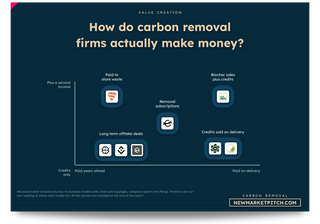
Map of carbon removal business models with company logos: How do carbon removal firms actually make money? (Carbon Removal Market, NewMarketPitch)
Value Creation

How is value created and monetized exactly?

Long-term offtake contracts, spot credit sales, government purchase programs, fees for storing someone else's CO2 and side revenue from heat, power or biochar: carbon removal companies get paid in many ways.

We compare who pays and what each tonne costs to produce. A DAC plant sells expensive tonnes and spends heavily on energy. A biochar producer sells cheaper credits and can also sell the biochar to farmers. A BECCS plant may earn money from heat or power, but it needs a pipeline and a storage site nearby. And every supplier pays for measurement and verification before it can sell a single credit.

You'll see which models can survive if credit prices fall, and which ones only work while one big buyer keeps signing.

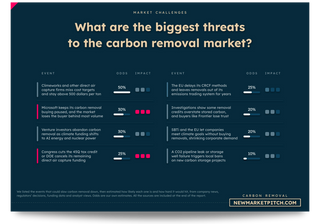
Table of the events that could slow the carbon removal market, with their odds and impact: What are the biggest threats to the carbon removal market? (Carbon Removal Market, NewMarketPitch)
Market Challenges

What could slow this market down?

Some brakes are easy to see: high costs per tonne, a small group of buyers, and public money that can vanish with a new government.

Others are easier to miss. Removal credits can be confused with cheap offsets, and one scandal can hurt the whole market. Storage sites and pipelines need permits that take years. Biomass has other uses that compete for it. And if compliance carbon markets don't accept removals, buyers have little reason to pay more than they do today.

We look at each risk in turn, rate how likely it is, and explain which removal methods it would hit hardest.

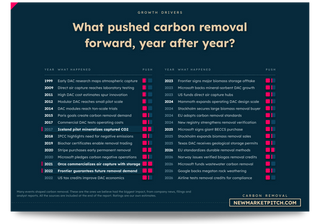
Timeline of the events that pushed the carbon removal market forward, with their impact: What pushed carbon removal forward, year after year? (Carbon Removal Market, NewMarketPitch)
Growth Drivers

What are the growth drivers in this market?

A forecast is only as good as the forces behind it, so we list them one by one.

Some drivers are obvious: corporate net-zero targets, climate scenarios that need removals to reach any target, and costs that fall as plants get bigger. Others reinforce each other. Common rules make credits easier to compare. Easier comparison brings in new buyers, which lets suppliers sign longer contracts. And longer contracts help them finance bigger plants at a lower cost per tonne.

Before building or investing, you should know what would get a second and a third large buyer to sign, and what would make governments pay for removals themselves.

Investor Bets

Where are investors placing their bets today?

Investors still back carbon removal, but they now ask harder questions about who will buy the tonnes.

We compare recent rounds across direct air capture, biochar, rock weathering and the companies that measure and certify removals. We also look at how much signed offtake contracts weigh in a raise, and we flag newer bets like registries and ratings for removal credits.

You'll see which removal startups are still raising now that the biggest buyer has slowed down, and how many contracted tonnes a younger company needs to show before investors commit.

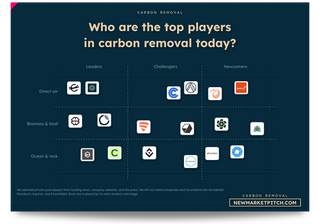
Market grid of the top carbon removal startups and companies by segment: Who are the top players in carbon removal today? (Carbon Removal Market, NewMarketPitch)
Top Players

Who are the top startups and companies?

Charm Industrial and Stockholm Exergi often come up first in carbon removal, but they're only a slice of the market.

Many of the most interesting players stay out of the headlines. Some spread crushed basalt on farms in Brazil or India and measure how much carbon it locks away. Others turn crop waste into biochar, pump CO2 into old wells, or build the software that checks every tonne before it's sold.

They're hard to compare because a tonne from a DAC plant and a tonne from a farm field don't cost the same, don't last the same and aren't checked the same way. Many also sell through brokers, so buyers rarely see who made the tonne.

Here, we share the market grids and ecosystem maps we've built to show each removal method, who supplies it, who buys it and where new players are getting in.

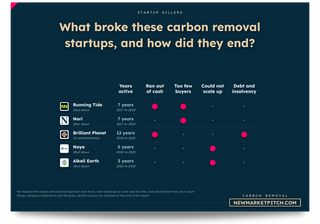
Table of carbon removal startups that shut down or struggled, and why: What broke these carbon removal startups, and how did they end? (Carbon Removal Market, NewMarketPitch)
Startup Killers

What could kill a startup in this market?

In carbon removal, a signed contract isn't revenue yet. The tonnes have to be delivered, measured and certified first.

So we studied why removal startups fail or stall. Some sign big offtake deals, then can't build the plant on time. Others pick a method whose carbon is too hard to measure, and buyers walk away. And some depend on one buyer, or on one public grant that disappears.

If you're building, you'll see why delivery, measurement and a wider set of buyers matter more than a headline contract. If you're investing, you'll know what to check about delivered tonnes, verification costs and how much revenue comes from one customer.

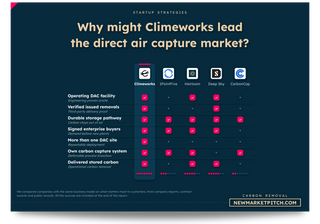
Scorecard showing what sets the leading carbon removal company apart: Why might Climeworks lead the direct air capture market? (Carbon Removal Market, NewMarketPitch)
Startup Strategies

How do you win in this market?

Exomad Green, Puro.earth, Terradot… a few carbon removal companies are already delivering tonnes, or certifying them, for paying buyers.

Exomad Green turns forestry waste into biochar in Bolivia and has signed one of the largest biochar deals so far. Puro.earth writes standards and certifies the credits that many removal suppliers sell. Terradot spreads crushed rock on farms in Brazil and works with scientists to prove how much carbon it removes. None of them has yet shown a business that works without a few large buyers.

We'll look at how these teams picked a method they could measure, signed buyers early, and kept the cost of each tonne under control.

Questions?

Who is this market report actually for?+

It's for founders, investors, companies that buy carbon credits, project developers, carbon market platforms, policymakers and strategy teams who want a clear view of carbon removal.

Use it to compare DAC, BECCS, biochar and rock weathering, to decide how to price and contract removal tonnes, to judge how far new rules could change demand, or to understand size, technology, business models, funding, competitors and risks across the whole market.

How many pages are in the report?+

It has 190+ pages. It is designed to be comprehensive enough to support serious market evaluation, while still being fast to read and easy to use.

We prioritize signal, structure, and visual clarity over unnecessary length.

What do you include in the carbon removal market?+

We define the carbon removal market as solutions that remove carbon dioxide from the atmosphere and store it.

We include direct air capture, biomass-based removal, mineralization and ecosystem-based removal with measurable storage.

We exclude avoided emissions, fossil-source capture alone and carbon accounting without actual removal.

Do you list your sources clearly?+

Yes. All key data points and assumptions are explained and sourced in the document.

All sources are tier-1: company filings, funding databases, public datasets, expert interviews, industry reports, etc.

Is the data up to date?+

Yes. The report was last updated on October 30, 2026 with the latest market signals.

Is this a one-time payment?+

Yes. This is a one-time purchase. There is no subscription required to access the document.

I want to buy several market reports, can I get a discount code?+

Yes. You can use NEWMARKET for 20% off when purchasing two reports, or NEWMARKETMAX for 30% off when purchasing five or more.

I’m interested in a market but I can’t find it here+

If a market you care about is not currently on the list, email us at team@newmarketpitch.com and we may be able to cover it.

I have more questions for you+

No problem. You can reach out directly and we respond within 24 hours.

LAST UPDATED: October 30, 2026

The carbon removal market, without the blind spots

Every carbon removal company needs buyers, and right now one company signs most of the contracts. This report covers the whole carbon removal market, from size and buyers to removal methods, business models, funding, key players, risks and where new openings are.

PRO
$49
One-time payment
  • ✓ Market Definition
  • ✓ Market Opportunity
  • ✓ Market Size
  • ✓ Pain Points
  • ✓ Tech & Infra
  • ✓ Value Creation
  • ✓ Market Challenges
  • ✓ Growth Drivers
  • ✓ Investor Bets
  • ✓ Top Players
  • ✓ Startup Killers
  • ✓ Startup Strategies
PRO+
$79
One-time payment
  • ✓ Market Definition
  • ✓ Market Opportunity
  • ✓ Market Size
  • ✓ Pain Points
  • ✓ Tech & Infra
  • ✓ Value Creation
  • ✓ Market Challenges
  • ✓ Growth Drivers
  • ✓ Investor Bets
  • ✓ Top Players
  • ✓ Startup Killers
  • ✓ Startup Strategies
PRO++
$99
One-time payment
  • ✓ Market Definition
  • ✓ Market Opportunity
  • ✓ Market Size
  • ✓ Pain Points
  • ✓ Tech & Infra
  • ✓ Value Creation
  • ✓ Market Challenges
  • ✓ Growth Drivers
  • ✓ Investor Bets
  • ✓ Top Players
  • ✓ Startup Killers
  • ✓ Startup Strategies
Use code MARKETPITCH for 10% off your order