LAST UPDATED: October 29, 2026

Make smarter decisions on the cloud database market

AI agents now spin up databases on their own, and every new app needs somewhere to keep its vectors, events and plain old rows. The real question is which databases can take that load without the bill getting out of hand. This report brings you up to speed on the whole market as it stands today.

  • 190+ pages
  • 12 sections
  • verified data only
Make smarter decisions on the cloud database market market report cover

What’s inside the report?

12 sections to help founders and investors understand the cloud database market with clarity

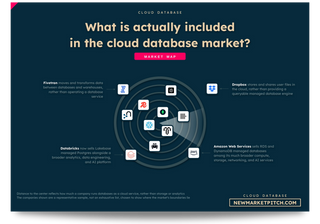
Radar map of the cloud database market showing which companies count as part of it, which sit on its edge and which stay outside: What is actually included in the cloud database market? (Cloud Database Market, NewMarketPitch)
Market Definition

Where does this market start and stop?

People often lump cloud databases together with data warehouses, storage services and analytics tools, so we first spell out what counts.

A managed Postgres service that runs an app's orders and accounts is in. So is a vector database that stores what an AI assistant searches, or a cloud analytical database behind live dashboards. Plain file storage is out, and so is a dashboard tool that only reads data someone else stores.

This way, every number and every company in the report refer to the same kind of product.

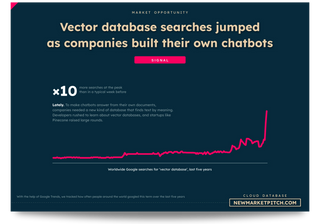
Google Trends curve of worldwide searches over five years for the cloud database market: Vector database searches jumped as companies built their own chatbots (Cloud Database Market, NewMarketPitch)
Market Opportunity

What changed for this market lately?

The cloud database market is hot again, and AI apps are the reason.

We've found a lot of interesting signals. For example, ClickHouse raised $400M at a $15B valuation in January 2026, and bought Langfuse, an open-source tool for monitoring AI apps, in the same announcement. In June, Supabase raised $500M at $10.5B, about double its valuation eight months earlier. Investors are betting that AI apps and agents will need far more databases, and they're paying up for the ones developers already like.

In this section, we explain why AI has made databases exciting again, which kinds are winning the new workloads, and what these rounds mean for the databases the big clouds sell themselves.

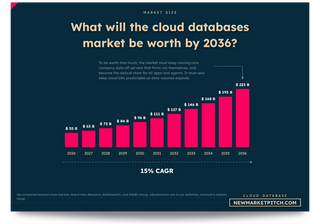
Bar chart of the cloud database market size year by year to 2036, with its growth rate: What will the cloud databases market be worth by 2036? (Cloud Database Market, NewMarketPitch)
Market Size

How big could this market get?

Cloud database market sizes online often mix in data warehouses, storage, and the on-premise licenses companies still pay for.

So we size it from first principles. We build the estimate ourselves, compare it with other sources and lay out every assumption, so you can check the math.

And we show a low case and a high case, so you can see how much the answer depends on AI workloads.

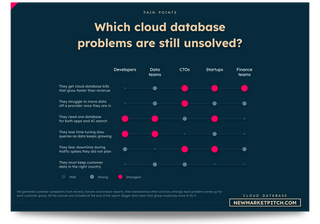
Matrix of the problems cloud database customers still face, rated for each type of buyer: Which cloud database problems are still unsolved? (Cloud Database Market, NewMarketPitch)
Pain Points

What are the pain points, and for whom?

Every app needs a database, and most teams end up running more of them than they can manage.

We compare six kinds of cloud database companies, from managed relational and document databases to vector, time-series and analytical engines. Their buyers range from solo developers and startups to large enterprises moving off old systems. Then we rank what they need most: lower bills, less time spent running databases, and enough speed when traffic spikes.

This shows which problems buyers will pay to fix now, and which ones they simply live with.

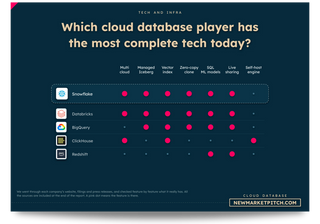
Comparison table of the tech offered by leading cloud database companies: Which cloud database player has the most complete tech today? (Cloud Database Market, NewMarketPitch)
Tech & Infra

What is the latest tech and infrastructure?

Databases used to be the boring part of the stack. Now they separate storage from compute, shrink to zero when nobody uses them, and add vector search for AI.

We map the stack from storage to the query engine, the managed service and the tools developers use to connect apps and agents. We also show where things get stuck, like migrations that take years, costs that jump with traffic, data copied back and forth between systems, and vector search added to databases that weren't built for it.

You'll see which new designs already run real workloads today, and which are still mostly promises.

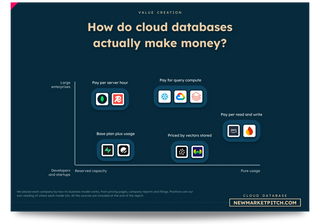
Map of cloud database business models with company logos: How do cloud databases actually make money? (Cloud Database Market, NewMarketPitch)
Value Creation

How is value created and monetized exactly?

Usage-based fees, provisioned capacity, free tiers that turn into paid plans, enterprise contracts and sales through the big clouds' marketplaces: cloud database companies make money in many ways.

We compare who pays and what it costs to serve them. Most independent databases run on AWS, Azure or Google Cloud, so part of every dollar goes back to the cloud they compete with. Free tiers bring in millions of developers, but only a few turn into big accounts. And usage pricing grows with customers, but it also shrinks when they tune their queries.

You'll see which models keep healthy margins after paying the cloud bill, and which ones depend on customers never shopping around.

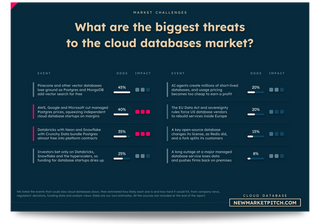
Table of the events that could slow the cloud database market, with their odds and impact: What are the biggest threats to the cloud databases market? (Cloud Database Market, NewMarketPitch)
Market Challenges

What could slow this market down?

Some brakes are easy to see: the big clouds bundle their own databases, migrations are slow and risky, and Postgres is free for anyone to host.

Others are easier to miss. Open-source licenses can change overnight, and so can the community behind a project. Vector search is becoming a feature of every database, which squeezes the specialists. Agents can create thousands of tiny databases that cost money but earn little. And one big outage can make a buyer rethink a whole vendor.

We go through each of these risks, rate how likely it is, and show who would feel it most.

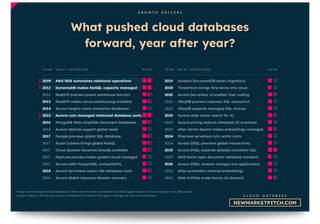
Timeline of the events that pushed the cloud database market forward, with their impact: What pushed cloud databases forward, year after year? (Cloud Database Market, NewMarketPitch)
Growth Drivers

What are the growth drivers in this market?

Any growth forecast is only as good as the reasons behind it. So here we lay out what actually pushes cloud databases forward.

Some drivers are plain to see: more apps, more data, and companies leaving the servers they run themselves. Others build on each other. AI apps need vector search and memory for their agents. Coding tools now set up a database with every new project. And the more data a company keeps in one database, the harder it is to move away.

Before building or investing, you should know what makes a team pick a database for a new project, and what keeps it there years later.

Investor Bets

What are investors betting on now?

Databases were a quiet corner of software investing for years. AI has put them back on investors' lists.

We compare recent rounds across Postgres platforms, analytical engines and vector databases. We also look at whether investors prefer databases built for AI agents or general databases that added AI features. And we flag the newer bets, like databases that run inside the app or close to users and sync with the cloud.

You'll see which database companies are raising now, after rounds like ClickHouse's, and how much developer usage a younger company needs to show before it can raise.

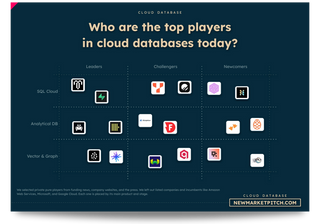
Market grid of the top cloud database startups and companies by segment: Who are the top players in cloud databases today? (Cloud Database Market, NewMarketPitch)
Top Players

Who are the top startups and companies?

Snowflake and MongoDB are the names most people know in cloud databases, but they're only part of the story.

Plenty of strong teams work further from the headlines. Some build databases that agents can create and throw away in seconds. Others handle time-series data for factories and power grids, store graphs for fraud detection, or keep small databases running inside apps that sync to the cloud.

They're hard to compare because many are built on the same open-source engines, like Postgres. Two products can look alike on a pricing page and behave very differently under heavy traffic. And many sell through the big clouds' marketplaces, so outsiders rarely see how much they really sell.

Below, you'll find the market grids and ecosystem maps we've built to show which database does what, and where the newer engines fit.

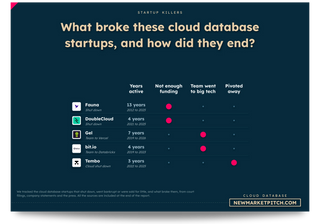
Table of cloud database startups that shut down or struggled, and why: What broke these cloud database startups, and how did they end? (Cloud Database Market, NewMarketPitch)
Startup Killers

What could kill a startup in this market?

Developers will try any database for free. Moving their data in for good is another matter.

So we studied why cloud database startups fail or stall. Some build a great engine but can't compete with the database the big cloud bundles in. Others grow on a free tier that never turns into revenue. And some see their open-source project hosted by someone else, or change their license and lose the community.

If you're building, you'll see why turning free users into paying ones and staying ahead of the big clouds' own databases matter more than benchmark wins. If you're investing, you'll know what to check about free-tier conversion, cloud costs and license risk.

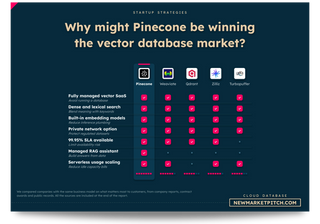
Scorecard showing what sets the leading cloud database company apart: Why might Pinecone be winning the vector database market? (Cloud Database Market, NewMarketPitch)
Startup Strategies

How do you win in this market?

Neon, PlanetScale, Pinecone… a few cloud database startups have won something real. They just haven't all won the same thing.

Neon made Postgres quick to start and cheap to pause, and Databricks bought it for about $1B as AI agents began creating databases. PlanetScale built its name running MySQL for very large apps, then added Postgres. Pinecone turned vector search into a product people paid for early, and now competes with databases that added vectors themselves.

We'll look at what these teams got right with developers first, and what it took to keep customers once bigger rivals offered something similar.

Questions?

Who is this market report actually for?+

It's for founders, investors, engineering and data leaders, platform teams and software companies who want a clear view of cloud databases.

Use it to choose between a big cloud's own database and an independent one, to decide whether AI apps need a dedicated vector database, to compare usage and capacity pricing, or to understand demand, technology, funding, competitors and risks across the whole market.

How many pages are in the report?+

It has 190+ pages. It is designed to be comprehensive enough to support serious market evaluation, while still being fast to read and easy to use.

We prioritize signal, structure, and visual clarity over unnecessary length.

What do you include in the cloud database market?+

We define the cloud database market as database products delivered or operated as cloud services.

We include managed relational, document, graph, vector and analytical databases.

We exclude on-premise-only database products, general storage services and analytics tools that do not provide a database.

Do you list your sources clearly?+

Yes. All key data points and assumptions are explained and sourced in the document.

All sources are tier-1: company filings, funding databases, public datasets, expert interviews, industry reports, etc.

Is the data up to date?+

Yes. The report was last updated on October 29, 2026 with the latest market signals.

Is this a one-time payment?+

Yes. This is a one-time purchase. There is no subscription required to access the document.

I want to buy several market reports, can I get a discount code?+

Yes. You can use NEWMARKET for 20% off when purchasing two reports, or NEWMARKETMAX for 30% off when purchasing five or more.

I’m interested in a market but I can’t find it here+

If a market you care about is not currently on the list, email us at team@newmarketpitch.com and we may be able to cover it.

I have more questions for you+

No problem. You can reach out directly and we respond within 24 hours.

LAST UPDATED: October 29, 2026

Get the full picture of the cloud database market

A database is easy to try and very hard to leave, which is great for the winners and brutal for everyone else. This report maps the wider cloud database market, from market size and customer needs to technology, pricing models, funding, competitors and risks.

PRO
$49
One-time payment
  • ✓ Market Definition
  • ✓ Market Opportunity
  • ✓ Market Size
  • ✓ Pain Points
  • ✓ Tech & Infra
  • ✓ Value Creation
  • ✓ Market Challenges
  • ✓ Growth Drivers
  • ✓ Investor Bets
  • ✓ Top Players
  • ✓ Startup Killers
  • ✓ Startup Strategies
PRO+
$79
One-time payment
  • ✓ Market Definition
  • ✓ Market Opportunity
  • ✓ Market Size
  • ✓ Pain Points
  • ✓ Tech & Infra
  • ✓ Value Creation
  • ✓ Market Challenges
  • ✓ Growth Drivers
  • ✓ Investor Bets
  • ✓ Top Players
  • ✓ Startup Killers
  • ✓ Startup Strategies
PRO++
$99
One-time payment
  • ✓ Market Definition
  • ✓ Market Opportunity
  • ✓ Market Size
  • ✓ Pain Points
  • ✓ Tech & Infra
  • ✓ Value Creation
  • ✓ Market Challenges
  • ✓ Growth Drivers
  • ✓ Investor Bets
  • ✓ Top Players
  • ✓ Startup Killers
  • ✓ Startup Strategies
Use code MARKETPITCH for 10% off your order