LAST UPDATED: October 28, 2026

Make better decisions on the cloud infrastructure market

Cloud infrastructure is booming, so are the bills. The big clouds are spending more than ever to keep up with AI, and their largest customers are signing bigger, longer contracts. At the same time, many companies wonder whether they pay too much, and where their data should live. This report maps the whole market, from the biggest clouds to the smaller players picking off their customers.

  • 190+ pages
  • 12 sections
  • verified data only
Make better decisions on the cloud infrastructure market market report cover

What’s inside the report?

12 sections to help founders and investors understand the cloud infrastructure market with clarity

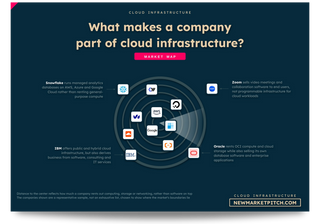
Radar map of the cloud infrastructure market showing which companies count as part of it, which sit on its edge and which stay outside: What makes a company part of cloud infrastructure? (Cloud Infrastructure Market, NewMarketPitch)
Market Definition

Where does this market start and stop?

"The cloud" can mean almost anything, from an email app to a data center, so we start by saying exactly what we count.

Renting virtual servers, storage or networking from a cloud provider is in. So are the platforms teams use to run containers, serverless functions and private clouds. A SaaS app like a CRM is out, and so is a server a company buys and runs in its own building.

It means the market size, the growth rate and the companies we compare all describe the same market.

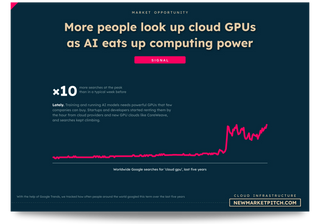
Google Trends curve of worldwide searches over five years for the cloud infrastructure market: More people look up cloud GPUs as AI eats up computing power (Cloud Infrastructure Market, NewMarketPitch)
Market Opportunity

Why this market now?

Cloud infrastructure is growing fast again, and AI is pushing the bills up.

We've found a lot of interesting signals. For example, OpenAI signed a $38B deal in November 2025 to run its models on AWS over seven years. Then, in February 2026, Alphabet said it would spend $175B to $185B on infrastructure this year, about double the year before, as its cloud backlog of signed contracts reached $240B. The biggest buyers are locking in capacity for years, and the clouds are spending as fast as they can to deliver it.

We'll dig into why AI has restarted cloud growth, who is paying for all this capacity, and what it means for smaller providers and the companies renting from them.

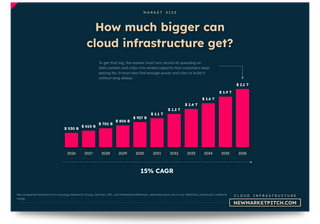
Bar chart of the cloud infrastructure market size year by year to 2036, with its growth rate: How much bigger can cloud infrastructure get? (Cloud Infrastructure Market, NewMarketPitch)
Market Size

How big could this market get?

Cloud infrastructure market sizes online often lump in SaaS, data center construction, or every IT dollar a company spends.

We size the market from first principles, then check our number against other sources. Every assumption is written down, so you can see where it comes from and decide how much to trust it.

We also show how the number moves if AI demand keeps climbing, or if companies slow down and start trimming their cloud bills.

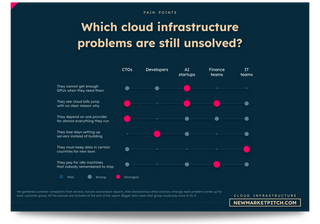
Matrix of the problems cloud infrastructure customers still face, rated for each type of buyer: Which cloud infrastructure problems are still unsolved? (Cloud Infrastructure Market, NewMarketPitch)
Pain Points

What are the pain points, and for whom?

Companies moved to the cloud to save money and move faster. Many now get a monthly bill nobody fully understands.

We compare six kinds of cloud infrastructure companies, from compute and storage providers to Kubernetes platforms, edge clouds and tools that manage costs across clouds. Their buyers range from startups and SaaS companies to banks and governments. Then we rank what they need most: lower bills, capacity when they need it, and control over where their data sits.

This shows which problems buyers will pay to fix first, and which ones they put up with to avoid a move.

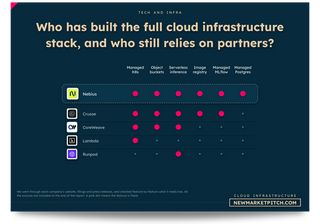
Comparison table of the tech offered by leading cloud infrastructure companies: Who has built the full cloud infrastructure stack, and who still relies on partners? (Cloud Infrastructure Market, NewMarketPitch)
Tech & Infra

What is the latest tech and infrastructure?

The cloud is no longer just rented servers. It now includes custom chips, serverless platforms that bill by the millisecond, and networks that reach into hundreds of cities.

We map the stack from chips and data centers to virtual machines, containers, serverless, networking and the tools that manage it all. We also show where things get stuck, like GPU shortages, fees for moving data out of a cloud, Kubernetes that takes a full team to run, and outages in one region that take thousands of apps down with them.

You'll see which parts of the stack are settled today, and which are still changing fast because of AI.

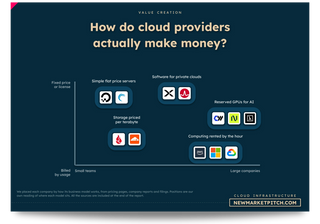
Map of cloud infrastructure business models with company logos: How do cloud providers actually make money? (Cloud Infrastructure Market, NewMarketPitch)
Value Creation

How is value created and monetized exactly?

Pay-as-you-go compute, reserved capacity, multi-year spending commitments, storage and data transfer fees, and managed platforms priced on usage: cloud infrastructure providers make money in many ways.

We compare who pays and what it costs to serve them. Hyperscalers spend billions on data centers years before the revenue arrives. Smaller clouds compete on price, but they pay as much for chips and more to borrow. Software layers like Kubernetes platforms keep higher margins, but they depend on the clouds they run on. And fees for moving data out bring in money while making customers angry.

You'll see which models can earn back huge upfront spending, and which ones get squeezed between the hyperscalers and their own suppliers.

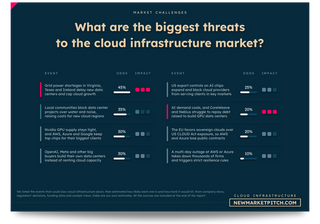
Table of the events that could slow the cloud infrastructure market, with their odds and impact: What are the biggest threats to the cloud infrastructure market? (Cloud Infrastructure Market, NewMarketPitch)
Market Challenges

What could slow this market down?

Some brakes are easy to see: power and chip shortages, rising building costs, and customers watching their cloud bills more closely.

Others are easier to miss. Regulators in Europe and the UK keep looking at the fees and licensing rules that make it hard to switch clouds. Governments want data kept at home. A few AI labs sign a large share of new contracts, so one cancellation can matter a lot. And a single big outage can push companies to spread their work across several providers.

In this section, we map each risk, rate how likely it is, and explain who would take the biggest hit.

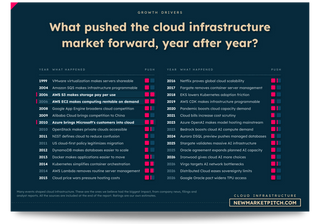
Timeline of the events that pushed the cloud infrastructure market forward, with their impact: What pushed the cloud infrastructure market forward, year after year? (Cloud Infrastructure Market, NewMarketPitch)
Growth Drivers

What are the growth drivers in this market?

We give you a realistic growth rate. Here, we show what has to keep happening for the market to get there.

Some drivers are plain to see: AI training and inference, more data, and companies still moving old systems out of their own server rooms. Others feed each other. Every new AI app needs compute, storage and networking around the model. Long contracts give providers the confidence to build more. And once a company runs on one cloud, it tends to add more services from the same provider.

Before building or investing, you should know what keeps customers spending more each year, and what makes them move work somewhere cheaper.

Investor Bets

What are investors chasing right now?

Most of the money going into cloud infrastructure now comes from the giants themselves. Investors look for the gaps they leave open.

We compare recent rounds across developer clouds, edge platforms, sovereign clouds and tools that cut cloud costs. We also look at how investors weigh companies that own their servers against software that runs on someone else's. And we flag the newer bets, like platforms built to run AI agents.

You'll see which cloud startups are raising now that the giants are spending at record levels, and what a younger provider needs to show to raise money next to them.

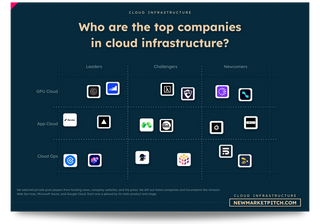
Market grid of the top cloud infrastructure startups and companies by segment: Who are the top companies in cloud infrastructure? (Cloud Infrastructure Market, NewMarketPitch)
Top Players

Who are the top startups and companies?

AWS, Microsoft Azure and Google Cloud take most of the money in cloud infrastructure, but they're far from the only players.

Away from the giants, a lot of smaller providers do one thing well. Some rent simple servers to developers and small companies at simpler, cheaper prices. Others run clouds that keep European data under European law, manage Kubernetes for teams that don't want to, or put computing in hundreds of cities close to users.

They're hard to compare because very different businesses use the same word. A provider that owns its data centers and a platform that runs on top of a hyperscaler can both call themselves a cloud. And many smaller providers are private, so their revenue and margins rarely show up anywhere.

Below, you'll find the market grids and ecosystem maps we've built to show who runs which layer of the cloud, and where smaller providers still win deals.

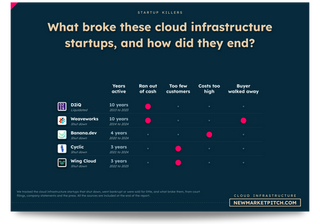
Table of cloud infrastructure startups that shut down or struggled, and why: What broke these cloud infrastructure startups, and how did they end? (Cloud Infrastructure Market, NewMarketPitch)
Startup Killers

What could kill a startup in this market?

In cloud infrastructure, your biggest competitor is often also your supplier, your landlord and your customer's default choice.

So we studied why cloud infrastructure startups fail or stall. Some compete on price and run out of money before they get big enough. Others build a tool that a hyperscaler later adds for free. And some depend on one or two large customers, then struggle when those customers leave or build their own.

If you're building, you'll see why a clear edge on price, simplicity or location matters more than matching every hyperscaler feature. If you're investing, you'll know what to check about upfront spending, customer concentration and how exposed a company is to the giants' next launch.

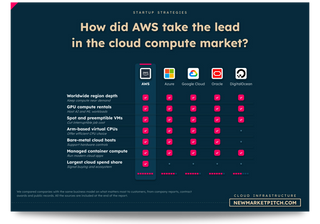
Scorecard showing what sets the leading cloud infrastructure company apart: How did AWS take the lead in the cloud compute market? (Cloud Infrastructure Market, NewMarketPitch)
Startup Strategies

How do you win in this market?

Cloudflare, DigitalOcean, OVHcloud… a few companies have built real cloud businesses next to the giants.

Cloudflare started with a network that sits in front of websites, then let developers run code on it. DigitalOcean kept its cloud simple and predictable for developers and small companies. OVHcloud builds its own servers and sells European customers a cloud that stays under European law. None of them tried to beat the hyperscalers at everything.

We'll show how these teams picked a fight they could win, and kept customers who could easily have gone to the biggest clouds.

Questions?

Who is this market report actually for?+

It's for founders, investors, CTOs, platform and infrastructure teams, cloud providers and strategy teams looking at cloud infrastructure.

Use it to compare hyperscalers with smaller and sovereign clouds, to decide what to keep on reserved capacity or bring back in-house, to see how AI demand changes pricing and supply, or to understand demand, technology, funding, competitors and risks across the whole market.

How many pages are in the report?+

It has 190+ pages. It is designed to be comprehensive enough to support serious market evaluation, while still being fast to read and easy to use.

We prioritize signal, structure, and visual clarity over unnecessary length.

What do you include in the cloud infrastructure market?+

We define the cloud infrastructure market as computing resources and infrastructure services delivered through cloud environments.

We include cloud compute, storage, networking and platforms used to deploy and manage cloud workloads.

We exclude end-user SaaS applications, on-premise-only equipment and consulting without an infrastructure offering.

Do you list your sources clearly?+

Yes. All key data points and assumptions are explained and sourced in the document.

All sources are tier-1: company filings, funding databases, public datasets, expert interviews, industry reports, etc.

Is the data up to date?+

Yes. The report was last updated on October 28, 2026 with the latest market signals.

Is this a one-time payment?+

Yes. This is a one-time purchase. There is no subscription required to access the document.

I want to buy several market reports, can I get a discount code?+

Yes. You can use NEWMARKET for 20% off when purchasing two reports, or NEWMARKETMAX for 30% off when purchasing five or more.

I’m interested in a market but I can’t find it here+

If a market you care about is not currently on the list, email us at team@newmarketpitch.com and we may be able to cover it.

I have more questions for you+

No problem. You can reach out directly and we respond within 24 hours.

LAST UPDATED: October 28, 2026

Build or invest in the cloud infrastructure market with clear eyes

The cloud giants are spending record sums, and every smaller provider has to decide where it can still compete. This report walks through the whole cloud infrastructure market: how big it is, who buys, the tech stack, how providers make money, where funding goes, who competes, and what could go wrong.

PRO
$49
One-time payment
  • ✓ Market Definition
  • ✓ Market Opportunity
  • ✓ Market Size
  • ✓ Pain Points
  • ✓ Tech & Infra
  • ✓ Value Creation
  • ✓ Market Challenges
  • ✓ Growth Drivers
  • ✓ Investor Bets
  • ✓ Top Players
  • ✓ Startup Killers
  • ✓ Startup Strategies
PRO+
$79
One-time payment
  • ✓ Market Definition
  • ✓ Market Opportunity
  • ✓ Market Size
  • ✓ Pain Points
  • ✓ Tech & Infra
  • ✓ Value Creation
  • ✓ Market Challenges
  • ✓ Growth Drivers
  • ✓ Investor Bets
  • ✓ Top Players
  • ✓ Startup Killers
  • ✓ Startup Strategies
PRO++
$99
One-time payment
  • ✓ Market Definition
  • ✓ Market Opportunity
  • ✓ Market Size
  • ✓ Pain Points
  • ✓ Tech & Infra
  • ✓ Value Creation
  • ✓ Market Challenges
  • ✓ Growth Drivers
  • ✓ Investor Bets
  • ✓ Top Players
  • ✓ Startup Killers
  • ✓ Startup Strategies
Use code MARKETPITCH for 10% off your order