LAST UPDATED: November 21, 2026

Make better decisions on the crypto wallet market

Lose your seed phrase, lose it all, wallets want to fix that. Keeping keys safe without scaring new users away is the hard part, while the wallet turns into the crypto app people open every day, with cards, trading and savings built in. This report covers the whole crypto wallet market, from phone apps and hardware to the infrastructure behind them.

  • 190+ pages
  • 12 sections
  • verified data only
Make better decisions on the crypto wallet market market report cover

What’s inside the report?

12 sections to help founders and investors understand the crypto wallet market with clarity

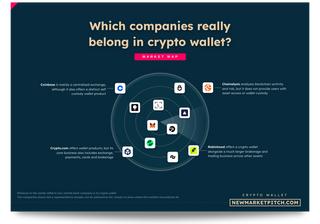
Radar map of the crypto wallet market showing which companies count as part of it, which sit on its edge and which stay outside: Which companies really belong in crypto wallet? (Crypto Wallet Market, NewMarketPitch)
Market Definition

What does this market really cover?

People use the word wallet for very different things, from a phone app to a bank-grade custody system. So the first step is to pin down what we count and what we leave out.

A phone app where you hold your own keys is in. So is a hardware device, a custodial wallet sold as its own product, and the tools that let other apps create wallets for their users. An exchange account with no separate wallet is out, and so is analytics software that can't move a single coin.

That way, the market size, the company comparisons and the funding data all describe the same market.

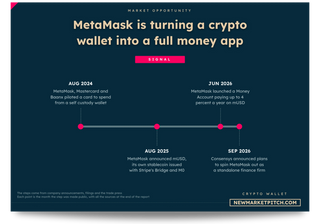
Timeline of the dated steps showing how the crypto wallet market is moving, with one key signal: MetaMask is turning a crypto wallet into a full money app (Crypto Wallet Market, NewMarketPitch)
Market Opportunity

Why this market now?

Wallets have become one of the most fought-over parts of crypto, and security is still their weak point.

We've found a lot of interesting signals. For example, in October 2025, Fireblocks agreed to buy Dynamic, whose tools let apps create wallets and log users in. In September 2026, Consensys said it would split in two and turn MetaMask into a separate company, because the wallet was growing faster than the rest of the business. And in December 2025, a poisoned update of Trust Wallet's Chrome extension let attackers drain about $7M from users. Big companies are paying up to own wallets, and one bad update can still empty a user's account.

In this section, we look at why so many companies want to own the wallet, which kinds of wallets are winning users, and why security keeps holding the market back.

Bar chart of the crypto wallet market size year by year to 2036, with its growth rate: How much room is left for crypto wallet to grow? (Crypto Wallet Market, NewMarketPitch)
Market Size

How big could this market get?

Wallet market numbers online often mix in hardware sales, crypto trading revenue or the value of the assets people hold, which are very different things.

We size the market from first principles, starting from who pays wallet companies and for what. Then we compare our estimate with other sources and lay out every assumption.

We also show how the number changes if adoption stays slow, and if it speeds up.

Matrix of the problems crypto wallet customers still face, rated for each type of buyer: What are the unsolved pain points in crypto wallet? (Crypto Wallet Market, NewMarketPitch)
Pain Points

What are the pain points, and for whom?

Holding crypto is still stressful. Lose a seed phrase, sign the wrong transaction or click a fake link, and the money is gone for good.

We compare six types of wallet companies, from consumer apps and hardware wallets to smart contract wallets and the infrastructure that banks, fintechs and games plug into. Then we rank what their users and buyers need most: safe recovery, simple sign-up, fewer scams and support for many blockchains.

This shows which problems people will pay a wallet to solve, and which ones they expect for free.

Comparison table of the tech offered by leading crypto wallet companies: Which crypto wallet players can already do the most today? (Crypto Wallet Market, NewMarketPitch)
Tech & Infra

What is the latest tech and infrastructure?

A wallet looks like a simple app. Underneath, it has to protect keys, talk to dozens of blockchains and warn users before they sign something dangerous.

We map the stack layer by layer, from key storage, MPC and secure chips to smart accounts, passkeys and the nodes a wallet reads from. We also show where things get stuck, like recovery that still depends on a seed phrase, fees that must be paid in a token the user doesn't have, and browser extensions that one bad update can turn against their users.

You'll see which parts already work well today, and which still put users' money at risk.

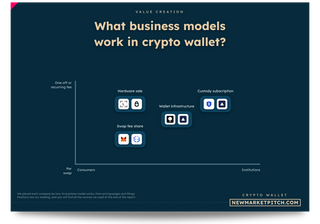
Map of crypto wallet business models with company logos: What business models work in crypto wallet? (Crypto Wallet Market, NewMarketPitch)
Value Creation

How is value created and monetized exactly?

Swap fees, hardware sales, subscriptions, staking commissions, card revenue and per-wallet fees paid by developers: wallet companies earn money in many ways, and little of it comes from simply holding coins.

We compare who pays and what each model really costs. A consumer app takes a small cut on swaps, but users can move to another app in minutes. A hardware maker sells a device once, then has to find other things to sell the same buyer. Infrastructure providers charge apps per active wallet or per signature, which is steadier but rises and falls with their clients. Security work, audits and customer support cost money in every model.

You'll see which models still make money when swap fees fall and users hop between apps.

Table of the events that could slow the crypto wallet market, with their odds and impact: What are the biggest threats to the crypto wallet market? (Crypto Wallet Market, NewMarketPitch)
Market Challenges

What could slow this market down?

Some risks are easy to see: hacks, phishing, falling crypto prices that cut usage, and rules that treat custodial wallets like financial firms.

Others are easier to miss. Browsers and app stores can block or delay an update. Exchanges and fintechs build their own wallets and drop outside providers. Free wallets make paid features hard to sell. And a leak of customer names and addresses can put users in physical danger.

For each risk, we rate how likely it is and which types of wallets would feel it most.

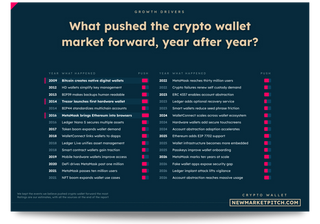
Timeline of the events that pushed the crypto wallet market forward, with their impact: What pushed the crypto wallet market forward, year after year? (Crypto Wallet Market, NewMarketPitch)
Growth Drivers

What are the growth drivers in this market?

A growth figure needs reasons behind it. Here, we explain what pushes more people and companies to use wallets.

Some drivers are clear: stablecoins people use to save and pay, clearer rules in Europe and the US, and phones that can store keys in a secure chip. Others feed each other. Easier login brings in users who never wrote down a seed phrase. More users make wallets worth building on for apps and games. And once a wallet holds someone's card and savings, they open it every day.

Before building or investing, you should know what makes someone trust a wallet with real savings, and what stops them from moving to the next free app.

Bar chart of where investors put their money in crypto wallet, by category: Where did crypto wallet investors put their money this past year? (Crypto Wallet Market, NewMarketPitch)
Investor Bets

What are investors betting on now?

Wallets have become a favorite target for crypto investors and buyers, from consumer apps to the tools behind them.

We go through the latest rounds and deals and what they have in common. We compare the money going into consumer apps, hardware makers and the infrastructure other companies build on. We also look at whether investors prefer wallets that earn from trading or from software fees, and which newer bets, like wallets for AI agents or for banks, are starting to raise.

You'll see which wallet businesses investors trust today, after deals like Fireblocks' purchase of Dynamic, and what a younger team needs to show before it raises.

Market grid of the top crypto wallet startups and companies by segment: Which companies lead crypto wallet right now? (Crypto Wallet Market, NewMarketPitch)
Top Players

Who are the top startups and companies?

Phantom and Ledger are the names most crypto users know, but they're only a small part of the wallet market.

Plenty of interesting companies stay in the background. Some build wallets you recover with a face scan or a passkey. Others give banks and brokers the custody technology behind their crypto offer, check every transaction for scams before you sign, or let a game create a wallet for each player without them noticing.

They're hard to spot because many work behind someone else's brand. A user sees the logo of their bank or their game, not the company holding the keys. And download numbers say little about how many wallets actually hold money.

Below, you'll find the market grids and ecosystem maps we built to show who does what, from the device in your pocket to the infrastructure banks plug into.

Table of crypto wallet startups that shut down or struggled, and why: What broke these crypto wallet startups, and how did they end? (Crypto Wallet Market, NewMarketPitch)
Startup Killers

What could kill a startup in this market?

In wallets, one bad update can undo years of trust. Users don't blame the hacker. They blame the app.

We looked at wallet startups that failed or stalled. Some grew fast on a token airdrop, then lost users when the rewards stopped. Others built for one blockchain that fell out of fashion. And some infrastructure startups depended on a few big clients who later built their own wallets.

If you're building, you'll see why security, easy recovery and support for the right chains matter more than a slick interface. If you're investing, you'll know what to check about wallets that actually hold money, revenue per user and dependence on a few big clients.

Scorecard showing what sets the leading crypto wallet company apart: How did Ledger take the lead in hardware crypto wallets? (Crypto Wallet Market, NewMarketPitch)
Startup Strategies

How do you win in this market?

Safe, BitGo, Exodus… a few wallet companies have built real businesses, and they make money in very different ways.

Safe provides the smart accounts that DAOs, foundations and institutions use to protect shared funds, and other wallets build on its open-source code. Its revenue grew about fivefold in 2025, though it says it is not profitable yet. BitGo sells custody and wallet services to institutions and went public on the NYSE in January 2026. Exodus runs a self-custody app, earns mostly from swaps made inside it, and also sells its swap service to other businesses. Each found a different buyer, and none of these models fits every wallet.

We'll look at how these teams chose who to sell to, earned trust before chasing scale, and kept revenue coming when trading slowed down.

Questions?

Who is this market report actually for?+

It's for founders, investors, wallet teams, banks and fintechs, exchanges, security teams and strategists who want a clear view of crypto wallets.

Use it to choose between self-custody and custodial models, to decide whether to build a wallet or plug into wallet infrastructure, to compare swap, hardware and software revenue, or to understand demand, technology, funding, competitors and risks across the whole market.

How many pages are in the report?+

It has 190+ pages. It is designed to be comprehensive enough to support serious market evaluation, while still being fast to read and easy to use.

We prioritize signal, structure, and visual clarity over unnecessary length.

What do you include in the crypto wallet market?+

We define the crypto wallet market as consumer, institutional and developer products whose core value is creating, securing, recovering or operating blockchain wallets and their signing authority.

We include software and mobile self-custody wallets, chain-specific and Bitcoin wallets, hardware wallets, smart-contract and social-recovery wallets, multiparty computation, multisignature and institutional custody wallet platforms, embedded wallet SDKs, and wallet-first apps built around the wallet.

We exclude centralized exchanges where custody is ancillary, standalone DEX aggregators, payment processors and stablecoin rail providers without a wallet-first product, general blockchain nodes, analytics and identity tools, non-commercial foundations, and older acquired or listed wallet providers.

Do you list your sources clearly?+

Yes. All key data points and assumptions are explained and sourced in the document.

All sources are tier-1: company filings, funding databases, public datasets, expert interviews, industry reports, etc.

Is the data up to date?+

Yes. The report was last updated on November 21, 2026 with the latest market signals.

Is this a one-time payment?+

Yes. This is a one-time purchase. There is no subscription required to access the document.

I want to buy several market reports, can I get a discount code?+

Yes. You can use NEWMARKET for 20% off when purchasing two reports, or NEWMARKETMAX for 30% off when purchasing five or more.

I’m interested in a market but I can’t find it here+

If a market you care about is not currently on the list, email us at team@newmarketpitch.com and we may be able to cover it.

I have more questions for you+

No problem. You can reach out directly and we respond within 24 hours.

LAST UPDATED: November 21, 2026

Make smarter decisions about the crypto wallet market

A wallet can win millions of users with a free app and lose them after one hack or one confusing signing screen. This report covers the whole crypto wallet market, from size and users to technology, business models, funding, key players, risks and openings.

PRO
$49
One-time payment
  • ✓ Market Definition
  • ✓ Market Opportunity
  • ✓ Market Size
  • ✓ Pain Points
  • ✓ Tech & Infra
  • ✓ Value Creation
  • ✓ Market Challenges
  • ✓ Growth Drivers
  • ✓ Investor Bets
  • ✓ Top Players
  • ✓ Startup Killers
  • ✓ Startup Strategies
PRO+
$79
One-time payment
  • ✓ Market Definition
  • ✓ Market Opportunity
  • ✓ Market Size
  • ✓ Pain Points
  • ✓ Tech & Infra
  • ✓ Value Creation
  • ✓ Market Challenges
  • ✓ Growth Drivers
  • ✓ Investor Bets
  • ✓ Top Players
  • ✓ Startup Killers
  • ✓ Startup Strategies
PRO++
$99
One-time payment
  • ✓ Market Definition
  • ✓ Market Opportunity
  • ✓ Market Size
  • ✓ Pain Points
  • ✓ Tech & Infra
  • ✓ Value Creation
  • ✓ Market Challenges
  • ✓ Growth Drivers
  • ✓ Investor Bets
  • ✓ Top Players
  • ✓ Startup Killers
  • ✓ Startup Strategies
Use code MARKETPITCH for 10% off your order