LAST UPDATED: October 27, 2026

Make better decisions on the digital banking market

Neobanks used to lose money, the biggest now make it. They are now getting full bank licences, and the race has moved from opening accounts to becoming the account people get paid into. This report walks you through the whole digital banking market as it stands today.

  • 190+ pages
  • 12 sections
  • verified data only
Make better decisions on the digital banking market market report cover

What’s inside the report?

12 sections to help founders and investors understand the digital banking market with clarity

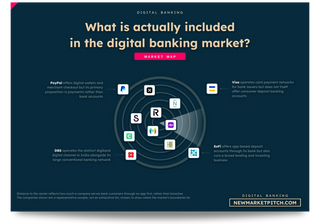
Radar map of the digital banking market showing which companies count as part of it, which sit on its edge and which stay outside: What is actually included in the digital banking market? (Digital Banking Market, NewMarketPitch)
Market Definition

What does this market really cover?

People call almost any finance app with a card a digital bank. So we start by drawing the line.

A neobank where you keep your salary, your debit card and your savings is in. So is a business account for a small company, and the platform that lets others launch bank accounts. A buy now, pay later app is out, and so is a traditional bank's mobile app, unless the bank runs a separate digital brand.

Every number and company comparison later in the report uses this same line.

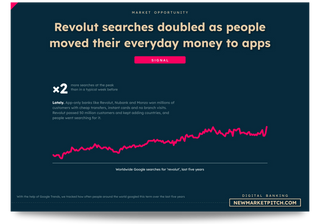
Google Trends curve of worldwide searches over five years for the digital banking market: Revolut searches doubled as people moved their everyday money to apps (Digital Banking Market, NewMarketPitch)
Market Opportunity

What changed for this market lately?

Digital banking is growing up. The largest neobanks are turning into full banks in their biggest markets.

We've found a lot of interesting signals. For example, in January 2026, Nubank won conditional approval from the US banking regulator, the OCC, to open a national bank in the United States. And in March 2026, after applying in 2021, Revolut finally got its full UK banking licence. The leaders no longer want to rent a partner bank's licence. They want their own.

In this section, we look at why licences matter so much now, what changes when a neobank can lend from its own deposits, and what it means for younger digital banks that still rely on partner banks.

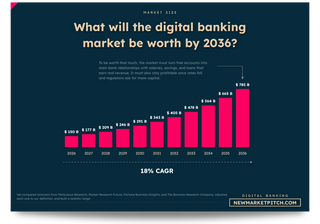
Bar chart of the digital banking market size year by year to 2036, with its growth rate: What will the digital banking market be worth by 2036? (Digital Banking Market, NewMarketPitch)
Market Size

How big could this market get?

Digital banking market sizes online often count deposits, loan books or every bank's app users, so the numbers rarely line up.

We start from first principles and build our own estimate. Then we compare it with other sources and lay out every assumption along the way.

We also show a cautious and an optimistic scenario, so you can see what has to go right for the market to grow faster.

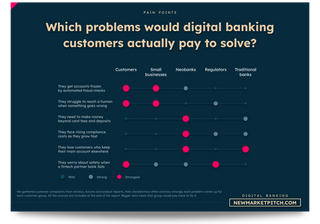
Matrix of the problems digital banking customers still face, rated for each type of buyer: Which problems would digital banking customers actually pay to solve? (Digital Banking Market, NewMarketPitch)
Pain Points

What are the pain points, and for whom?

Many people and small firms still pay too much for a basic account, wait days to open one, or can't get one at all.

We compare six types of digital banks, from consumer neobanks and accounts for small businesses to banks for freelancers, families and newcomers to a country. Then we rank what their customers need most: fast sign-up, low fees, quick access to their pay, and an account that works across borders.

This shows which needs make people move their main account, and which ones only earn a spare card in the drawer.

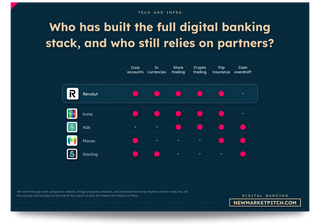
Comparison table of the tech offered by leading digital banking companies: Who has built the full digital banking stack, and who still relies on partners? (Digital Banking Market, NewMarketPitch)
Tech & Infra

What is the latest tech and infrastructure?

A nice app sits on top of a lot of plumbing. A digital bank needs a core banking system, card issuing, identity checks and fraud tools that all work in real time.

We map the stack layer by layer, from core systems and card processors to open banking links, instant payment rails and the partner banks that hold deposits. We also show where things get stuck, like slow checks at sign-up, old cores that can't launch products fast, and partner banks that pull back.

You'll see which parts of the stack a digital bank can rent today, and which ones it has to own to stand out.

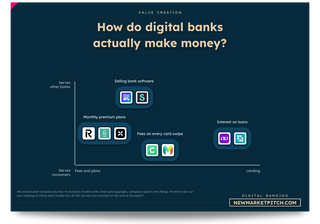
Map of digital banking business models with company logos: How do digital banks actually make money? (Digital Banking Market, NewMarketPitch)
Value Creation

How is value created and monetized exactly?

Card fees, interest on deposits, lending, monthly plans, currency fees on travel spending and software sold to other banks: digital banks earn money in more ways than it seems.

We compare who pays and where the margins come from. Card fees are small on each payment and capped in some regions, like Europe. Deposit income rises and falls with interest rates. Lending pays more but brings credit losses. Paid plans work only if people value the extras. And a bank that sells its own software to other banks turns a cost into revenue.

You'll see which models still make money when rates fall, and which ones depend on customers who never move their salary.

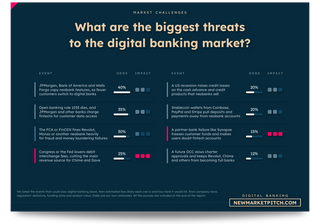
Table of the events that could slow the digital banking market, with their odds and impact: What are the biggest threats to the digital banking market? (Digital Banking Market, NewMarketPitch)
Market Challenges

What could slow this market down?

Some brakes are easy to see: people keep their salary at their old bank, licences take years, and big banks now have good apps too.

Others are easier to miss. When a middleman between apps and banks fails, as Synapse did in 2024, customers can lose access to their money for months. Falling rates shrink deposit income. Scams push regulators to demand more checks at sign-up. And growing in a new country often means starting the licence process again.

We go through each risk, rate how likely it is, and show which kinds of digital banks would be hit hardest.

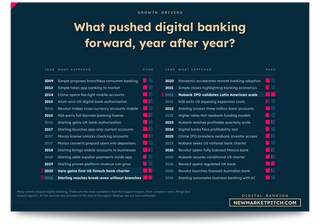
Timeline of the events that pushed the digital banking market forward, with their impact: What pushed digital banking forward, year after year? (Digital Banking Market, NewMarketPitch)
Growth Drivers

What are the growth drivers in this market?

We don't stop at a growth rate. We explain what would make more people and companies bank this way.

The obvious drivers are customers who have never needed a branch, instant payments, and open banking rules that make switching easier. Others reinforce each other. Once a neobank holds someone's salary, it can offer savings and loans. Lending income pays for cheaper accounts, which bring in more customers. And a full licence lets a bank lend from its own deposits instead of a partner's.

Before building or investing, you should know what makes someone move their salary to a digital bank, and what keeps it there.

Investor Bets

What are investors betting on now?

Investors are paying up for digital banks again, but mostly for the ones that already make money.

We compare recent rounds and share sales across consumer neobanks, business accounts and the software that runs digital banks. We also look at whether investors favor banks with their own licence or those that rent one, and flag newer bets like banks built for immigrants and for wealthy clients.

You'll see which digital banks are raising money now, after deals like Revolut's $75B share sale, and what a younger bank needs to show, from active customers to profit, before investors write a check.

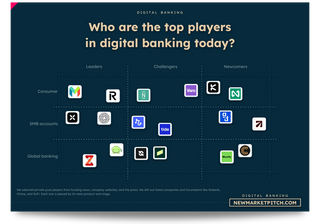
Market grid of the top digital banking startups and companies by segment: Who are the top players in digital banking today? (Digital Banking Market, NewMarketPitch)
Top Players

Who are the top startups and companies?

Chime and Monzo come up first when people talk about neobanks, but they're only a slice of digital banking.

Many of the most interesting players stay off the app-store charts. Some bank truck drivers, nurses or new immigrants. Others serve teenagers and their parents, or give wealthy clients a private banker inside an app. And some sell the core systems and card tools that other digital banks run on.

They're hard to compare because a sign-up count says little. One bank holds people's salaries, another is a spare card used on holiday. Licences also differ by country, so two apps that look alike can carry very different risks.

Below, you'll find the market grids and ecosystem maps we've built to show who serves which customers, who holds a licence, and where newer banks are getting in.

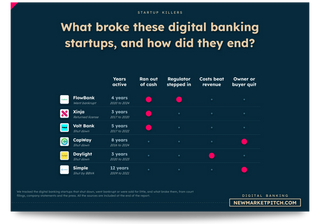
Table of digital banking startups that shut down or struggled, and why: What broke these digital banking startups, and how did they end? (Digital Banking Market, NewMarketPitch)
Startup Killers

What could kill a startup in this market?

Opening accounts is easy. Getting people to move their salary is the hard part, and many neobanks never get there.

So we studied why digital banking startups fail or stall. Some buy users with rewards that stop when the money runs out. Others depend on one partner bank, or on deposit income that falls with rates. And some expand to new countries before they make money in the first one.

If you're building, you'll see why main accounts, a path to your own licence and income beyond interest matter more than sign-ups. If you're investing, you'll know what to check about active users, partner bank risk and the cost of each customer.

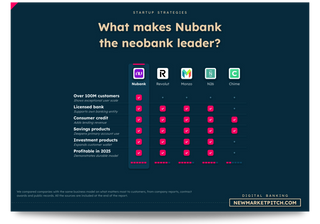
Scorecard showing what sets the leading digital banking company apart: What makes Nubank the neobank leader? (Digital Banking Market, NewMarketPitch)
Startup Strategies

How do you win in this market?

Starling, KakaoBank, Qonto… a few digital banks have turned their customers into a real business.

Starling has been profitable five years in a row and sells its banking software, Engine, to other banks, including Scotiabank's Tangerine in Canada. KakaoBank posted a record profit in South Korea in 2025. Qonto serves more than 600,000 small businesses in Europe and has applied for its own banking licence. They grew in very different ways, and none of these models has been proven in every country.

We'll look at how these banks chose their first customers, became the account those customers use every day, and found income that doesn't depend on rates alone.

Questions?

Who is this market report actually for?+

It's for founders, investors, banks, fintech and infrastructure companies, and strategists who want a clear view of digital banking.

Use it to choose which customers to serve first, to decide between your own licence and a partner bank, to compare card, deposit and lending income, or to understand demand, technology, funding, competitors and risks across the whole market.

How many pages are in the report?+

It has 190+ pages. It is designed to be comprehensive enough to support serious market evaluation, while still being fast to read and easy to use.

We prioritize signal, structure, and visual clarity over unnecessary length.

What do you include in the digital banking market?+

We define the digital banking market as banks and banking platforms that deliver their core services primarily through digital channels.

We include digital banks, neobanks and digital banking providers offering accounts and related financial services.

We exclude single-purpose payment or lending apps without a banking proposition and conventional banks without a distinct digital offering.

Do you list your sources clearly?+

Yes. All key data points and assumptions are explained and sourced in the document.

All sources are tier-1: company filings, funding databases, public datasets, expert interviews, industry reports, etc.

Is the data up to date?+

Yes. The report was last updated on October 27, 2026 with the latest market signals.

Is this a one-time payment?+

Yes. This is a one-time purchase. There is no subscription required to access the document.

I want to buy several market reports, can I get a discount code?+

Yes. You can use NEWMARKET for 20% off when purchasing two reports, or NEWMARKETMAX for 30% off when purchasing five or more.

I’m interested in a market but I can’t find it here+

If a market you care about is not currently on the list, email us at team@newmarketpitch.com and we may be able to cover it.

I have more questions for you+

No problem. You can reach out directly and we respond within 24 hours.

LAST UPDATED: October 27, 2026

It's time to really understand the digital banking market

A neobank can sign up millions of people and still not be anyone's main bank. This report covers the whole digital banking market: its size, customers, technology, business models, funding, key players, risks and the openings still left.

PRO
$49
One-time payment
  • ✓ Market Definition
  • ✓ Market Opportunity
  • ✓ Market Size
  • ✓ Pain Points
  • ✓ Tech & Infra
  • ✓ Value Creation
  • ✓ Market Challenges
  • ✓ Growth Drivers
  • ✓ Investor Bets
  • ✓ Top Players
  • ✓ Startup Killers
  • ✓ Startup Strategies
PRO+
$79
One-time payment
  • ✓ Market Definition
  • ✓ Market Opportunity
  • ✓ Market Size
  • ✓ Pain Points
  • ✓ Tech & Infra
  • ✓ Value Creation
  • ✓ Market Challenges
  • ✓ Growth Drivers
  • ✓ Investor Bets
  • ✓ Top Players
  • ✓ Startup Killers
  • ✓ Startup Strategies
PRO++
$99
One-time payment
  • ✓ Market Definition
  • ✓ Market Opportunity
  • ✓ Market Size
  • ✓ Pain Points
  • ✓ Tech & Infra
  • ✓ Value Creation
  • ✓ Market Challenges
  • ✓ Growth Drivers
  • ✓ Investor Bets
  • ✓ Top Players
  • ✓ Startup Killers
  • ✓ Startup Strategies
Use code MARKETPITCH for 10% off your order