LAST UPDATED: November 21, 2026

Need to get familiar with the digital dentistry market? Get our report

Scanners have replaced the messy impression tray in many offices, and crowns can now be printed or milled while the patient waits. The hard part is paying for all that equipment and keeping it busy. This report covers the whole market as it stands today.

  • 190+ pages
  • 12 sections
  • verified data only
Need to get familiar with the digital dentistry market? Get our report market report cover

What’s inside the report?

12 sections to help founders and investors understand the digital dentistry market with clarity

Radar map of the digital dentistry market showing which companies count as part of it, which sit on its edge and which stay outside: Who is in digital dentistry, and who stays outside? (Digital Dentistry Market, NewMarketPitch)
Market Definition

What is this market about?

Digital dentistry gets lumped in with dental AI, practice software and plain dental supplies, so we start by drawing a clear line.

An intraoral scanner, a chairside milling machine or a 3D printer that makes aligner models is in. So is the design software that turns a scan into a crown, or a lab that works only from digital files. A bag of impression material, a hand instrument or a scheduling system is out.

That way, every number and every company in the report refer to the same market.

Timeline of the dated steps showing how the digital dentistry market is moving, with one key signal: Pearl's AI went from reading dental X rays to reading 3D scans (Digital Dentistry Market, NewMarketPitch)
Market Opportunity

Why this market now?

Digital dentistry is now standard in many offices, but the big equipment makers are having a hard time, and growth is moving to products dentists pay for case by case.

We've found a lot of interesting signals. For example, in May 2026, Dentsply Sirona, the maker of CEREC and Primescan, reported a quarterly net loss and $60M of costs tied to its restructuring plan. Then in August, Envista said its Spark clear aligners were growing at a double-digit rate, while warning that China's bulk-buying program would push orthodontic prices down. Selling big machines is getting harder, and the money is moving to treatments dentists order patient by patient.

In this section, we look at why practices still buy scanners and printers, what's slowing equipment sales, and where newer companies are finding room.

Bar chart of the digital dentistry market size year by year to 2036, with its growth rate: How much bigger can digital dentistry get? (Digital Dentistry Market, NewMarketPitch)
Market Size

How big could this market get?

Digital dentistry market sizes online often include all dental equipment, clear aligners at full retail price, or dental AI, so the figures rarely line up.

We don't copy someone else's number. We build our own estimate, compare it with outside sources and explain each assumption, so you can judge the result yourself.

We also show how it shifts if practices put off equipment purchases, or speed them up.

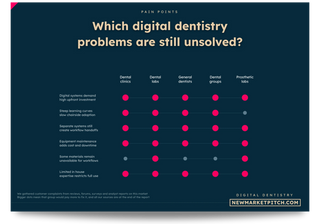
Matrix of the problems digital dentistry customers still face, rated for each type of buyer: Which digital dentistry problems are still unsolved? (Digital Dentistry Market, NewMarketPitch)
Pain Points

What are the pain points, and for whom?

Dentists want fewer remakes and fewer second visits, but every new machine costs money and staff time to learn.

We compare six kinds of digital dentistry companies, from scanner and printer makers to design software, digital labs and aligner brands. Their buyers include solo dentists, dental groups, orthodontists and dental labs. Then we rank what hurts most, like crowns that don't fit, lab cases that take weeks, and equipment that doesn't work with other brands.

This shows which problems a practice will pay to fix, and which ones it can still live with.

Comparison table of the tech offered by leading digital dentistry companies: Which digital dentistry company has the most complete tech today? (Digital Dentistry Market, NewMarketPitch)
Tech & Infra

What is the latest tech and infrastructure?

A scan is only the first step. The file has to travel to design software, then to a printer, a mill or a lab, without losing accuracy on the way.

We go through the stack piece by piece: intraoral scanners, design software, chairside mills, 3D printers and their resins, 3D X-ray and implant planning tools, and the cloud platforms that send cases to labs. We also show where things break, like closed systems that only talk to one brand, printed materials not yet approved for every use, and staff who don't have time to learn new software.

You'll see which digital steps are already routine in offices today, and which still need better materials or easier software.

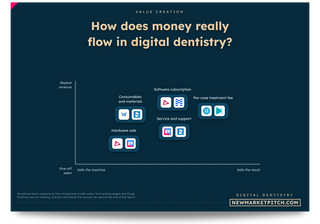
Map of digital dentistry business models with company logos: How does money really flow in digital dentistry? (Digital Dentistry Market, NewMarketPitch)
Value Creation

How is value created and monetized exactly?

Equipment sales, scanner subscriptions, per-case lab fees, resins and materials, software licenses and clear aligners sold per patient: digital dentistry companies make money in several ways.

We compare who pays and how often. A scanner or a mill is a big one-time purchase, often financed, so sales slow when practices get nervous. Printers earn more over time through the resins they use. Digital labs and aligner brands get paid on every case, and some give the scanner away to win that flow. Software can be a subscription, or a free add-on that ties the dentist to one system.

You'll see which models keep earning when practices stop buying equipment, and which ones need a steady stream of new machines.

Table of the events that could slow the digital dentistry market, with their odds and impact: What are the biggest threats to the digital dentistry market? (Digital Dentistry Market, NewMarketPitch)
Market Challenges

What could slow this market down?

Some brakes are obvious: expensive equipment, small practices with tight budgets, and dentists who are happy with what they already have.

Others are easier to miss. Price cuts from bulk buying in China can spread to other markets. Cheaper scanners from Asian makers put pressure on prices. Tariffs raise the cost of imported machines and materials. And when equipment from different brands won't connect, dentists hesitate to add more.

We go through each risk, rate how likely it is, and show who would be hit hardest.

Timeline of the events that pushed the digital dentistry market forward, with their impact: What pushed the digital dentistry market forward, year after year? (Digital Dentistry Market, NewMarketPitch)
Growth Drivers

What are the growth drivers in this market?

Behind the growth numbers are a few clear forces. We go through them one by one.

Some are easy to see: more adults getting aligners and implants, dental groups buying practices and standardizing their equipment, and printers that keep getting cheaper. Others feed each other. Once an office scans every patient, it can send cases to digital labs and offer aligners more easily. More printed restorations push material makers to get new resins approved. And every scan stored in the cloud makes the next treatment easier to plan.

Before building or investing, you should know what makes a practice buy its first scanner, and what keeps it ordering cases and materials every month.

Bar chart of where investors put their money in digital dentistry, by category: Where did digital dentistry investors put their money this past year? (Digital Dentistry Market, NewMarketPitch)
Investor Bets

What are investors into right now?

Dental equipment used to be a story about a few big public companies. Today investors also fund digital labs, 3D printing and the software that ties them together.

We compare recent rounds and deals across scanners, 3D printing, digital labs and aligners. We also look at whether investors prefer equipment makers or companies paid on every case, and which newer bets, like same-day dentures and crowns, are getting funded.

You'll see which digital dentistry companies investors are backing while the big equipment makers restructure, and what a younger company needs to show, in practices signed and cases per month, before it can raise.

Market grid of the top digital dentistry startups and companies by segment: Who are the top players in digital dentistry today? (Digital Dentistry Market, NewMarketPitch)
Top Players

Who are the top startups and companies?

Straumann and Medit are names most dentists have heard of, one for implants and scanners, the other for its affordable scanners, but they're only part of the digital dentistry market.

Many interesting players work behind the scenes. Some print aligner models by the thousand for orthodontists. Others design crowns overnight for small labs, make the resins that printers use, or plan implant surgery from a 3D scan.

They're hard to compare because many sell through distributors, dental groups or labs, so the dentist may never know who made the part. Equipment and software also come bundled, which makes it hard to tell who earns what.

Below, you'll find the market grids and ecosystem maps we've built to show who does what, from the scan to the finished crown, and where newer companies are getting in.

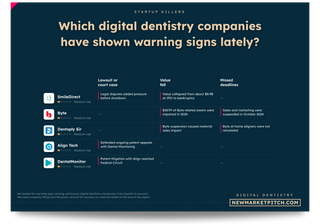
Table of the warning signs shown by leading digital dentistry companies: Which digital dentistry companies have shown warning signs lately? (Digital Dentistry Market, NewMarketPitch)
Startup Killers

What could kill a startup in this market?

Dentists don't replace their equipment often. Miss the moment, and the next chance may be years away.

So we studied why digital dentistry startups fail or stall. Some built a good scanner but couldn't match the giants' sales teams and distributors. Others sold printers to offices that never learned to use them. And some sold aligners or lab work straight to consumers, where marketing costs ate the margin.

If you're building, you'll see why training, distribution and repeat orders matter more than a slightly better scan. If you're investing, you'll know what to check about how often equipment gets used, who sells it, and how much revenue comes back after the first sale.

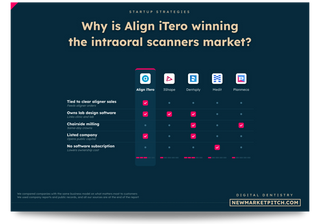
Scorecard showing what sets the leading digital dentistry company apart: Why is Align iTero winning the intraoral scanners market? (Digital Dentistry Market, NewMarketPitch)
Startup Strategies

How do you win in this market?

SprintRay, Dandy, Formlabs… a few newer digital dentistry companies have found real customers, each with a different model.

SprintRay sells chairside 3D printers with its own resins and AI design services, so a dentist can print a crown during the visit. Dandy is a digital dental lab that gives practices a scanner at no hardware cost, then earns on the lab cases they send. Formlabs sells printers used across many industries, with materials made for dental labs and offices. Each one earns more after the first sale, but all are still growing next to much larger equipment makers.

We'll look at how these companies turned one sale into repeat orders, and what that teaches a startup that only sells equipment.

Questions?

Who is this market report actually for?+

It's for founders, investors, dental groups, labs, equipment and materials makers, distributors and strategists who want a clear view of digital dentistry.

Use it to choose between selling equipment, materials, software or lab services, to decide whether to target single offices, dental groups or labs, to compare one-time sales with per-case revenue, or to understand demand, technology, funding, competitors and risks across the whole market.

How many pages are in the report?+

It has 190+ pages. It is designed to be comprehensive enough to support serious market evaluation, while still being fast to read and easy to use.

We prioritize signal, structure, and visual clarity over unnecessary length.

What do you include in the digital dentistry market?+

We define the digital dentistry market as dental-first technology that digitizes the capture, interpretation, planning, manufacture, delivery or monitoring of dental and orthodontic care.

We include dental scanning and imaging, dental AI and computer-aided treatment design, intraoral and laboratory CAD/CAM, dental 3D printing and materials, digital clinic-to-lab networks, digital orthodontic fabrication and monitoring, and image-guided dental robotics.

We exclude conventional clinics and dental chains without proprietary digital technology, general healthcare and imaging products, dental insurance and staffing, generic practice administration, toothbrushes and oral wellness products, and diversified manufacturers where dentistry is a minor application.

Do you list your sources clearly?+

Yes. All key data points and assumptions are explained and sourced in the document.

All sources are tier-1: company filings, funding databases, public datasets, expert interviews, industry reports, etc.

Is the data up to date?+

Yes. The report was last updated on November 21, 2026 with the latest market signals.

Is this a one-time payment?+

Yes. This is a one-time purchase. There is no subscription required to access the document.

I want to buy several market reports, can I get a discount code?+

Yes. You can use NEWMARKET for 20% off when purchasing two reports, or NEWMARKETMAX for 30% off when purchasing five or more.

I’m interested in a market but I can’t find it here+

If a market you care about is not currently on the list, email us at team@newmarketpitch.com and we may be able to cover it.

I have more questions for you+

No problem. You can reach out directly and we respond within 24 hours.

LAST UPDATED: November 21, 2026

The digital dentistry market, without the blind spots

A dental scanner can win over a dentist in a five-minute demo, then sit in a corner because no one has time to learn the rest of the workflow. This report covers the whole digital dentistry market, from size and buyers to technology, business models, funding, key players, risks and the openings that remain.

PRO
$49
One-time payment
  • ✓ Market Definition
  • ✓ Market Opportunity
  • ✓ Market Size
  • ✓ Pain Points
  • ✓ Tech & Infra
  • ✓ Value Creation
  • ✓ Market Challenges
  • ✓ Growth Drivers
  • ✓ Investor Bets
  • ✓ Top Players
  • ✓ Startup Killers
  • ✓ Startup Strategies
PRO+
$79
One-time payment
  • ✓ Market Definition
  • ✓ Market Opportunity
  • ✓ Market Size
  • ✓ Pain Points
  • ✓ Tech & Infra
  • ✓ Value Creation
  • ✓ Market Challenges
  • ✓ Growth Drivers
  • ✓ Investor Bets
  • ✓ Top Players
  • ✓ Startup Killers
  • ✓ Startup Strategies
PRO++
$99
One-time payment
  • ✓ Market Definition
  • ✓ Market Opportunity
  • ✓ Market Size
  • ✓ Pain Points
  • ✓ Tech & Infra
  • ✓ Value Creation
  • ✓ Market Challenges
  • ✓ Growth Drivers
  • ✓ Investor Bets
  • ✓ Top Players
  • ✓ Startup Killers
  • ✓ Startup Strategies
Use code MARKETPITCH for 10% off your order