LAST UPDATED: October 29, 2026

Make smarter decisions on the FinTech market

The fintech boom is over, the survivors make money. They now post real profits, and AI agents and stablecoins are starting to move money. The open question is who keeps the margin when banks copy fast and fraud gets cheaper. This report lays out the whole market as it looks right now.

  • 196+ pages
  • 12 sections
  • verified data only
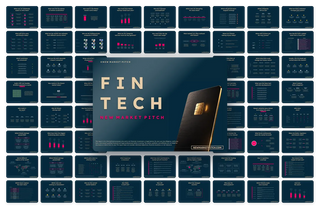
Make smarter decisions on the FinTech market market report cover

What’s inside the report?

12 sections to help founders and investors understand the FinTech market with clarity

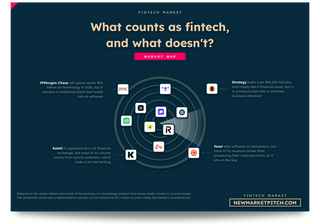
Radar map of the fintech market showing which companies count as part of it, which sit on its edge and which stay outside: What counts as fintech, and what does not? (FinTech Market, NewMarketPitch)
Market Definition

What does this market really cover?

We start by setting the scope: which products count as FinTech, which don't, and which markets sit at the edges.

A payments API built for developers and a mobile bank built for consumers are both FinTech, but they make money in very different ways. And we count revenue, not the trillions of dollars that flow through these apps.

So when you read a number later, you know what it covers.

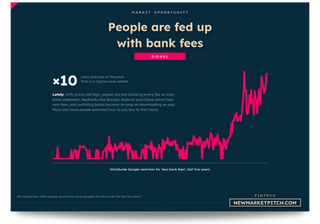
Curve of a key fintech growth signal over recent periods, with its latest value: Paying Robinhood Gold members grew 33% in a year (FinTech Market, NewMarketPitch)
Market Opportunity

What changed for this market lately?

FinTech is back in a big way in 2026.

We've found a lot of interesting signals. Stripe reached a $159B valuation in a tender offer for employees. And Capital One completed its acquisition of corporate card company Brex in April 2026, after announcing a $5.15B deal in January. Large investors and banks are paying for fintech businesses that have already found scale.

Here, we'll look at what's behind the comeback, from profits and IPOs to stablecoins and instant payments, and which parts of FinTech it really reaches.

Donut chart splitting the fintech market size between its main categories, with leading companies: How is the fintech market split between its categories? (FinTech Market, NewMarketPitch)
Market Size

How big could this market get?

Look up the size of the FinTech market and you'll see numbers from about $320 billion to $650 billion. Some measure technology sold to banks, others measure what fintechs actually earn.

We built our own estimate from the revenue fintechs report, block by block: payments, investing, lending, insurance, and the rest. Then we compared it with other sources and laid out the assumptions, so you can see what's in the number and what's not.

Matrix of the problems fintech customers still face, rated for each type of buyer: What has been fixed in fintech, and what is left to solve? (FinTech Market, NewMarketPitch)
Pain Points

What are the pain points, and for whom?

Fintech fixed many old money problems. Opening an account or sending money abroad now takes minutes. But new problems took their place.

We compare six kinds of FinTech companies, from payments and lending to banking and financial infrastructure. Then we look at who pays and rank real problems, like fraud, rejected payments and people who struggle to get credit.

This shows where people still lose time or money, and would pay to stop.

Comparison table of the tech offered by leading fintech companies: Which digital bank offers the most complete tech today? (FinTech Market, NewMarketPitch)
Tech & Infra

What is the latest tech and infrastructure?

Instant rails like Pix and UPI, stablecoins with US rules, AI agents that pay merchants, fraud models trained on billions of payments: the plumbing of money is changing quickly.

We map the stack, from customer apps and payment rails to bank licenses, core systems, data, fraud, and compliance, and show which parts make the most money. We also look at the bottlenecks still in the way, like AI-driven fraud and partner bank risk.

You'll see what's live today and what's still an experiment.

Map of fintech business models with company logos: How do fintech companies actually make money? (FinTech Market, NewMarketPitch)
Value Creation

How is value created and monetized exactly?

Fintechs earn money in four main ways: a small cut of each payment, interest on loans and deposits, monthly plans, and software contracts.

We compare these models in plain terms. Card fees keep shrinking. Interest income falls when rates drop. Lending looks great until credit losses arrive. Software sells slowly but sticks. We show what each one costs to run and how much margin it really keeps.

You'll also see where the new money is, from agent payments and stablecoin rails to finance agents and fraud defense, and why free accounts and zero-fee trading no longer set anyone apart.

Table of the events that could slow the fintech market, with their odds and impact: What are the biggest threats to fintech? (FinTech Market, NewMarketPitch)
Market Challenges

What could slow this market down?

Some obstacles are familiar: heavy compliance, slow licenses, and people who keep their salary at their old bank.

Others are newer. AI makes fake identities cheap. Falling rates cut the interest income many neobanks now rely on. US rules on bank data are stuck in court. And big banks copy good features fast.

We score each downside scenario by how likely it is and how badly it would hurt, so you can sort real threats from background noise.

Timeline of the events that pushed the fintech market forward, with their impact: What pushed fintech forward, year after year? (FinTech Market, NewMarketPitch)
Growth Drivers

What are the growth drivers in this market?

A growth rate only helps if you know what powers it. So after sizing the market, we look at the forces pushing FinTech forward, and whether they keep working as it gets bigger.

Some drivers are clear: instant payment rails, finance built into business software, stablecoins, and AI that cuts the cost of support and fraud checks. Others could speed things up: clear US rules on bank data, faster licenses, and AI agents that people trust to pay and save for them.

Before building or investing, you should know what makes people move their main account, and their trust, to a new financial app.

Bar chart of where investors put their money in fintech, by category: Where did fintech investors put their money this past year? (FinTech Market, NewMarketPitch)
Investor Bets

Where are investors placing their bets today?

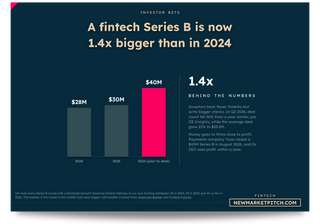
Investors are writing bigger checks to fewer fintechs. Rounds of $100M or more were a small share of deals, but they took most of the money.

We'll compare recent funding for payments, banking and financial software, and look at which companies can attract investors today. We'll also show how profits, regulation and big bank deals influence where money goes.

You'll see what the latest rounds, from billion-dollar checks to fast-growing compliance deals, say about where FinTech investors see lasting profits today.

Market grid of the top fintech startups and companies by segment: Who are the leading companies in fintech? (FinTech Market, NewMarketPitch)
Top Players

Who are the top startups and companies?

Revolut and Ramp grab most of the headlines, but they're only two pieces of a much bigger market.

Some of the most interesting fintechs are invisible to consumers. They build AI that closes a company's books, stablecoin card programs, identity checks for banks, or payment rails that other apps run on.

They're hard to spot because they sell to other businesses, work under another brand's logo, or sit deep in the plumbing. A user never sees them, even when every payment runs through them.

In this section, we share our market grids and ecosystem maps, so you can see who owns which part of the stack and where new challengers are rising.

Table of fintech startups that shut down or struggled, and why: What broke these fintech startups, and how did they end? (FinTech Market, NewMarketPitch)
Startup Killers

What could kill a startup in this market?

In FinTech, trust takes years to build and one bad day to lose. A frozen account, a fraud wave, or a partner bank that walks away can end the story.

So we looked at why fintech startups fail. Some never became the main account and earned too little per user. Some lenders saw credit losses outrun revenue. Others depended on a single partner bank or client, and lost everything when it left.

If you're building, you'll see why sign-ups mean little if users never move their money, or if the bank behind you can pull out. If you're investing, you'll know what to check about main accounts, credit losses, and partner risk.

Scorecard showing what sets the leading fintech company apart: Why is Stripe winning online payments? (FinTech Market, NewMarketPitch)
Startup Strategies

How do you win in this market?

Nubank, Mercury, Airwallex… each built a fintech that customers rely on every day.

Nubank won customers in Brazil by dropping card fees. Mercury focused on startups and became profitable. Airwallex built its own licensed payments network. Each found something hard to copy: customer loyalty, a specific niche, or the infrastructure itself.

We'll look at how fintech leaders pick a first niche, become a customer's main account, and decide when to get their own licenses.

Questions?

Who is this market report actually for?+

It's for founders, investors, banks, payment companies, and strategy teams who need a clear view of the FinTech market.

It helps if you're comparing payments, digital banking, lending, investing, or finance software, and need to understand licenses, fraud, interest rates, regulation, funding, and competition across the whole market.

How many pages are in the report?+

It has 196+ pages. It is designed to be comprehensive enough to support serious market evaluation, while still being fast to read and easy to use.

We prioritize signal, structure, and visual clarity over unnecessary length.

What do you include in the FinTech market?+

We define the FinTech market as technology-led products and services that deliver or improve financial activities.

We include digital payments, banking, lending, investing, insurance technology and financial infrastructure.

We exclude non-financial software, conventional financial institutions without a distinct technology offering and crypto projects without a financial use.

Do you list your sources clearly?+

Yes. All key data points and assumptions are explained and sourced in the document.

All sources are tier-1: company filings, funding databases, public datasets, expert interviews, industry reports, etc.

Is the data up to date?+

Yes. The report was last updated on October 29, 2026 with the latest market signals.

Is this a one-time payment?+

Yes. This is a one-time purchase. There is no subscription required to access the document.

I want to buy several market reports, can I get a discount code?+

Yes. You can use NEWMARKET for 20% off when purchasing two reports, or NEWMARKETMAX for 30% off when purchasing five or more.

I’m interested in a market but I can’t find it here+

If a market you care about is not currently on the list, email us at team@newmarketpitch.com and we may be able to cover it.

I have more questions for you+

No problem. You can reach out directly and we respond within 24 hours.

LAST UPDATED: October 29, 2026

It's time to really understand the FinTech market

A finance app can win millions of users and still earn very little from each one. This report covers the full FinTech market: its size, customers, technology, business models, funding, key players, risks, and the openings that remain.

PRO
$49
One-time payment
  • ✓ Market Definition
  • ✓ Market Opportunity
  • ✓ Market Size
  • ✓ Pain Points
  • ✓ Tech & Infra
  • ✓ Value Creation
  • ✓ Market Challenges
  • ✓ Growth Drivers
  • ✓ Investor Bets
  • ✓ Top Players
  • ✓ Startup Killers
  • ✓ Startup Strategies
PRO+
$79
One-time payment
  • ✓ Market Definition
  • ✓ Market Opportunity
  • ✓ Market Size
  • ✓ Pain Points
  • ✓ Tech & Infra
  • ✓ Value Creation
  • ✓ Market Challenges
  • ✓ Growth Drivers
  • ✓ Investor Bets
  • ✓ Top Players
  • ✓ Startup Killers
  • ✓ Startup Strategies
PRO++
$99
One-time payment
  • ✓ Market Definition
  • ✓ Market Opportunity
  • ✓ Market Size
  • ✓ Pain Points
  • ✓ Tech & Infra
  • ✓ Value Creation
  • ✓ Market Challenges
  • ✓ Growth Drivers
  • ✓ Investor Bets
  • ✓ Top Players
  • ✓ Startup Killers
  • ✓ Startup Strategies
Use code MARKETPITCH for 10% off your order