LAST UPDATED: October 30, 2026

Make better decisions on the fraud prevention market

Fraudsters now use AI, banks have to keep up. They fake voices, faces and whole identities, and stolen money moves in seconds. Banks, merchants and payment networks are racing to stop them without turning away good customers. This report gives you the latest on the whole fraud prevention market.

  • 190+ pages
  • 12 sections
  • verified data only
Make better decisions on the fraud prevention market market report cover

What’s inside the report?

12 sections to help founders and investors understand the fraud prevention market with clarity

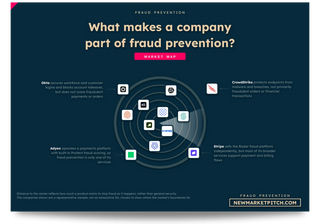
Radar map of the fraud prevention market showing which companies count as part of it, which sit on its edge and which stay outside: What makes a company part of fraud prevention? (Fraud Prevention Market, NewMarketPitch)
Market Definition

What is this market about?

Fraud prevention overlaps with cybersecurity, identity checks and compliance, so we start by saying exactly what we count.

A tool that scores a card payment before it goes through is in. So is software that spots an account takeover, or a platform where a fraud team sets rules and works its cases. A firewall is out, and so is a reporting tool used only to file regulatory paperwork.

This keeps the market size and every company we compare on the same footing.

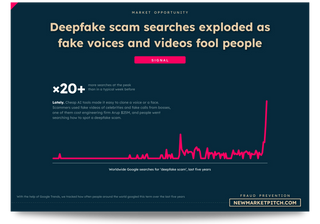
Google Trends curve of worldwide searches over five years for the fraud prevention market: Deepfake scam searches exploded as fake voices and videos fool people (Fraud Prevention Market, NewMarketPitch)
Market Opportunity

What changed for this market lately?

Fraud prevention is hot right now, and the biggest names in payments are paying up for it.

We've found a lot of interesting signals. For example, in October 2025, Feedzai raised $75M at a $2B valuation, after being picked to help the European Central Bank fight fraud on the digital euro. And in August 2026, Visa agreed to buy BioCatch, which spots fraud from the way people type and swipe, for $2.4B in cash. As AI makes scams cheaper to run, banks and payment networks are paying more for the tools that stop them.

In this section, we look at why fraud losses keep rising despite better tools, which kinds of fraud are growing fastest, and what these deals mean for independent fraud startups.

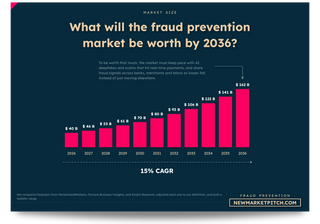
Bar chart of the fraud prevention market size year by year to 2036, with its growth rate: What will the fraud prevention market be worth by 2036? (Fraud Prevention Market, NewMarketPitch)
Market Size

How big could this market get?

Fraud prevention market sizes are all over the map. Some add identity checks and cybersecurity, others count fraud losses instead of what companies spend to stop them.

We size the market from first principles, starting with what banks, merchants and platforms spend on fraud tools. Then we compare the result with other sources and show each assumption, so you can test it yourself.

We also show what the market could look like in a low and a high scenario.

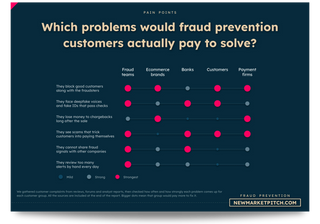
Matrix of the problems fraud prevention customers still face, rated for each type of buyer: Which problems would fraud prevention customers actually pay to solve? (Fraud Prevention Market, NewMarketPitch)
Pain Points

What are the pain points, and for whom?

Every fraud team faces the same trade-off: stop more bad payments without turning away good customers.

We compare six kinds of fraud prevention companies, from payment fraud and account takeover to new-account fraud, e-commerce fraud, chargebacks and fraud decision platforms. Their buyers range from banks and card issuers to online merchants, marketplaces and gig platforms. For each, we rank the pains that hurt most, like scams where victims send the money themselves, false declines that cost sales and fake accounts made with AI.

This shows which fraud losses a company will pay to cut first, and which ones it still writes off as a cost of doing business.

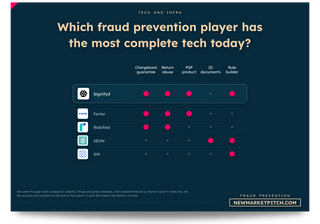
Comparison table of the tech offered by leading fraud prevention companies: Which fraud prevention player has the most complete tech today? (Fraud Prevention Market, NewMarketPitch)
Tech & Infra

What is the latest tech and infrastructure?

Rules alone stopped working once fraudsters began testing them at machine speed. Today's tools combine device data, behavior and signals shared across many companies.

We map the stack layer by layer, from data and device signals to models, decision engines and case management. We also show where things get stuck, like instant payments that leave no time to check, deepfakes that pass selfie checks, and banks that can't share what they know about the same fraudster.

You'll see which kinds of fraud today's tools catch reliably, and which still slip through.

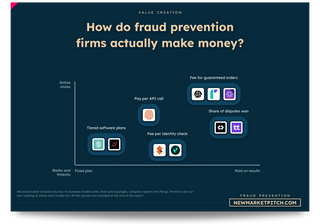
Map of fraud prevention business models with company logos: How do fraud prevention firms actually make money? (Fraud Prevention Market, NewMarketPitch)
Value Creation

How is value created and monetized exactly?

Fees per transaction or per check, yearly platform licenses, chargeback guarantees and shares of recovered losses: fraud prevention companies charge in very different ways.

We compare who pays and where the costs sit. A per-transaction fee grows with volume, but big merchants push the price down. A chargeback guarantee wins deals fast, but the vendor pays when its model gets it wrong. Bank platforms earn large licenses after long sales cycles. And every vendor pays for data, from device signals to identity records.

You'll see which models keep their margins as fraud gets smarter, and which ones get squeezed when payment providers bundle fraud tools for free.

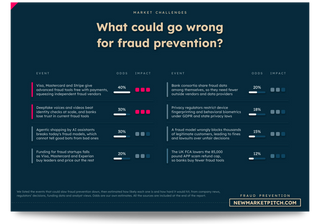
Table of the events that could slow the fraud prevention market, with their odds and impact: What could go wrong for fraud prevention? (Fraud Prevention Market, NewMarketPitch)
Market Challenges

What could slow this market down?

The obvious brakes are long bank sales cycles, privacy rules on sharing data and payment providers that bundle their own fraud tools.

The less obvious ones can hurt more. Rules like the UK's now make banks repay many scam victims, which changes who pays for fraud. Every takeover by a card network leaves fewer independent vendors. Customers hate extra checks. And each new defense pushes fraudsters toward the next weak spot, often a person rather than a system.

For each risk, we rate how likely it is and explain which kinds of fraud vendors it would hurt most.

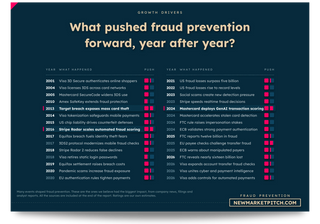
Timeline of the events that pushed the fraud prevention market forward, with their impact: What pushed fraud prevention forward, year after year? (Fraud Prevention Market, NewMarketPitch)
Growth Drivers

What are the growth drivers in this market?

Fraud keeps growing, but that alone doesn't explain why companies spend more to stop it. Here, we go through the real drivers.

Instant payments, more online shopping and AI tools that make scams cheap to run are the drivers everyone sees. Several others push in the same direction. Every fraud attempt a network sees makes its models better for every customer. Rules that make banks repay victims give them a reason to spend before the loss. And once a company sees how much fraud it was missing, it tends to add more checks.

Before building or investing, you should know what makes a company pay to stop fraud before it happens, rather than just absorbing the losses.

Investor Bets

What are investors betting on now?

Fraud prevention used to be a steady, quiet corner of fintech. Now it draws large rounds and billion-dollar takeovers.

We compare recent rounds across bank fraud platforms, e-commerce fraud, identity fraud and tools against scams. We also look at which startups investors see as future targets for card networks and data companies, and we flag newer bets, like tools that check whether an AI agent shopping for a customer can be trusted.

You'll see which fraud startups are getting funded today, as card networks buy up fraud specialists. We also look at what a younger company must prove, in fraud caught and good customers let through, before it can raise.

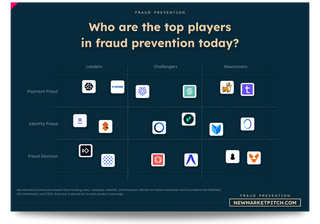
Market grid of the top fraud prevention startups and companies by segment: Who are the top players in fraud prevention today? (Fraud Prevention Market, NewMarketPitch)
Top Players

Who are the top startups and companies?

Forter and Riskified come up first when merchants talk about fraud, but they cover only one corner of the market.

Much of the action happens away from the checkout page. Some startups only stop scams where victims are tricked into sending money. Others spot fake accounts on gig and dating apps, catch money mules at banks, or fight false chargeback claims for merchants.

Side by side, they're tough to judge: each one sees a different kind of fraud, and companies rarely publish how much they catch. A vendor that blocks 99% of bad payments may also block too many good ones, and that number almost never makes the pitch deck.

Below, you'll find the market grids and ecosystem maps we've built to show which kinds of fraud each company stops, and where new players are getting in.

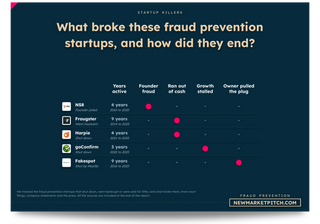
Table of fraud prevention startups that shut down or struggled, and why: What broke these fraud prevention startups, and how did they end? (Fraud Prevention Market, NewMarketPitch)
Startup Killers

What could kill a startup in this market?

Fraudsters adapt faster than sales cycles. A model that works today can be beaten by next quarter.

So we studied why fraud prevention startups fail or stall. Some catch one kind of fraud that moves elsewhere as soon as they win. Others offer guarantees that turn into losses when attacks spike. And some sell a feature that payment providers or card networks then give away.

If you're building, you'll see why data from many customers, few false declines and an edge the networks can't bundle matter more than one strong model. If you're investing, you'll know what to check about loss exposure, access to data and how easily a customer could switch.

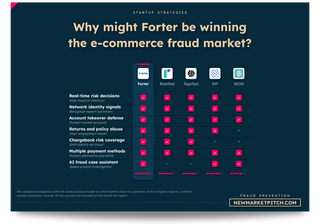
Scorecard showing what sets the leading fraud prevention company apart: Why might Forter be winning the e-commerce fraud market? (Fraud Prevention Market, NewMarketPitch)
Startup Strategies

How do you win in this market?

Sardine, Alloy, Signifyd… a few fraud companies have turned stopping fraud into steady revenue.

Sardine combines device and behavior signals to stop fraud at banks, fintechs and crypto firms. Alloy lets banks and fintechs check new customers and watch their accounts on one platform, and reported more than 900 customers in July 2026. Signifyd reviews online orders and repays merchants for fraud on orders it approved. Each picked a clear kind of buyer, though none has yet shown it can cover every kind of fraud for every company.

We'll look at how these teams pooled data from many customers, priced their risk so they could survive a bad month, and widened their product from one kind of fraud to the next.

Questions?

Who is this market report actually for?+

It's for founders, investors, fraud and risk teams at banks, merchants and platforms, payment companies and strategists who want a clear view of fraud prevention.

Use it to decide which kinds of fraud to tackle first, to weigh one platform against several specialist tools, to compare per-transaction pricing with chargeback guarantees, and to see demand, technology, business models, funding, competitors and risks across the whole market.

How many pages are in the report?+

It has 190+ pages. It is designed to be comprehensive enough to support serious market evaluation, while still being fast to read and easy to use.

We prioritize signal, structure, and visual clarity over unnecessary length.

What do you include in the fraud prevention market?+

We define the fraud prevention market as products that detect, prevent or investigate fraudulent activity.

We include transaction fraud detection, account protection, identity-fraud controls, chargeback and dispute tools, and fraud decision and case management platforms.

We exclude general cybersecurity without a fraud focus and compliance tools used only for non-fraud reporting.

Do you list your sources clearly?+

Yes. All key data points and assumptions are explained and sourced in the document.

All sources are tier-1: company filings, funding databases, public datasets, expert interviews, industry reports, etc.

Is the data up to date?+

Yes. The report was last updated on October 30, 2026 with the latest market signals.

Is this a one-time payment?+

Yes. This is a one-time purchase. There is no subscription required to access the document.

I want to buy several market reports, can I get a discount code?+

Yes. You can use NEWMARKET for 20% off when purchasing two reports, or NEWMARKETMAX for 30% off when purchasing five or more.

I’m interested in a market but I can’t find it here+

If a market you care about is not currently on the list, email us at team@newmarketpitch.com and we may be able to cover it.

I have more questions for you+

No problem. You can reach out directly and we respond within 24 hours.

LAST UPDATED: October 30, 2026

Before you build or invest in the fraud prevention market, read this

Every check that stops a thief can also stop a real customer. This report shows you the wider fraud prevention market, from size and buyers to the technology, business models, funding, competitors, risks and the openings that remain.

PRO
$49
One-time payment
  • ✓ Market Definition
  • ✓ Market Opportunity
  • ✓ Market Size
  • ✓ Pain Points
  • ✓ Tech & Infra
  • ✓ Value Creation
  • ✓ Market Challenges
  • ✓ Growth Drivers
  • ✓ Investor Bets
  • ✓ Top Players
  • ✓ Startup Killers
  • ✓ Startup Strategies
PRO+
$79
One-time payment
  • ✓ Market Definition
  • ✓ Market Opportunity
  • ✓ Market Size
  • ✓ Pain Points
  • ✓ Tech & Infra
  • ✓ Value Creation
  • ✓ Market Challenges
  • ✓ Growth Drivers
  • ✓ Investor Bets
  • ✓ Top Players
  • ✓ Startup Killers
  • ✓ Startup Strategies
PRO++
$99
One-time payment
  • ✓ Market Definition
  • ✓ Market Opportunity
  • ✓ Market Size
  • ✓ Pain Points
  • ✓ Tech & Infra
  • ✓ Value Creation
  • ✓ Market Challenges
  • ✓ Growth Drivers
  • ✓ Investor Bets
  • ✓ Top Players
  • ✓ Startup Killers
  • ✓ Startup Strategies
Use code MARKETPITCH for 10% off your order