LAST UPDATED: November 21, 2026

Make better decisions on the HR tech market

Everyone hates their HR software, AI might finally fix it. Now AI agents answer employee questions, check payroll and draft reviews, and selling software by the seat is starting to look shaky. This report covers the whole HR tech market, from payroll to people analytics.

  • 190+ pages
  • 12 sections
  • verified data only
Make better decisions on the HR tech market market report cover

What’s inside the report?

12 sections to help founders and investors understand the HR tech market with clarity

Radar map of the HR tech market showing which companies count as part of it, which sit on its edge and which stay outside: What is actually included in the HR tech market? (HR Tech Market, NewMarketPitch)
Market Definition

What does this market really cover?

HR tech is a crowded label. People use it for payroll, recruiting, staffing agencies and even office chat tools, so we start by saying exactly what we count.

An HR system that holds employee records is in, and so are payroll platforms, applicant tracking, onboarding, performance reviews and learning tools. A staffing agency with no product of its own is out, and so is general office software like email or spreadsheets.

That way, the market size, the company lists and the comparisons all describe the same market.

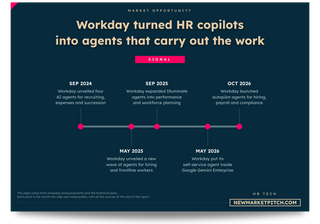
Timeline of the dated steps showing how the HR tech market is moving, with one key signal: Workday turned HR copilots into agents that carry out the work (HR Tech Market, NewMarketPitch)
Market Opportunity

Why this market now?

HR tech is being shaken up. Big incumbents are changing owners and leaders as AI threatens the way they sell, while investors keep backing newer platforms that are growing fast.

We've found a lot of interesting signals. For example, in February 2026, Thoma Bravo completed its $12.3B purchase of Dayforce and took the payroll and HR company private. Days later, Workday brought back its co-founder Aneel Bhusri as CEO, saying AI is a bigger shift than the move to SaaS. And in September, HiBob raised $166M, mostly from Salesforce, after passing $400M in annualized revenue. The old HR suites are being reworked, and buyers with deep pockets still pay up for platforms that keep growing.

In this section, we look at why AI puts pressure on HR software priced per employee, which parts of the market still attract money, and what this shake-up means for smaller players.

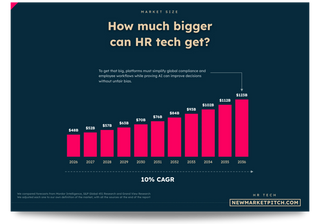
Bar chart of the HR tech market size year by year to 2036, with its growth rate: How much bigger can HR tech get? (HR Tech Market, NewMarketPitch)
Market Size

How big could this market get?

HR tech market sizes online swing widely, because some count payroll processing fees, outsourced HR services or job ads, and others don't.

We size HR tech from first principles, check the result against outside sources and lay out each assumption, so you can test the number yourself.

You'll also see a low and a high scenario, and what would push the market toward each one.

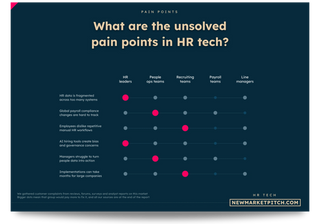
Matrix of the problems HR tech customers still face, rated for each type of buyer: What are the unsolved pain points in HR tech? (HR Tech Market, NewMarketPitch)
Pain Points

What are the pain points, and for whom?

HR teams spend much of their week fixing data that lives in five different tools, and employees still wait days for simple answers.

We compare six kinds of HR tech companies, from core HR and payroll platforms to recruiting, learning and performance tools. Their buyers range from a founder running payroll for ten people to a global company paying staff in dozens of countries. Then we rank what hurts most, like payroll errors, slow onboarding, compliance in new countries and reports no one trusts.

This shows which problems a company will pay to fix this year, and which ones HR can keep handling with spreadsheets.

Comparison table of the tech offered by leading HR tech companies: Which HR tech players can already do the most today? (HR Tech Market, NewMarketPitch)
Tech & Infra

What is the latest tech and infrastructure?

The employee record sits at the center of everything. Payroll, benefits, access to apps and the new AI assistants all depend on it being right.

We go through the stack piece by piece: employee records, payroll engines and tax rules, links with finance and IT tools, people analytics, and the AI agents now being added on top. We also show where things get stuck, like messy employee data, payroll that has to be right in every country, and AI tools that can see salaries and personal details.

You'll see which HR tasks AI already handles well today, and which ones still need a person to check the result.

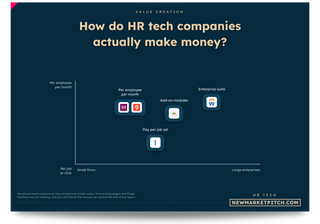
Map of HR tech business models with company logos: How do HR tech companies actually make money? (HR Tech Market, NewMarketPitch)
Value Creation

How is value created and monetized exactly?

Monthly fees per employee, payroll processing charges, interest earned on payroll funds, employer-of-record fees per worker and paid add-on modules: HR tech companies make money in several ways.

We compare who pays, how much, and what each customer costs to keep. Small-business payroll is cheap to buy but costly to support. An employer-of-record service charges a high fee per worker, but carries legal and tax risk in each country. Big suites earn more by selling extra modules to the same customer, while point tools have to justify their price against the suite's bundle. And if AI agents take over more of HR's work, pricing per seat may stop making sense.

You'll see which models still make money when customers cut headcount, and which ones depend on selling more seats every year.

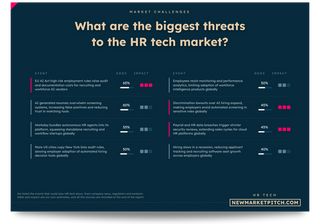
Table of the events that could slow the HR tech market, with their odds and impact: What are the biggest threats to the HR tech market? (HR Tech Market, NewMarketPitch)
Market Challenges

What could slow this market down?

Some brakes are obvious: long sales cycles at large companies, buyers who replace their HR system only once a decade, and budgets that shrink when hiring slows.

Others are easier to miss. Fewer employees means fewer seats to bill. Privacy rules and new laws on AI in hiring and reviews add legal risk. A payroll error destroys trust fast. And the big suites keep adding features that make standalone tools harder to sell.

We look at each risk in turn, rate how likely it is to happen, and say which types of companies it would hurt most.

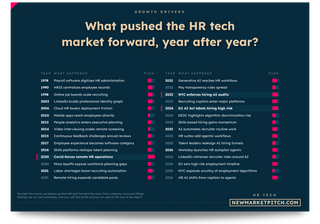
Timeline of the events that pushed the HR tech market forward, with their impact: What pushed the HR tech market forward, year after year? (HR Tech Market, NewMarketPitch)
Growth Drivers

What are the growth drivers in this market?

Growth in HR tech doesn't come from one trend. We look at the forces behind it, one at a time.

Some are easy to see: more remote and cross-border hiring, small companies moving off spreadsheets, and stricter rules on pay and data. Others feed each other. Once a company puts payroll and records in one platform, adding benefits, devices or learning is an easy sale. Cleaner data makes AI assistants more useful. And the more HR work those assistants handle, the more companies want everything in one place.

Before building or investing, you should know what makes a company move its employee records to a new platform, and what keeps it there for years.

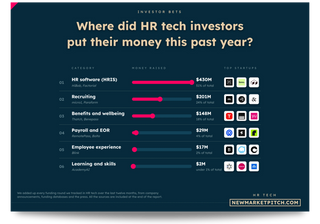
Bar chart of where investors put their money in HR tech, by category: Where did HR tech investors put their money this past year? (HR Tech Market, NewMarketPitch)
Investor Bets

What are investors betting on now?

HR tech is no longer one funding story. Some investors buy mature suites and run them for cash, while others put big money into platforms that are still growing fast.

We compare recent rounds and deals across core HR, payroll, global employment and talent tools. We also look at whether investors prefer all-in-one platforms or specialists that plug into them, and which newer bets, like AI agents that answer employee questions, are getting funded.

We'll look at the latest deals, from private equity buyouts to big rounds for fast-growing platforms. You'll see which HR businesses investors trust today, and what a younger company needs to show to raise money.

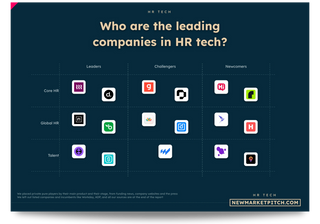
Market grid of the top HR tech startups and companies by segment: Who are the leading companies in HR tech? (HR Tech Market, NewMarketPitch)
Top Players

Who are the top startups and companies?

Rippling and Deel come up first in almost every HR tech conversation, but they're only two names in a very large market.

Many interesting players work out of sight. Some run payroll only for restaurants or construction crews. Others handle visas and relocation, keep org charts in sync with IT tools, or check that pay is fair across teams.

They're hard to spot because many sell through payroll providers, accountants or the big suites' app stores, so their name never shows up on the employee's screen. And most HR products claim to do everything, which makes it hard to tell what each one really does best.

Below, you'll find the market grids and ecosystem maps we've built to show who does what across hiring, pay and people management, and where newer companies are getting in.

Table of the warning signs shown by leading HR tech companies: Which HR tech companies have shown warning signs lately? (HR Tech Market, NewMarketPitch)
Startup Killers

What could kill a startup in this market?

HR software handles people's pay. Get one paycheck wrong, and the whole company hears about it.

So we studied why HR tech startups fail or stall. Some built a nice point tool that the big suites copied and bundled for free. Others won small customers who left once they outgrew the product, or entered new countries before their payroll worked there. And some relied on a single partner's app store to find customers.

If you're building, you'll see why accurate payroll, clean data and a reason to stay beyond one feature matter more than a slick interface. If you're investing, you'll know what to check about churn, payroll errors, and how exposed a product is to the suites' next release.

Scorecard showing what sets the leading HR tech company apart: Why is Deel winning the global HR market? (HR Tech Market, NewMarketPitch)
Startup Strategies

How do you win in this market?

Gusto, Personio, Lattice… a few HR tech companies have built large customer bases, each starting from a different job.

Gusto started with payroll for small US businesses and added benefits and HR around it. Personio built an HR system for midsize European companies. Lattice began with performance reviews and grew into engagement and pay tools. Each found a first job that HR teams do every month, though none has yet shown it can replace the big suites at the largest employers.

We'll look at how these companies picked one job to own first, then grew around it without losing the customers they started with.

Questions?

Who is this market report actually for?+

It's for founders, investors, HR and payroll leaders, software companies and strategists who want a clear view of HR tech.

Use it to decide between an all-in-one platform and a specialist tool, to choose between small businesses, midsize firms and global employers, to compare per-employee fees with payroll and employer-of-record revenue, or to understand demand, technology, funding, competitors and risks across the whole market.

How many pages are in the report?+

It has 190+ pages. It is designed to be comprehensive enough to support serious market evaluation, while still being fast to read and easy to use.

We prioritize signal, structure, and visual clarity over unnecessary length.

What do you include in the HR tech market?+

We define the HR tech market as software and technology-enabled platforms whose main business is helping employers manage the employee lifecycle, people operations, talent, pay, development, experience and workforce decisions.

We include core HRIS and HCM, payroll and global employment infrastructure, digital talent acquisition and screening, learning and internal mobility, performance and compensation software, employee experience and recognition, benefits administration and wellbeing software, and people analytics.

We exclude generic collaboration tools, staffing agencies without proprietary technology, job content sites without employer HR technology, financial services without HR integration, consultants whose main product is advice, and technology sold mainly to buyers other than employers.

Do you list your sources clearly?+

Yes. All key data points and assumptions are explained and sourced in the document.

All sources are tier-1: company filings, funding databases, public datasets, expert interviews, industry reports, etc.

Is the data up to date?+

Yes. The report was last updated on November 21, 2026 with the latest market signals.

Is this a one-time payment?+

Yes. This is a one-time purchase. There is no subscription required to access the document.

I want to buy several market reports, can I get a discount code?+

Yes. You can use NEWMARKET for 20% off when purchasing two reports, or NEWMARKETMAX for 30% off when purchasing five or more.

I’m interested in a market but I can’t find it here+

If a market you care about is not currently on the list, email us at team@newmarketpitch.com and we may be able to cover it.

I have more questions for you+

No problem. You can reach out directly and we respond within 24 hours.

LAST UPDATED: November 21, 2026

Build or invest in the HR tech market with clear eyes

HR software is easy to buy and painful to replace, and AI is now questioning how it's priced. This report gives you the full picture: market size, buyers and their problems, technology, business models, funding, competitors, risks and where newer companies still have room.

PRO
$49
One-time payment
  • ✓ Market Definition
  • ✓ Market Opportunity
  • ✓ Market Size
  • ✓ Pain Points
  • ✓ Tech & Infra
  • ✓ Value Creation
  • ✓ Market Challenges
  • ✓ Growth Drivers
  • ✓ Investor Bets
  • ✓ Top Players
  • ✓ Startup Killers
  • ✓ Startup Strategies
PRO+
$79
One-time payment
  • ✓ Market Definition
  • ✓ Market Opportunity
  • ✓ Market Size
  • ✓ Pain Points
  • ✓ Tech & Infra
  • ✓ Value Creation
  • ✓ Market Challenges
  • ✓ Growth Drivers
  • ✓ Investor Bets
  • ✓ Top Players
  • ✓ Startup Killers
  • ✓ Startup Strategies
PRO++
$99
One-time payment
  • ✓ Market Definition
  • ✓ Market Opportunity
  • ✓ Market Size
  • ✓ Pain Points
  • ✓ Tech & Infra
  • ✓ Value Creation
  • ✓ Market Challenges
  • ✓ Growth Drivers
  • ✓ Investor Bets
  • ✓ Top Players
  • ✓ Startup Killers
  • ✓ Startup Strategies
Use code MARKETPITCH for 10% off your order