LAST UPDATED: November 1, 2026

Building or investing in the in vivo CAR-T market? Get our report

Big pharma is betting on in vivo CAR-T before the data is in. In vivo CAR-T wants to turn a cell therapy into an off-the-shelf drug: one infusion, no cell collection, no factory in between. This report covers the whole field, from the science to the deals behind it.

  • 190+ pages
  • 12 sections
  • verified data only
Building or investing in the in vivo CAR-T market? Get our report market report cover

What’s inside the report?

12 sections to help founders and investors understand the in vivo CAR-T market with clarity

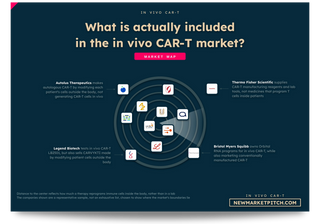
Radar map of the in vivo CAR-T market showing which companies count as part of it, which sit on its edge and which stay outside: What is actually included in the in vivo CAR-T market? (In Vivo CAR-T Market, NewMarketPitch)
Market Definition

What is this market, exactly?

In vivo CAR-T is easy to confuse with classic CAR-T, gene therapy and other immune drugs, so we start by drawing the line.

A therapy that delivers CAR genes to T cells inside the body, with a viral vector or a lipid nanoparticle, is in. So is a delivery platform built for that purpose. CAR-T cells made in a lab and infused back are out, and so are delivery tools with no in vivo CAR-T program behind them.

This way, our numbers track only therapies made inside the patient, not the wider cell therapy market.

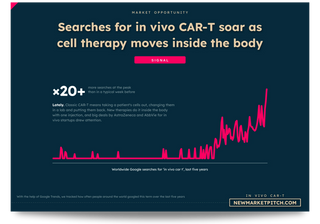
Google Trends curve of worldwide searches over five years for the in vivo CAR-T market: Searches for in vivo CAR-T soar as cell therapy moves inside the body (In Vivo CAR-T Market, NewMarketPitch)
Market Opportunity

Why is everyone looking at this market now?

In vivo CAR-T is one of the hottest corners of biotech in 2026, even though nearly every program is still in early trials or in the lab.

We've found a lot of interesting signals. For example, Bristol Myers Squibb agreed to buy Orbital Therapeutics for $1.5B in October 2025, for an RNA-based program that hadn't yet reached patients. And in July 2026, J&J committed $785M upfront to Sail Biomedicines, with an option to buy it for $2.58B. Big drugmakers are paying early for a chance to make CAR-T without a factory, starting with autoimmune diseases.

In this section, we look at why pharma is buying so early, why many programs start with autoimmune diseases rather than cancer, and what these prices mean for the startups that are still independent.

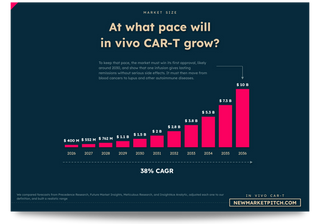
Bar chart of the in vivo CAR-T market size year by year to 2036, with its growth rate: At what pace will in vivo CAR-T grow? (In Vivo CAR-T Market, NewMarketPitch)
Market Size

How big could this market get?

No in vivo CAR-T product is on sale yet, so most market sizes online borrow their numbers from the whole cell therapy market.

We use first principles. We build our own estimate from the ground up, check it against outside sources, and show each assumption, so you can judge it yourself.

We also show how the number moves in a cautious and an optimistic scenario, depending on when the first approvals arrive.

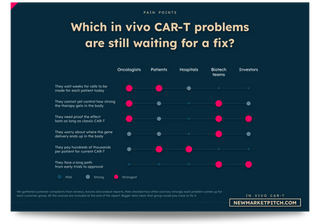
Matrix of the problems in vivo CAR-T customers still face, rated for each type of buyer: Which in vivo CAR-T problems are still waiting for a fix? (In Vivo CAR-T Market, NewMarketPitch)
Pain Points

What are the pain points, and for whom?

Classic CAR-T can work wonders in some blood cancers, but it takes weeks to make, needs chemotherapy first, and reaches only a small share of the patients who could use it.

We look at six types of companies, from viral vector and lipid nanoparticle developers to gene editing and DNA delivery platforms. Their buyers and partners are mostly big pharma, along with cancer and autoimmune specialists. For each, we rank the biggest pains, like reaching T cells without hitting the liver, controlling how strong the response gets, and staying safe when the therapy can't be pulled back.

This shows which problems partners will pay to solve now, and which still need human data first.

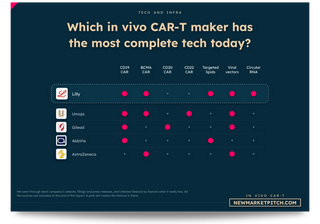
Comparison table of the tech offered by leading in vivo CAR-T companies: Which in vivo CAR-T maker has the most complete tech today? (In Vivo CAR-T Market, NewMarketPitch)
Tech & Infra

What is the latest tech and infrastructure?

The CAR is the easy part. The hard part is getting the gene into the right T cells inside the body, and nowhere else.

We map the delivery options one by one, from targeted lentiviral vectors and lipid nanoparticles carrying RNA to virus-like particles and DNA tools. We also show where things get stuck, like vectors that end up in the liver, RNA effects that fade, and the risk of a gene landing in the wrong place.

You'll see which approaches already have patient data, and which are still being tested in animals.

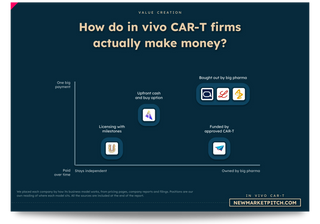
Map of in vivo CAR-T business models with company logos: How do in vivo CAR-T firms actually make money? (In Vivo CAR-T Market, NewMarketPitch)
Value Creation

How is value created and monetized exactly?

No in vivo CAR-T company sells a product yet. They make money through pharma partnerships, upfront payments, milestones and, more and more often, the sale of the whole company.

We compare these paths and show who pays, and when. A platform deal brings cash early but hands the best programs to a partner. Keeping a program in-house keeps the upside, but trials in cancer and autoimmune disease are expensive. And once products launch, their price will be compared with classic CAR-T, which needs a custom factory run for each patient.

You'll see which models bring in cash before the first approval, and which only pay off if the science works in patients.

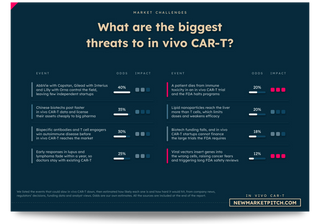
Table of the events that could slow the in vivo CAR-T market, with their odds and impact: What are the biggest threats to in vivo CAR-T? (In Vivo CAR-T Market, NewMarketPitch)
Market Challenges

What could slow this market down?

The obvious brakes are safety, early data from very few patients, and regulators still deciding how to judge a gene therapy that builds a cell therapy.

Others are easier to miss. A gene can end up in the wrong cell. RNA-based effects can fade, so patients may need repeat doses. Classic CAR-T and other autoimmune drugs keep improving. And one serious side effect in a single trial could slow the whole field.

We go through each risk, rate how likely it is, and explain which delivery approaches it would hurt most.

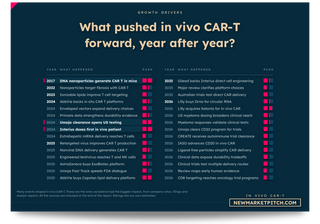
Timeline of the events that pushed the in vivo CAR-T market forward, with their impact: What pushed in vivo CAR-T forward, year after year? (In Vivo CAR-T Market, NewMarketPitch)
Growth Drivers

What are the growth drivers in this market?

Behind our growth estimate are a few forces that must keep working. This section walks through each one.

Some drivers are clear: no cell collection, no factory per patient, and a possible use in common autoimmune diseases like lupus. Others feed each other. Each human result makes the next partnership easier to sign. Pharma money pays for better delivery. And better delivery could make treatment simple enough for regular hospitals, not just top cancer centers.

Before building or investing, you should know what it takes for an off-the-shelf infusion to work safely in many patients, at a price that lets them get it.

Investor Bets

Where are investors placing their bets today?

In vivo CAR-T draws money from two sides: venture funds backing new platforms, and big pharma buying them before human data arrives.

We compare recent rounds and deals across viral vectors, lipid nanoparticles and newer delivery methods. We also look at whether investors favor cancer or autoimmune diseases first, and how much they pay for programs that started in China.

You'll see where in vivo CAR-T money is going after deals like J&J's with Sail, and what a newer company must show to raise money without selling itself first.

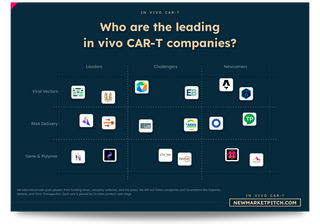
Market grid of the top in vivo CAR-T startups and companies by segment: Who are the leading in vivo CAR-T companies? (In Vivo CAR-T Market, NewMarketPitch)
Top Players

Who are the top startups and companies?

Capstan Therapeutics and EsoBiotec became the field's reference names when AbbVie and AstraZeneca bought them, but many more teams are racing behind them.

Several smaller companies work on one piece of the problem. Some design particles that only bind to T cells. Others build vectors that insert the gene in a safe spot, or add switches that let doctors turn the cells off. A growing number are in China, where early human studies can start quickly.

They're hard to compare because they use different delivery tools, target different diseases and report results from a handful of patients. Many also work inside pharma partnerships, so their best data stays private.

Below, you'll find the market grids and ecosystem maps we've built to show who uses which delivery method, for which disease, and where new players are getting in.

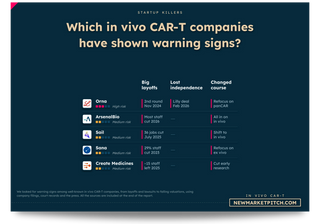
Table of in vivo CAR-T startups that shut down or struggled, and why: Which in vivo CAR-T companies have shown warning signs? (In Vivo CAR-T Market, NewMarketPitch)
Startup Killers

What could kill a startup in this market?

In vivo CAR-T has no factory to blame. If the delivery doesn't reach the right cells, nothing else matters.

So we studied why in vivo CAR-T startups fail or stall. Some pick a delivery method that works in mice but not in people. Others run out of cash before human data, or tie their only platform to one partner who later walks away.

If you're building, you'll see why delivery that works in humans, early safety data and enough cash matter more than a clever CAR design. If you're investing, you'll know what to check about results in animals versus people, cash burn and partner terms.

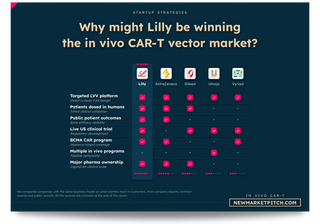
Scorecard showing what sets the leading in vivo CAR-T company apart: Why might Lilly be winning the in vivo CAR-T vector market? (In Vivo CAR-T Market, NewMarketPitch)
Startup Strategies

How do you win in this market?

Umoja Biopharma, CREATE Medicines, MagicRNA… a few in vivo CAR-T teams have already reached human trials. None has proven its approach yet.

Umoja Biopharma uses a lentiviral vector to make CAR-T cells inside the body and is testing it in blood cancers. CREATE Medicines delivers RNA in lipid nanoparticles and says it has dosed more than 50 patients across its programs. MagicRNA, based in Shenzhen, published early results in lupus in The New England Journal of Medicine. The data are promising but still small.

We'll look at how these teams moved from animals to patients, picked a first disease, and raised money without selling too early.

Questions?

Who is this market report actually for?+

It's for founders, investors, pharma and biotech teams, cell therapy specialists and strategists who want a clear view of in vivo CAR-T.

Use it to compare viral vectors and lipid nanoparticles, to choose between cancer and autoimmune disease as a first target, to weigh a partnership against going alone, or to understand the science, funding, competitors and risks across the whole market.

How many pages are in the report?+

It has 190+ pages. It is designed to be comprehensive enough to support serious market evaluation, while still being fast to read and easy to use.

We prioritize signal, structure, and visual clarity over unnecessary length.

What do you include in the in vivo CAR-T market?+

We define the in vivo CAR-T market as therapies that create CAR-T cells directly inside a patient's body.

We include delivery platforms and therapeutic programs that engineer T cells in vivo to express chimeric antigen receptors.

We exclude CAR-T cells manufactured outside the body, non-CAR immune therapies and generic gene delivery without an in vivo CAR-T program.

Do you list your sources clearly?+

Yes. All key data points and assumptions are explained and sourced in the document.

All sources are tier-1: company filings, funding databases, public datasets, expert interviews, industry reports, etc.

Is the data up to date?+

Yes. The report was last updated on November 1, 2026 with the latest market signals.

Is this a one-time payment?+

Yes. This is a one-time purchase. There is no subscription required to access the document.

I want to buy several market reports, can I get a discount code?+

Yes. You can use NEWMARKET for 20% off when purchasing two reports, or NEWMARKETMAX for 30% off when purchasing five or more.

I’m interested in a market but I can’t find it here+

If a market you care about is not currently on the list, email us at team@newmarketpitch.com and we may be able to cover it.

I have more questions for you+

No problem. You can reach out directly and we respond within 24 hours.

LAST UPDATED: November 1, 2026

It's time to really understand the in vivo CAR-T market

Making CAR-T inside the body could remove the factory, but only if the delivery reaches the right cells safely. This report covers the whole in vivo CAR-T market, from size and patients to delivery technology, business models, funding, key players, risks and the openings that remain.

PRO
$49
One-time payment
  • ✓ Market Definition
  • ✓ Market Opportunity
  • ✓ Market Size
  • ✓ Pain Points
  • ✓ Tech & Infra
  • ✓ Value Creation
  • ✓ Market Challenges
  • ✓ Growth Drivers
  • ✓ Investor Bets
  • ✓ Top Players
  • ✓ Startup Killers
  • ✓ Startup Strategies
PRO+
$79
One-time payment
  • ✓ Market Definition
  • ✓ Market Opportunity
  • ✓ Market Size
  • ✓ Pain Points
  • ✓ Tech & Infra
  • ✓ Value Creation
  • ✓ Market Challenges
  • ✓ Growth Drivers
  • ✓ Investor Bets
  • ✓ Top Players
  • ✓ Startup Killers
  • ✓ Startup Strategies
PRO++
$99
One-time payment
  • ✓ Market Definition
  • ✓ Market Opportunity
  • ✓ Market Size
  • ✓ Pain Points
  • ✓ Tech & Infra
  • ✓ Value Creation
  • ✓ Market Challenges
  • ✓ Growth Drivers
  • ✓ Investor Bets
  • ✓ Top Players
  • ✓ Startup Killers
  • ✓ Startup Strategies
Use code MARKETPITCH for 10% off your order