LAST UPDATED: October 27, 2026

Make smarter decisions on the K-beauty market

K-beauty went global, keeping shoppers is the hard part. Korean sunscreens and serums now sell out in American drugstores, not just in Seoul. Next come tariffs, foreign ingredient rules, copycats and shoppers who switch brands with every new trend. This report gives you the full picture of the K-Beauty market today.

  • 190+ pages
  • 12 sections
  • verified data only
Make smarter decisions on the K-beauty market market report cover

What’s inside the report?

12 sections to help founders and investors understand the K-Beauty market with clarity

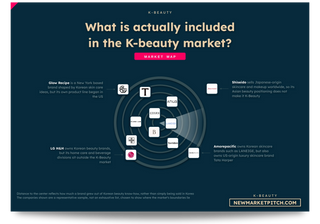
Radar map of the K-beauty market showing which companies count as part of it, which sit on its edge and which stay outside: What is actually included in the K-beauty market? (K-Beauty Market, NewMarketPitch)
Market Definition

What is this market, exactly?

K-Beauty gets used as a label for almost anything with snail mucin or a glass-skin promise, so we start by saying exactly which brands we count.

A Korean sunscreen brand selling in Seoul and online worldwide is in. So is a Korean makeup or haircare brand sold mostly abroad. A Western brand with a "Korean-inspired" serum is out, and so is a factory that makes products for other brands without selling its own.

That way, the market size and every brand we compare describe the same thing.

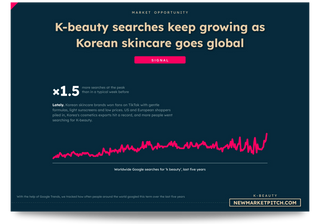
Google Trends curve of worldwide searches over five years for the K-beauty market: K-beauty searches keep growing as Korean skincare goes global (K-Beauty Market, NewMarketPitch)
Market Opportunity

What changed for this market lately?

K-Beauty is hot right now, and it has moved from a niche aisle to a mainstream export.

We've found a lot of interesting signals. For example, South Korea exported a record $11.4B of cosmetics in 2025, passing the US to become the world's second-largest exporter after France, and the US is now its biggest customer. And in May 2026, Olive Young, Korea's largest beauty retailer, opened its first US store in Pasadena, with around 400 brands on the shelves. Korean beauty is no longer something American shoppers hunt for online. It's becoming a normal part of how they buy skincare.

In this section, we look at why Korean brands are winning abroad now, which product types travel best, and what the move into physical stores means for smaller brands that grew up online.

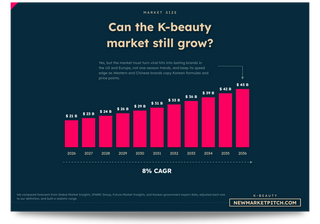
Bar chart of the K-beauty market size year by year to 2036, with its growth rate: Can the K-beauty market still grow? (K-Beauty Market, NewMarketPitch)
Market Size

How big could this market get?

K-Beauty market numbers rarely agree. Some count only Korean exports, others every product sold in Korea, and some add Western brands that borrow the look.

We use first principles. We build our own estimate, compare it with outside sources, and show each assumption, so you can see how we got there.

We also show how that number changes in a cautious and an optimistic scenario, for example if tariffs or a slowdown in China weigh more than expected.

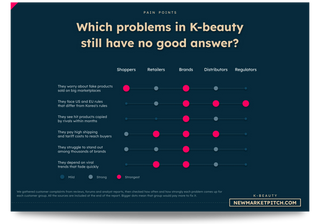
Matrix of the problems K-beauty customers still face, rated for each type of buyer: Which problems in K-beauty still have no good answer? (K-Beauty Market, NewMarketPitch)
Pain Points

What are the pain points, and for whom?

Shoppers want skincare that works, feels light and doesn't cost a fortune. Korean brands built their reputation on exactly that, but selling it abroad is another story.

We compare six types of companies, from indie skincare and sun care brands to makeup, haircare, derma brands sold in clinics and home beauty devices. Their buyers range from Gen Z shoppers on TikTok to big retailers and distributors in the US, Japan, Europe and Southeast Asia. For each, we rank the biggest pains, like winning shelf space, meeting foreign ingredient rules, fighting fakes and keeping customers after the first viral product.

This shows which problems brands will pay to solve first, and which needs shoppers are still looking to fill.

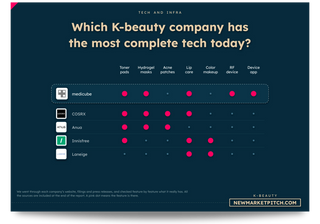
Comparison table of the tech offered by leading K-beauty companies: Which K-beauty company has the most complete tech today? (K-Beauty Market, NewMarketPitch)
Tech & Infra

What is the latest tech and infrastructure?

A great formula is only the start. K-Beauty also depends on fast contract manufacturers, new ingredients and a content machine that can turn a serum into a trend in weeks.

We map the chain from ingredients and formulation to manufacturing, packaging, logistics and the channels that reach shoppers. We also cover what's new, from PDRN and fermented ingredients to at-home devices and AI skin analysis. And we show where things get stuck, like Korean sunscreen filters that US rules don't allow, long registration in China, and copies that hit shelves within months.

You'll see which innovations actually move sales today, and which are mostly marketing.

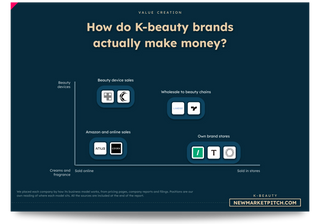
Map of K-beauty business models with company logos: How do K-beauty brands actually make money? (K-Beauty Market, NewMarketPitch)
Value Creation

How is value created and monetized exactly?

Direct-to-consumer sites, Amazon, TikTok Shop, wholesale to chains like Ulta and Costco, distributors abroad and duty-free: K-Beauty brands sell in many ways.

We compare who pays and what it costs to get there. Products made by Korean contract manufacturers are often cheap to produce, but creator fees, ads and samples eat much of the margin. Retail chains bring volume but take a big cut and expect marketing support. Distributors open new countries fast but keep the customer data. And tariffs and shipping costs now weigh on every product sent to the US.

You'll see which channels let a brand keep its margins once the viral moment fades, and which ones only buy growth.

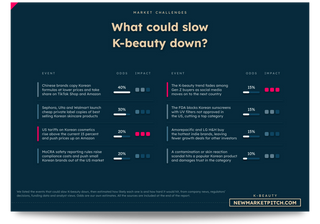
Table of the events that could slow the K-beauty market, with their odds and impact: What could slow K-beauty down? (K-Beauty Market, NewMarketPitch)
Market Challenges

What could slow this market down?

Some brakes are easy to see: US tariffs on Korean goods, weaker demand from China, and Western and Japanese giants launching their own Korean-style products.

Others are easier to miss. Hundreds of brands share the same contract manufacturers, so products look more and more alike. Ingredient trends burn out fast. Fakes and gray-market imports hurt prices and trust. And a brand that depends on one hero product or one platform can lose half its sales when the algorithm moves on.

We go through each risk, rate how likely it is, and explain which brands and channels would feel it first.

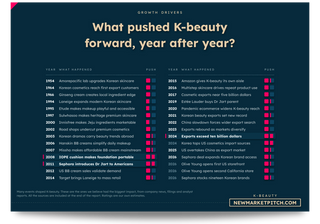
Timeline of the events that pushed the K-beauty market forward, with their impact: What pushed K-beauty forward, year after year? (K-Beauty Market, NewMarketPitch)
Growth Drivers

What are the growth drivers in this market?

Behind any growth rate there are a few real forces, and K-Beauty has more than most.

Some drivers are plain to see: good products at fair prices, K-pop and K-dramas, and short videos that make skincare routines go viral. Others reinforce each other. Each new store abroad makes the next brand easier to launch. Retailers that see one Korean brand sell well make room for more. And contract manufacturers let a new brand go from idea to shelf in months, which keeps the category fresh.

Before building or investing, you should know what makes a Korean brand keep selling abroad after its first viral hit, and what it takes to turn online fans into repeat buyers in stores.

Investor Bets

What are investors into right now?

K-Beauty has become one of the few consumer markets where buyers, public investors and private equity all want in.

We compare recent deals across indie skincare brands, beauty device makers and groups that own several brands. We also look at whether buyers prefer brands that sell mostly in Korea or ones already strong in the US. And we flag the newer bets, like derma brands, haircare and stock market listings on the Korean exchange.

You'll see which K-Beauty brands investors and acquirers are backing today, and how much overseas sales and repeat buying a younger brand needs before it can raise or sell.

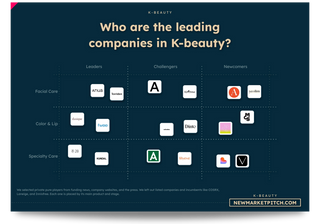
Market grid of the top K-beauty startups and companies by segment: Who are the leading companies in K-beauty? (K-Beauty Market, NewMarketPitch)
Top Players

Who are the top startups and companies?

Cosrx and Beauty of Joseon became the names everyone knows, one for its snail essence and the other for its sunscreen, but they're only a small part of the K-Beauty market.

Many interesting brands are barely known outside Korea or outside one platform. Some sell only in Japan or Southeast Asia. Others make one product for one skin problem, sell mostly through dermatology clinics, or build a whole business around a single at-home device.

They're hard to compare because sales figures are rarely public, many brands sit inside larger groups, and online bestseller lists change every week. A brand that tops a chart this month can disappear the next.

Below, you'll find the market grids and ecosystem maps we've built to show which brands sell what, where, and through which channels.

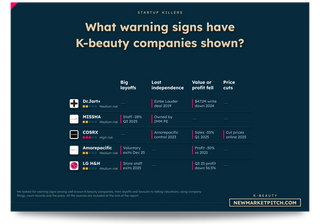
Table of K-beauty startups that shut down or struggled, and why: What warning signs have K-beauty companies shown? (K-Beauty Market, NewMarketPitch)
Startup Killers

What could kill a startup in this market?

Going viral is easy in K-Beauty. Staying on the shelf is not.

So we studied why Korean beauty brands fail or stall. Some live on one hero product until a cheaper copy shows up. Others grow on social media but can't handle the volumes or the demands of a big retail chain. And some bet on one market, like China, and get caught when demand or the rules change.

If you're building, you'll see why a second hit, steady retail partners and sales in more than one country matter more than one viral video. If you're investing, you'll know what to check about product concentration, channel dependence and how much of the growth comes from paid promotion.

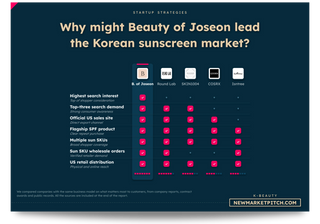
Scorecard showing what sets the leading K-beauty company apart: Why might Beauty of Joseon lead the Korean sunscreen market? (K-Beauty Market, NewMarketPitch)
Startup Strategies

How do you win in this market?

Medicube, Anua, Skin1004… a few Korean brands have turned online buzz into big global sales.

Their routes differ. Medicube built a business around at-home beauty devices and has sold more than six million of them. Anua grew from one toner to sales above $500M and a spot in every Ulta store. Skin1004 built a whole range on one ingredient, Madagascar centella, and took it all the way into Costco. Each found a product people come back to, though none has yet shown it can stay on top for a decade, as Korea's older beauty groups did.

We'll look at how these brands turned one hero product into a range, won the big retail chains, and kept growing after the trend that made them moved on.

Questions?

Who is this market report actually for?+

It's for founders, investors, brand managers, retailers, distributors and strategists who want a clear view of Korean beauty.

Use it to choose which countries and channels to enter first, to compare selling online and through social shops with going into stores, to size up a brand you might buy or back, or to understand demand, products, business models, funding, competitors and risks across the whole K-Beauty market.

How many pages are in the report?+

It has 190+ pages. It is designed to be comprehensive enough to support serious market evaluation, while still being fast to read and easy to use.

We prioritize signal, structure, and visual clarity over unnecessary length.

What do you include in the K-Beauty market?+

We define the K-Beauty market as beauty brands whose products and positioning originate in South Korea.

We include Korean skincare, makeup and other beauty-product brands sold domestically or internationally.

We exclude non-Korean brands using Korean-inspired messaging and manufacturers or distributors without their own consumer brand.

Do you list your sources clearly?+

Yes. All key data points and assumptions are explained and sourced in the document.

All sources are tier-1: company filings, funding databases, public datasets, expert interviews, industry reports, etc.

Is the data up to date?+

Yes. The report was last updated on October 27, 2026 with the latest market signals.

Is this a one-time payment?+

Yes. This is a one-time purchase. There is no subscription required to access the document.

I want to buy several market reports, can I get a discount code?+

Yes. You can use NEWMARKET for 20% off when purchasing two reports, or NEWMARKETMAX for 30% off when purchasing five or more.

I’m interested in a market but I can’t find it here+

If a market you care about is not currently on the list, email us at team@newmarketpitch.com and we may be able to cover it.

I have more questions for you+

No problem. You can reach out directly and we respond within 24 hours.

LAST UPDATED: October 27, 2026

Build or invest in the K-beauty market with clear eyes

A Korean serum can sell out in a week after one viral video and be copied the next month. This report covers the whole K-Beauty market, from size and shoppers to products, channels, business models, funding, key brands, risks and the openings that remain.

PRO
$49
One-time payment
  • ✓ Market Definition
  • ✓ Market Opportunity
  • ✓ Market Size
  • ✓ Pain Points
  • ✓ Tech & Infra
  • ✓ Value Creation
  • ✓ Market Challenges
  • ✓ Growth Drivers
  • ✓ Investor Bets
  • ✓ Top Players
  • ✓ Startup Killers
  • ✓ Startup Strategies
PRO+
$79
One-time payment
  • ✓ Market Definition
  • ✓ Market Opportunity
  • ✓ Market Size
  • ✓ Pain Points
  • ✓ Tech & Infra
  • ✓ Value Creation
  • ✓ Market Challenges
  • ✓ Growth Drivers
  • ✓ Investor Bets
  • ✓ Top Players
  • ✓ Startup Killers
  • ✓ Startup Strategies
PRO++
$99
One-time payment
  • ✓ Market Definition
  • ✓ Market Opportunity
  • ✓ Market Size
  • ✓ Pain Points
  • ✓ Tech & Infra
  • ✓ Value Creation
  • ✓ Market Challenges
  • ✓ Growth Drivers
  • ✓ Investor Bets
  • ✓ Top Players
  • ✓ Startup Killers
  • ✓ Startup Strategies
Use code MARKETPITCH for 10% off your order