LAST UPDATED: October 30, 2026

Get a reality check on the liquid biopsy market

Liquid biopsy works, getting paid for it is the hard part. A simple blood draw can now help pick a cancer drug, catch a relapse early and, more and more, screen people with no symptoms. The hard part is getting doctors to trust these tests and insurers to pay for them. This report brings you the latest on the whole liquid biopsy market.

  • 190+ pages
  • 12 sections
  • verified data only
Get a reality check on the liquid biopsy market market report cover

What’s inside the report?

12 sections to help founders and investors understand the liquid biopsy market with clarity

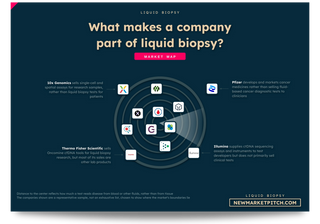
Radar map of the liquid biopsy market showing which companies count as part of it, which sit on its edge and which stay outside: What makes a company part of liquid biopsy? (Liquid Biopsy Market, NewMarketPitch)
Market Definition

What is this market, exactly?

Liquid biopsy is easy to confuse with ordinary blood work and tissue testing, so we first spell out what we count.

A blood test that finds tumor DNA to choose a cancer drug is in. So is a test that watches for cancer coming back after surgery, or a screening test for people with no symptoms. A tissue biopsy is out, and so is a routine cholesterol test or blood count.

Every number and every company in the report uses that same line.

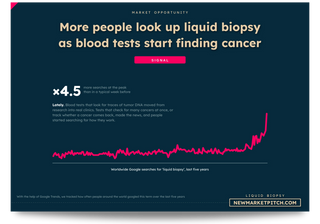
Google Trends curve of worldwide searches over five years for the liquid biopsy market: More people look up liquid biopsy as blood tests start finding cancer (Liquid Biopsy Market, NewMarketPitch)
Market Opportunity

What changed for this market lately?

Liquid biopsy is heating up, and blood tests are moving from cancer clinics into routine screening.

We've found a lot of interesting signals. For example, in February 2026, a new US law created Medicare coverage for FDA-approved multi-cancer blood tests, starting in 2028. Then in May, the American Cancer Society added a blood test, Guardant's Shield, to its colon cancer screening guideline, as an option for people who won't do a stool test or a colonoscopy. Lawmakers and guideline writers are making room for cancer screening by blood test.

In this section, we look at why screening is opening up now, which tests already get paid for, and what still stands between a good study and everyday use.

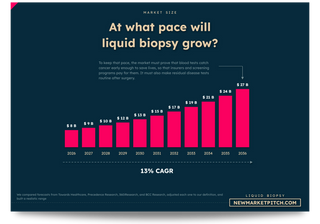
Bar chart of the liquid biopsy market size year by year to 2036, with its growth rate: At what pace will liquid biopsy grow? (Liquid Biopsy Market, NewMarketPitch)
Market Size

How big could this market get?

Liquid biopsy market sizes online often lump in all genetic testing, prenatal screening or any lab test run on blood.

We build our own estimate from the bottom up, check it against other sources and explain every assumption, so you can see where the number comes from.

We also show how it changes if screening takes off fast, or if payers stay slow.

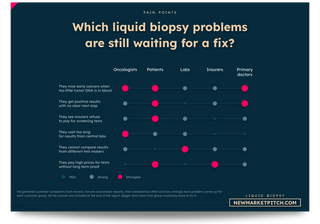
Matrix of the problems liquid biopsy customers still face, rated for each type of buyer: Which liquid biopsy problems are still waiting for a fix? (Liquid Biopsy Market, NewMarketPitch)
Pain Points

What are the pain points, and for whom?

Many cancers are still found too late, and a tissue biopsy can be painful, slow and sometimes impossible.

We compare six types of liquid biopsy companies, from early detection and screening to drug selection, residual disease and monitoring tests. Their customers include oncologists, primary care doctors, health systems, insurers and drug makers running trials. Then we rank their biggest pains, like late diagnosis, slow results, tests that miss small tumors and bills insurers won't pay.

This shows which tests doctors will order and someone will pay for, and which ones are still stuck in research.

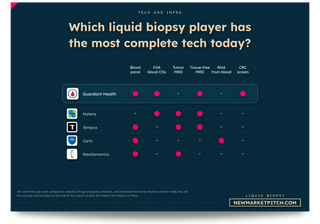
Comparison table of the tech offered by leading liquid biopsy companies: Which liquid biopsy player has the most complete tech today? (Liquid Biopsy Market, NewMarketPitch)
Tech & Infra

What is the latest tech and infrastructure?

A tube of blood holds tiny traces of tumor DNA. The challenge is finding them in a sea of normal DNA.

We map the stack layer by layer, from blood collection and sequencing to methylation and fragment analysis, AI models and lab software. We also show where things get stuck, like the very small amount of tumor DNA in early cancer, false alarms that send healthy people for scans, and sequencing costs that still weigh on each test.

You'll see what blood tests already do well today, like matching a patient to a targeted drug, and what still needs better data, like finding early cancers reliably.

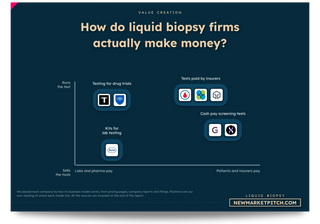
Map of liquid biopsy business models with company logos: How do liquid biopsy firms actually make money? (Liquid Biopsy Market, NewMarketPitch)
Value Creation

How is value created and monetized exactly?

Per-test payments from insurers and Medicare, cash-pay screening, drug company contracts for trials and companion tests, and data deals: liquid biopsy companies earn money in several ways.

We compare who pays and what each test costs to run. A test with Medicare coverage can grow fast, but each new use needs fresh evidence. Cash-pay screening skips insurers but depends on consumers and employers. Pharma contracts bring steady revenue, though they rise and fall with trials. And sequencing, sales teams and lab staff take a big share of every test.

You'll see which models pay for themselves at scale, and which ones lose money on every test until coverage arrives.

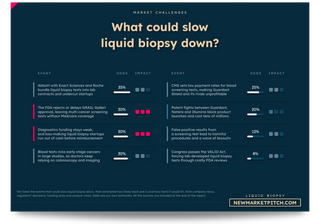
Table of the events that could slow the liquid biopsy market, with their odds and impact: What could slow liquid biopsy down? (Liquid Biopsy Market, NewMarketPitch)
Market Challenges

What could slow this market down?

Some brakes are easy to see: slow insurance coverage, big trials that take years, and doctors who still trust colonoscopy and tissue biopsies.

Others are easier to miss. A screening study that misses its main goal can cool the whole field. FDA rules for lab-developed tests keep shifting. False alarms lead to costly follow-up scans. And patent fights between large labs can keep a product off the market for years.

We rate each risk by how likely it is, so you can see which ones deserve your attention first.

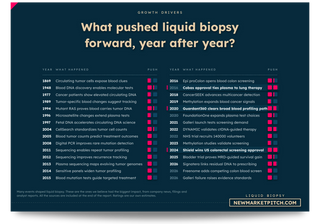
Timeline of the events that pushed the liquid biopsy market forward, with their impact: What pushed liquid biopsy forward, year after year? (Liquid Biopsy Market, NewMarketPitch)
Growth Drivers

What are the growth drivers in this market?

Better science explains only part of the growth here. So we go through the other forces one by one.

Some drivers are plain to see: cheaper sequencing, more targeted cancer drugs that need a test, and an aging population. Others reinforce each other. Each new guideline makes insurers more willing to pay. Coverage brings more tests, and more tests bring data that sharpens the next version. Drug makers also use these tests in their trials, which helps them become standard care.

Before building or investing, you should know what gets a blood test into a doctor's routine, and what gets it paid for.

Investor Bets

What are investors backing right now?

Investors are paying close attention to liquid biopsy again, and they look hard at what each test earns.

We'll compare funding for screening tests, residual disease tests and tests that help pick a drug. We'll also look at whether investors prefer companies running their own labs or selling kits to other labs, and newer bets beyond cancer.

We'll look at recent rounds, listings and coverage wins to see which test makers investors expect to reach profit. You'll also see what proof a younger company needs before it can raise.

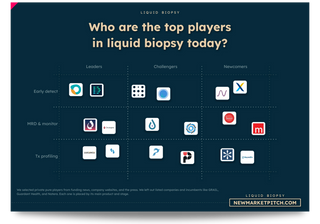
Market grid of the top liquid biopsy startups and companies by segment: Who are the top players in liquid biopsy today? (Liquid Biopsy Market, NewMarketPitch)
Top Players

Who are the top startups and companies?

GRAIL and Guardant Health come up first when people talk about cancer blood tests, but the market runs much deeper.

Many interesting players work quietly. Some only test for cancer coming back after surgery. Others sell kits and software to hospital labs, read DNA fragments with AI, or run tests for drug makers during their trials.

They're hard to compare because results depend on the cancer, the stage and the study. A test that looks strong in late-stage patients can miss many early ones, and few companies report their numbers the same way. Many also sell through pharma partners or lab networks, so patients never see their name.

Below, you'll find the market grids and ecosystem maps we've built to show who tests for what, at which stage of care, and where newer companies are getting in.

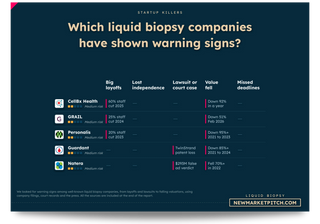
Table of liquid biopsy startups that shut down or struggled, and why: Which liquid biopsy companies have shown warning signs? (Liquid Biopsy Market, NewMarketPitch)
Startup Killers

What could kill a startup in this market?

In screening, a false alarm costs more than a missed sale. Send healthy people for scans they didn't need, and doctors stop ordering the test.

So we studied why liquid biopsy startups fail or stall. Some build a strong test but never win coverage, so each sale loses money. Others spend years on one big screening trial and run out of cash before the results. And some compete on price against large labs that run far more tests.

If you're building, you'll see why evidence, coverage and the cost of each test matter as much as accuracy. If you're investing, you'll know what to check about reimbursement, trial timelines and lab costs.

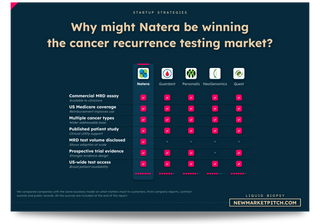
Scorecard showing what sets the leading liquid biopsy company apart: Why might Natera be winning the cancer recurrence testing market? (Liquid Biopsy Market, NewMarketPitch)
Startup Strategies

How do you win in this market?

Natera, Foundation Medicine, Freenome… a few liquid biopsy companies have built real test volume or landed big partners. Their paths, and their results, are very different.

Natera made its Signatera test a routine way to check whether cancer is coming back after treatment. Foundation Medicine, part of Roche, sells blood and tissue tests that help doctors pick a drug. Freenome licensed its colon cancer blood test to a larger lab company instead of selling it alone. Not every one of these models has proven profitable yet.

We'll look at how these teams picked their first use, gathered the evidence payers asked for, and kept the cost of each test under control.

Questions?

Who is this market report actually for?+

It's for founders, investors, diagnostics companies, lab operators, pharma teams and strategists who want a clear view of liquid biopsy.

Use it to compare screening, drug selection and residual disease tests, to weigh running your own lab against selling kits, to plan for coverage and evidence, or to understand demand, technology, funding, competitors and risks across the whole market.

How many pages are in the report?+

It has 190+ pages. It is designed to be comprehensive enough to support serious market evaluation, while still being fast to read and easy to use.

We prioritize signal, structure, and visual clarity over unnecessary length.

What do you include in the liquid biopsy market?+

We define the liquid biopsy market as tests that analyze disease-related biological material in bodily fluids.

We include blood and other fluid tests for cancer detection, treatment selection, residual disease and disease monitoring.

We exclude tissue biopsies and routine blood tests that do not measure disease-derived molecular signals.

Do you list your sources clearly?+

Yes. All key data points and assumptions are explained and sourced in the document.

All sources are tier-1: company filings, funding databases, public datasets, expert interviews, industry reports, etc.

Is the data up to date?+

Yes. The report was last updated on October 30, 2026 with the latest market signals.

Is this a one-time payment?+

Yes. This is a one-time purchase. There is no subscription required to access the document.

I want to buy several market reports, can I get a discount code?+

Yes. You can use NEWMARKET for 20% off when purchasing two reports, or NEWMARKETMAX for 30% off when purchasing five or more.

I’m interested in a market but I can’t find it here+

If a market you care about is not currently on the list, email us at team@newmarketpitch.com and we may be able to cover it.

I have more questions for you+

No problem. You can reach out directly and we respond within 24 hours.

LAST UPDATED: October 30, 2026

Want to know what's really going on in the liquid biopsy market?

A blood test can find cancer early and still struggle to get paid. This report gives you the whole liquid biopsy market in one place: its size, customers, technology, business models, funding, key players, risks and the openings left.

PRO
$49
One-time payment
  • ✓ Market Definition
  • ✓ Market Opportunity
  • ✓ Market Size
  • ✓ Pain Points
  • ✓ Tech & Infra
  • ✓ Value Creation
  • ✓ Market Challenges
  • ✓ Growth Drivers
  • ✓ Investor Bets
  • ✓ Top Players
  • ✓ Startup Killers
  • ✓ Startup Strategies
PRO+
$79
One-time payment
  • ✓ Market Definition
  • ✓ Market Opportunity
  • ✓ Market Size
  • ✓ Pain Points
  • ✓ Tech & Infra
  • ✓ Value Creation
  • ✓ Market Challenges
  • ✓ Growth Drivers
  • ✓ Investor Bets
  • ✓ Top Players
  • ✓ Startup Killers
  • ✓ Startup Strategies
PRO++
$99
One-time payment
  • ✓ Market Definition
  • ✓ Market Opportunity
  • ✓ Market Size
  • ✓ Pain Points
  • ✓ Tech & Infra
  • ✓ Value Creation
  • ✓ Market Challenges
  • ✓ Growth Drivers
  • ✓ Investor Bets
  • ✓ Top Players
  • ✓ Startup Killers
  • ✓ Startup Strategies
Use code MARKETPITCH for 10% off your order