LAST UPDATED: November 20, 2026

Make smarter decisions on the longevity biotech market

Everyone wants to live longer, no drug is approved for it yet. Aging science is entering regulated trials, in people and even in dogs. The open question is who can prove a real benefit, to a regulator, before the money runs out. This report gives you an up-to-date view of the whole market.

  • 212+ pages
  • 12 sections
  • verified data only
Make smarter decisions on the longevity biotech market market report cover

What’s inside the report?

12 sections to help founders and investors understand the longevity biotech market with clarity

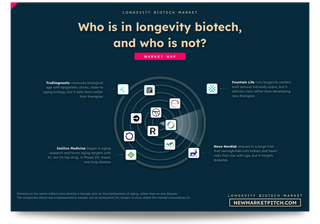
Radar map of the longevity biotech market showing which companies count as part of it, which sit on its edge and which stay outside: Who is in longevity biotech, and who stays outside? (Longevity Biotech Market, NewMarketPitch)
Market Definition

What does this market really cover?

We start by setting the limits of the market: what counts as longevity biotech, and what doesn't.

A drug that targets a cause of aging, like worn-out cells or failing repair, is in. So is a platform built to find or test those drugs. A clinic selling IV drips or a supplement brand is out, and so is a drug for one disease with no link to aging biology.

This matters, because many companies now call themselves longevity players. Our numbers only count the ones working on aging biology.

Google Trends curve of worldwide searches over five years for the longevity biotech market: More and more people ask how to live longer, as longevity goes mainstream (Longevity Biotech Market, NewMarketPitch)
Market Opportunity

Why is everyone looking at this market now?

Longevity biotech is heating up in 2026, and the science is finally meeting regulators.

We've found a lot of interesting signals. The FDA cleared Life Biosciences to test partial epigenetic reprogramming in humans. And Loyal raised $100M for a pill intended to extend senior dogs' lives, after the FDA accepted its safety data. Rejuvenation research is moving toward formal trials and approval paths.

Here, we'll look at which aging approaches are reaching patients first, who is paying for them, and why regulators matter so much in this market.

Bar chart of the longevity biotech market size year by year to 2036, with its growth rate: How much bigger can longevity biotech get? (Longevity Biotech Market, NewMarketPitch)
Market Size

How big could this market get?

Longevity market sizes online can reach into the trillions, because many include spas, supplements and fitness. That isn't the market we measure.

We build our estimate from the ground up, counting what companies spend and earn on therapies that target aging and on the platforms behind them. Then we check it against other estimates and explain why they differ. Every assumption is on the page.

Since one trial result can change the picture, we add an optimistic and a cautious scenario.

Matrix of the problems longevity biotech customers still face, rated for each type of buyer: Which longevity biotech problems are still unsolved? (Longevity Biotech Market, NewMarketPitch)
Pain Points

What are the pain points, and for whom?

Aging is the biggest risk factor for most chronic diseases, yet no drug is approved to treat aging itself.

We compare six types of longevity biotech companies, from senolytics and reprogramming to discovery platforms. Then we rank the hardest problems for developers and partners: long trials, measuring benefits, and getting treatments to patients.

This shows where a company can create value now, before aging itself becomes something a doctor can treat.

Comparison table of the tech offered by leading longevity biotech companies: Which longevity biotech has the most complete tech today? (Longevity Biotech Market, NewMarketPitch)
Tech & Infra

What is the latest tech and infrastructure?

Treating aging isn't one scientific bet. Gene therapies, cellular reprogramming and drugs that target aging cells take very different paths to the clinic.

We keep this section current with what's in human trials, what's in animals, and what's still in the lab, and we point out the bottlenecks, like delivering gene therapies safely and agreeing on biomarkers that prove a drug slows aging.

A clear snapshot of which approaches are closest to the clinic.

Map of longevity biotech business models with company logos: How do longevity biotechs actually make money? (Longevity Biotech Market, NewMarketPitch)
Value Creation

How is value created and monetized exactly?

Most longevity biotechs don't sell an aging drug yet. They make money through pharma partnerships, licensing, milestone payments and grants, and in a few cases through products for pets.

We compare these models and show who pays, and when. A company can target one disease first, like glaucoma or a skin condition, to reach approval sooner, then expand. A discovery platform can sell targets to pharma for upfront cash and royalties, but it gives away much of the upside.

You'll see which paths bring in revenue before a big trial pays off, and which ones need investors willing to wait ten years.

Table of the events that could slow the longevity biotech market, with their odds and impact: What could go wrong for longevity biotech? (Longevity Biotech Market, NewMarketPitch)
Market Challenges

What could slow this market down?

The main brakes are well known: trials that take years, regulators who don't treat aging as a disease, and high costs.

Others are easier to miss. Hype from the wellness world hurts trust. Aging clocks don't always agree with each other. Gene and cell therapies raise safety questions. And a setback at one company can drag down the whole field's stocks.

In this section, we list the main risks, estimate the odds of each one, and show what each would mean for developers and investors.

Timeline of the events that pushed the longevity biotech market forward, with their impact: What pushed longevity biotech forward, year after year? (Longevity Biotech Market, NewMarketPitch)
Growth Drivers

What are the growth drivers in this market?

Behind our growth estimate are a few forces that have to keep working. This section explains them one by one.

Some drivers are clear: aging populations, wealthy founders funding the field, and drugmakers looking for the next big chronic-disease market after obesity drugs. Others build over time. Each human trial makes the next one easier to design. Better aging clocks could shorten studies. And a first approval, even for dogs, could open a path for others.

Before building or investing, you should know what it takes to turn aging research into approved drugs patients can use.

Bar chart of where investors put their money in longevity biotech, by category: Where did longevity biotech investors put their money this past year? (Longevity Biotech Market, NewMarketPitch)
Investor Bets

What are investors into right now?

Longevity biotech has a funding mix unlike most of biotech: billionaire founders, dedicated longevity funds, pharma partners and a few public listings.

We'll compare funding for drug developers, diagnostics and technologies aimed at slowing age-related disease. We'll look at which teams can show solid clinical evidence and which still depend on a long path to approval.

You'll see what recent rounds say about which aging approaches investors trust today, and how much the field still depends on a handful of big checks.

Market grid of the top longevity biotech startups and companies by segment: Who are the top players in longevity biotech today? (Longevity Biotech Market, NewMarketPitch)
Top Players

Who are the top startups and companies?

Cambrian Bio and Juvenescence often come up first when people talk about drugs for aging, but the field runs much deeper.

Many smaller companies work on one mechanism of aging, like failing mitochondria, old immune cells or stiff tissue. Others build tools, such as aging clocks or animal models, to test ideas faster. Some start with pets, where trials are shorter.

Side by side, they rarely line up. They don't aim at the same disease or the same proof. One tests a skin cream, another an eye injection, a third a pill for dogs. And many describe their work as treating a disease, not aging, to fit the rules regulators use.

That's why we built market grids and ecosystem maps that show who targets which mechanism, and where new players are emerging.

Table of longevity biotech startups that shut down or struggled, and why: What broke these longevity biotech startups, and how did they end? (Longevity Biotech Market, NewMarketPitch)
Startup Killers

What could kill a startup in this market?

In longevity, the big promise is the easy part. Proving that a drug slows aging in people can take longer than a company's runway.

So we studied why longevity biotechs fail or stall. Some chase too many diseases at once. Others pick endpoints regulators won't accept, run out of cash between trials, or lose credibility through hype.

If you're building, you'll see why a clear first disease, accepted endpoints and careful claims matter as much as the science. If you're investing, you'll know what to check about trial design, cash runway and the evidence behind each claim.

Scorecard showing what sets the leading longevity biotech company apart: Why might Retro be winning the rejuvenation race? (Longevity Biotech Market, NewMarketPitch)
Startup Strategies

How do you win in this market?

Gero, Rubedo Life Sciences, Turn Biotechnologies… a few longevity biotechs are showing real progress, even though no aging drug is approved yet.

Gero sells AI-discovered aging targets to Chugai. Rubedo tested its senolytic drug on skin first. Turn Bio licensed its rejuvenation platform to a Korean drugmaker. None is proven at scale, but each has partners or data to build on.

We'll look at how these teams picked a first target, found partners willing to pay, and kept going through the long years before approval.

Questions?

Who is this market report actually for?+

It's for founders, investors, pharma teams, research funders and strategists who want a clear view of longevity biotech.

It's useful if you're comparing aging approaches, choosing a first disease to target, weighing a platform or pipeline bet, or trying to understand trials, regulation, money, competitors and risks across the field.

How many pages are in the report?+

It has 212+ pages. It is designed to be comprehensive enough to support serious market evaluation, while still being fast to read and easy to use.

We prioritize signal, structure, and visual clarity over unnecessary length.

What do you include in the longevity biotech market?+

We define the longevity biotech market as biotechnology built to slow, prevent, repair or reverse the biological mechanisms of aging, including platforms made to discover and validate such interventions.

We include mechanism-first developers working on senescence, epigenetic rejuvenation, cell, tissue and immune regeneration, autophagy, mitochondrial and metabolic aging, telomere and DNA damage biology, and geroscience discovery platforms. Their first clinical indication may be a named disease if the core platform targets an aging mechanism. Human and veterinary lifespan medicines qualify too.

We exclude screening, biological-age tests, lifestyle programs, clinics, supplements and skincare that develop no aging-biology therapeutic, general regenerative medicine, fertility care, cancer, obesity and disease-only drugs, generic AI drug discovery, and non-aging research infrastructure.

Do you list your sources clearly?+

Yes. All key data points and assumptions are explained and sourced in the document.

All sources are tier-1: company filings, funding databases, public datasets, expert interviews, industry reports, etc.

Is the data up to date?+

Yes. The report was last updated on November 20, 2026 with the latest market signals.

Is this a one-time payment?+

Yes. This is a one-time purchase. There is no subscription required to access the document.

I want to buy several market reports, can I get a discount code?+

Yes. You can use NEWMARKET for 20% off when purchasing two reports, or NEWMARKETMAX for 30% off when purchasing five or more.

I’m interested in a market but I can’t find it here+

If a market you care about is not currently on the list, email us at team@newmarketpitch.com and we may be able to cover it.

I have more questions for you+

No problem. You can reach out directly and we respond within 24 hours.

LAST UPDATED: November 20, 2026

Get the full picture of the longevity biotech market

Slowing aging in mice is one thing. Proving it in people, to a regulator, is another. This report covers the whole longevity biotech market, from the science and trials to market size, partners, business models, funding, key companies and the risks along the way.

PRO
$49
One-time payment
  • ✓ Market Definition
  • ✓ Market Opportunity
  • ✓ Market Size
  • ✓ Pain Points
  • ✓ Tech & Infra
  • ✓ Value Creation
  • ✓ Market Challenges
  • ✓ Growth Drivers
  • ✓ Investor Bets
  • ✓ Top Players
  • ✓ Startup Killers
  • ✓ Startup Strategies
PRO+
$79
One-time payment
  • ✓ Market Definition
  • ✓ Market Opportunity
  • ✓ Market Size
  • ✓ Pain Points
  • ✓ Tech & Infra
  • ✓ Value Creation
  • ✓ Market Challenges
  • ✓ Growth Drivers
  • ✓ Investor Bets
  • ✓ Top Players
  • ✓ Startup Killers
  • ✓ Startup Strategies
PRO++
$99
One-time payment
  • ✓ Market Definition
  • ✓ Market Opportunity
  • ✓ Market Size
  • ✓ Pain Points
  • ✓ Tech & Infra
  • ✓ Value Creation
  • ✓ Market Challenges
  • ✓ Growth Drivers
  • ✓ Investor Bets
  • ✓ Top Players
  • ✓ Startup Killers
  • ✓ Startup Strategies
Use code MARKETPITCH for 10% off your order