LAST UPDATED: November 20, 2026

Need to get familiar with the machine vision market? Get our report

Factory cameras used to check one thing: is this part good or bad? Now AI lets them learn new defects from a few images, and the big vendors want the same cameras to guide robots. This report covers the whole machine vision market as it stands today.

  • 190+ pages
  • 12 sections
  • verified data only
Need to get familiar with the machine vision market? Get our report market report cover

What’s inside the report?

12 sections to help founders and investors understand the machine vision market with clarity

Radar map of the machine vision market showing which companies count as part of it, which sit on its edge and which stay outside: Which companies really belong in machine vision? (Machine Vision Market, NewMarketPitch)
Market Definition

What does this market really cover?

Machine vision gets confused with computer vision in general, security cameras and medical scans, so we start by saying exactly what we count.

A camera that rejects a scratched phone case on a production line is in. So is a barcode reader on a parcel sorter, and the 3D camera that tells a robot where to grab a part. A smartphone camera, a hospital scanner and a CCTV system watching a parking lot are out.

That way, our market size and every company we compare refer to the same thing.

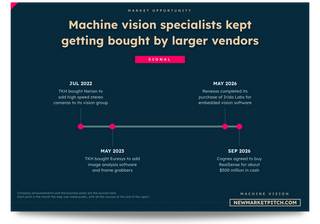
Timeline of the dated steps showing how the machine vision market is moving, with one key signal: Machine vision specialists kept getting bought by larger vendors (Machine Vision Market, NewMarketPitch)
Market Opportunity

Why this market now?

Machine vision is coming out of a slow patch, and its leaders now want to give robots eyes, not just inspect parts.

We've found a lot of interesting signals. For example, in September 2026, Cognex agreed to buy RealSense, the depth camera maker spun out of Intel, for about $500M. And in May 2026, German camera maker Basler raised its forecast after first-quarter orders jumped 64%, pulled by chips, electronics and logistics. Demand is coming back, and the biggest players are betting that robots will need vision as much as quality control does.

In this section, we look at which industries are buying again, why 3D and robot guidance draw so much attention, and what that shift means for companies that only sell inspection.

Bar chart of the machine vision market size year by year to 2036, with its growth rate: How much bigger can machine vision get? (Machine Vision Market, NewMarketPitch)
Market Size

How big could this market get?

Machine vision figures online swing a lot. Some reports count only cameras and lenses, others add the robot, the software or even consumer image sensors.

We size the market from first principles: we build our own estimate, check it against outside sources, and write down every assumption. You can see what's inside our number and why it may not match others.

We also show how the number changes in a slow case and a fast one.

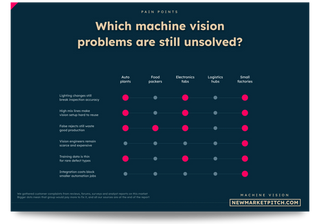
Matrix of the problems machine vision customers still face, rated for each type of buyer: Which machine vision problems are still unsolved? (Machine Vision Market, NewMarketPitch)
Pain Points

What are the pain points, and for whom?

Every plant wants to catch bad parts before they ship. Few have the people to set up and tune a vision system, and fewer still can afford to stop a line when it rejects good parts by mistake.

We compare six types of machine vision companies, from camera and lens makers to smart camera vendors, AI inspection software, 3D vision for robots, turnkey inspection machines and the integrators who put it all together. Their buyers run electronics, car, battery, food, pharma and parcel operations. For each, we rank the pains that matter most, like false rejects, defects too rare to train on, frequent product changes and lighting that is never the same twice.

This shows which checks a plant will pay to automate first, and which ones it still trusts to a person with a magnifying glass.

Comparison table of the tech offered by leading machine vision companies: Which machine vision players can already do the most today? (Machine Vision Market, NewMarketPitch)
Tech & Infra

What is the latest tech and infrastructure?

A good camera is only the start. A vision system also needs the right lens and lighting, software that can tell a defect from a reflection, and a link to the machine that acts on the answer.

We map the stack layer by layer, from sensors, optics and lighting to smart cameras, edge computers, deep learning tools and 3D imaging. We also show where projects get stuck, like shiny or transparent parts, models that need retraining for each new product, slow line speeds and cameras that don't talk to the factory's control systems.

You'll see which inspections AI already handles well today, and which still need a classic rules-based tool or a human eye.

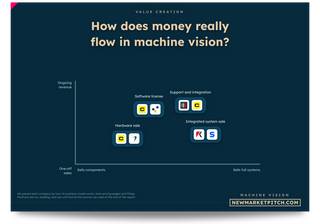
Map of machine vision business models with company logos: How does money really flow in machine vision? (Machine Vision Market, NewMarketPitch)
Value Creation

How is value created and monetized exactly?

Camera and code reader sales, software licenses per line, AI inspection subscriptions, integration projects and turnkey machines for one industry: machine vision companies make money in very different ways.

We compare who pays and where the margin comes from. Hardware vendors with their own software can keep high margins, but they rely on factory spending cycles. AI software sold by subscription earns recurring revenue, yet each new line still needs images, labels and tuning. Integrators win bigger projects, but much of that work is custom and hard to repeat.

You'll see which models hold up as cameras get cheaper and AI tools spread, and where customers still pay a premium.

Table of the events that could slow the machine vision market, with their odds and impact: What are the biggest threats to the machine vision market? (Machine Vision Market, NewMarketPitch)
Market Challenges

What could slow this market down?

Some brakes are easy to see: factories that delay new lines when demand drops, electronics and battery makers that cut spending, and tariffs on imported equipment.

Others are easier to miss. Low-cost Chinese vendors are pushing prices down. One large customer can make or break a vendor's year. AI models that work in a demo can fail when the lighting changes. And robot makers may build their own vision instead of buying it.

We go through each risk, rate how likely it is, and explain which types of companies would be hit hardest.

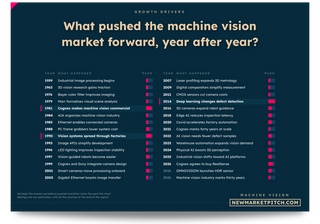
Timeline of the events that pushed the machine vision market forward, with their impact: What pushed the machine vision market forward, year after year? (Machine Vision Market, NewMarketPitch)
Growth Drivers

What are the growth drivers in this market?

A growth number tells you little until you know what pushes it. So we explain the forces behind ours.

Some drivers are plain to see: stricter quality demands, labor shortages on inspection jobs, more parcels to scan and more robots to guide. Others build on each other. Cheaper edge chips make AI inspection affordable for smaller lines. Each defect a system learns makes the next line faster to set up. And once a plant trusts cameras for one check, it tends to add more.

Before building or investing, you should know what makes a plant trust a camera to decide which parts ship, and why so many checks are still done by hand.

Bar chart of where investors put their money in machine vision, by category: Where did machine vision investors put their money this past year? (Machine Vision Market, NewMarketPitch)
Investor Bets

What are investors into right now?

For years, investors saw machine vision as a mature hardware business. AI and robots are changing that.

We compare recent rounds across AI inspection software, 3D cameras for robot picking and vision tools built for one industry, like chips or batteries. We also look at whether investors prefer startups that sell hardware and software together, or software that runs on any camera. And we flag newer bets on vision models that need very few defect images.

You'll see where investors are putting money now that the RealSense deal and recent listings have put robot vision in the spotlight, and how much proof a younger company needs before it can raise.

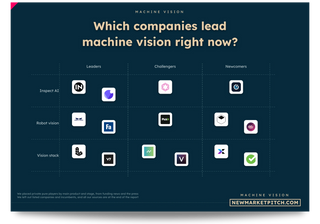
Market grid of the top machine vision startups and companies by segment: Which companies lead machine vision right now? (Machine Vision Market, NewMarketPitch)
Top Players

Who are the top startups and companies?

Cognex and Zebra Technologies are the names most factory engineers know, but they leave plenty of room for others.

Many interesting players work out of sight. Some only inspect wafers, battery cells or medicine vials. Others sell AI software that learns a new defect from a handful of photos, build 3D cameras that help robots pick parts from a bin, or read labels on parcels moving at full speed.

They're hard to compare because every inspection is different. A system that finds scratches on metal may be useless on food or glass, and few companies publish their error rates. Many also sell through integrators or machine builders, so the plant never sees their name.

Below, you'll find the market grids and ecosystem maps we've built to show who supplies which part of a vision system, and where newcomers are breaking in.

Table of the warning signs shown by leading machine vision companies: Which machine vision companies have shown warning signs lately? (Machine Vision Market, NewMarketPitch)
Startup Killers

What could kill a startup in this market?

A vision system that rejects good parts gets switched off. On a production line, operators lose patience fast.

So we studied why machine vision startups fail or stall. Some build impressive AI but need weeks of setup for every new product. Others sell to one large electronics or battery customer and suffer when its spending stops. And some compete on hardware against vendors with bigger sales teams and lower prices.

If you're building, you'll see why fast setup, low false rejects and a clear channel to plants matter more than model accuracy in a lab. If you're investing, you'll know what to check about setup time per line, customer concentration and how much custom work each sale needs.

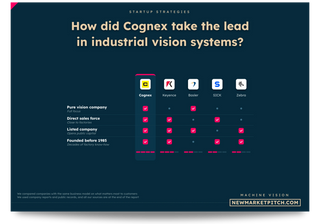
Scorecard showing what sets the leading machine vision company apart: How did Cognex take the lead in industrial vision systems? (Machine Vision Market, NewMarketPitch)
Startup Strategies

How do you win in this market?

Keyence, Hikrobot, Mech-Mind… a few machine vision companies already sell in large volumes to paying customers.

Keyence sells through its own large sales force and ships fast, which helps it keep prices high. Hikrobot grew with China's electronics and battery plants, selling cameras, code readers and vision software. Mech-Mind sells 3D cameras and software that help robots pick parts, with more than 29,000 units deployed. Their paths are very different, and it's not yet clear whether AI-first software companies can build businesses this large.

We'll look at how these companies chose their first industries, made vision simple enough for plant teams to use, and kept prices up while hardware got cheaper.

Questions?

Who is this market report actually for?+

It's for founders, investors, manufacturers, system integrators, robot makers, component suppliers and strategy teams who want a clear view of the machine vision market.

Use it to decide between selling hardware, software or complete systems, to see which inspections and industries are ready for AI, to judge where 3D and robot guidance fit, or to understand demand, technology, funding, competitors and risks across the whole market.

How many pages are in the report?+

It has 190+ pages. It is designed to be comprehensive enough to support serious market evaluation, while still being fast to read and easy to use.

We prioritize signal, structure, and visual clarity over unnecessary length.

What do you include in the machine vision market?+

We define the machine vision market as purpose-built imaging hardware, visual perception software and integrated optical systems that let machines inspect, identify, measure, locate or guide physical objects and processes.

We include industrial 2D and 3D cameras and smart imaging modules, optical metrology and depth sensors, AI and rule-based visual inspection, machine vision software platforms, vision-guided robot perception sold as a distinct product, machine-readable identification, and dedicated inspection systems for vehicles, electronics, food and materials.

We exclude general video analytics, image generation, consumer photo apps, generic AI chips and edge infrastructure, robots whose main product is the robot, acoustic and X-ray-only inspection without image interpretation, and broad analytics with no visual perception product.

Do you list your sources clearly?+

Yes. All key data points and assumptions are explained and sourced in the document.

All sources are tier-1: company filings, funding databases, public datasets, expert interviews, industry reports, etc.

Is the data up to date?+

Yes. The report was last updated on November 20, 2026 with the latest market signals.

Is this a one-time payment?+

Yes. This is a one-time purchase. There is no subscription required to access the document.

I want to buy several market reports, can I get a discount code?+

Yes. You can use NEWMARKET for 20% off when purchasing two reports, or NEWMARKETMAX for 30% off when purchasing five or more.

I’m interested in a market but I can’t find it here+

If a market you care about is not currently on the list, email us at team@newmarketpitch.com and we may be able to cover it.

I have more questions for you+

No problem. You can reach out directly and we respond within 24 hours.

LAST UPDATED: November 20, 2026

Here's what you need to know about the machine vision market

A camera that flags too many good parts can be switched off within a week. This report covers the whole machine vision market: its size, buyers, technology, business models, funding, main players, risks and where the openings are now.

PRO
$49
One-time payment
  • ✓ Market Definition
  • ✓ Market Opportunity
  • ✓ Market Size
  • ✓ Pain Points
  • ✓ Tech & Infra
  • ✓ Value Creation
  • ✓ Market Challenges
  • ✓ Growth Drivers
  • ✓ Investor Bets
  • ✓ Top Players
  • ✓ Startup Killers
  • ✓ Startup Strategies
PRO+
$79
One-time payment
  • ✓ Market Definition
  • ✓ Market Opportunity
  • ✓ Market Size
  • ✓ Pain Points
  • ✓ Tech & Infra
  • ✓ Value Creation
  • ✓ Market Challenges
  • ✓ Growth Drivers
  • ✓ Investor Bets
  • ✓ Top Players
  • ✓ Startup Killers
  • ✓ Startup Strategies
PRO++
$99
One-time payment
  • ✓ Market Definition
  • ✓ Market Opportunity
  • ✓ Market Size
  • ✓ Pain Points
  • ✓ Tech & Infra
  • ✓ Value Creation
  • ✓ Market Challenges
  • ✓ Growth Drivers
  • ✓ Investor Bets
  • ✓ Top Players
  • ✓ Startup Killers
  • ✓ Startup Strategies
Use code MARKETPITCH for 10% off your order