LAST UPDATED: November 21, 2026

Here is your reality check on the metal additive manufacturing market

Metal 3D printing was overhyped, now it's real. Metal 3D printing now makes smartwatch cases and missile parts, not just prototypes. The hard part is printing the same part thousands of times at a cost that beats casting and machining. This report walks you through the whole market today.

  • 190+ pages
  • 12 sections
  • verified data only
Here is your reality check on the metal additive manufacturing market market report cover

What’s inside the report?

12 sections to help founders and investors understand the metal additive manufacturing market with clarity

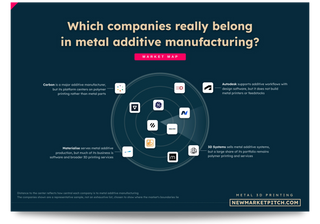
Radar map of the metal additive manufacturing market showing which companies count as part of it, which sit on its edge and which stay outside: Which companies really belong in metal additive manufacturing? (Metal Additive Manufacturing Market, NewMarketPitch)
Market Definition

Where does this market start and stop?

Metal additive manufacturing gets confused with plastic 3D printing, CNC machining and design software, so we start by setting clear limits.

A laser printer that builds titanium parts from powder is in. So is the metal powder made for it, or a factory that prints rocket engine parts for customers. A desktop printer for plastic is out, and so is a machine shop that only cuts metal.

This keeps our market size and our company comparisons on the same ground.

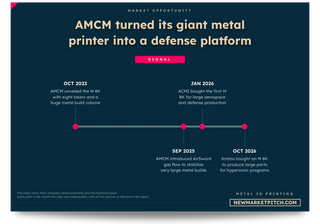
Timeline of the dated steps showing how the metal additive manufacturing market is moving, with one key signal: AMCM turned its giant metal printer into a defense platform (Metal Additive Manufacturing Market, NewMarketPitch)
Market Opportunity

What changed for this market lately?

Metal additive manufacturing is moving from prototypes to production, pulled by consumer electronics and defense.

We've found a lot of interesting signals. For example, in November 2025, Apple said every Apple Watch Ultra 3 case and every titanium Series 11 case is now 3D-printed from recycled titanium powder. And in December 2025, the Pentagon's Defense Innovation Unit gave Velo3D a $32.6M contract to print and qualify parts for a major weapon system with the US Navy. Big manufacturers now trust metal printing for parts they need in volume.

In this section, we look at which parts are moving to printing first, why defense and electronics moved early, and what this means for printer makers and print shops.

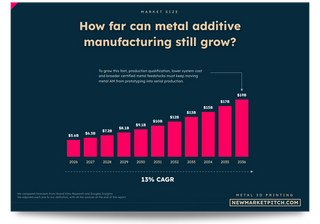
Bar chart of the metal additive manufacturing market size year by year to 2036, with its growth rate: How far can metal additive manufacturing still grow? (Metal Additive Manufacturing Market, NewMarketPitch)
Market Size

How big could this market get?

Metal additive market sizes online often lump in plastic printing, design software and sometimes the entire 3D printing industry.

We build our own estimate rather than picking a number off the shelf, compare it with outside sources, and show each assumption so you can judge it.

We also show how the number could change if aerospace and defense orders speed up, or if consumer uses stay rare.

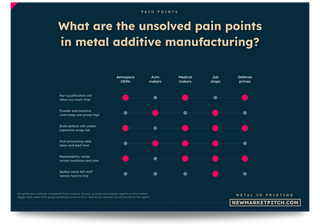
Matrix of the problems metal additive manufacturing customers still face, rated for each type of buyer: What are the unsolved pain points in metal additive manufacturing? (Metal Additive Manufacturing Market, NewMarketPitch)
Pain Points

What are the pain points, and for whom?

Many metal parts still take months to arrive, because castings and forgings depend on a handful of suppliers with long queues.

We compare six kinds of metal AM companies, from powder bed printers to binder jetting, wire and powder deposition, cold spray, metal powders and print-on-demand factories. Their buyers range from aerospace and defense primes to medical device makers, energy companies and consumer electronics brands. For each, we rank the pains that matter most, like long lead times for castings, heavy parts that burn more fuel, and the cost of qualifying a new supplier.

This shows which parts a manufacturer will pay to print first, and which ones are still cheaper to cast or machine.

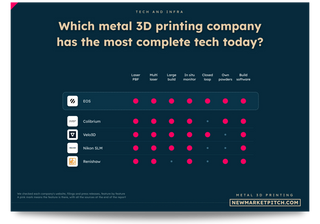
Comparison table of the tech offered by leading metal additive manufacturing companies: Which metal 3D printing company has the most complete tech today? (Metal Additive Manufacturing Market, NewMarketPitch)
Tech & Infra

What is the latest tech and infrastructure?

The printer is only one piece. Powder, software, heat treatment and inspection decide whether a printed part passes qualification.

We map the stack, from powders and wire to printers, build software, post-processing and the testing that certifies each part. We also show where things get stuck, like slow build rates, parts that warp as they cool, and certification that has to be redone for every new machine or material.

You'll see which parts metal printing already makes in series, and which still need years of qualification.

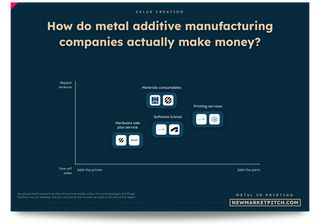
Map of metal additive manufacturing business models with company logos: How do metal additive manufacturing companies actually make money? (Metal Additive Manufacturing Market, NewMarketPitch)
Value Creation

How is value created and monetized exactly?

Printer sales, powder and consumables, service contracts, payment per part and long supply deals with defense primes: metal AM companies earn money in very different ways.

We look at who pays in each model and what it costs to deliver. Printer makers sell expensive machines, then rely on powder and service revenue. Print shops buy the machines and get paid per part, so they need full build plates to make money. Powder makers sell by the kilo but must meet strict quality specs. And companies that design and print whole systems can charge more, but carry the qualification cost themselves.

You'll see which models still make money when printer sales slow, and which depend on a few large defense programs.

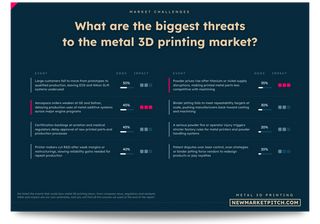
Table of the events that could slow the metal additive manufacturing market, with their odds and impact: What are the biggest threats to the metal 3D printing market? (Metal Additive Manufacturing Market, NewMarketPitch)
Market Challenges

What could slow this market down?

Some brakes are easy to see: expensive machines, slow qualification in aerospace and medical devices, and printed parts that still cost more than cast ones.

Others are easier to miss. Printer makers have been through layoffs, bankruptcies and forced mergers, which makes buyers wary of a supplier that may not last. Defense budgets can shift. Export controls limit who can buy some machines. And a few large customers can decide to bring printing in-house.

We weigh each of these risks, rate how likely it is, and show which types of companies would take the biggest hit.

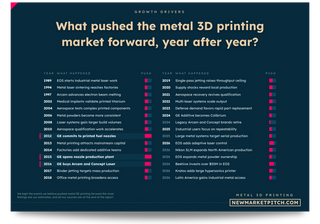
Timeline of the events that pushed the metal additive manufacturing market forward, with their impact: What pushed the metal 3D printing market forward, year after year? (Metal Additive Manufacturing Market, NewMarketPitch)
Growth Drivers

What are the growth drivers in this market?

Growth in metal AM won't come from the promise of printing everything. It comes from a few specific forces, which we go through here.

Some drivers are obvious: defense programs that need parts faster, supply chains moving closer to home, and lighter parts for aircraft and rockets. Others reinforce each other. Each part that gets qualified makes the next one easier to approve. More production brings down the cost of powder and machines. And as engineers learn to design for printing, they find more parts that can only be made this way.

Before building or investing, you should know what makes a manufacturer move a part from casting to printing, and keep printing it after the first order.

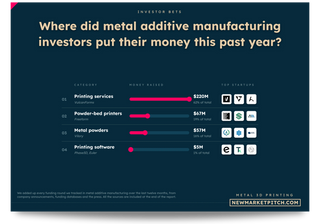
Bar chart of where investors put their money in metal additive manufacturing, by category: Where did metal additive manufacturing investors put their money this past year? (Metal Additive Manufacturing Market, NewMarketPitch)
Investor Bets

What are investors backing right now?

Investors cooled on printer makers, then came back for companies that print defense parts in their own factories.

We compare recent rounds across printer makers, powder producers and factories that print parts for defense and aerospace. We also look at whether investors prefer selling machines or selling finished parts, and we flag newer bets like large-format printers and AI that checks each layer as it's built.

You'll see which metal AM companies investors back now, after big rounds for companies that print missile parts, and how much production revenue a younger company needs to show before it raises.

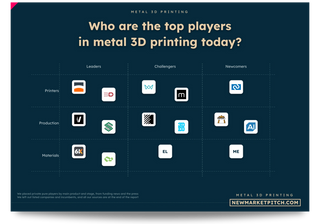
Market grid of the top metal additive manufacturing startups and companies by segment: Who are the top players in metal 3D printing today? (Metal Additive Manufacturing Market, NewMarketPitch)
Top Players

Who are the top startups and companies?

EOS and Nikon SLM Solutions are the printer brands most engineers know, but they're only part of the metal AM market.

Many of the most interesting players are hard to see from outside. Some only make titanium or nickel powders. Others print heat exchangers for aircraft, repair worn turbine blades with metal deposition, or run software that spots defects layer by layer.

They're hard to compare because most work under defense or aerospace confidentiality. A printed part often ships under the prime contractor's name, so the company that printed it stays invisible.

Below, you'll find the market grids and ecosystem maps we've built to show who makes the machines, the powder and the parts, and where new players are getting in.

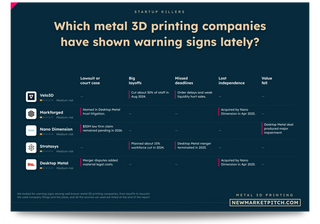
Table of the warning signs shown by leading metal additive manufacturing companies: Which metal 3D printing companies have shown warning signs lately? (Metal Additive Manufacturing Market, NewMarketPitch)
Startup Killers

What could kill a startup in this market?

Printing one perfect part is easy to show. Printing ten thousand identical ones at a profit is where most companies stumble.

So we studied why metal AM startups fail or stall. Some sell printers into a market that buys only a few machines a year. Others become print shops with idle machines and thin margins. And some spend years qualifying parts for a customer who then moves the work in-house.

If you're building, you'll see why busy machines, qualified parts and repeat orders matter more than print speed in a demo. If you're investing, you'll know what to check about machine use, customer concentration and how long qualification takes.

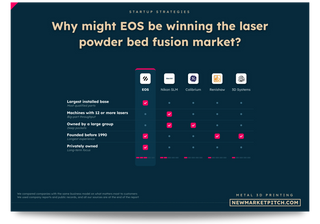
Scorecard showing what sets the leading metal additive manufacturing company apart: Why might EOS be winning the laser powder bed fusion market? (Metal Additive Manufacturing Market, NewMarketPitch)
Startup Strategies

How do you win in this market?

Divergent, Sintavia, Conflux Technology… a few metal AM companies already turn printing into repeat production work.

Divergent designs and prints structures for defense primes and carmakers in its own factories. Sintavia prints flight and defense parts for aerospace companies, and Lockheed Martin has taken a stake in it. Conflux Technology designs printed heat exchangers for aircraft, motorsport and energy. Each built its business around parts, not printers, though none has yet shown this model can match the scale of traditional suppliers.

We'll look at how these teams chose parts where printing clearly wins, got them qualified, and kept their machines busy.

Questions?

Who is this market report actually for?+

It's for founders, investors, manufacturers, aerospace and defense suppliers, printer and powder makers, and strategy teams who want a clear view of metal additive manufacturing.

Use it to decide which parts to print first, to compare buying printers with buying printed parts, to weigh powder bed, binder jetting and deposition technologies, or to understand size, technology, business models, funding, competitors and risks across the whole market.

How many pages are in the report?+

It has 190+ pages. It is designed to be comprehensive enough to support serious market evaluation, while still being fast to read and easy to use.

We prioritize signal, structure, and visual clarity over unnecessary length.

What do you include in the metal additive manufacturing market?+

We define the metal additive manufacturing market as the industry developing, supplying, controlling or operating layer-by-layer and similar digitally directed processes that create, consolidate or repair functional metal components.

We include metal 3D printing systems, laser and electron-beam powder-bed fusion, directed energy deposition, wire-arc and cold-spray printing, binder jetting and bound-metal sintering, other metal deposition methods, metal printing feedstock, metal-specific production services, and metal-specific design, control and inspection software.

We exclude polymer-only, ceramic-only, concrete and bioprinting, conventional casting, forming, welding and machining, commodity metal powders, companies that print metal only to make unrelated end-products, and generic manufacturing software.

Do you list your sources clearly?+

Yes. All key data points and assumptions are explained and sourced in the document.

All sources are tier-1: company filings, funding databases, public datasets, expert interviews, industry reports, etc.

Is the data up to date?+

Yes. The report was last updated on November 21, 2026 with the latest market signals.

Is this a one-time payment?+

Yes. This is a one-time purchase. There is no subscription required to access the document.

I want to buy several market reports, can I get a discount code?+

Yes. You can use NEWMARKET for 20% off when purchasing two reports, or NEWMARKETMAX for 30% off when purchasing five or more.

I’m interested in a market but I can’t find it here+

If a market you care about is not currently on the list, email us at team@newmarketpitch.com and we may be able to cover it.

I have more questions for you+

No problem. You can reach out directly and we respond within 24 hours.

LAST UPDATED: November 21, 2026

Thinking about the metal additive manufacturing market? Start here

A printed metal part can win on design and still lose on cost per part. This report takes you through the whole metal additive manufacturing market: size, buyers, technology, business models, funding, key players, risks and the openings that are still there.

PRO
$49
One-time payment
  • ✓ Market Definition
  • ✓ Market Opportunity
  • ✓ Market Size
  • ✓ Pain Points
  • ✓ Tech & Infra
  • ✓ Value Creation
  • ✓ Market Challenges
  • ✓ Growth Drivers
  • ✓ Investor Bets
  • ✓ Top Players
  • ✓ Startup Killers
  • ✓ Startup Strategies
PRO+
$79
One-time payment
  • ✓ Market Definition
  • ✓ Market Opportunity
  • ✓ Market Size
  • ✓ Pain Points
  • ✓ Tech & Infra
  • ✓ Value Creation
  • ✓ Market Challenges
  • ✓ Growth Drivers
  • ✓ Investor Bets
  • ✓ Top Players
  • ✓ Startup Killers
  • ✓ Startup Strategies
PRO++
$99
One-time payment
  • ✓ Market Definition
  • ✓ Market Opportunity
  • ✓ Market Size
  • ✓ Pain Points
  • ✓ Tech & Infra
  • ✓ Value Creation
  • ✓ Market Challenges
  • ✓ Growth Drivers
  • ✓ Investor Bets
  • ✓ Top Players
  • ✓ Startup Killers
  • ✓ Startup Strategies
Use code MARKETPITCH for 10% off your order