LAST UPDATED: October 29, 2026

Get a reality check on the organ-on-a-chip market

Regulators now say animal tests are not the only way to show a drug is safe, and organ chips are one of the alternatives. Whether drug makers will pay for them at scale is the open question. This report covers the whole organ-on-a-chip market, from chips and instruments to buyers and winners.

  • 190+ pages
  • 12 sections
  • verified data only
Get a reality check on the organ-on-a-chip market market report cover

What’s inside the report?

12 sections to help founders and investors understand the organ-on-a-chip market with clarity

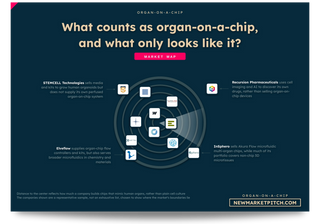
Radar map of the organ-on-a-chip market showing which companies count as part of it, which sit on its edge and which stay outside: What counts as organ-on-a-chip, and what only looks like it? (Organ-on-a-Chip Market, NewMarketPitch)
Market Definition

What does this market really cover?

Organ-on-a-chip gets mixed up with simple cell cultures and with microfluidics in general, so we start by saying exactly what we count.

A chip with living human cells that copies how a lung, liver or gut works is in. So is a system that links several organ chips together, a chip built from a patient's own cells, and the instruments and testing services sold with them. A flat dish of cells is out, and so are animal-model services and microfluidic tools that do not model an organ.

That way, the market size and every company comparison in the report cover the same set of products.

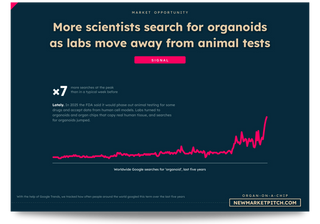
Google Trends curve of worldwide searches over five years for the organ-on-a-chip market: More scientists search for organoids as labs move away from animal tests (Organ-on-a-Chip Market, NewMarketPitch)
Market Opportunity

What changed for this market lately?

Organ chips are getting real backing from industry, regulators and even NASA.

We've found a lot of interesting signals. For example, in April 2026, Emulate's bone marrow chips, made from the Artemis II astronauts' own cells, flew around the Moon to study how deep space affects human cells. In August, Bruker announced a majority investment in MIMETAS, a Dutch organ chip maker. And in September, the FDA issued a rule that swaps "animal" for "nonclinical" in its drug safety regulations, wording that leaves room for methods like organ chips. Chips are being flown, bought and written into the rules.

In this section, we look at why drug makers want human-based tests now, which buyers are paying for them today, and what deals like this one mean for the independent chip makers.

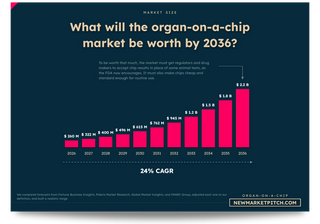
Bar chart of the organ-on-a-chip market size year by year to 2036, with its growth rate: What will the organ-on-a-chip market be worth by 2036? (Organ-on-a-Chip Market, NewMarketPitch)
Market Size

How big could this market get?

Organ-on-a-chip market estimates online are all over the place. Some count only the chips, others add lab instruments, testing services or every 3D cell culture product.

We use first principles. We build our own estimate from the ground up, compare it with outside sources, and show each assumption so you can follow the logic.

We also show a cautious and an optimistic scenario, depending on how fast drug makers move tests from animals to chips and how much they pay for each study.

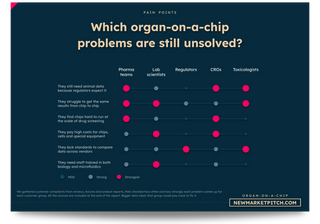
Matrix of the problems organ-on-a-chip customers still face, rated for each type of buyer: Which organ-on-a-chip problems are still unsolved? (Organ-on-a-Chip Market, NewMarketPitch)
Pain Points

What are the pain points, and for whom?

A drug can look safe in animals and still harm people. Drug makers want tests that act more like a human organ, but they won't drop a method they trust until a new one has proved itself.

We compare six kinds of organ-chip companies, from single-organ and multi-organ systems to patient-derived chips, instruments, testing services and AI-driven platforms. Their buyers range from big pharma safety teams to biotech startups, contract labs and academic centers. Then we rank what hurts most: chips that run too few tests at once, results regulators have not yet accepted, and the work of learning a new system.

This shows which problems drug makers will pay to solve now, and which ones they still handle with animal studies and older methods.

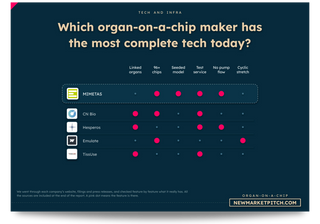
Comparison table of the tech offered by leading organ-on-a-chip companies: Which organ-on-a-chip maker has the most complete tech today? (Organ-on-a-Chip Market, NewMarketPitch)
Tech & Infra

What is the latest tech and infrastructure?

A chip is more than a clear plastic slide. It has to keep living human cells healthy for weeks, feed them, and give readings a drug team can trust.

We map the stack layer by layer, from the chip and its materials to the cells, pumps, sensors, imaging and software that read the results. We also show where things get stuck, like cells that behave differently from batch to batch, materials that soak up the drug being tested, chips that run only a few tests at a time, and few agreed standards for proving a model works.

You'll see which tests chips already do well today, and which still depend on animal studies.

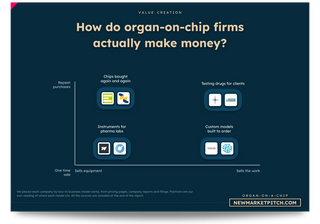
Map of organ-on-a-chip business models with company logos: How do organ-on-chip firms actually make money? (Organ-on-a-Chip Market, NewMarketPitch)
Value Creation

How is value created and monetized exactly?

Instrument sales, single-use chips and plates, testing services, data deals and pharma partnerships: organ-chip companies earn money in many ways.

We break down who pays for each model and what serving that customer costs. An instrument brings one big sale, then repeat orders for the chips used on it, but labs must first be convinced to buy. Running tests as a service wins pharma budgets faster, but it needs lab staff, so margins are thinner and growth depends on hiring. Selling data or models only works once enough studies have made them trusted. And many drug maker contracts start as small pilots.

You'll see which models can grow without adding a lab for every new customer, and which ones depend on a few big drug makers to keep paying.

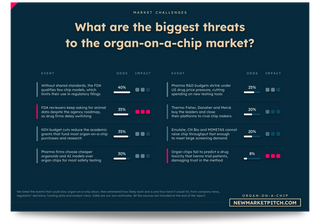
Table of the events that could slow the organ-on-a-chip market, with their odds and impact: What are the biggest threats to the organ-on-a-chip market? (Organ-on-a-Chip Market, NewMarketPitch)
Market Challenges

What could slow this market down?

Some brakes are easy to see: slow regulatory acceptance, the high price of each study, and chips that can't yet run as many tests as animal studies or older cell tests.

Others are easier to miss. Regulators may allow chips but still ask for animal data in practice. Rules can change as agencies and political priorities shift. Large instrument makers and contract labs can buy or copy small chip makers. Results from one lab are hard to repeat in another. And a few high-profile misses could make buyers cautious.

We go through these risks one by one, rate how likely each is, and explain which kinds of organ-chip companies would feel it most.

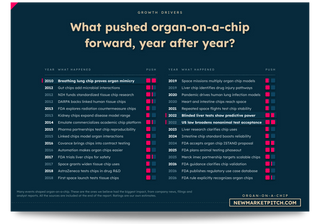
Timeline of the events that pushed the organ-on-a-chip market forward, with their impact: What pushed organ-on-a-chip forward, year after year? (Organ-on-a-Chip Market, NewMarketPitch)
Growth Drivers

What are the growth drivers in this market?

Growth numbers alone say little. So we look at what makes drug makers move real budgets to organ chips.

The obvious drivers are rules that open the door to non-animal tests, public money for human-based methods, and the wish to catch toxic drugs before human trials. Others feed each other. Every study that matches human results makes the next one easier to trust. Faster chips bring down the price of each test. And once one drug maker uses a chip model in a filing, others are more willing to follow.

Before building or investing, you should know what moves a drug team from a pilot on a few chips to using them for real decisions, and what keeps it ordering once the pilot ends.

Investor Bets

What are investors backing right now?

Organ chips used to be a quiet corner of lab tools. Now policy shifts and deals by larger companies are drawing in new money.

We compare recent rounds and deals across single-organ chips, multi-organ systems and AI-led testing platforms. We also look at whether investors prefer companies that sell instruments, run tests as a service, or sell data to drug developers, and we flag newer bets like chips made from a patient's own cells.

You'll see where the money is going today, after moves like Bruker's stake in MIMETAS, and what a younger company needs to show, from repeat pharma orders to results regulators will accept, before it can raise.

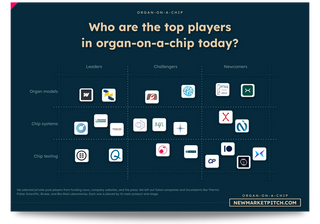
Market grid of the top organ-on-a-chip startups and companies by segment: Who are the top players in organ-on-a-chip today? (Organ-on-a-Chip Market, NewMarketPitch)
Top Players

Who are the top startups and companies?

Emulate and CN Bio come up first when people talk about organ chips, but they are only part of the market.

Many interesting players work quietly. Some build nerve chips to test whether a drug damages nerves. Others focus on the kidney, or link several organs so a drug's effect on the liver and gut shows up at once. Some make chips from a patient's own cells. Others build the pumps, plates and imaging tools that chips run on.

They're hard to tell apart because almost every company says its chip is the most human-like, and there is no single test that proves it. Many also sell tests as a service to a few drug makers who don't name them, so real traction is rarely public.

Below, you'll find the market grids and ecosystem maps we've built to show who makes chips, who runs tests and who supplies the tools, and where newer players fit.

Startup Killers

What could kill a startup in this market?

A chip that matches human biology earns nothing until a drug team trusts it enough to skip an animal test.

So we studied why organ-chip startups fail or stall. Some build a clever chip that runs only a few tests at a time, so labs can't use it for real screening. Others sell pilots to pharma that never turn into repeat orders. And some lean on one rule change or one grant, then stall when policy or funding shifts.

If you're building, you'll see why test volume, results regulators accept and repeat orders matter more than an impressive demo. If you're investing, you'll know what to check about pilot conversion, dependence on a few buyers and reliance on policy.

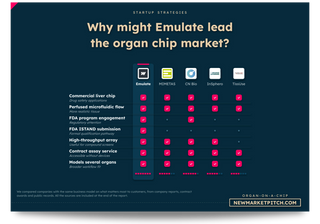
Scorecard showing what sets the leading organ-on-a-chip company apart: Why might Emulate lead the organ chip market? (Organ-on-a-Chip Market, NewMarketPitch)
Startup Strategies

How do you win in this market?

Vivodyne, Hesperos, Quris-AI… a few organ-chip companies have found drug makers willing to use their results. Their models differ, and each still has something to prove.

Vivodyne runs drug tests on lab-grown human tissues with robots and AI, and says most large drug companies use its technology, though it names no customers. Hesperos built a human-on-a-chip nerve model whose data Sanofi used to support a clinical trial application. Quris-AI combines AI with chip systems, and Merck KGaA says it built the platform into its safety testing. Each found a way in, but none has shown that one approach works for every drug or buyer.

We'll look at how these teams picked one job drug makers needed done, produced data a regulator could use, and kept customers after the first pilot.

Questions?

Who is this market report actually for?+

It's for founders, investors, pharma and biotech leaders, contract research and instrument companies, and strategists who want a clear view of organ-on-a-chip.

Use it to decide between building chips in house and buying them, to compare chips, instruments and testing services, to plan for new FDA and NIH moves away from animal testing, or to understand demand, technology, funding, competitors and risks across the whole market.

How many pages are in the report?+

It has 190+ pages. It is designed to be comprehensive enough to support serious market evaluation, while still being fast to read and easy to use.

We prioritize signal, structure, and visual clarity over unnecessary length.

What do you include in the organ-on-a-chip market?+

We define the organ-on-a-chip market as microfluidic devices and platforms that grow human cells in 3D to reproduce how human organs and tissues work, for research and drug testing.

We include single-organ and multi-organ chips, organoid-on-chip platforms, the instruments and consumables that run them, and testing services built on these models.

We exclude conventional 2D cell culture, organoid or stem-cell suppliers without a chip platform, and purely computational models.

Do you list your sources clearly?+

Yes. All key data points and assumptions are explained and sourced in the document.

All sources are tier-1: company filings, funding databases, public datasets, expert interviews, industry reports, etc.

Is the data up to date?+

Yes. The report was last updated on October 29, 2026 with the latest market signals.

Is this a one-time payment?+

Yes. This is a one-time purchase. There is no subscription required to access the document.

I want to buy several market reports, can I get a discount code?+

Yes. You can use NEWMARKET for 20% off when purchasing two reports, or NEWMARKETMAX for 30% off when purchasing five or more.

I’m interested in a market but I can’t find it here+

If a market you care about is not currently on the list, email us at team@newmarketpitch.com and we may be able to cover it.

I have more questions for you+

No problem. You can reach out directly and we respond within 24 hours.

LAST UPDATED: October 29, 2026

Build or invest in the organ-on-a-chip market with clear eyes

Regulators are opening the door to non-animal tests, but drug makers still have to decide when a chip is good enough to trust. This report covers the whole organ-on-a-chip market: its size, buyers, technology, business models, funding, key players, risks and the openings that remain.

PRO
$49
One-time payment
  • ✓ Market Definition
  • ✓ Market Opportunity
  • ✓ Market Size
  • ✓ Pain Points
  • ✓ Tech & Infra
  • ✓ Value Creation
  • ✓ Market Challenges
  • ✓ Growth Drivers
  • ✓ Investor Bets
  • ✓ Top Players
  • ✓ Startup Killers
  • ✓ Startup Strategies
PRO+
$79
One-time payment
  • ✓ Market Definition
  • ✓ Market Opportunity
  • ✓ Market Size
  • ✓ Pain Points
  • ✓ Tech & Infra
  • ✓ Value Creation
  • ✓ Market Challenges
  • ✓ Growth Drivers
  • ✓ Investor Bets
  • ✓ Top Players
  • ✓ Startup Killers
  • ✓ Startup Strategies
PRO++
$99
One-time payment
  • ✓ Market Definition
  • ✓ Market Opportunity
  • ✓ Market Size
  • ✓ Pain Points
  • ✓ Tech & Infra
  • ✓ Value Creation
  • ✓ Market Challenges
  • ✓ Growth Drivers
  • ✓ Investor Bets
  • ✓ Top Players
  • ✓ Startup Killers
  • ✓ Startup Strategies
Use code MARKETPITCH for 10% off your order