LAST UPDATED: November 19, 2026

Make smarter decisions on the POS software market

Square and Toast changed the checkout, everyone wants in. Every shop already has a checkout. What's changing is who runs it: payment companies, online platforms and old POS vendors are all fighting for the counter. This report gives you a full view of the POS software market as it stands today.

  • 190+ pages
  • 12 sections
  • verified data only
Make smarter decisions on the POS software market market report cover

What’s inside the report?

12 sections to help founders and investors understand the POS software market with clarity

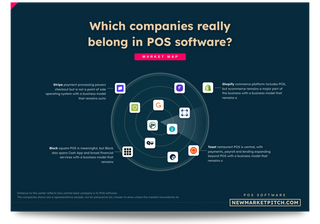
Radar map of the POS software market showing which companies count as part of it, which sit on its edge and which stay outside: Which companies really belong in POS software? (POS Software Market, NewMarketPitch)
Market Definition

Where does this market start and stop?

POS software gets mixed up with card terminals, payment processing and online stores, so we start by saying exactly what we count.

Checkout software that also tracks a boutique's stock is in. So is a restaurant system that sends orders to the kitchen, or a salon's booking and payment app. A card reader sold on its own is out, and so is a processor that only moves the money, or an online store with no in-person sales.

With that line drawn, our market size and company comparisons all cover the same software.

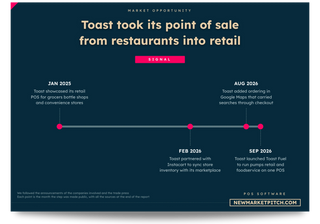
Timeline of the dated steps showing how the POS software market is moving, with one key signal: Toast took its point of sale from restaurants into retail (POS Software Market, NewMarketPitch)
Market Opportunity

Why this market now?

POS software is a crowded, mature market, but it's moving again. Big chains are replacing old systems, and online platforms want a place at the counter.

We've found a lot of interesting signals. For example, in March 2026, Pilot, which runs more than 900 travel centers in the US and Canada, signed a five-year deal to move its store checkout and fuel sales onto NCR Voyix's platform. And in August 2026, Shopify reported that in-store sales through its POS grew 32% from a year earlier. Large chains and online brands are both changing how they sell in person, and they want one system for stores, stock and customers.

In this section, we look at why so many merchants are switching systems now, who is winning them, and what that means for smaller POS vendors.

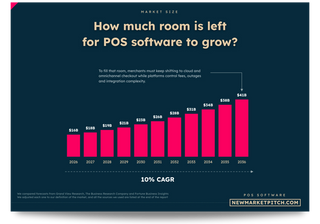
Bar chart of the POS software market size year by year to 2036, with its growth rate: How much room is left for POS software to grow? (POS Software Market, NewMarketPitch)
Market Size

How big could this market get?

POS market sizes online often fold in terminals, hardware and payment volume, so the numbers are hard to compare.

We build our own estimate from the ground up, starting with how many stores and restaurants run POS software and what they pay for it. Then we compare our number with other sources and explain each assumption.

We also show how the number changes in a cautious and an optimistic scenario, depending on how fast merchants move to cloud systems and how much revenue comes from payments.

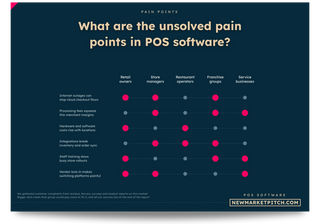
Matrix of the problems POS software customers still face, rated for each type of buyer: What are the unsolved pain points in POS software? (POS Software Market, NewMarketPitch)
Pain Points

What are the pain points, and for whom?

A merchant doesn't want a cash register. They want to know what sold, what's left and who came back.

We compare six kinds of POS companies, from general retail and restaurant systems to grocery, specialty shops, appointment businesses and large multi-store chains. Their buyers range from a single café to retailers with hundreds of stores. For each, we rank the pains that matter most, like stock counts that never match, systems that crash at the busiest hour, and payment fees bundled into contracts that are hard to leave.

This shows which problems will make a merchant switch, and which ones they'll live with to avoid a painful move.

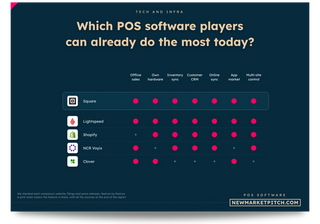
Comparison table of the tech offered by leading POS software companies: Which POS software players can already do the most today? (POS Software Market, NewMarketPitch)
Tech & Infra

What is the latest tech and infrastructure?

The screen at the counter is the easy part. The system has to keep working when the internet drops and stay in sync with stock, payments and the online store.

We map the stack layer by layer, from hardware and payments to inventory, loyalty, kitchen screens and the links to ecommerce and accounting. We also show where things get stuck, like old systems big chains can't easily switch off, offline modes that fail, and data that never matches between the stores and the website.

You'll see which parts have become standard, and where AI and cloud tools are starting to change what a POS can do.

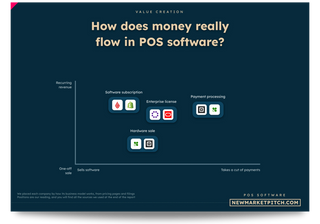
Map of POS software business models with company logos: How does money really flow in POS software? (POS Software Market, NewMarketPitch)
Value Creation

How is value created and monetized exactly?

Monthly software fees, a cut of each card payment, hardware sales and leases, add-ons like loyalty or payroll, and loans to merchants: POS companies make money in many ways.

We compare who pays and how margins differ. Many vendors price the software low and earn most of their money on payments, which ties their revenue to card volume. Others charge more per location and let merchants pick their own processor. Enterprise vendors sign fewer, larger contracts but need long rollouts and big support teams. And hardware brings revenue at thin margins.

You'll see which models still make money once payment fees come under pressure, and which ones depend on merchants never comparing rates.

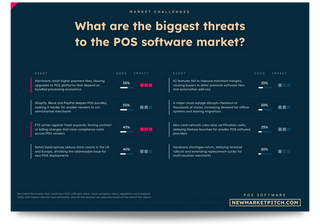
Table of the events that could slow the POS software market, with their odds and impact: What are the biggest threats to the POS software market? (POS Software Market, NewMarketPitch)
Market Challenges

What could slow this market down?

Some brakes are easy to see: crowded markets, small merchants who close or switch often, and payment fees squeezed by regulators and rivals.

Others are easier to miss. Payment giants can bundle POS software for almost nothing. Long contracts and leased hardware slow down switching, which protects old vendors. A single outage on a Saturday night can cost a vendor many customers. And big chains take years to roll out a new system.

We go through these risks one by one, rate how likely each is, and show which kinds of POS vendors are most exposed.

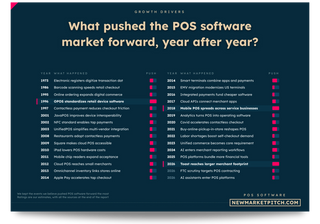
Timeline of the events that pushed the POS software market forward, with their impact: What pushed the POS software market forward, year after year? (POS Software Market, NewMarketPitch)
Growth Drivers

What are the growth drivers in this market?

A growth rate on its own won't tell you much about POS. What matters is why merchants switch, and what makes them stay.

Some drivers are plain to see: old on-site systems reaching the end of their life, shops selling both online and in store, and staff who want tablets and handhelds instead of fixed tills. Others feed each other. More data from the counter makes loyalty and marketing tools work better. Those tools keep merchants on the system. And every extra product a merchant uses makes switching harder.

Before building or investing, you should know what makes a merchant replace a system that still works, and what keeps them from leaving once they compare payment rates.

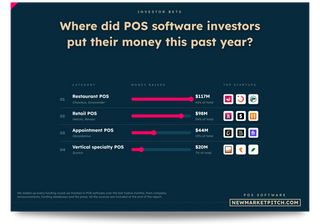
Bar chart of where investors put their money in POS software, by category: Where did POS software investors put their money this past year? (POS Software Market, NewMarketPitch)
Investor Bets

What are investors chasing right now?

POS used to be a sleepy hardware business. Since payments moved into the software, investors see it as a way to own the merchant.

We compare recent rounds across restaurant, retail, appointment and enterprise POS. We also look at whether investors prefer systems built for one niche, like nightlife or grocery, or broad platforms that sell to everyone. And we flag the new ideas investors are starting to back, like AI that helps owners reorder stock and plan staff.

You'll see which POS companies are raising money today, as big chains and online platforms rethink the counter, and what a younger vendor needs to show, from payment volume to merchants who stay, before it can raise.

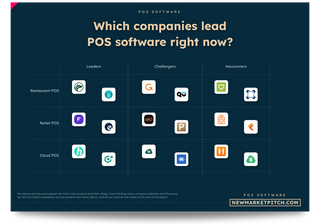
Market grid of the top POS software startups and companies by segment: Which companies lead POS software right now? (POS Software Market, NewMarketPitch)
Top Players

Who are the top startups and companies?

Clover and Shopify are the names many shop owners think of for checkout, but POS software goes far beyond them.

Some of the most interesting players serve one kind of business. Some only build systems for bars and nightclubs, cannabis stores or bike shops. Others run checkout for salons and gyms, power self-service kiosks, or replace old systems at grocery and convenience chains.

They're hard to compare because many earn most of their money from payments, not software, and few publish how many merchants they keep. A vendor that looks small in retail can lead a niche you've never heard of.

Below, you'll find the market grids and ecosystem maps we've built to show who sells checkout to which kind of merchant, and where new players are getting in.

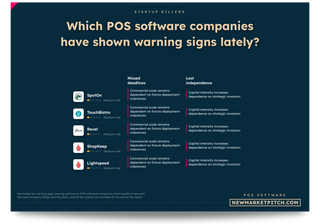
Table of the warning signs shown by leading POS software companies: Which POS software companies have shown warning signs lately? (POS Software Market, NewMarketPitch)
Startup Killers

What could kill a startup in this market?

In POS, a merchant forgives a lot, but not a frozen screen at the lunch rush.

So we studied why POS startups fail or stall. Some win small merchants with cheap software, then lose them when a rival offers better payment rates. Others build for one niche that turns out too small. And some sell to large chains, then sink under long rollouts and custom work.

If you're building, you'll see why reliability at peak hours, a niche big enough to grow and merchants who stay matter more than extra features. If you're investing, you'll know what to check on payment margins, merchant churn and the cost of each rollout.

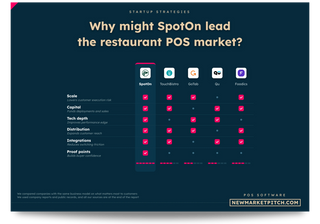
Scorecard showing what sets the leading POS software company apart: Why might SpotOn lead the restaurant POS market? (POS Software Market, NewMarketPitch)
Startup Strategies

How do you win in this market?

SpotOn, Boulevard, Lightspeed… a few POS companies have grown real businesses in very different corners of the market.

SpotOn sells restaurant and retail systems with hands-on local support. Boulevard built its checkout around booking for salons and spas. Lightspeed is betting on US retailers and European restaurants after years of buying smaller rivals. Each found a clear group of merchants, though not all have shown they can grow and turn a profit at the same time.

We'll look at how these teams chose which merchants to serve first, earned their trust at the counter, and kept them when rivals offered cheaper payments.

Questions?

Who is this market report actually for?+

It's for founders, investors, retailers and restaurant groups, payment companies, software vendors and strategists who want a clear view of POS software.

Use it to choose between a niche system and a broad platform, to compare software fees with payment-based pricing, to plan a move off an old system, or to understand demand, technology, funding, competitors and risks across the whole market.

How many pages are in the report?+

It has 190+ pages. It is designed to be comprehensive enough to support serious market evaluation, while still being fast to read and easy to use.

We prioritize signal, structure, and visual clarity over unnecessary length.

What do you include in the POS software market?+

We define the POS software market as software platforms that operate or directly control merchant checkout or order capture at a physical point of sale and manage the transaction-linked workflows of a retail, hospitality or in-person service business.

We include cloud, mobile and on-premises POS, restaurant and hotel order-entry POS, retail checkout and in-store selling platforms, self-service and kiosk checkout, specialty-sector POS, and integrated POS with inventory, customer, staff, loyalty, appointment or accounting workflows when physical transaction capture stays central.

We exclude payment acquiring, gateways and terminals without substantial checkout software, pure ecommerce storefronts, delivery aggregation middleware, standalone inventory, ERP, booking, marketing or analytics tools, and checkout hardware without proprietary operating software.

Do you list your sources clearly?+

Yes. All key data points and assumptions are explained and sourced in the document.

All sources are tier-1: company filings, funding databases, public datasets, expert interviews, industry reports, etc.

Is the data up to date?+

Yes. The report was last updated on November 19, 2026 with the latest market signals.

Is this a one-time payment?+

Yes. This is a one-time purchase. There is no subscription required to access the document.

I want to buy several market reports, can I get a discount code?+

Yes. You can use NEWMARKET for 20% off when purchasing two reports, or NEWMARKETMAX for 30% off when purchasing five or more.

I’m interested in a market but I can’t find it here+

If a market you care about is not currently on the list, email us at team@newmarketpitch.com and we may be able to cover it.

I have more questions for you+

No problem. You can reach out directly and we respond within 24 hours.

LAST UPDATED: November 19, 2026

Get the POS software market report

Selling a POS system is easy. Keeping the merchant once a rival offers cheaper card rates is the hard part. This report covers the whole POS software market: its size and structure, merchants, technology, business models, funding, competitors, risks and the openings that remain.

PRO
$49
One-time payment
  • ✓ Market Definition
  • ✓ Market Opportunity
  • ✓ Market Size
  • ✓ Pain Points
  • ✓ Tech & Infra
  • ✓ Value Creation
  • ✓ Market Challenges
  • ✓ Growth Drivers
  • ✓ Investor Bets
  • ✓ Top Players
  • ✓ Startup Killers
  • ✓ Startup Strategies
PRO+
$79
One-time payment
  • ✓ Market Definition
  • ✓ Market Opportunity
  • ✓ Market Size
  • ✓ Pain Points
  • ✓ Tech & Infra
  • ✓ Value Creation
  • ✓ Market Challenges
  • ✓ Growth Drivers
  • ✓ Investor Bets
  • ✓ Top Players
  • ✓ Startup Killers
  • ✓ Startup Strategies
PRO++
$99
One-time payment
  • ✓ Market Definition
  • ✓ Market Opportunity
  • ✓ Market Size
  • ✓ Pain Points
  • ✓ Tech & Infra
  • ✓ Value Creation
  • ✓ Market Challenges
  • ✓ Growth Drivers
  • ✓ Investor Bets
  • ✓ Top Players
  • ✓ Startup Killers
  • ✓ Startup Strategies
Use code MARKETPITCH for 10% off your order