LAST UPDATED: November 18, 2026

Make smarter decisions on the post-quantum cryptography market

Most of the encryption protecting bank data, software updates and private messages could one day be broken by a quantum computer, and attackers can already copy data today to unlock it later. Now the biggest tech companies have set their own deadlines to switch. This report covers the whole post-quantum cryptography market, from the standards to the money.

  • 190+ pages
  • 12 sections
  • verified data only
Make smarter decisions on the post-quantum cryptography market market report cover

What’s inside the report?

12 sections to help founders and investors understand the post-quantum cryptography market with clarity

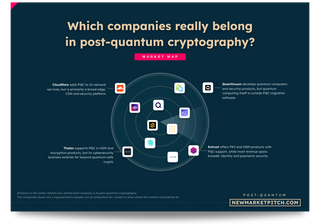
Radar map of the post-quantum cryptography market showing which companies count as part of it, which sit on its edge and which stay outside: Which companies really belong in post-quantum cryptography? (Post-Quantum Cryptography Market, NewMarketPitch)
Market Definition

Where does this market start and stop?

Post-quantum cryptography gets mixed up with quantum computing and with quantum key distribution, so we start by drawing the line.

A software library that runs new quantum-resistant algorithms is in. So is a chip built to run them fast, a tool that finds old encryption inside a company, and a VPN or key manager that has been upgraded. Quantum key distribution is out, because it relies on special optical hardware. So is the quantum computer itself, and so is a security product that never touches encryption.

That way, the market size and every company comparison in the report cover the same set of products.

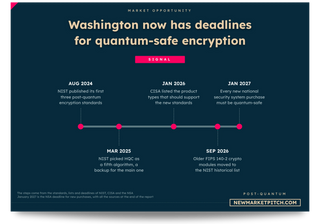
Timeline of the dated steps showing how the post-quantum cryptography market is moving, with one key signal: Washington now has deadlines for quantum-safe encryption (Post-Quantum Cryptography Market, NewMarketPitch)
Market Opportunity

What changed for this market lately?

Post-quantum cryptography has moved from research papers to deadlines, and the biggest tech companies are the ones setting them.

We've found a lot of interesting signals. For example, in March 2026, Google said it plans to finish moving its own systems to post-quantum cryptography by 2029. In April, Cloudflare set the same year for its whole platform. And on June 30, Microsoft pulled its full deadline forward from 2033 to 2029. These are plans, not finished migrations. Still, three of the biggest names on the internet now have dates, and companies that depend on them will need tools to keep up.

In this section, we look at why the date moved closer, what the standards already cover, and why finding old encryption can take longer than swapping it.

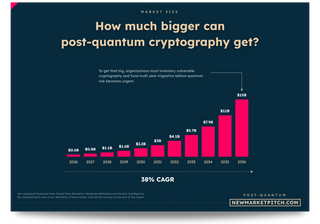
Bar chart of the post-quantum cryptography market size year by year to 2036, with its growth rate: How much bigger can post-quantum cryptography get? (Post-Quantum Cryptography Market, NewMarketPitch)
Market Size

How big could this market get?

Estimates of this market online disagree, because some count only new products while others add consulting, quantum key distribution or all of cybersecurity.

We build our own estimate from the ground up, starting with who has to switch and what they spend to do it. Then we compare it with outside sources and explain every assumption, so you can follow the logic.

We also show a cautious case and an optimistic one, depending on how fast deadlines are enforced and how quickly companies get started.

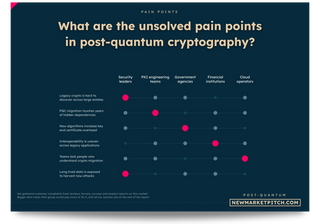
Matrix of the problems post-quantum cryptography customers still face, rated for each type of buyer: What are the unsolved pain points in post-quantum cryptography? (Post-Quantum Cryptography Market, NewMarketPitch)
Pain Points

What are the pain points, and for whom?

Most companies don't know where their encryption lives. It sits in old applications, devices and contracts that nobody has looked at in years.

We compare five kinds of companies, from software libraries and chips to tools that find old encryption, key management, and network products. Their buyers range from chip designers to banks and government agencies. Then we rank what hurts most: not knowing what to replace, old devices that can't be updated, and slower connections after the switch.

This shows which problems buyers will pay to solve this year, and which ones can still wait.

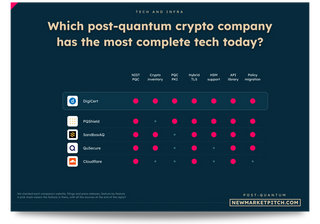
Comparison table of the tech offered by leading post-quantum cryptography companies: Which post-quantum crypto company has the most complete tech today? (Post-Quantum Cryptography Market, NewMarketPitch)
Tech & Infra

What is the latest tech and infrastructure?

Swapping an algorithm sounds simple. In practice, new keys and signatures are bigger, and every system that touches them has to cope.

We map the stack layer by layer, from the standardized algorithms and their libraries to chips, certificates, key management and network gear. We also show where things get stuck, like tiny devices with little memory, systems that use both old and new methods during the switch, and software that was never built to swap its encryption.

You'll see which parts of the work products already handle well today, and which still need a lot of manual engineering.

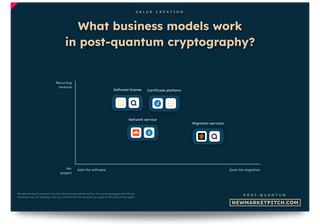
Map of post-quantum cryptography business models with company logos: What business models work in post-quantum cryptography? (Post-Quantum Cryptography Market, NewMarketPitch)
Value Creation

How is value created and monetized exactly?

Licenses for cryptography code, royalties on chips, yearly software subscriptions, hardware sales and consulting projects: companies in this market charge in very different ways.

We break down who pays for each model and what it costs to serve them. A library or chip design may earn a small royalty on every device, but the sale takes a long time. Discovery software is sold as a subscription, yet each deployment needs engineers. Hardware makers earn more per unit but carry certification costs. Services bring in cash quickly and are hard to scale.

You'll see which models can keep healthy margins once the first wave of upgrades is done, and which ones lose out when large security vendors add the same feature to their existing products.

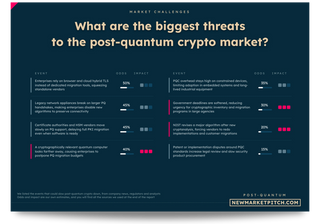
Table of the events that could slow the post-quantum cryptography market, with their odds and impact: What are the biggest threats to the post-quantum crypto market? (Post-Quantum Cryptography Market, NewMarketPitch)
Market Challenges

What could slow this market down?

Some brakes are easy to see. Quantum computers that can break today's encryption don't exist yet, and the migration is a long, dull project with no visible payoff.

Others are easier to miss. Free open-source libraries can cover the basics. Large vendors may bundle post-quantum features into products customers already own. Rules and standards are still being finished, so some buyers wait. And a surprise, like a flaw found in a new algorithm, could force a redo.

We go through these risks one by one, rate how likely each is, and explain which kinds of companies would feel it most.

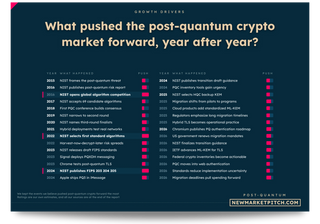
Timeline of the events that pushed the post-quantum cryptography market forward, with their impact: What pushed the post-quantum crypto market forward, year after year? (Post-Quantum Cryptography Market, NewMarketPitch)
Growth Drivers

What are the growth drivers in this market?

Growth numbers alone say little. So we look at what actually forces organizations to spend on this.

The obvious drivers are final standards, government deadlines and the risk of data being copied now to be unlocked later. The US rules for national security systems, for example, say that from January 1, 2027, new equipment bought for those systems must be compliant. Others feed each other. Big platforms that switch push their customers and suppliers to switch too. And once a company has listed its encryption, it can see how much work is left.

Before building or investing, you should know what moves a company from planning to paying, and what keeps the budget alive once the first upgrades are done.

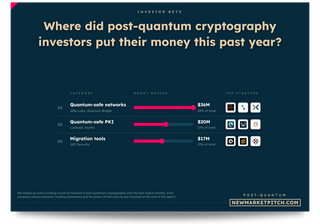
Bar chart of where investors put their money in post-quantum cryptography, by category: Where did post-quantum cryptography investors put their money this past year? (Post-Quantum Cryptography Market, NewMarketPitch)
Investor Bets

What are investors into right now?

Post-quantum cryptography used to be a niche for cryptographers. Now it draws seed rounds, strategic buyers and big security vendors.

We compare recent rounds across tools that find old encryption, chip and software providers, and migration platforms for specific industries. We also look at whether investors prefer standalone specialists or products that fit inside a larger security platform, and flag newer bets such as migration help for blockchains.

You'll see where the money is going today, after rounds like QIZ Security's seed in July 2026 and Project Eleven's Series A in January, and what a younger company needs to show, from pilots to paying customers, before it can raise.

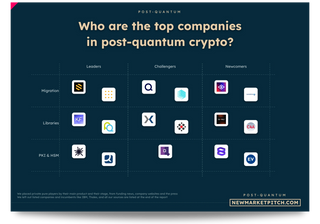
Market grid of the top post-quantum cryptography startups and companies by segment: Who are the top companies in post-quantum crypto? (Post-Quantum Cryptography Market, NewMarketPitch)
Top Players

Who are the top startups and companies?

Thales and SandboxAQ come up quickly when people talk about post-quantum security, but the market reaches well beyond them.

Many of the most interesting players work quietly. Some design small, fast cryptography for chips in cars and sensors. Others scan software to find old encryption, retrofit it on aging networks, or manage the certificates that prove who a machine is. A few focus only on blockchains or on defense contracts.

They're hard to tell apart because most now say they are quantum-ready. A chip designer, a discovery tool and a network product can sell to the same buyer, yet solve very different parts of the problem. Many also sell through partners, so their names rarely appear in the news.

Below, you'll find the market grids and ecosystem maps we've built to show who supplies the algorithms, the chips, the tools and the services, and where newer players fit.

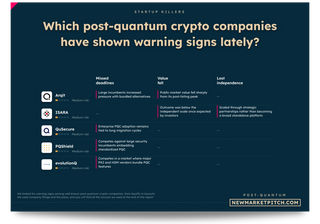
Table of the warning signs shown by leading post-quantum cryptography companies: Which post-quantum crypto companies have shown warning signs lately? (Post-Quantum Cryptography Market, NewMarketPitch)
Startup Killers

What could kill a startup in this market?

In post-quantum cryptography, the hardest competitor is often the product your customer already owns.

So we studied why startups in this field stall. Some sell a clever algorithm that large vendors then build in for free. Others depend on a standard that changes or a government that delays. And some win pilots but wait years for the real budget, while the sale cycle eats their cash.

If you're building, you'll see why a product big vendors can't easily copy, a way to survive long sales and real deployments matter more than a good pilot. If you're investing, you'll know what to check about customer budgets, overlap with large vendors and how much each deployment costs to support.

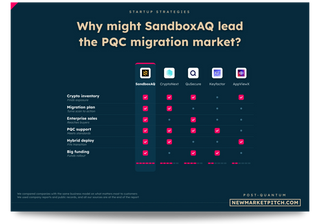
Scorecard showing what sets the leading post-quantum cryptography company apart: Why might SandboxAQ lead the PQC migration market? (Post-Quantum Cryptography Market, NewMarketPitch)
Startup Strategies

How do you win in this market?

PQShield, QuSecure, CryptoNext... a few post-quantum companies have built real positions, each in a different layer.

PQShield sells post-quantum software and chip designs that other makers build into their own products. QuSecure sells software that sits on top of existing networks, and counts the US Army and Air Force among its customers. CryptoNext sells tools to find and fix weak encryption, and is backed by AXA Venture Partners and Quantonation. Each picked a clear job, but none has shown yet that a standalone company can stay ahead once large security vendors bundle the same features.

We'll look at how these teams picked a first buyer who had a real deadline, earned trust with certified, hard-to-copy technology, and stayed useful as bigger platforms moved in.

Questions?

Who is this market report actually for?+

It's for founders, investors, security and IT leaders, chip and device makers, cloud and software companies, and strategists who want a clear view of post-quantum cryptography.

Use it to decide what to build, buy or fund, to compare libraries, chips and discovery tools, to judge how fast deadlines will turn into budgets, or to understand demand, technology, business models, competitors and risks across the whole market.

How many pages are in the report?+

It has 190+ pages. It is designed to be comprehensive enough to support serious market evaluation, while still being fast to read and easy to use.

We prioritize signal, structure, and visual clarity over unnecessary length.

What do you include in the post-quantum cryptography market?+

We define the post-quantum cryptography market as independent providers whose core product is quantum-resistant classical cryptography, including algorithms, software, hardware IP, security products and migration tooling that protect data, signatures, identities and communications against future quantum computers.

We include NIST-standard or credible prestandard implementations, embedded and silicon IP, PKI and signing, cryptographic discovery and migration orchestration, algorithm agility, PQC and hybrid networking, and quantum-resistant security for specific applications or blockchains. QKD or QRNG products qualify when PQC migration is a core thesis.

We exclude quantum processor design and algorithms, pure QKD equipment, QRNG and entropy-only devices, research labs without a marketed PQC product, general security, PKI, cloud or networking vendors that merely add a PQC feature, and conventional encryption marketed as quantum-proof.

Do you list your sources clearly?+

Yes. All key data points and assumptions are explained and sourced in the document.

All sources are tier-1: company filings, funding databases, public datasets, expert interviews, industry reports, etc.

Is the data up to date?+

Yes. The report was last updated on November 18, 2026 with the latest market signals.

Is this a one-time payment?+

Yes. This is a one-time purchase. There is no subscription required to access the document.

I want to buy several market reports, can I get a discount code?+

Yes. You can use NEWMARKET for 20% off when purchasing two reports, or NEWMARKETMAX for 30% off when purchasing five or more.

I’m interested in a market but I can’t find it here+

If a market you care about is not currently on the list, email us at team@newmarketpitch.com and we may be able to cover it.

I have more questions for you+

No problem. You can reach out directly and we respond within 24 hours.

LAST UPDATED: November 18, 2026

Make sense of the post-quantum cryptography market

Every company that relies on encryption will have to change it, yet most can't say where it is used or who should pay. This report covers the whole post-quantum cryptography market: its size, buyers, technology, business models, funding, key players, risks and the openings that remain.

PRO
$49
One-time payment
  • ✓ Market Definition
  • ✓ Market Opportunity
  • ✓ Market Size
  • ✓ Pain Points
  • ✓ Tech & Infra
  • ✓ Value Creation
  • ✓ Market Challenges
  • ✓ Growth Drivers
  • ✓ Investor Bets
  • ✓ Top Players
  • ✓ Startup Killers
  • ✓ Startup Strategies
PRO+
$79
One-time payment
  • ✓ Market Definition
  • ✓ Market Opportunity
  • ✓ Market Size
  • ✓ Pain Points
  • ✓ Tech & Infra
  • ✓ Value Creation
  • ✓ Market Challenges
  • ✓ Growth Drivers
  • ✓ Investor Bets
  • ✓ Top Players
  • ✓ Startup Killers
  • ✓ Startup Strategies
PRO++
$99
One-time payment
  • ✓ Market Definition
  • ✓ Market Opportunity
  • ✓ Market Size
  • ✓ Pain Points
  • ✓ Tech & Infra
  • ✓ Value Creation
  • ✓ Market Challenges
  • ✓ Growth Drivers
  • ✓ Investor Bets
  • ✓ Top Players
  • ✓ Startup Killers
  • ✓ Startup Strategies
Use code MARKETPITCH for 10% off your order