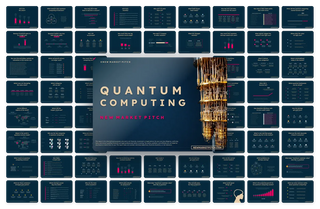
Quantum Computing Market Pitch Deck

LAST UPDATED: April 17, 2026

Catch opportunities first in the quantum computing market

The market is moving fast. Keep up with the latest changes here. Forget the outdated PDFs no one finishes and the charts that don’t say anything. You'll get clear thinking, clean structure and zero friction.

What’s inside the deck?

12 sections to help founders and investors understand
the quantum computing market with clarity

quantum computing market europe asia africa usa world
Market Definition

What is this market about?

First thing first, we define the market in plain words ... what it covers, what it doesn’t, how we split it up, and what we’re not counting.

We do this because all the sizing, growth, and competitive takeaways only make sense if we’re talking about the same market.

It helps you understand all the data in this deck (and there is a lot) without second-guessing what they mean.

quantum-computing chart
Market Opportunity

Why this market now?

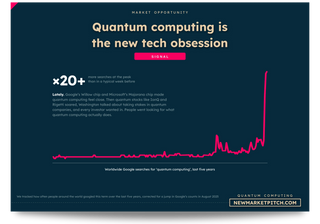
In 2026, the quantum computing market is clearly very hot.

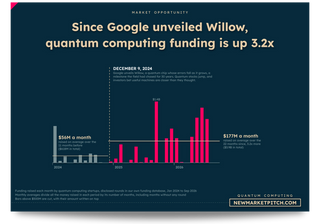
We’re seeing strong signals. IonQ making large strategic moves, IBM expanding enterprise partnerships, Google advancing on error correction, and multiple quantum startups raising $100M+ rounds are some of them. Governments in the U.S., Europe, and Asia continue to fund national quantum programs, treating it as critical infrastructure for the future.

Here, we will break down why quantum is getting so much attention from builders and investors.

quantum computing market cagr growth rate market size
Market Size

How big could this market get?

There are tons of quantum computing market size and CAGR numbers online, and they’re all over the place. It’s tough to know what to trust.

We built our own estimate using first-principles analysis, validated with aggregated sources, and we lay out every assumption and step so you can trust the result.

The goal is a quick, reliable sanity check on whether this market is worth pursuing.

quantum computing market revenue breakdown segments
Pain Points

What are the pain points, and for whom?

If quantum computing is gaining momentum, it's also because classical systems are hitting their limits.

Enterprises, research labs, government agencies, and cybersecurity teams all face problems that quantum solutions can tackle. We walk you through each customer segment and the real obstacles they're navigating.

When you see who's struggling and why, you can build or back quantum ventures that capture genuine demand.

quantum-computing tech chart
Tech & Infra

What is the latest tech and infrastructure?

If you're tracking the quantum computing market, you've noticed how quickly the landscape shifts. New qubit modalities, error correction milestones, and cloud access platforms seem to drop every quarter.

That's why we keep this section updated, covering what's operational, what's in testing, and what's on the roadmap. From superconducting and photonic hardware to quantum software frameworks, simulators, and the hybrid classical-quantum infrastructure enabling early use cases.

quantum computing market business models startups
Value Creation

How is value created and monetized exactly?

You need to understand where quantum computing creates willingness to pay (cloud access, algorithm licensing, consulting, or hardware components) before you build on the wrong layer of the stack.

We will give you clarity on which business models are working right now, and why some segments seem to deliver 10x better unit economics than others.

You will see how leaders monetize through quantum-as-a-service, enterprise pilots, government contracts, and hybrid classical-quantum workflows, and how to avoid models that depend on timelines that keep slipping.

quantum computing market challenges
Market Challenges

What could slow this market down?

You're probably already aware of the headline frictions in quantum computing: hardware instability, error rates, and the gap between lab results and real-world usefulness.

The less obvious threats tend to surface later: classical computing catching up on key use cases, talent scarcity that slows every roadmap, and enterprise buyers who can't justify spend without clear near-term ROI.

In this section, we map the main hurdles and rate how likely they are, so you get a practical risk briefing before you invest or build.

quantum computing market consumer adoption chart
Growth Drivers

What are the growth drivers in this market?

The quantum computing market really has a lot of potential, but some things need to happen for it to grow faster beyond research labs and early pilots.

Some drivers are easy to see: limitations of classical computing for certain problems, growing government investment, and demand for breakthroughs in drug discovery, optimization, and cryptography. But growth also depends on less obvious shifts such as error correction progress, a broader talent pipeline, hybrid classical-quantum workflows that deliver near-term value, and enterprise-ready development tools, just to name a few.

Before building or investing, you should know what has to be true for adoption to scale.

quantum computing market fundraising investors
Investor Bets

What are investors chasing right now?

Some investors love the quantum computing market because the upside is enormous when the technology finally delivers on problems classical systems can't touch.

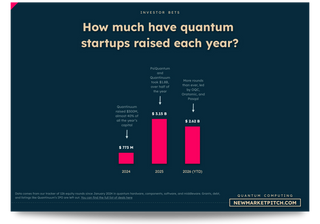
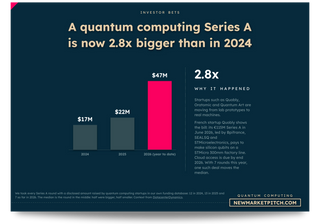
In this section, we'll show you where money is flowing and what's actually getting funded right now. You'll see which companies are raising, plus what those rounds have in common: the layers and approaches investors keep leaning into, what they're excited about today, and what they've mostly stopped backing. We'll also flag the newer theses starting to gain traction.

Use this to understand where conviction is building, so you can invest with context or build toward the milestones capital is rewarding.

quantum computing market map top startups
Top Players

Who are the top startups and companies?

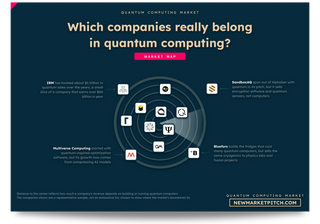
IBM Quantum and IonQ may be household names, but the quantum computing market is expanding fast beyond superconducting qubits and trapped ions.

Startups are building across hardware modalities, error correction, quantum software, networking, and industry-specific applications.

In our conversations with entrepreneurs and investors, we've found confusion at every turn: around timelines, technology bets, and which layers of the stack will capture the most value. That's why we built this section.

Below, you'll find the market grids and ecosystem maps we've created to bring clarity to what's emerging and where the biggest opportunities lie.

quantum computing market pain points customers
Startup Killers

What could kill a startup in this market?

The quantum computing market is exciting, but it's not "build a qubit and scale". Timelines are long, error rates are stubborn, talent is scarce, and enterprise buyers don't yet know what to do with it.

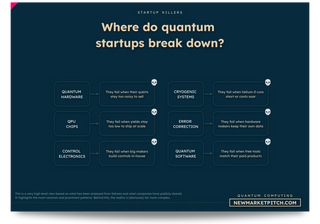
So we studied quantum startups that failed and pulled out the quiet traps: overpromising near-term advantage, building hardware without a software ecosystem, or targeting use cases where classical solutions keep improving faster.

After reading this section, you'll have clarity on these non-obvious challenges, so you can spot them early, and avoid them before they slow you down.

quantum computing market market share
Startup Strategies

How do you win in this market?

IBM Quantum, IonQ, Quantinuum… quantum computing is starting to produce visible leaders.

So what made them credible when "quantum advantage" is still debated? How did they build developer ecosystems, land enterprise pilots, and keep investor confidence through long timelines? There are a few recurring moves worth noticing.

We've studied the teams that shipped real access (not just papers) and we'll lay out the cheat codes in this section so you can apply the same logic.

Questions?

Who is this market report actually for?+

This deck is built for founders, investors, operators, and strategists who need a clearer view of the market before they build, invest, partner, or reposition.

It is especially useful if you are trying to understand where the opportunity is real, how the market is evolving, and what separates the promising segments from the fragile ones.

How many pages are in the deck?+

The deck is around 210+ pages. It is designed to be comprehensive enough to support serious market evaluation, while still being fast to read and easy to use.

We prioritize signal, structure, and visual clarity over unnecessary length.

What do you include in the quantum computing market?+

We define the quantum computing market as commercial products and services whose primary purpose is to deliver quantum computation to end users.

We include quantum hardware systems and components sold as part of those systems, quantum compute access (cloud or hosted), and quantum-specific software and services used to program, run, and integrate workloads on quantum processors.

We exclude quantum sensing and quantum communications, general-purpose classical compute/cloud services, and R&D funding or tooling that is not sold primarily for quantum computing use.

Do you list your sources clearly?+

Yes. All key data points and assumptions are explained and sourced in the deck.

All sources are tier-1: company filings, funding databases, public datasets, expert interviews, industry reports, etc.

Is the data up to date?+

Yes. The deck was last updated on April 17, 2026 with the latest market signals.

Is this a one-time payment?+

Yes. This is a one-time purchase. There is no subscription required to access the deck.

I want to buy several market reports, can I get a discount code?+

Yes. You can use NEWMARKET for 20% off when purchasing two reports, or NEWMARKETMAX for 30% off when purchasing five or more.

I’m interested in a market but I can’t find it here+

If a market you care about is not currently on the list, email us at team@newmarketpitch.com and we may be able to cover it.

I have more questions for you+

No problem. You can reach out directly and we respond within 24 hours.

Get the quantum computing market report

The cost of misreading a market is high, especially in a category as nuanced as this one. This deck helps you understand where the market is real, where it is moving, and what matters most before you commit time, capital, or strategy

PRO
$49
One-time payment
  • Market Definition
  • Market Opportunity
  • Market Size
  • Pain Points
  • Tech & Infra
  • Value Creation
  • Market Challenges
  • Growth Drivers
  • Investor Bets
  • Top Players
  • Startup Killers
  • Startup Strategies
PRO+
$79
One-time payment
  • Market Definition
  • Market Opportunity
  • Market Size
  • Pain Points
  • Tech & Infra
  • Value Creation
  • Market Challenges
  • Growth Drivers
  • Investor Bets
  • Top Players
  • Startup Killers
  • Startup Strategies
PRO++
$99
One-time payment
  • Market Definition
  • Market Opportunity
  • Market Size
  • Pain Points
  • Tech & Infra
  • Value Creation
  • Market Challenges
  • Growth Drivers
  • Investor Bets
  • Top Players
  • Startup Killers
  • Startup Strategies
Use code MARKETPITCH for 10% off your order