LAST UPDATED: October 27, 2026

Make smarter decisions on the radiopharmaceuticals market

Big pharma is betting billions on radioactive drugs. They have moved from a quiet corner of nuclear medicine to one of the busiest deal zones in pharma. The hard part is physical: isotopes that decay within days, few reactors to make them, and hospitals that need special rooms and staff. This report walks you through the whole market, from isotope supply to the drugs in late trials.

  • 190+ pages
  • 12 sections
  • verified data only
Make smarter decisions on the radiopharmaceuticals market market report cover

What’s inside the report?

12 sections to help founders and investors understand the radiopharmaceuticals market with clarity

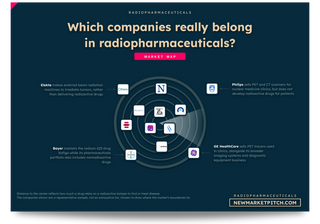
Radar map of the radiopharmaceuticals market showing which companies count as part of it, which sit on its edge and which stay outside: Which companies really belong in radiopharmaceuticals? (Radiopharmaceuticals Market, NewMarketPitch)
Market Definition

What is this market, exactly?

Radiopharmaceuticals get lumped in with radiation therapy machines and medical imaging in general, so we start by drawing a clear line.

A radioactive drug that finds prostate cancer cells and destroys them from the inside is in. So is a PET tracer that shows a doctor where the tumor is, and a company that produces the isotopes these drugs need. A radiotherapy machine that aims beams from outside the body is out, and so is a scanner sold on its own.

This keeps our numbers clean. Counting scanners and radiotherapy equipment would make the market look much bigger than it is.

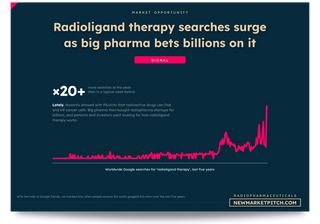
Google Trends curve of worldwide searches over five years for the radiopharmaceuticals market: Radioligand therapy searches surge as big pharma bets billions on it (Radiopharmaceuticals Market, NewMarketPitch)
Market Opportunity

What changed for this market lately?

Radiopharma is hot in 2026, and the industry is starting to consolidate.

We've found a lot of interesting signals. For example, in August 2026, Curium agreed to buy Lantheus, which makes widely used prostate cancer imaging agents, for up to $8B. A month later, Telix agreed to buy ITM, a German developer that also produces the isotope lutetium-177, for $1.65B upfront. The companies that already make and ship radioactive drugs are joining forces to control both the supply and the pipeline.

In this section, we look at why deals are speeding up now, which parts of the chain buyers want most, and what this wave of mergers leaves for smaller developers.

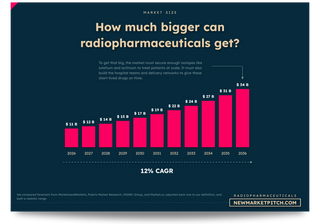
Bar chart of the radiopharmaceuticals market size year by year to 2036, with its growth rate: How much bigger can radiopharmaceuticals get? (Radiopharmaceuticals Market, NewMarketPitch)
Market Size

How big could this market get?

Radiopharma market figures online often add in imaging scanners, radiotherapy equipment or the whole nuclear medicine sector.

We use first principles: we build our own estimate, check it against outside sources, and show each assumption, so you can see where the number comes from.

We also show a cautious and an optimistic scenario, because isotope supply and the timing of approvals can move the number a lot.

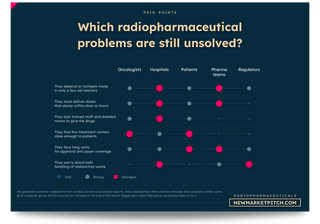
Matrix of the problems radiopharmaceuticals customers still face, rated for each type of buyer: Which radiopharmaceutical problems are still unsolved? (Radiopharmaceuticals Market, NewMarketPitch)
Pain Points

What are the pain points, and for whom?

Radioactive drugs can treat cancers that other drugs no longer reach, but getting them to patients is a race against the clock.

We look at six types of companies, from tracer makers and radioligand developers to theranostic platforms, isotope producers and manufacturing networks. Their buyers include hospitals, nuclear medicine centers and the big drugmakers that license their programs. For each, we rank the biggest pains, like doses that decay within days, scarce isotopes such as actinium-225, and too few sites able to give the treatment.

This shows which problems buyers will pay to solve now, and which ones depend on supply that doesn't exist yet.

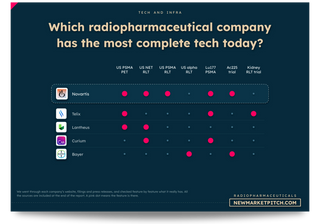
Comparison table of the tech offered by leading radiopharmaceuticals companies: Which radiopharmaceutical company has the most complete tech today? (Radiopharmaceuticals Market, NewMarketPitch)
Tech & Infra

What is the latest tech and infrastructure?

A better target is only half the story. A radiopharmaceutical also needs the right isotope, chemistry that holds it in place, and a factory close enough to deliver the dose before it decays.

We map the stack layer by layer, from reactors and cyclotrons to targeting molecules, chemistry and dose production. We also show where things get stuck, like the move from beta to alpha emitters, the few suppliers of enriched starting materials, and doses that have to be made and shipped within hours or days.

You'll see which parts of the chain are ready to grow today, and which ones still hold the whole market back.

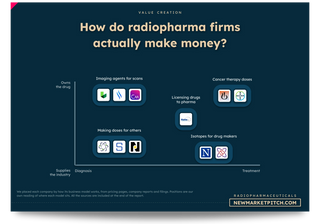
Map of radiopharmaceuticals business models with company logos: How do radiopharma firms actually make money? (Radiopharmaceuticals Market, NewMarketPitch)
Value Creation

How is value created and monetized exactly?

Radiopharma companies make money in several ways: selling doses per patient, pairing an imaging agent with a matching treatment, licensing programs to big pharma, and selling isotopes or production capacity to other developers.

We compare who pays and what each model costs. A treatment dose sells for a high price, but it has to be made fresh and is lost if the delivery runs late. A diagnostic tracer sells in larger volumes at a lower price, and insurers decide how much hospitals get paid for it. Isotope producers can sign long supply contracts, but they need years and heavy spending to build capacity.

You'll see which models keep their margins when supply is tight, and which ones depend on a partner's pipeline to survive.

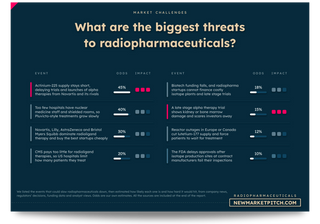
Table of the events that could slow the radiopharmaceuticals market, with their odds and impact: What are the biggest threats to radiopharmaceuticals? (Radiopharmaceuticals Market, NewMarketPitch)
Market Challenges

What could slow this market down?

The obvious brakes are well known: isotope shortages, reactor outages, and treatments that only a small number of hospitals can give.

Others are easier to miss. Copies of older radioligand drugs are starting to reach the market. Hospitals need shielded rooms and trained staff before they can treat more patients. Rules for radioactive waste differ from one country to the next. And payment for imaging agents can change with a single decision by insurers.

For each risk, we estimate how likely it is and which players it would hurt most, from small developers to isotope suppliers.

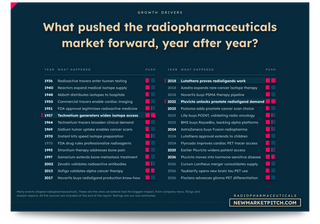
Timeline of the events that pushed the radiopharmaceuticals market forward, with their impact: What pushed the radiopharmaceuticals market forward, year after year? (Radiopharmaceuticals Market, NewMarketPitch)
Growth Drivers

What are the growth drivers in this market?

Our growth estimate rests on a few forces. Here, we look at each of them.

Some drivers are easy to see: more cancer patients, new targets beyond prostate and neuroendocrine tumors, and big pharma money. Others reinforce each other. Each new imaging agent finds patients who could get the matching treatment. More treatment sites make the next drug easier to launch. And new isotope capacity lowers the risk for developers waiting on supply.

Before building or investing, you should know what it takes to make, ship and give a radioactive drug to many patients, not just to a few in trials.

Investor Bets

What are investors backing right now?

Radiopharma has gone from a niche for specialists to a field where big pharma, venture funds and public markets compete for the same assets.

We compare recent rounds and deals across drug developers, theranostic platforms and isotope producers. We also look at whether investors prefer alpha emitters like actinium or the better-known lutetium, and which newer bets, like new targeting molecules or production sites, are starting to get funded.

You'll see which radiopharma companies investors are backing now, after deals like Curium's offer for Lantheus, and what a smaller developer needs to show before it can raise.

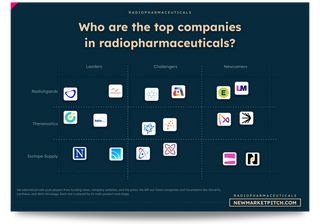
Market grid of the top radiopharmaceuticals startups and companies by segment: Who are the top companies in radiopharmaceuticals? (Radiopharmaceuticals Market, NewMarketPitch)
Top Players

Who are the top startups and companies?

RayzeBio and Fusion Pharmaceuticals are the names people remember, because big pharma paid billions for them, but they're only a small part of this market.

Plenty of smaller companies do quieter work. Some produce one isotope, like lead-212 or actinium-225, for everyone else. Others design the chemistry that links an isotope to a targeting molecule, or run the local sites that make and deliver doses each morning.

They're hard to compare because one company can be a drug developer, a supplier and a manufacturer at the same time. Many also sell through partners, so their name rarely appears on the drug a patient receives.

Below, you'll find the market grids and ecosystem maps we've built to show who makes what, from the reactor to the patient, and where new players are getting in.

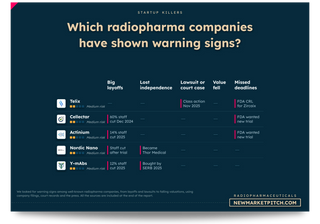
Table of radiopharmaceuticals startups that shut down or struggled, and why: Which radiopharma companies have shown warning signs? (Radiopharmaceuticals Market, NewMarketPitch)
Startup Killers

What could kill a startup in this market?

In radiopharma, a great drug can still miss its delivery window. If the dose decays on the way, the patient gets nothing and the company pays for it anyway.

So we studied why radiopharma startups fail or stall. Some build a drug around an isotope they can't buy in enough volume. Others underestimate how hard it is to make doses at scale, or count on a pharma partner who later drops the program.

If you're building, you'll see why secure isotope supply and a working production plan matter as much as the target. If you're investing, you'll know what to check about supply contracts, manufacturing and dependence on one partner.

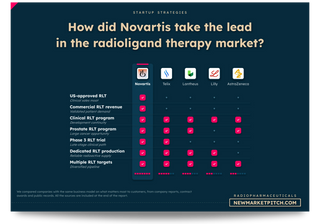
Scorecard showing what sets the leading radiopharmaceuticals company apart: How did Novartis take the lead in the radioligand therapy market? (Radiopharmaceuticals Market, NewMarketPitch)
Startup Strategies

How do you win in this market?

Aktis Oncology, Clarity Pharmaceuticals, SHINE Technologies… a few radiopharma companies are pulling ahead, each in its own way. Their models are still being tested.

Aktis raised $318M in the first biotech IPO of 2026 to take its alpha-emitting drugs through early trials. Clarity pairs two copper isotopes, one to image a tumor and one to treat it, and its prostate cancer imaging agent is in late-stage trials. SHINE produces lutetium-177 and sells it to other developers. One bets on the drug, one on the pairing, one on supply.

We'll look at how these teams secured their isotopes early, chose where in the chain to compete, and found partners willing to pay before a first approval.

Questions?

Who is this market report actually for?+

It's for founders, investors, pharma and biotech teams, isotope suppliers, hospital leaders and strategists who want a clear view of radiopharmaceuticals.

Use it to choose between developing drugs and supplying isotopes or production, to compare alpha and beta emitters, to judge whether an imaging and treatment pair can reach enough patients, or to understand demand, technology, funding, competitors and risks across the whole market.

How many pages are in the report?+

It has 190+ pages. It is designed to be comprehensive enough to support serious market evaluation, while still being fast to read and easy to use.

We prioritize signal, structure, and visual clarity over unnecessary length.

What do you include in the radiopharmaceuticals market?+

We define the radiopharmaceuticals market as medicines containing radioactive isotopes for diagnosis or treatment.

We include radioligand and other radiopharmaceutical developers, as well as dedicated isotope and production platforms.

We exclude external-beam radiotherapy equipment, non-radioactive medicines and general imaging hardware.

Do you list your sources clearly?+

Yes. All key data points and assumptions are explained and sourced in the document.

All sources are tier-1: company filings, funding databases, public datasets, expert interviews, industry reports, etc.

Is the data up to date?+

Yes. The report was last updated on October 27, 2026 with the latest market signals.

Is this a one-time payment?+

Yes. This is a one-time purchase. There is no subscription required to access the document.

I want to buy several market reports, can I get a discount code?+

Yes. You can use NEWMARKET for 20% off when purchasing two reports, or NEWMARKETMAX for 30% off when purchasing five or more.

I’m interested in a market but I can’t find it here+

If a market you care about is not currently on the list, email us at team@newmarketpitch.com and we may be able to cover it.

I have more questions for you+

No problem. You can reach out directly and we respond within 24 hours.

LAST UPDATED: October 27, 2026

Make sense of the radiopharmaceuticals market

A radioactive drug that works in trials still has to reach the patient before it decays. This report covers the whole radiopharmaceuticals market, from size and buyers to isotopes, technology, business models, funding, key players, risks and the openings that remain.

PRO
$49
One-time payment
  • ✓ Market Definition
  • ✓ Market Opportunity
  • ✓ Market Size
  • ✓ Pain Points
  • ✓ Tech & Infra
  • ✓ Value Creation
  • ✓ Market Challenges
  • ✓ Growth Drivers
  • ✓ Investor Bets
  • ✓ Top Players
  • ✓ Startup Killers
  • ✓ Startup Strategies
PRO+
$79
One-time payment
  • ✓ Market Definition
  • ✓ Market Opportunity
  • ✓ Market Size
  • ✓ Pain Points
  • ✓ Tech & Infra
  • ✓ Value Creation
  • ✓ Market Challenges
  • ✓ Growth Drivers
  • ✓ Investor Bets
  • ✓ Top Players
  • ✓ Startup Killers
  • ✓ Startup Strategies
PRO++
$99
One-time payment
  • ✓ Market Definition
  • ✓ Market Opportunity
  • ✓ Market Size
  • ✓ Pain Points
  • ✓ Tech & Infra
  • ✓ Value Creation
  • ✓ Market Challenges
  • ✓ Growth Drivers
  • ✓ Investor Bets
  • ✓ Top Players
  • ✓ Startup Killers
  • ✓ Startup Strategies
Use code MARKETPITCH for 10% off your order