LAST UPDATED: November 14, 2026

It's time to better understand the RL environments market

AI labs no longer just buy labeled data. They pay for practice worlds, like a copy of Salesforce, a trading desk or a codebase, where models try, fail and get scored. This report covers the whole market as it stands today.

  • 190+ pages
  • 12 sections
  • verified data only
It's time to better understand the RL environments market market report cover

What’s inside the report?

12 sections to help founders and investors understand the RL environments market with clarity

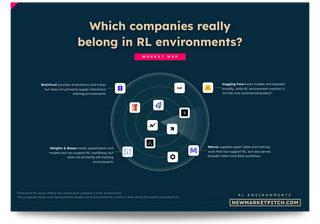
Radar map of the RL environments market showing which companies count as part of it, which sit on its edge and which stay outside: Which companies really belong in RL environments? (RL Environments Market, NewMarketPitch)
Market Definition

What is this market about?

RL environments get confused with datasets, benchmarks and plain simulators, so we start by drawing the line.

A copy of a CRM where an agent practices closing a ticket and gets a score is in. So is a coding task with tests that tell the model whether it succeeded, or a physics sim used to train a robot. A static dataset is out, and so is a benchmark used only to grade models, or a simulator nobody uses for training.

With that line drawn, our numbers and company comparisons all describe the same thing.

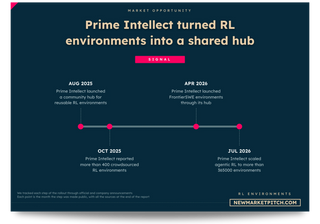
Timeline of the dated steps showing how the RL environments market is moving, with one key signal: Prime Intellect turned RL environments into a shared hub (RL Environments Market, NewMarketPitch)
Market Opportunity

Why is everyone looking at this market now?

RL environments are hot, but the market has very few buyers. A handful of AI labs pay for most of it, and the best builders are being bought quickly.

We've found a lot of interesting signals. For example, in July 2026, Mercor, best known for paying experts to train AI models, agreed to buy Deeptune, four months after Deeptune raised $43M led by Andreessen Horowitz to build copies of workplace software for agents to practice in. And in September 2026, Google reportedly closed a deal worth more than $1.5B to license the technology of Mechanize, which builds training environments for coding agents, and bring its co-founder and part of its team into DeepMind. Labs and their suppliers would rather own the people who build these practice worlds than rent them.

In this section, we look at why labs now spend on environments as well as data, why so much of the demand comes from so few buyers, and what that means for independent builders.

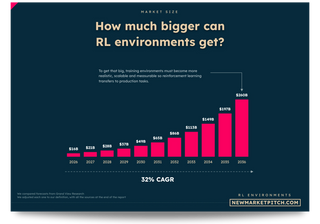
Bar chart of the RL environments market size year by year to 2036, with its growth rate: How much bigger can RL environments get? (RL Environments Market, NewMarketPitch)
Market Size

How big could this market get?

RL environment spending rarely shows up in market reports. When it does, it's mixed with data labeling, model evaluation or the whole reinforcement learning market.

So we build our own estimate from the ground up, compare it with outside sources, and explain each assumption, so you can see what the number rests on.

We then run a low and a high scenario, based on how much labs spend on training and how much of the work they keep in-house.

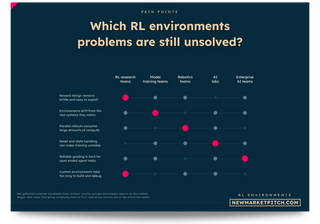
Matrix of the problems RL environments customers still face, rated for each type of buyer: Which RL environments problems are still unsolved? (RL Environments Market, NewMarketPitch)
Pain Points

What are the pain points, and for whom?

Models are running out of easy lessons. To get better at real work, they need places to practice it, and those are slow and costly to build.

We compare six kinds of RL environment companies, from coding and computer-use environments to enterprise workflow, robotics and scientific ones. Then we rank what their buyers need most: tasks hard enough to teach something new, scores a model can't game, and enough volume to matter in a training run.

This shows which environments labs will pay a premium for, and which ones they are likely to build themselves.

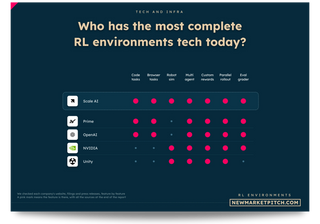
Comparison table of the tech offered by leading RL environments companies: Who has the most complete RL environments tech today? (RL Environments Market, NewMarketPitch)
Tech & Infra

What is the latest tech and infrastructure?

An environment is more than a fake app. It needs tasks, a way to check the answer, and a sandbox that can run thousands of copies at once.

We map the stack from software replicas and task design to graders, sandboxes and the training runs that use them. We also show where things get stuck, like models that find shortcuts to a high score, replicas that drift away from the real product, tasks that go stale after one training run, and quality control across hundreds of contractors.

You'll see which kinds of environments are well understood today, and which still take a lot of trial and error.

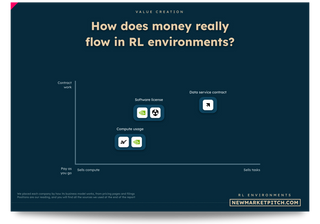
Map of RL environments business models with company logos: How does money really flow in RL environments? (RL Environments Market, NewMarketPitch)
Value Creation

How is value created and monetized exactly?

Quarterly contracts, prices per task, exclusive deals, open hubs paid through compute, and services for companies training their own agents: RL environment builders make money in several ways.

We compare who pays and what each environment costs to build. A lab pays far more for an exclusive environment, but then the builder can't sell it again. A shared one can go to several labs, but loses value once everyone has trained on it. Building takes skilled engineers and experts in each field, so margins depend on how much of the work can be reused.

You'll see which models hold up when one lab brings in most of the revenue, and when labs move more of the work in-house.

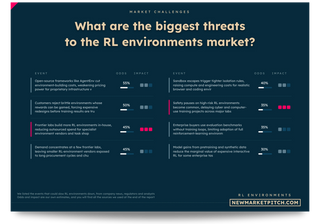
Table of the events that could slow the RL environments market, with their odds and impact: What are the biggest threats to the RL environments market? (RL Environments Market, NewMarketPitch)
Market Challenges

What could slow this market down?

Some brakes are easy to see: a tiny group of buyers, labs hiring their own environment teams, and big data suppliers adding environments to what they already sell.

Others are easier to miss. Models learn to game the score instead of doing the task. A new model generation can make last quarter's environments too easy. Software makers may object to copies of their products. And if a new training method needs less RL, demand could cool fast.

We look at each of these risks, score how likely it is, and explain which kinds of environment builders would be hit hardest.

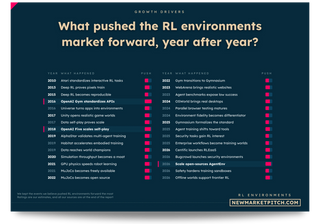
Timeline of the events that pushed the RL environments market forward, with their impact: What pushed the RL environments market forward, year after year? (RL Environments Market, NewMarketPitch)
Growth Drivers

What are the growth drivers in this market?

Labs keep saying reinforcement learning is where the next gains will come from. Here, we show what turns that belief into steady spending on environments.

Some drivers are plain to see: labs want agents that do real work, and they are putting more compute into reinforcement learning. Others feed each other. Each stronger model needs harder environments to keep improving. Companies that want their own agents start buying environments too. And shared tools for hosting and grading make each new environment cheaper to build.

Before building or investing, you should know what keeps labs ordering new environments, and what would make them stop.

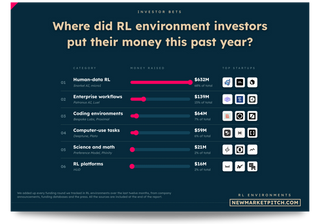
Bar chart of where investors put their money in RL environments, by category: Where did RL environment investors put their money this past year? (RL Environments Market, NewMarketPitch)
Investor Bets

Where are investors placing their bets today?

RL environments went from a niche research topic to a crowded funding race in very little time.

We compare recent rounds across coding, computer-use, finance and other workflow environments. We also look at whether investors prefer specialists in one field or platforms that host environments for everyone. And we flag newer bets, like environments sold to enterprises rather than labs.

You'll see where investors are putting money now, as data suppliers and big labs buy up environment builders, and what a young team needs to show, from lab contracts to repeat orders, before it can raise.

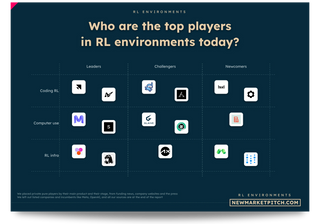
Market grid of the top RL environments startups and companies by segment: Who are the top players in RL environments today? (RL Environments Market, NewMarketPitch)
Top Players

Who are the top startups and companies?

Mechanize and Bespoke Labs come up first when researchers talk about RL environments, but they're only a small part of the market.

Many of the most interesting players work quietly. Some rebuild a single product, like a spreadsheet or a CRM, down to the last button. Others write finance or legal tasks with experts from those fields, build sims for robots, or run the sandboxes where thousands of environments go live at once.

They're hard to spot because their customers are a few labs that rarely say who they buy from, and many deals come with confidentiality or exclusivity. Several also started as data or evaluation companies, so their labels don't match what they sell now.

Below, you'll find the market grids and ecosystem maps we've built to show who builds which kind of environment, and where new players are getting in.

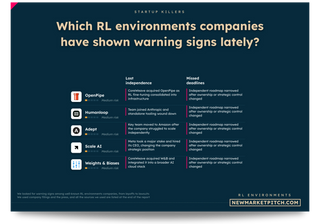
Table of the warning signs shown by leading RL environments companies: Which RL environments companies have shown warning signs lately? (RL Environments Market, NewMarketPitch)
Startup Killers

What could kill a startup in this market?

Your biggest customer can turn into your competitor overnight. In RL environments, the labs that buy your work are also hiring teams to do it themselves.

So we studied why RL environment startups fail or stall. Some depend on one lab for most of their revenue. Others ship environments that models learn to game, and lose the customer's trust. And some sell exclusive work they can never resell, so each new contract starts from zero.

If you're building, you'll see why a second and third buyer, graders that hold up, and work you can reuse matter more than one big lab contract. If you're investing, you'll know what to check about customer concentration, exclusivity terms and how fast a team's environments go stale.

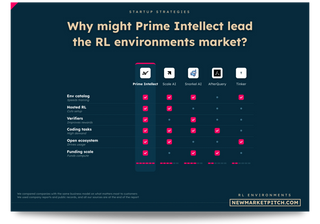
Scorecard showing what sets the leading RL environments company apart: Why might Prime Intellect lead the RL environments market? (RL Environments Market, NewMarketPitch)
Startup Strategies

How do you win in this market?

Halluminate, Fleet, Prime Intellect… a few environment builders have found a clear way to make money, or a clear place in the market.

Halluminate builds finance environments, like private equity due diligence, and says four of the top five closed US labs pay for them. Fleet recreates tools like Salesforce and Excel for agents to train in, and investors reportedly valued it at more than $700M in 2026. Prime Intellect runs an open hub where anyone can publish environments, and pays bounties to the people who build them. None has yet shown it can grow beyond a small group of lab buyers.

We'll look at how these teams chose a field or a role in the market, kept their environments hard enough for each new model, and found more than one buyer.

Questions?

Who is this market report actually for?+

It's for founders, investors, AI lab and research teams, data suppliers, enterprise AI leaders and strategists who want a clear view of RL environments.

Use it to decide whether to build environments in-house or buy them, to compare exclusive and shared deals, to pick which fields to cover first, or to understand demand, technology, funding, competitors and risks across the whole market.

How many pages are in the report?+

It has 190+ pages. It is designed to be comprehensive enough to support serious market evaluation, while still being fast to read and easy to use.

We prioritize signal, structure, and visual clarity over unnecessary length.

What do you include in the RL environments market?+

We define the RL environments market as companies whose core offer, or widely recognized role, is building, supplying or enabling interactive task worlds with executable agent actions and verifiable feedback for reinforcement-learning training and evaluation of AI systems.

We include dedicated coding, browser, computer-use, enterprise-workflow, security, math and science gyms, high-fidelity tool, API and multi-agent simulation, task, trajectory and reward-verifier design, platforms where customers author scored environments, and training-data firms widely seen as leading RL-environment suppliers.

We exclude labeled datasets without interactive tasks, static benchmark scoreboards, model pretraining and model APIs, cloud GPUs, generic sandboxes and agent orchestration without task and reward design, agent or robotics makers using environments only internally, and academic software without a company.

Do you list your sources clearly?+

Yes. All key data points and assumptions are explained and sourced in the document.

All sources are tier-1: company filings, funding databases, public datasets, expert interviews, industry reports, etc.

Is the data up to date?+

Yes. The report was last updated on November 14, 2026 with the latest market signals.

Is this a one-time payment?+

Yes. This is a one-time purchase. There is no subscription required to access the document.

I want to buy several market reports, can I get a discount code?+

Yes. You can use NEWMARKET for 20% off when purchasing two reports, or NEWMARKETMAX for 30% off when purchasing five or more.

I’m interested in a market but I can’t find it here+

If a market you care about is not currently on the list, email us at team@newmarketpitch.com and we may be able to cover it.

I have more questions for you+

No problem. You can reach out directly and we respond within 24 hours.

LAST UPDATED: November 14, 2026

It's time to really understand the RL environments market

A great environment can teach a model something new, until the next model finds it too easy. This report covers the whole RL environments market: size, buyers and their needs, the tech, business models, funding, key players, risks and where new builders can still win.

PRO
$49
One-time payment
  • ✓ Market Definition
  • ✓ Market Opportunity
  • ✓ Market Size
  • ✓ Pain Points
  • ✓ Tech & Infra
  • ✓ Value Creation
  • ✓ Market Challenges
  • ✓ Growth Drivers
  • ✓ Investor Bets
  • ✓ Top Players
  • ✓ Startup Killers
  • ✓ Startup Strategies
PRO+
$79
One-time payment
  • ✓ Market Definition
  • ✓ Market Opportunity
  • ✓ Market Size
  • ✓ Pain Points
  • ✓ Tech & Infra
  • ✓ Value Creation
  • ✓ Market Challenges
  • ✓ Growth Drivers
  • ✓ Investor Bets
  • ✓ Top Players
  • ✓ Startup Killers
  • ✓ Startup Strategies
PRO++
$99
One-time payment
  • ✓ Market Definition
  • ✓ Market Opportunity
  • ✓ Market Size
  • ✓ Pain Points
  • ✓ Tech & Infra
  • ✓ Value Creation
  • ✓ Market Challenges
  • ✓ Growth Drivers
  • ✓ Investor Bets
  • ✓ Top Players
  • ✓ Startup Killers
  • ✓ Startup Strategies
Use code MARKETPITCH for 10% off your order