LAST UPDATED: November 20, 2026

Get a reality check on the robot foundation models market

Robots are still waiting for their ChatGPT moment. Robot makers are starting to plug in someone else's brain instead of building their own. The open question is whether one model can learn a new job, on a new robot, without weeks of fresh training. This report brings you up to speed on the whole robot foundation models market.

  • 190+ pages
  • 12 sections
  • verified data only
Get a reality check on the robot foundation models market market report cover

What’s inside the report?

12 sections to help founders and investors understand the robot foundation models market with clarity

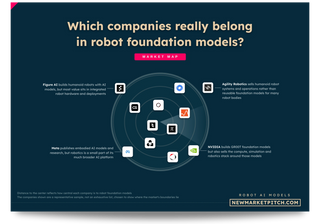
Radar map of the robot foundation models market showing which companies count as part of it, which sit on its edge and which stay outside: Which companies really belong in robot foundation models? (Robot Foundation Models Market, NewMarketPitch)
Market Definition

What is this market, exactly?

Robot foundation models get mixed up with robot hardware, simulators and software that runs one machine on one task, so we start by drawing a clear line.

A model that learns to fold laundry, pack boxes and open doors, and can be adapted to an arm or a humanoid, is in. So is a platform that sells that kind of reusable robot intelligence to other robot makers. A controller written for one welding cell is out, and so is a robot sold without a reusable model, or a simulator that only produces data.

Once that line is clear, every number and every company in the report describes the same market.

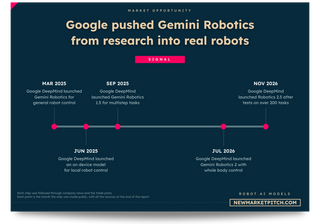
Timeline of the dated steps showing how the robot foundation models market is moving, with one key signal: Google pushed Gemini Robotics from research into real robots (Robot Foundation Models Market, NewMarketPitch)
Market Opportunity

Why is everyone looking at this market now?

Robot foundation models are drawing some of the biggest checks in AI, while most of the robots running them are still in pilots.

We've found a lot of interesting signals. For example, in November 2025, Physical Intelligence raised $600M at a valuation of about $5.6B to build models that can run many kinds of robots. And in August 2026, LG said its next humanoid will be built on Nvidia's GR00T, an open foundation model for humanoid robots. Investors are paying up for general robot brains, and large manufacturers are starting to build on someone else's.

In this section, we look at why robot models are improving so fast, which robot makers would rather buy a brain than train one, and what these valuations assume about revenue that mostly doesn't exist yet.

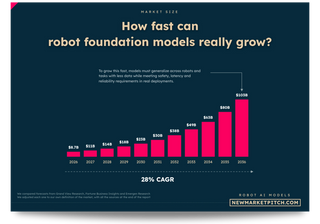
Bar chart of the robot foundation models market size year by year to 2036, with its growth rate: How fast can robot foundation models really grow? (Robot Foundation Models Market, NewMarketPitch)
Market Size

How big could this market get?

Market sizes for robot foundation models are hard to find, and the ones that exist often lump in robot hardware, chips or the whole robotics industry.

We build our own estimate from the bottom up, compare it with outside figures, and write down every assumption, so you can follow the reasoning and change it if you disagree.

We also show how the number moves in a cautious and an optimistic scenario, since it depends on how fast robot makers start paying for a brain they didn't build.

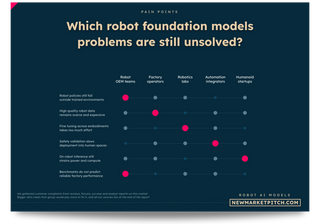
Matrix of the problems robot foundation models customers still face, rated for each type of buyer: Which robot foundation models problems are still unsolved? (Robot Foundation Models Market, NewMarketPitch)
Pain Points

What are the pain points, and for whom?

Robots are good at one task in one place. Ask them to do something new, and someone has to write code or record weeks of demonstrations.

We compare six kinds of companies, from vision-language-action model makers to humanoid brains, manipulation and navigation models, and platforms that help a robot adapt to a new site. Their buyers are robot makers, factories, warehouses and integrators. Then we rank what hurts most: too little robot data, models that fail in an unfamiliar room, and the cost of training.

This shows which buyers will pay for a general brain now, and which still prefer a robot programmed for one job.

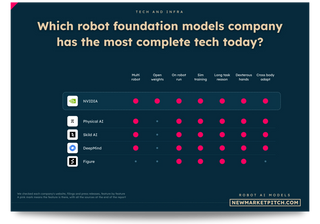
Comparison table of the tech offered by leading robot foundation models companies: Which robot foundation models company has the most complete tech today? (Robot Foundation Models Market, NewMarketPitch)
Tech & Infra

What is the latest tech and infrastructure?

A bigger model is not enough. A robot brain needs data from real robots, a way to run on the machine itself, and enough speed to react before something falls.

We map the stack layer by layer, from teleoperation and human video data to pretraining, simulation, fine-tuning and the chips inside the robot. We also show where things get stuck, like models that work in the lab but fail under different lighting, hands that still drop soft objects, and safety tests that nobody has standardized yet.

You'll see which tasks robot models already handle reliably today, and which still need a person ready to take over.

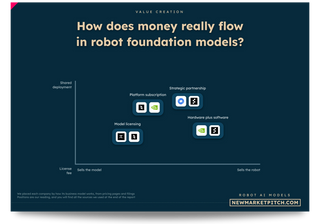
Map of robot foundation models business models with company logos: How does money really flow in robot foundation models? (Robot Foundation Models Market, NewMarketPitch)
Value Creation

How is value created and monetized exactly?

Licenses per robot, fees per hour of work, paid access to a model through an API, custom training deals with robot makers, and open models with paid services around them: robot model companies try many ways to make money.

We look at who pays, and at the costs behind each deal. A model maker pays for computing power and for the people who teleoperate robots to collect data. A per-robot license grows with a maker's fleet, but only if the robots ship. Per-hour pricing ties revenue to real work, while an open model brings users but little cash. And a company that sells the whole robot keeps more of each deal, but carries the hardware costs.

You'll see which models still make money once data collection and on-site tuning are counted, and which only work while investors keep paying the bills.

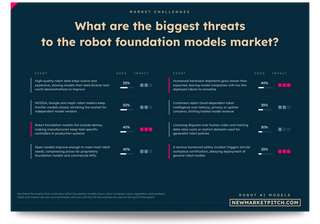
Table of the events that could slow the robot foundation models market, with their odds and impact: What are the biggest threats to the robot foundation models market? (Robot Foundation Models Market, NewMarketPitch)
Market Challenges

What could slow this market down?

Some brakes are easy to see: robots that still fail too often, safety rules for machines working next to people, and the cost of training each new model.

Others are easier to miss. Robot makers may train their own brain once they have enough data. Big tech groups can give models away to sell chips or cloud time. Open models catch up fast. And a single accident with a general-purpose robot could make every buyer more careful.

We go through each risk, rate how likely it is, and explain which kind of company would be hit first.

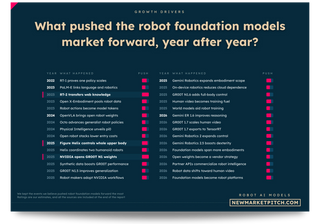
Timeline of the events that pushed the robot foundation models market forward, with their impact: What pushed the robot foundation models market forward, year after year? (Robot Foundation Models Market, NewMarketPitch)
Growth Drivers

What are the growth drivers in this market?

Robot brains won't spread just because they look good on video. Here are the forces that would make this market grow, one by one.

Some drivers are plain to see: labor shortages in factories and warehouses, cheaper robot hardware, and better AI models. Others feed each other. Each robot in the field sends back data that improves the model. A better model makes more tasks worth automating. And once a maker builds on one brain, its whole fleet runs on it, which gives the model maker even more data.

Before building or investing, you should know what it takes for a robot maker to trust someone else's model inside its machines, and for its customers to pay for the work that model does.

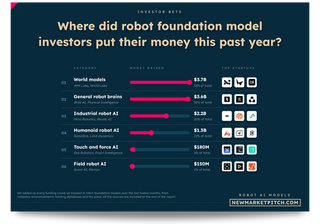
Bar chart of where investors put their money in robot foundation models, by category: Where did robot foundation model investors put their money this past year? (Robot Foundation Models Market, NewMarketPitch)
Investor Bets

What are investors betting on now?

Robot brains have become one of the most crowded bets in AI, with rounds that used to go only to chatbot labs.

We compare recent rounds across general robot models, humanoid brains, manipulation models and the platforms that help robots learn on site. We also look at whether investors prefer teams that sell only software or teams that build their own robots too, and at how fast Chinese robot model makers are raising.

You'll see which robot model makers are raising today, after rounds like Physical Intelligence's, and how much paid work a younger team needs to show before investors write a check.

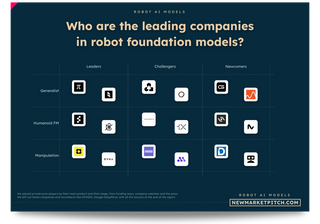
Market grid of the top robot foundation models startups and companies by segment: Who are the leading companies in robot foundation models? (Robot Foundation Models Market, NewMarketPitch)
Top Players

Who are the top startups and companies?

Google DeepMind and Nvidia get most of the headlines in robot foundation models, but they're far from the only teams building robot brains.

Many interesting players work out of sight. Some train models only for robot hands that grip, sort and assemble. Others build brains for robots working outdoors on rough ground, make one model run on arms, dogs and humanoids alike, or help a factory tune a general model to its own line in days.

They're hard to compare because every team shows its best video, on its own robot, doing its own tasks. Few publish how often their model fails in a new place, and many are still deciding whether to sell software or whole robots.

Further down, you'll find the market grids and ecosystem maps we've built to show who trains which model, for which robots, and where new teams are getting in.

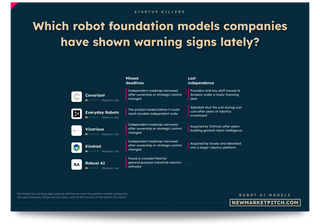
Table of the warning signs shown by leading robot foundation models companies: Which robot foundation models companies have shown warning signs lately? (Robot Foundation Models Market, NewMarketPitch)
Startup Killers

What could kill a startup in this market?

A robot that works in the demo and fails on the customer's floor is worse than no robot at all. In this market, the gap between the two can eat years of work and a lot of money.

So we studied why robot model startups fail or stall. Some spend their cash on computing power before they find a task anyone will pay for. Others depend on a single robot maker that later builds its own brain. And some try to sell general intelligence when buyers only want one job done well.

If you're building, you'll see why paid work on real sites, data you control and more than one hardware partner matter more than a viral video. If you're investing, you'll know what to check about failure rates, data costs and who owns the robots the model runs on.

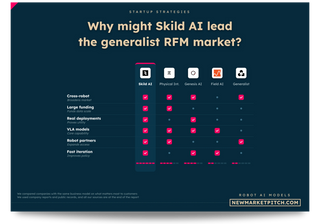
Scorecard showing what sets the leading robot foundation models company apart: Why might Skild AI lead the generalist RFM market? (Robot Foundation Models Market, NewMarketPitch)
Startup Strategies

How do you win in this market?

FieldAI, Dyna Robotics, Covariant… a few robot model companies have taken their brains out of the lab and into paid work, though none has proven the business at scale.

FieldAI runs its models on robots that work on construction and energy sites. Dyna Robotics puts robots to work on daily tasks in hotels, restaurants and laundromats. Covariant built models for warehouse picking, then licensed them to Amazon, which also hired its founders. Three different routes, each showing what a robot brain can earn before it can do everything.

We'll look at how these teams picked a first task worth paying for, gathered data from real work, and decided whether to sell a model, a robot or a service.

Questions?

Who is this market report actually for?+

It's for founders, investors, robot makers, manufacturers, logistics operators, chip and cloud companies, and strategists who want a clear view of robot foundation models.

Use it to decide whether to build a robot brain or license one, to compare per-robot, per-hour and API pricing, to see which tasks are ready for general models, or to understand demand, technology, funding, competitors and risks across the whole market.

How many pages are in the report?+

It has 190+ pages. It is designed to be comprehensive enough to support serious market evaluation, while still being fast to read and easy to use.

We prioritize signal, structure, and visual clarity over unnecessary length.

What do you include in the robot foundation models market?+

We define the robot foundation models market as startups developing pretrained, adaptable AI models that learn reusable perception-to-action, robot-control or physical-world prediction capabilities across multiple tasks, settings or robot embodiments.

We include generalist robot policy and vision-language-action models, transferable industrial manipulation and force-action models, embodied autonomy foundations for field and mobile robots, world and action models positioned for robot learning, and robot makers whose central thesis is a reusable embodied foundation model.

We exclude scripted or single-task automation, robot hardware vendors without a named reusable model platform, perception-only inspection AI, general LLMs and video generation without robot control positioning, tools selling only teleoperation, labeling, simulation, orchestration, data or sensors, and corporate research units.

Do you list your sources clearly?+

Yes. All key data points and assumptions are explained and sourced in the document.

All sources are tier-1: company filings, funding databases, public datasets, expert interviews, industry reports, etc.

Is the data up to date?+

Yes. The report was last updated on November 20, 2026 with the latest market signals.

Is this a one-time payment?+

Yes. This is a one-time purchase. There is no subscription required to access the document.

I want to buy several market reports, can I get a discount code?+

Yes. You can use NEWMARKET for 20% off when purchasing two reports, or NEWMARKETMAX for 30% off when purchasing five or more.

I’m interested in a market but I can’t find it here+

If a market you care about is not currently on the list, email us at team@newmarketpitch.com and we may be able to cover it.

I have more questions for you+

No problem. You can reach out directly and we respond within 24 hours.

LAST UPDATED: November 20, 2026

Thinking about the robot foundation models market? Start here

A robot brain can master a task in the lab and still need weeks of new data on every customer site. This report covers the whole robot foundation models market, from size and buyers to technology, business models, funding, key players, risks and the openings that remain.

PRO
$49
One-time payment
  • ✓ Market Definition
  • ✓ Market Opportunity
  • ✓ Market Size
  • ✓ Pain Points
  • ✓ Tech & Infra
  • ✓ Value Creation
  • ✓ Market Challenges
  • ✓ Growth Drivers
  • ✓ Investor Bets
  • ✓ Top Players
  • ✓ Startup Killers
  • ✓ Startup Strategies
PRO+
$79
One-time payment
  • ✓ Market Definition
  • ✓ Market Opportunity
  • ✓ Market Size
  • ✓ Pain Points
  • ✓ Tech & Infra
  • ✓ Value Creation
  • ✓ Market Challenges
  • ✓ Growth Drivers
  • ✓ Investor Bets
  • ✓ Top Players
  • ✓ Startup Killers
  • ✓ Startup Strategies
PRO++
$99
One-time payment
  • ✓ Market Definition
  • ✓ Market Opportunity
  • ✓ Market Size
  • ✓ Pain Points
  • ✓ Tech & Infra
  • ✓ Value Creation
  • ✓ Market Challenges
  • ✓ Growth Drivers
  • ✓ Investor Bets
  • ✓ Top Players
  • ✓ Startup Killers
  • ✓ Startup Strategies
Use code MARKETPITCH for 10% off your order