LAST UPDATED: November 21, 2026

Need to get familiar with the sales tech market? Get our report

Most sales teams already pay for a CRM, a call recorder, an email sequencer and a content library. Now those vendors are merging, and buyers want one platform whose AI does real work instead of five tools reps half use. This report gives you the full picture of the sales tech market right now.

  • 190+ pages
  • 12 sections
  • verified data only
Need to get familiar with the sales tech market? Get our report market report cover

What’s inside the report?

12 sections to help founders and investors understand the sales tech market with clarity

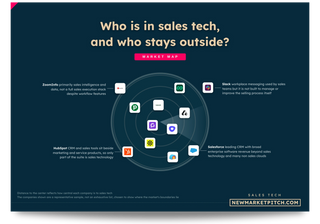
Radar map of the sales tech market showing which companies count as part of it, which sit on its edge and which stay outside: Who is in sales tech, and who stays outside? (Sales Tech Market, NewMarketPitch)
Market Definition

What is this market about?

Sales tech overlaps with marketing software, support tools and everyday office apps, so we start by saying exactly what counts.

A CRM built around pipelines and deals is in. So are tools that send email sequences, record and score sales calls, build quotes or forecast the quarter. An email marketing platform is out, and so is a help desk or a shared calendar with no sales job.

It keeps the market size and the company maps consistent from the first page of the report to the last.

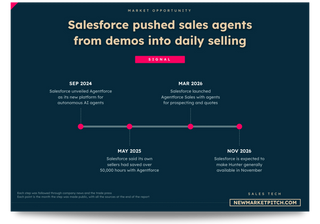
Timeline of the dated steps showing how the sales tech market is moving, with one key signal: Salesforce pushed sales agents from demos into daily selling (Sales Tech Market, NewMarketPitch)
Market Opportunity

Why this market now?

Sales tech is consolidating. Buyers are tired of paying for ten separate tools, and the vendors that bring AI to the whole sales process are pulling ahead.

We've found a lot of interesting signals. For example, Clari and Salesloft completed their merger in December 2025, putting forecasting and sales engagement under one roof. In August 2026, Seismic closed its merger with Highspot, joining the two best-known names in sales enablement. And in May 2026, Gong said its annual recurring revenue had passed $500M, with growth above 55% a year. Rivals are merging to stay relevant, while the platforms that already sit on every sales call keep growing.

In this section, we look at why sales teams are cutting their tool lists, which categories are folding into bigger platforms, and where that leaves the smaller vendors.

Bar chart of the sales tech market size year by year to 2036, with its growth rate: How much bigger can sales tech get? (Sales Tech Market, NewMarketPitch)
Market Size

How big could this market get?

Sales tech market sizes online rarely agree. Some fold in the whole CRM market, service and marketing included, while others count only a couple of categories.

We use first principles: how many sales teams there are, how many sellers they employ, and what they spend on each kind of tool. Then we check the result against outside sources and show every assumption.

We also show how the number changes in a cautious and an ambitious scenario, depending on how fast AI changes the way sales software is priced.

Matrix of the problems sales tech customers still face, rated for each type of buyer: What are the unsolved pain points in sales tech? (Sales Tech Market, NewMarketPitch)
Pain Points

What are the pain points, and for whom?

Sellers lose a big part of their week to admin, research and CRM updates, and their managers still can't trust the forecast.

We compare six kinds of sales tech companies, from CRM platforms and engagement tools to enablement, call recording, quoting and forecasting software. Their buyers range from a startup with three reps to global teams with thousands of sellers. For each, we rank the pains that matter most, like CRM data nobody keeps up to date, deals that slip without warning and new reps who take months to close their first deal.

This shows which problems sales leaders will pay to fix now, and which ones they will keep patching with spreadsheets and extra hires.

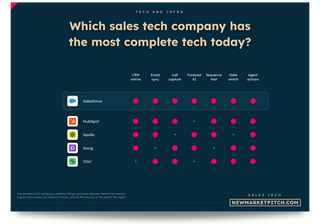
Comparison table of the tech offered by leading sales tech companies: Which sales tech company has the most complete tech today? (Sales Tech Market, NewMarketPitch)
Tech & Infra

What is the latest tech and infrastructure?

The CRM is no longer just a place to type notes. Sales tools now listen to calls, read email threads and suggest the next step, and they all depend on the same messy customer data.

We map the stack layer by layer, from customer data and the CRM to engagement, call analysis, quoting and forecasting, and the AI agents now added on top. We also show where things get stuck, like duplicate records, tools that don't share data, call transcripts nobody reads and AI suggestions reps simply ignore.

You'll see which parts of the sales process software already handles well today, and which still depend on a rep's judgment.

Log scale column chart of how much is paid at each step of the sales tech market, from the smallest to the biggest amount: The bigger the sales team, the bigger its software bill (Sales Tech Market, NewMarketPitch)
Value Creation

How is value created and monetized exactly?

Per-seat licenses, platform bundles, usage credits for AI features, fees per recorded minute and multi-year enterprise contracts: sales tech vendors get paid in many ways.

We look at who pays, and what each model costs the vendor. Per-seat pricing works while sales teams grow, but revenue shrinks when companies cut reps. Usage pricing for AI grows with activity, and so do model and data costs. Big platforms can throw in features for free, which squeezes single-product vendors. And enterprise deals bring large contracts, but also months of integration work.

You'll see which models still hold up when sales teams get smaller, and which ones depend on headcount that AI is supposed to reduce.

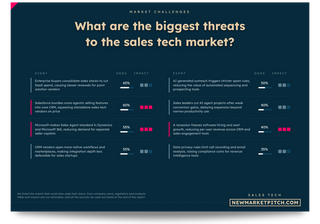
Table of the events that could slow the sales tech market, with their odds and impact: What are the biggest threats to the sales tech market? (Sales Tech Market, NewMarketPitch)
Market Challenges

What could slow this market down?

Some brakes are easy to see: tight software budgets, long enterprise sales cycles and CRM giants that bundle new features into existing contracts.

Others are easier to miss. Fewer sales reps means fewer seats to sell. Rules on recording calls and on consent differ by country. Mergers leave customers unsure which product will survive. And when every tool adds the same AI features, buyers struggle to tell them apart.

We take each risk in turn, rate how likely it is, and show which kinds of sales tech vendors it would hurt first.

Timeline of the events that pushed the sales tech market forward, with their impact: What pushed the sales tech market forward, year after year? (Sales Tech Market, NewMarketPitch)
Growth Drivers

What are the growth drivers in this market?

A forecast tells you little until you know what pushes it. So we list the forces one by one.

Some drivers are plain to see: pressure to sell more with leaner teams, better AI models and more sales activity that can be recorded and analyzed. Others reinforce each other. Every call and email that gets logged makes the CRM more useful. A fuller CRM makes forecasts and AI suggestions more accurate. And once a team trusts a platform with one job, it tends to hand it the next one.

Before building or investing, you should know what makes a sales team keep using a tool after the rollout, and what pushes it to move everything onto one platform.

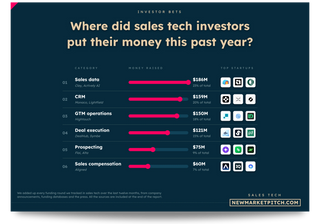
Bar chart of where investors put their money in sales tech, by category: Where did sales tech investors put their money this past year? (Sales Tech Market, NewMarketPitch)
Investor Bets

What are investors betting on now?

Sales tech is one of the oldest corners of software, and AI has given investors a reason to look at it again.

We compare recent rounds across AI-native CRMs, revenue intelligence, enablement and quoting tools. We also look at whether investors favor new platforms built around AI or established vendors buying startups to catch up, and we flag newer bets, like CRMs that fill themselves in from email and calls.

You'll see which sales tech companies are raising money now, while older players merge, and what a younger vendor needs to show to win against bundled platforms.

Market grid of the top sales tech startups and companies by segment: Which companies lead sales tech right now? (Sales Tech Market, NewMarketPitch)
Top Players

Who are the top startups and companies?

Salesforce and HubSpot are the names every sales team knows, but the market goes far beyond the two CRM giants.

Some of the most interesting players are names few people know. A few build quotes for complex B2B deals. Others coach reps during live calls, route new leads in seconds, calculate commissions, or build CRMs for one industry, like real estate or logistics.

They're hard to compare because most of them plug into the same CRM and claim the same AI features. The difference shows up only after months, in whether reps keep using the tool, and vendors rarely publish that.

Below, you'll find the market grids and ecosystem maps we've built to show who owns the CRM, who builds on top of it, and where new players are finding room.

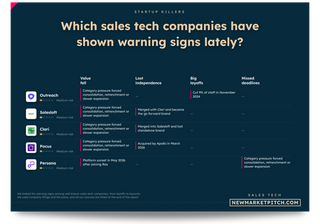
Table of the warning signs shown by leading sales tech companies: Which sales tech companies have shown warning signs lately? (Sales Tech Market, NewMarketPitch)
Startup Killers

What could kill a startup in this market?

In sales tech, your best feature can become a free add-on in someone else's CRM next year.

So we studied why sales tech startups fail or stall. Some build a useful feature, then watch the big CRM vendors bundle it. Others sell seats to teams that later cut reps. And some sign small teams quickly, then lose them at the first budget review.

If you're building, you'll see why an edge the CRM giants can't easily copy, and real daily use by reps, matter more than a fast launch. If you're investing, you'll know what to check about overlap with the big platforms, seat counts and renewals.

Scorecard showing what sets the leading sales tech company apart: Why is Gong winning the revenue intelligence market? (Sales Tech Market, NewMarketPitch)
Startup Strategies

How do you win in this market?

Pipedrive, Outreach, Attio… a few sales tech companies have carved out a place of their own in a crowded market.

Pipedrive won small businesses with a simple CRM built around a visual sales pipeline. Outreach became the tool many sales teams use to plan and send their daily emails and calls, and it now adds AI agents to that work. Attio built a newer CRM around AI and automatic data capture and is popular with startups, though it has yet to prove itself with large sales teams.

We'll look at how these teams chose their first buyers, became part of reps' daily routine, and kept growing as bigger platforms copied their features.

Questions?

Who is this market report actually for?+

It's for founders, investors, sales and revenue leaders, revenue operations teams, software companies and strategists who want a clear view of sales tech.

Use it to decide whether to keep separate tools or move to one platform, to compare CRM, engagement, enablement and forecasting vendors, to weigh seat and usage pricing, or to understand demand, technology, funding, competitors and risks across the whole market.

How many pages are in the report?+

It has 190+ pages. It is designed to be comprehensive enough to support serious market evaluation, while still being fast to read and easy to use.

We prioritize signal, structure, and visual clarity over unnecessary length.

What do you include in the sales tech market?+

We define the sales tech market as commercial software and proprietary data platforms whose main purpose is to help organizations find, engage, manage, convert and retain sales opportunities and to optimize the revenue teams and processes behind them.

We include sales CRM, prospecting data, engagement and agentic selling, conversation and deal intelligence, pipeline forecasting, sales workflow and routing, sales performance management, proposal, CPQ and deal execution, and sales-specific enablement and readiness.

We exclude general enterprise productivity tools, undifferentiated marketing automation, payments and subscription billing, post-sale support, horizontal analytics, and services without a distinct sales technology product.

Do you list your sources clearly?+

Yes. All key data points and assumptions are explained and sourced in the document.

All sources are tier-1: company filings, funding databases, public datasets, expert interviews, industry reports, etc.

Is the data up to date?+

Yes. The report was last updated on November 21, 2026 with the latest market signals.

Is this a one-time payment?+

Yes. This is a one-time purchase. There is no subscription required to access the document.

I want to buy several market reports, can I get a discount code?+

Yes. You can use NEWMARKET for 20% off when purchasing two reports, or NEWMARKETMAX for 30% off when purchasing five or more.

I’m interested in a market but I can’t find it here+

If a market you care about is not currently on the list, email us at team@newmarketpitch.com and we may be able to cover it.

I have more questions for you+

No problem. You can reach out directly and we respond within 24 hours.

LAST UPDATED: November 21, 2026

Thinking about the sales tech market? Start here

Most sales teams pay for more tools than their reps actually use, and every vendor now says its AI will fix that. This report covers the whole sales tech market: size, buyers, technology, business models, funding, competitors, risks and the openings still left.

PRO
$49
One-time payment
  • ✓ Market Definition
  • ✓ Market Opportunity
  • ✓ Market Size
  • ✓ Pain Points
  • ✓ Tech & Infra
  • ✓ Value Creation
  • ✓ Market Challenges
  • ✓ Growth Drivers
  • ✓ Investor Bets
  • ✓ Top Players
  • ✓ Startup Killers
  • ✓ Startup Strategies
PRO+
$79
One-time payment
  • ✓ Market Definition
  • ✓ Market Opportunity
  • ✓ Market Size
  • ✓ Pain Points
  • ✓ Tech & Infra
  • ✓ Value Creation
  • ✓ Market Challenges
  • ✓ Growth Drivers
  • ✓ Investor Bets
  • ✓ Top Players
  • ✓ Startup Killers
  • ✓ Startup Strategies
PRO++
$99
One-time payment
  • ✓ Market Definition
  • ✓ Market Opportunity
  • ✓ Market Size
  • ✓ Pain Points
  • ✓ Tech & Infra
  • ✓ Value Creation
  • ✓ Market Challenges
  • ✓ Growth Drivers
  • ✓ Investor Bets
  • ✓ Top Players
  • ✓ Startup Killers
  • ✓ Startup Strategies
Use code MARKETPITCH for 10% off your order